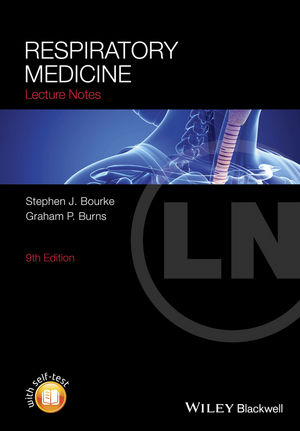
Respiratory Medicine (eBook)
John Wiley & Sons (Verlag)
978-1-118-65228-2 (ISBN)
Stephen J. Bourke is Consultant Physician, Royal Victoria Infirmary, Newcastle upon Tyne, and Honorary Senior Lecturer, Newcastle University Graham P. Burns is Consultant Physician, Royal Victoria Infirmary, Newcastle upon Tyne, and Honorary Senior Lecturer, Newcastle University
Preface ix
About the Companion Website xi
Part 1 Structure and function 1
1 Anatomy and physiology of the lungs 3
Part 2 History taking, examination and investigations 17
2 History taking and examination 19
3 Pulmonary function tests 32
4 Radiology of the chest 48
Part 3 Respiratory diseases 59
5 Upper respiratory tract infections and influenza 61
6 Pneumonia 69
7 Tuberculosis 86
8 Bronchiectasis and lung abscess 97
9 Cystic fibrosis 107
10 Asthma 120
11 Chronic obstructive pulmonary disease 139
12 Carcinoma of the lung 156
13 Interstitial lung disease 170
14 Occupational lung disease 182
15 Pulmonary vascular disease 194
16 Pneumothorax and pleural effusion 206
17 Acute respiratory distress syndrome 219
18 Ventilatory failure and sleep-related breathing disorders 226
19 Lung transplantation 235
Index 243
Chapter 1
Anatomy and physiology of the lungs
The anatomy and physiology of the respiratory system are designed in such a way as to bring air from the atmosphere and blood from the circulation into close proximity across the alveolar capillary membrane. This facilitates the exchange of oxygen and carbon dioxide between the blood and the outside world.
A brief revision of clinically relevant anatomy
Bronchial tree and alveoli
The trachea has cartilaginous horseshoe-shaped ‘rings’ supporting its anterior and lateral walls. The posterior wall is flaccid and bulges forward during coughing. This results in narrowing of the lumen, which increases the shearing force from the moving air on the mucus lying on the tracheal walls.
The trachea divides into the right and left main bronchi at the level of the sternal angle (angle of Louis). The left main bronchus is longer than the right and leaves the trachea at a more abrupt angle. The right main bronchus is more directly in line with the trachea, so that inhaled material tends to enter the right lung more readily than the left.
The main bronchi divide into lobar bronchi (upper, middle and lower on the right; upper and lower on the left) and then segmental bronchi, as shown in Fig. 1.1. The position of the lungs in relation to external landmarks is shown in Fig. 1.2. Bronchi are airways with cartilage in their walls, and there are about 10 divisions of bronchi beyond the tracheal bifurcation. Smaller airways without cartilage in their walls are referred to as bronchioles. Respiratory bronchioles are peripheral bronchioles with alveoli in their walls. Bronchioles immediately proximal to alveoli are known as terminal bronchioles. In the bronchi, smooth muscle is arranged in a spiral fashion internal to the cartilaginous plates. The muscle coat becomes more complete distally as the cartilaginous plates become more fragmentary.
Figure 1.1 Diagram of bronchopulmonary segments. LING, lingula; LL, lower lobe; ML, middle lobe; UL, upper lobe.
Figure 1.2 Surface anatomy. (a) Anterior view of the lungs. (b) Lateral view of the right side of the chest at resting end-expiratory position. LLL, left lower lobe; LUL, left upper lobe; RLL, right lower lobe; RML, right middle lobe; RUL, right upper lobe.
The epithelial lining is ciliated and includes goblet cells. The cilia beat with a whip-like action, and waves of contraction pass in an organised fashion from cell to cell so that material trapped in the sticky mucus layer above the cilia is moved upwards and out of the lung. This mucociliary escalator is an important part of the lung's defences. Larger bronchi also have acinar mucus-secreting glands in the submucosa, which are hypertrophied in chronic bronchitis.
Alveoli are about 0.1–0.2 mm in diameter and are lined by a thin layer of cells, of which there are two types: type I pneumocytes have flattened processes that extend to cover most of the internal surface of the alveoli; type II pneumocytes are less numerous and contain lamellated structures, which are concerned with the production of surfactant (Fig. 1.3). There is a potential space between the alveolar cells and the capillary basement membrane, which is only apparent in disease states, when it may contain fluid, fibrous tissue or a cellular infiltrate.
Figure 1.3 Structure of the alveolar wall as revealed by electron microscopy. Ia, type I pneumocyte; Ib, flattened extension of type I pneumocyte covering most of the internal surface of the alveolus; II, type II pneumocyte with lamellar inclusion bodies, which are probably the site of surfactant formation; IS, interstitial space; RBC, red blood corpuscle. Pneumocytes and endothelial cells rest upon thin continuous basement membranes, which are not shown.
Lung perfusion
The lungs receive a blood supply from both the pulmonary and the systemic circulations.
The pulmonary artery arises from the right ventricle and divides into left and right pulmonary arteries, which further divide into branches accompanying the bronchial tree. The pulmonary capillary network in the alveolar walls is very dense and provides a very large surface area for gas exchange. The pulmonary venules drain laterally to the periphery of lung lobules and then pass centrally into the interlobular and intersegmental septa, ultimately joining together to form the four main pulmonary veins, which empty into the left atrium.
Several small bronchial arteries usually arise from the descending aorta and travel in the outer layers of the bronchi and bronchioles, supplying the tissues of the airways down to the level of the respiratory bronchiole. Most of the blood drains into radicles of the pulmonary vein, contributing a small amount of desaturated blood, which accounts for part of the ‘physiological shunt’ (blood passing through the lungs without being oxygenated) observed in normal individuals. The bronchial arteries may undergo hypertrophy when there is chronic pulmonary inflammation, and major haemoptysis in diseases such as bronchiectasis or aspergilloma usually arises from the bronchial rather than the pulmonary arteries and may be treated by therapeutic bronchial artery embolisation. The pulmonary circulation normally offers a much lower resistance and operates at a lower perfusion pressure than the systemic circulation. The pulmonary capillaries may be compressed as they pass through the alveolar walls if alveolar pressure rises above capillary pressure.
Physiology
The core business of the lungs is to bring oxygen into the body and to take carbon dioxide out.
This is brought about by a process best considered in two steps:
- Ventilation. The movement of air in and out of the lungs (between the outside world and the alveoli).
- Gas exchange. The exchange of oxygen and carbon dioxide between the airspace of the alveoli and the blood.
This process continues throughout life, largely unconsciously, coordinated by a centre in the brain stem. The factors that regulate the process, ‘the control of breathing’, will also be considered here.
Ventilation
To understand this process, we need to consider the muscles that ‘drive the pump’ and the resistive forces they have to overcome. These forces include the inherent elastic property of the lungs and the resistance to airflow through the bronchi (airway resistance).
The muscles that drive the pump
Inspiration requires muscular work. The diaphragm is the principal muscle of inspiration. At the end of an expiration, the diaphragm sits in a high, domed position in the thorax (Fig. 1.4). To inspire, the strong muscular sheet contracts, stiffens and tends to push the abdominal contents down. There is variable resistance to this downward pressure by the abdomen, which means that in order to accommodate the new shape of the diaphragm, the lower ribs (to which it is attached) also move upwards and outwards. (When airway resistance is present, as in asthma or chronic obstructive pulmonary disease (COPD), the situation is very different; see Chapter 11.) The degree of resistance the abdomen presents can be voluntarily increased by contracting the abdominal muscles; inspiration then leads to a visible expansion of the thorax, rather than a distension of the abdomen (try it). The resistance may also be increased by abdominal obesity. In such circumstances, there is an involuntary limitation to the downward excursion of the diaphragm and, as the potential for upward movement of the ribs is limited, the capacity for full inspiration is diminished. This inability to fully inflate the lungs is an example of a restrictive ventilatory defect (see Chapter 3).
Figure 1.4 Effect of diaphragmatic contraction. Diagram of the ribcage, abdominal cavity and diaphragm showing the position at the end of resting expiration (a). As the diaphragm contracts, it pushes the abdominal contents down (the abdominal wall moves outwards) and reduces pressure within the thorax, which ‘sucks’ air in through the mouth (inspiration). (b) As the diaphragm shortens and descends, it also stiffens. The diaphragm meets a variable degree of resistance to downward discursion, which forces the lower ribs to move up and outward to accommodate its new position.
Other muscles are also involved in inspiration. The scalene muscles elevate the upper ribs and sternum. These were once considered, along with the sternocleidomastoids, to be ‘accessory muscles of respiration’, only brought into play during the exaggerated ventilatory effort of acute respiratory distress. Electromyographic studies, however, have demonstrated that these muscles are active even in quiet breathing, although less obviously so.
The intercostal muscles bind the ribs to ensure the integrity of the chest wall. They therefore transfer the effects of actions on the upper or lower ribs to the whole rib cage. They also brace the chest wall, resisting the bulging or in-drawing effect of changes in pleural pressure during breathing. This bracing effect can be overcome to some extent by the exaggerated pressure changes seen during periods of more extreme respiratory effort, and in slim individuals intercostal recession may be observed as a sign of respiratory distress.
Whilst inspiration is the...
| Erscheint lt. Verlag | 24.4.2015 |
|---|---|
| Reihe/Serie | Lecture Notes |
| Lecture Notes | Lecture Notes |
| Sprache | englisch |
| Themenwelt | Medizinische Fachgebiete ► Innere Medizin ► Pneumologie |
| Medizin / Pharmazie ► Pflege ► Fachpflege | |
| Schlagworte | Atemwegserkrankung • Krankenpflege • Medical Science • Medizin • Medizin des Atmungssystems • nursing • respiratory anatomy physiology aetiology disease medicine medical student respiration • Respiratory Medicine |
| ISBN-10 | 1-118-65228-2 / 1118652282 |
| ISBN-13 | 978-1-118-65228-2 / 9781118652282 |
| Informationen gemäß Produktsicherheitsverordnung (GPSR) | |
| Haben Sie eine Frage zum Produkt? |
 EPUB (Adobe DRM)
Kopierschutz: Adobe-DRM
Adobe-DRM ist ein Kopierschutz, der das eBook vor Mißbrauch schützen soll. Dabei wird das eBook bereits beim Download auf Ihre persönliche Adobe-ID autorisiert. Lesen können Sie das eBook dann nur auf den Geräten, welche ebenfalls auf Ihre Adobe-ID registriert sind.
Details zum Adobe-DRM
Dateiformat: EPUB (Electronic Publication)
EPUB ist ein offener Standard für eBooks und eignet sich besonders zur Darstellung von Belletristik und Sachbüchern. Der Fließtext wird dynamisch an die Display- und Schriftgröße angepasst. Auch für mobile Lesegeräte ist EPUB daher gut geeignet.
Systemvoraussetzungen:
PC/Mac: Mit einem PC oder Mac können Sie dieses eBook lesen. Sie benötigen eine
eReader: Dieses eBook kann mit (fast) allen eBook-Readern gelesen werden. Mit dem amazon-Kindle ist es aber nicht kompatibel.
Smartphone/Tablet: Egal ob Apple oder Android, dieses eBook können Sie lesen. Sie benötigen eine
Geräteliste und zusätzliche Hinweise
Buying eBooks from abroad
For tax law reasons we can sell eBooks just within Germany and Switzerland. Regrettably we cannot fulfill eBook-orders from other countries.
aus dem Bereich