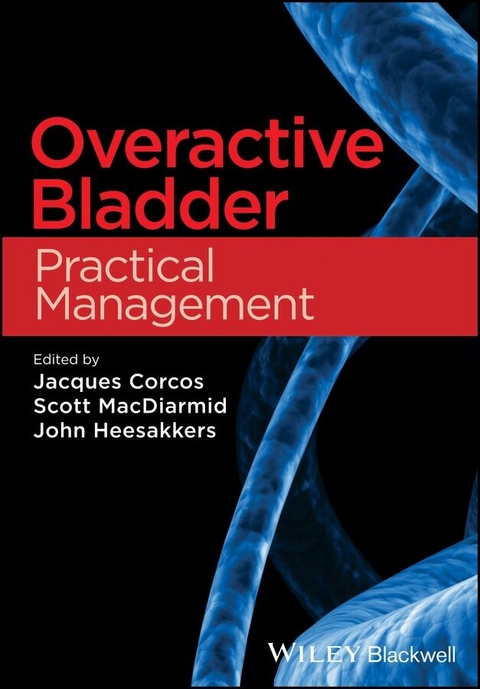
Overactive Bladder: Practical Management provides urologists, gynecologists and other health practitioners with a comprehensive clinical guide to this very common problem, resulting in a perfect resource to consult time and time again.
Beginning with an introductory section covering the definition and pathophysiolgy of OAB, it then moves on to cover evaluation, first-line management, second-line management and finally surgery.
Well-illustrated throughout, each chapter begins with a key points box outlining the most important take-home messages. Also included are clear management algorithms to aid decision-making, 'Do's and Don't' boxes to help avoid errors made, key references to the top journal articles, and the very latest guidelines from the EAU, AUA and other major urology societies.
Chapters are written by the top names in the field and the entire book is expertly edited by Jacques Corcos, John Heesakkers and Scott MacDiarmid. The result is a consistent, comprehensive and fully up to date approach to OAB, providing urologists managing patients with this condition with rapid access, specialist clinical guidance.
EDITED BY
Jacques Corcos
Professor of Urology
Department of Urology, McGill University, Canada
Scott MacDiarmid
Director, Bladder Control and Pelvic Pain Center
Alliance Urology Specialists
USA
John Heesakkers
Urologist, Department of Urology, Radboud University
Medical Center
The Netherlands
Overactive Bladder: Practical Management provides urologists, gynecologists and other health practitioners with a comprehensive clinical guide to this very common problem, resulting in a perfect resource to consult time and time again. Beginning with an introductory section covering the definition and pathophysiolgy of OAB, it then moves on to cover evaluation, first-line management, second-line management and finally surgery. Well-illustrated throughout, each chapter begins with a key points box outlining the most important take-home messages. Also included are clear management algorithms to aid decision-making, 'Do's and Don't' boxes to help avoid errors made, key references to the top journal articles, and the very latest guidelines from the EAU, AUA and other major urology societies. Chapters are written by the top names in the field and the entire book is expertly edited by Jacques Corcos, John Heesakkers and Scott MacDiarmid. The result is a consistent, comprehensive and fully up to date approach to OAB, providing urologists managing patients with this condition with rapid access, specialist clinical guidance.
EDITED BY Jacques Corcos Professor of Urology Department of Urology, McGill University, Canada Scott MacDiarmid Director, Bladder Control and Pelvic Pain Center Alliance Urology Specialists USA John Heesakkers Urologist, Department of Urology, Radboud University Medical Center The Netherlands
List of Contributors vi
Preface viii
1 Adolescent and transitional urology--an introduction 1
Part I: The kidney
2 Anatomical and cystic anomalies of the kidney 13
3 Stones 22
4 Prune?]belly syndrome 29
Part II: The ureter
5 Renal function in adolescents 41
Dr Kate Hillman and Professor Guy Neild
6 Structural anomalies and reconstruction of the ureter 49
7 Vesico?]ureteric reflux 58
Part III: The bladder
8 The neuropathic bladder and spina bifida 75
9 Lower urinary tract replacement and reconstruction 91
10 Urinary diversion and undiversion 116
11 Other bladder conditions 122
12 Exstrophy and epispadias 128
13 Cloacal exstrophy 154
Part IV: The urethra
14 Posterior urethral valves 167
15 Hypospadias 177
Part V: Disorders of sex development
16 Scrotal abnormalities 193
17 The overvirilized female 202
18 The undervirilized male 218
19 Adolescent sexuality and counseling 232
Part VI: Neoplasia
20 Neoplastic disease: outcomes in survivors 239
Index 250
CHAPTER 1
Overactive bladder: terminology and problem spectrum
John Heesakkers
Department of Urology, Radboud University Medical Center, Nijmegen, The Netherlands
KEY POINTS
- The key symptom in the OAB syndrome is urgency, which can be interpreted in many different ways.
- Urgency is difficult to appreciate by patients and caregivers.
- Therefore incidence and prevalence data have to be looked at with caution.
It is a challenge to really appreciate the exact terminology introduced to describe the symptoms and suffering from overactive bladder complaints.
In the last part of the 20th century the term urge incontinence was used frequently to describe the situation in which there is a strong sensation to go to the toilet and void or lose urine and when someone is in the process of getting there in time. However there were also patients who complained of frequent voiding and the feeling of needing to void who were often not incontinent. The compelling sensation was particularly regarded as abnormal. In 1988 Paul Abrams called this sensation “urgency,” defined as: a strong desire to void accompanied by fear of leakage or fear of pain (1988). [1] Although anyone could more or less understood which group of patients was meant, it was not easy to test this definition: not every patient had a fear of leakage or fear of pain. In 2002 this was further specified and explained as: the complaint of a sudden compelling desire to pass urine, which is difficult to defer. [2] Again, it was not easy to define what was sudden, compelling, and difficult to defer.
In 2002 the ICS defined overactive bladder complaints as: a medical condition referring to the symptom of urgency with or without urge incontinence, usually with frequency and nocturia. Other pathology like a urinary tract infection should be ruled out or treated. Urgency is the most important symptom here. It is a sensory sensation that makes you go to the toilet often (=frequency). If you have to do that at night it is called nocturia and if you do not get in time to the toilet it causes incontinence. It also means that urgency alone constitutes the OAB symptom syndrome. It is felt to be important to distinguish urgency, which is regarded as pathological, from urge which is the normal, healthy strong sensation to go to the toilet. This is difficult to understand for non–native English speakers because the translation of urgency or urge to another language is very often exactly the same. However, many contributions have been made by key experts on OAB in the past in order to explain the difference and also its pathophysiological mechanism. Chris Chapple contributed in 2005 to the discussion with the following. “It is important to differentiate between ‘urge’ which is a normal physiologic sensation, and urgency which we consider pathological. Central to this distinction is the debate over whether urgency is merely an extreme form of ‘urge.’ If this was a continuum, then normal people could experience urgency, but in the model we propose, urgency is always abnormal. ”[3] Michel and Chapple postulated that urgency originates in pathology while urge does not. “The mechanisms of urgency differ from those involved in the symptom of urge, which occurs during a physiologic bladder filling (C-fibers supposed to convey urgency and A-delta-fibers supposed to convey urge).” [4] Jerry Blaivas noted that: “Urgency is comprised of at least two different sensations. One is an intensification of the normal urge to void and the other is a different sensation. The implications of this distinction are important insofar as they may have different etiologies and respond differently to treatment.” [5]
So this all means that urge is a healthy sensation and urgency a not-healthy sensation, the latter based on pathology, the first on normal physiology. To attach frequency, nocturia, and incontinence to the driver of the syndrome had three consequences. The first was that to include and exclude patients in studies one had to find a translation of urgency into a workable definition. For frequency, for instance, this meant more than 8 times per 24 hours. The second was that the applied definition would influence the prevalence OAB. The third and most important consequence was that one had the feeling that a patient fitted into a pathological entity whereas the whole complex could also be a symptom without pathophysiological backing.
The late Norman Zinner addressed this point in an elegant debate with Paul Abrams in Neurourology and Urodynamics. He started by saying : “So OAB is urgency, with or without incontinence, usually with frequency and nocturia. This implies that incontinence, frequency and nocturia alone is not OAB. It also means that urgency without frequency, nocturia or incontinence, is OAB. So urgency alone is OAB, but what is it? We need descriptive terms like urgency to communicate, but not to make them medical terms and a 'syndrome' out of a constellation of unproven ambiguities.” [6] Paul Abrams responded to that by saying that perhaps his relationship to the term “OAB” is rather like his relationship to the motor car: I deprecate its effect on the environment, but I am not about to give it up! [7] Zinner stated that the phrase OAB is misleading because it “makes it too easy for clinicians to feel they have made a diagnosis when they have not.”[8]
So although there still is a debate about the existence, meaning, and pathophysiological backing of urgency and the OAB syndrome, every clinician dealing with a patient group that fits the definition knows what is meant by it.
The used definition, the translation in various languages, the validation process of questionnaires, and the interpretation of the respondents account for the number of people affected by OAB.
Studies from Milsom and Stewart et al. claimed that about 13–17% of the population suffer from OAB. [9, 10] This equates to about 49 million people in Europe; the prevalence increases with age. OAB is more present in women than in men. Others found other percentages. Wen et al. looked at prevalences in a Chinese population of more than 10 000 people. He found that OAB dry is present in 1.1% of the Chinese population and in 1.0% when one uses the OAB Symptom Score. OAB increases with age and more men than women suffer from it. [11]
OAB is also a chronic disease. Despite all the effort that is put in by caretakers, 88% of women that have OAB will still have it after 10 years. [12]
If the amount of bother is taken into account one must conclude that, as compared to the voiding phase and the post-micturition phase of the micturition cycle, the filling phase problems like OAB cause more bother. [13] OAB bother also compares well in comparison to other chronic diseases like diabetes mellitus or hypertension. [14]
Various reports have been published that look at the costs of the diagnosis and the treatment of overactive bladder complaints. Apart from that, the remnant costs after failed or not-100%-successful treatment of containment are also substantial. If the costs of disability for work are taken into account too, the total costs are very impressive. A study from Onukwugha et al. estimated the disease-specific total costs of OAB from the societal perspective and using an average costing method in the USA. [15]. This was done by analyzing a population-based survey, a claims data analysis, and the published literature. They applied the data in those community dwelling adults reporting the presence of urinary urgency or urgency urinary incontinence as “often” on a Likert scale. Based on the data they estimated the disease related cost at 25 billion dollars. If even the real cost were 25% of this figure one must conclude that OAB has a high impact on society, let alone on the individual patient.
References
- 1 Abrams P, BlaivasJ G, Stanton SL, et al. The standardisation of terminology of lower urinary tract function. Neurourol Urodyn. 1988; 7:403–426.
- 2 Abrams P, Cardozo L, Fall M, et al. The standardisation of terminology of lower urinary tract function. Neurourol Urodyn. 2002;21: 167–178.
- 3 Chapple CR, Artibani W, Cardozo LD, et al. The role of urinary urgency and its measurement in the overactive bladder symptom syndrome: current concepts and future prospects. BJU Int. 2005;95:335–340.
- 4 Michel MC, Chapple CR. Basic mechanisms of urgency: preclinical and clinical evidence. Eur Urol. 2009;56(2):298–307.
- 5 Blaivas JG, Panagopoulos G, Weiss JP, Somaroo C. Two types of urgency. Neurol Urodyn. 2009; 28:188–190.
- 6 Zinner NR. OAB: Are we barking up the wrong tree?Neurourol Urodyn. 2011;30:1410–1411.
- 7 Abrams P. Response to OAB: Are we barking up the wrong tree? Neurourol Urodyn. 2011;30: 1409.
- 8 Zinner NR. Author's response to Paul Abram's response to OAB. Neurourol Urodyn. 2011;30: 1412–1414.
- 9 Milsom I, Abrams P, Cardozo L, et al. How widespread are the symptoms of an overactive bladder and how are they managed? A population-based prevalence study. BJU Int. 2001;87(9):760–766.
- 10 Milsom I, Stewart WF, Van Rooyen JB, et al. Prevalence and burden of overactive bladder in the United States. World J Urol. 2003;20(6): 327–336.
- 11 Wen JG, Li JS,...
| Erscheint lt. Verlag | 24.4.2015 |
|---|---|
| Sprache | englisch |
| Themenwelt | Medizin / Pharmazie ► Medizinische Fachgebiete ► Urologie |
| Schlagworte | Medical Science • Medizin • Overactive Bladder, Urologists, Gynecologists, Urology Algorithms, Urinary Disease, Urodynamics • Urologie • Urology |
| ISBN-13 | 9781118640586 / 9781118640586 |
| Informationen gemäß Produktsicherheitsverordnung (GPSR) | |
| Haben Sie eine Frage zum Produkt? |
 EPUB (Adobe DRM)
Kopierschutz: Adobe-DRM
Adobe-DRM ist ein Kopierschutz, der das eBook vor Mißbrauch schützen soll. Dabei wird das eBook bereits beim Download auf Ihre persönliche Adobe-ID autorisiert. Lesen können Sie das eBook dann nur auf den Geräten, welche ebenfalls auf Ihre Adobe-ID registriert sind.
Details zum Adobe-DRM
Dateiformat: EPUB (Electronic Publication)
EPUB ist ein offener Standard für eBooks und eignet sich besonders zur Darstellung von Belletristik und Sachbüchern. Der Fließtext wird dynamisch an die Display- und Schriftgröße angepasst. Auch für mobile Lesegeräte ist EPUB daher gut geeignet.
Systemvoraussetzungen:
PC/Mac: Mit einem PC oder Mac können Sie dieses eBook lesen. Sie benötigen eine
eReader: Dieses eBook kann mit (fast) allen eBook-Readern gelesen werden. Mit dem amazon-Kindle ist es aber nicht kompatibel.
Smartphone/Tablet: Egal ob Apple oder Android, dieses eBook können Sie lesen. Sie benötigen eine
Geräteliste und zusätzliche Hinweise
Buying eBooks from abroad
For tax law reasons we can sell eBooks just within Germany and Switzerland. Regrettably we cannot fulfill eBook-orders from other countries.
aus dem Bereich