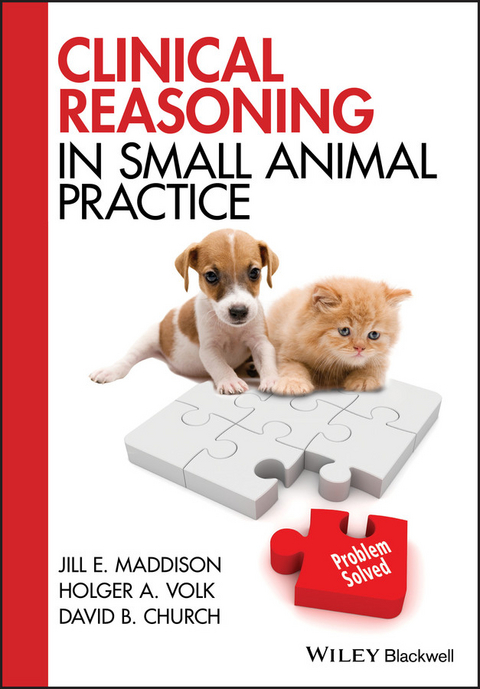
Clinical Reasoning in Small Animal Practice (eBook)
John Wiley & Sons (Verlag)
978-1-118-74173-3 (ISBN)
Written by internationally renowned clinicians and educators in clinical reasoning, key features of the book include:
- An easy to remember and logical approach to solving a wide range of clinical problems encountered in small animal medicine and neurology
- An invaluable resource for every level of learner, from student to experienced practitioner
- Flowcharts and key step markers throughout help illustrate the decision making process
Clinical inductive reasoning offers you the ability to solve cases more efficiently, resulting in better treatment and care for pets and happier owners. Clinical Reasoning in Small Animal Practice will help turn a terrifying case into a manageable one!
THE AUTHORS
Dr Jill E. Maddison BVSc, DipVetClinStud, PhD, FACVSc, MRCVS is Director of Professional Development, Extra Mural Studies and General Practice at The Royal Veterinary College, UK. Jill is actively involved in undergraduate teaching at the RVC in the areas of clinical problem solving and inductive clinical reasoning in small animal medicine and clinical pharmacology for veterinary students and nurses. She has published over 60 refereed papers in veterinary and medical journals and has been invited to speak at numerous international CPD meetings. In April 2012 she became the chair of the WSAVA Continuing Education (CE) Committee which facilitates CE for veterinarians in developing countries. Jill has been responsible for programming the clinical CPD streams at The London Vet Show since its launch in 2009.
Professor Holger A. Volk DVM, PGCAP, DipECVN, PhD, FHEA, MRCVS is Clinical Director of the Small Animal Referral Hospital and Professor of Veterinary Neurology and Neurosurgery at the Royal Veterinary College, UK. He is a Recognised RCVS and European Specialist in Veterinary Neurology, and President of the European College of Veterinary Neurology from 2014 to 2016. He is fascinated by and involved in facilitating learning for any type or level of learners. He is a frequent speaker at national and international meetings, is section editor of multiple basic and clinical veterinary science journals and is widely published in scholarly journals.
Professor David B. Church BVSc, PhD, MACVSc, FHEA, MRCVS is the Vice Principal for Learning and the Student Experience at The Royal Veterinary College, UK. He is the author of numerous scientific articles and book chapters and has an ongoing interest in relevant continuing education for practitioners and in particular the value of the problem-oriented approach to small animal medicine.
THE AUTHORS Dr Jill E. Maddison BVSc, DipVetClinStud, PhD, FACVSc, MRCVS is Director of Professional Development, Extra Mural Studies and General Practice at The Royal Veterinary College, UK. Jill is actively involved in undergraduate teaching at the RVC in the areas of clinical problem solving and inductive clinical reasoning in small animal medicine and clinical pharmacology for veterinary students and nurses. She has published over 60 refereed papers in veterinary and medical journals and has been invited to speak at numerous international CPD meetings. In April 2012 she became the chair of the WSAVA Continuing Education (CE) Committee which facilitates CE for veterinarians in developing countries. Jill has been responsible for programming the clinical CPD streams at The London Vet Show since its launch in 2009. Professor Holger A. Volk DVM, PGCAP, DipECVN, PhD, FHEA, MRCVS is Clinical Director of the Small Animal Referral Hospital and Professor of Veterinary Neurology and Neurosurgery at the Royal Veterinary College, UK. He is a Recognised RCVS and European Specialist in Veterinary Neurology, and President of the European College of Veterinary Neurology from 2014 to 2016. He is fascinated by and involved in facilitating learning for any type or level of learners. He is a frequent speaker at national and international meetings, is section editor of multiple basic and clinical veterinary science journals and is widely published in scholarly journals. Professor David B. Church BVSc, PhD, MACVSc, FHEA, MRCVS is the Vice Principal for Learning and the Student Experience at The Royal Veterinary College, UK. He is the author of numerous scientific articles and book chapters and has an ongoing interest in relevant continuing education for practitioners and in particular the value of the problem-oriented approach to small animal medicine.
Contributors vii
Foreword (Stephen May) ix
Acknowledgement xiii
1 Introduction to problem-based inductive clinical reasoning 1
Jill E. Maddison & Holger A. Volk
2 Vomiting and regurgitation 23
Jill E. Maddison
3 Diarrhoea 39
Jill E. Maddison
4 Weight loss 55
Jill E. Maddison
5 Abdominal enlargement 65
Jill E. Maddison
6 Weakness 75
Holger A. Volk, David B. Church & Jill E. Maddison
7 Fit, collapse or strange episodes 97
Holger A. Volk
8 Sneezing, dyspnoea, coughing and other respiratory signs 125
David B. Church
9 Anaemia 155
Jill E. Maddison
10 Jaundice 167
Jill E. Maddison
11 Bleeding 175
Jill E. Maddison
12 Polyuria/polydipsia and/or impaired urine concentration 191
Jill E. Maddison & David B. Church
13 Gait abnormalities 211
Holger A. Volk & Elvin R. Kulendra
14 Pruritus and scaling 241
Andrea V. Volk & Jill E. Maddison
Index 255
"The authors of this affordable book have deliberately focused their approach on the main symptoms such as diarrhoea, pruritus... and they guide the reader through the maze of clinical exams, secondary tests and intense mulling. Elementary, my dear Watson." (Vet Nurses Today, 1 October 2015)
"This book will be a useful addition to the library of any practitioner." (Journal of the American Veterinary Medical Association, 15 September 2015)A logical approach to making a diagnosis, puts the art back intoveterinary science. Essential reading for all small animalclinicians.
Professor Edward Hall MA (Cantab), VetMB, PhD(Liv),DipECVIM-CA, MRCVS, European Specialist in Small Animal InternalMedicine
Head of Division and Professor of Small Animal Internal Medicine,School of Veterinary Sciences, University of Bristol, UK
This book outlines the philosophy and approaches underlyingproblem-based clinical reasoning. It is an important resource forvets looking to advance themselves as small animal diagnosticiansand essential reading for new graduates and RCVS CertAVP smallanimal candidates.
David Killick BVetMed, PhD, CertSAM, DipECVIM-CA (Onc), MRCVS, RCVSand European Specialist in Veterinary Oncology
Senior Lecturer in Veterinary Oncology, University of Liverpool,UK
The authors present a logical structured framework fordiagnosing common clinical problems, which can be used byveterinary students just starting clinics, as well as experiencedveterinarians faced with difficult undiagnosed cases. The book iseasy to read, logically organized, medically sound and in myopinion, unlike any other small animal medical textbook currentlyavailable.
Susan E. Johnson, DVM, MS, Diplomate, ACVIM (InternalMedicine)
Professor and SAIM Service Head, The Ohio State University, USA
The veterinary profession has been in need of this book formany decades. The book is written in a down to earth style thatshows an appreciation of the working environment and priorities ofclinicians, making it a practical guide to efficient and effectiveclinical decision making.
Sue Bennett BSc, BVMS, MACVSc (Medicine of Cats), FACVSc (SmallAnimal Medicine)
Lecturer in Small Animal Medicine, Murdoch University VeterinaryHospital, Australia
Clinical Reasoning in Small Animal Practice is an invaluableresource for undergraduates and recent graduates to help them todevelop a structured, reasoned approach to every case. The book isclearly set out in 14 chapters which cover the most common problemsconfronting vets in general practice in a systematic and logicalway and will become the go-to text for all veterinarians who striveto achieve the highest standards in small animalpractice.
Dr Hugh White MVSc, MANZCVS
Director, Centre for Veterinary Education, University of Sydney,Australia
At last, here is a book that provides clinicians with a clearand structured approach to clinical diagnosis. It provides amethodology for clinical problem solving: for students,inexperienced clinicians, experienced veterinarians and specialistsalike. If you think diagnosis is easy or if you find itdifficult you need this book. The authors havedrawn on their extensive experience and championing of the clinicalreasoning concept to provide a workable template to make adiagnosis for animals presenting with common clinical signs. Adopting their problem based methodology will aid diagnosis, reduceunnecessary diagnostic investigations and make medicine enjoyable.This book is a 'must read' for veterinary students andall veterinarians in practice.
Boyd R Jones BVSC, FACVSc, DECVIM-Ca, MRCVS
Professor Emeritus University College Dublin, Ireland and MasseyUniversity, New Zealand
Chapter 1
Introduction to problem-based inductive clinical reasoning
Jill E. Maddison & Holger A. Volk
The Royal Veterinary College, Department of Clinical Science and Services, London, UK
The aim of this book is to assist you to develop a structured and pathophysiologically sound approach to the diagnosis of common clinical problems in small animal practice. The development of a sound basis for clinical problem solving provides the veterinarian with the foundation and scaffold to allow them to potentially reach a diagnosis regardless of whether they have seen the disorder before. Furthermore, the method presented in this book will help you avoid being stuck trying to remember long differential lists and hence free your thinking skills to solve complex medical cases. The aim of the book is not to bombard you with details of different diseases – there are many excellent textbooks and other resources that can fulfil this need. What we want to provide you with is a framework by which you can solve clinical problems and place your veterinary knowledge into an appropriate problem-solving context.
We all remember our first driving lessons, which may have been quite challenging – for us and/or our instructors! We had to think actively about many factors to ensure we drove safely. The more experienced we became at driving, the more non-driving-associated tasks, such as talking to our passengers, listening to the radio and changing the radio channels, we were able to do while driving. If we had attempted any of these tasks at the beginning of our driver training, we might have had an accident. As we become more experienced at a task, we need to think less about it, as we move to what is known as unconscious competence.
We see a similar process in clinical education. During the progression from veterinary student to experienced clinician, knowledge and skills are initially learnt in a conscious and structured way. Veterinary undergraduate education in most universities is therefore based on systems teaching, species teaching or a mixture of both. These are excellent approaches to help develop a thorough knowledge base and understanding of disease processes and treatments. However, when an animal or group of animals becomes unwell, the clinical signs they exhibit can be caused by a number of disorders of a range of different body systems – the list may seem endless. They do not present to the veterinarian with labels on their heads stating the disease they have (more's the pity!). Therefore, for the veterinarian to fully access their knowledge bank, they need to have a robust method of clinical reasoning they can rely on. This method allows them to consolidate and relate their knowledge to the clinical case and progress to a rational assessment of the likely differential diagnoses. This makes it easier to determine appropriate diagnostic and/or management options for the patient. Because you have a clear path, communication with the client becomes easier.
The next part of the journey of becoming an experienced clinician is that clinical judgement and decision-making processes become unconscious or intuitive. The rapid, unconscious process of clinical decision-making by experienced clinicians is referred to in medical literature as intuition or the ‘art’ of medicine. The conscious thinking process is often referred to as ‘science’ (evidence-based) or analytic. Intuition is context-sensitive, influenced by the level of the clinician's experience, context-dependent and has no obvious cause-and-effect logic. Why is this important? We have all thought – ‘I just know that the animal has …’ The unconscious mind will pretend to the conscious mind that the clinical decision was based on logical assumptions or causal relationships. This is not a problem as long the intuition or ‘pattern recognition’ has resulted in a correct diagnosis. However, when it does not, we need to understand why it failed and have a system in place to rationally progress our clinical decision-making. This book will provide you with the tools and thinking framework needed to unravel any clinical riddle, unleashing the potential of your unconscious mind rather than blocking your working memory as you try to recall all the facts you may have once known.
Why are some cases frustrating instead of fun?
Reflect on a medical case that you have recently dealt with that frustrated you or seemed difficult to diagnose and manage. Can you identify why the case was difficult?
There can be a multitude of reasons why complex medical cases are frustrating instead of fun.
- Was it due to the client (e.g. having unreal expectations that you could fix the problem at no cost to themselves? Unwilling or unable to pay for the diagnostic tests needed to reach a diagnosis? Unable to give a coherent history?)
- Was the case complex and didn't seem to fit any recognisable pattern?
- Were you unable to recall all the facts about a disease and this biased your thinking?
- Did the signalment, especially breed and age, cloud your clinical decision-making resulting in an incorrect differential list?
- Did the case seem to fit a pattern but subsequent testing proved your initial diagnosis wrong?
- Did you seem to spend a lot of the client's money on tests that weren't particularly illuminating?
Can you add any other factors that have contributed to frustrations and difficulties you may have experienced with medical cases?
Apart from the client issues (and as discussed later, we may be able to help a little bit here as well), we hope that by the end of this book, we will have gone some way towards removing the common barriers to correct, quick and efficient diagnosis of medical cases and have made unravelling medical riddles fun.
Solving clinical cases
When a patient presents with one or more clinical problems, there are various methods we can use to solve the case and formulate a list of differential diagnoses. One method involves pattern recognition – looking at the pattern of clinical signs and trying to match that pattern to known diagnoses. This is also referred to as developing an illness script. Another method can involve relying on blood tests to tell us what is wrong with the patient – also referred to as the minimum database. Or we can use problem-based clinical reasoning. Often, we may use all three methods.
Pattern recognition
Pattern recognition involves trying to remember all diseases that fit the ‘pattern’ of clinical signs/pathological abnormalities that the animal presents with. This may be relatively simple (but can also lead to errors of omission) and works best:
- For common disorders with typical presentations
- If a disorder has a unique pattern of clinical signs
- When all clinical signs have been recognised and considered, and the differential list is not just based on one cardinal clinical sign and the signalment of the patient presented
- If there are only a few diagnostic possibilities that are
- easily remembered or
- can easily be ruled in or out by routine tests
- If the vet has extensive experience, is well read and up-to-date, reflects on all of the diagnoses they make regularly and critically and has an excellent memory.
Pattern recognition works well for many common disorders and has the advantage of being quick and cost effective, provided the diagnosis is correct. The vet looks good to the client because they have acted decisively and confidently … provided the diagnosis is correct.
However, pattern recognition can be flawed and unsatisfactory when the clinician is inexperienced (and therefore has seen very few patterns) or only considers or recognises a small number of factors (and is not aware that this process is mainly driven by unconscious processes that might need to be reflected upon if they fail). Or even if the clinician is experienced, it can be flawed for uncommon diseases or common diseases presenting atypically, when the patient is exhibiting multiple clinical signs that are not immediately recognisable as a specific disease, or if the pattern of clinical signs is suggestive of certain disorders but not specific for them. In addition, for the experienced clinician, the success of pattern recognition relies on a correct diagnosis for the pattern observed previously being reached and not assuming that similar patterns must equal the same diagnosis. Pattern recognition can lead to dangerous tunnel vision where the clinician pursues his/her initial diagnostic hunch based on pattern spotting to the exclusion of other diagnostic possibilities. They may then interpret all subsequent data as favourable to their initial diagnosis, including ignoring data that doesn't ‘fit’ their preferred diagnosis. This phenomenon is described in psychological literature as confirmation bias – defined as a tendency for people to favour information that confirms their beliefs or hypotheses. And finally, the disadvantage of relying entirely on pattern recognition to solve clinical problems means that should the clinician realise subsequently that their pattern recognition was incorrect, they have no logical intellectual framework to help them reassess the patient. Thus, pattern-based assessment of clinical cases can result at best in a speedy, correct, ‘good value’ diagnosis but at worst in wasted time, money and, sometimes,...
| Erscheint lt. Verlag | 30.3.2015 |
|---|---|
| Sprache | englisch |
| Themenwelt | Medizin / Pharmazie |
| Veterinärmedizin ► Kleintier | |
| Schlagworte | canine • Cat • Clinical Reasoning • Differential Diagnosis • Dog • feline • Kleintier • Problem Solved • small animal • Veterinärmedizin • Veterinärmedizin f. Kleintiere • Veterinärmedizin / Innere Medizin • Veterinärmedizin • Veterinärmedizin f. Kleintiere • Veterinärmedizin / Innere Medizin • Veterinary Internal Medicine • Veterinary Medicine • Veterinary Medicine - Small Animal General • veterinary neurology |
| ISBN-10 | 1-118-74173-0 / 1118741730 |
| ISBN-13 | 978-1-118-74173-3 / 9781118741733 |
| Informationen gemäß Produktsicherheitsverordnung (GPSR) | |
| Haben Sie eine Frage zum Produkt? |
 EPUB (Adobe DRM)
Kopierschutz: Adobe-DRM
Adobe-DRM ist ein Kopierschutz, der das eBook vor Mißbrauch schützen soll. Dabei wird das eBook bereits beim Download auf Ihre persönliche Adobe-ID autorisiert. Lesen können Sie das eBook dann nur auf den Geräten, welche ebenfalls auf Ihre Adobe-ID registriert sind.
Details zum Adobe-DRM
Dateiformat: EPUB (Electronic Publication)
EPUB ist ein offener Standard für eBooks und eignet sich besonders zur Darstellung von Belletristik und Sachbüchern. Der Fließtext wird dynamisch an die Display- und Schriftgröße angepasst. Auch für mobile Lesegeräte ist EPUB daher gut geeignet.
Systemvoraussetzungen:
PC/Mac: Mit einem PC oder Mac können Sie dieses eBook lesen. Sie benötigen eine
eReader: Dieses eBook kann mit (fast) allen eBook-Readern gelesen werden. Mit dem amazon-Kindle ist es aber nicht kompatibel.
Smartphone/Tablet: Egal ob Apple oder Android, dieses eBook können Sie lesen. Sie benötigen eine
Geräteliste und zusätzliche Hinweise
Buying eBooks from abroad
For tax law reasons we can sell eBooks just within Germany and Switzerland. Regrettably we cannot fulfill eBook-orders from other countries.
aus dem Bereich