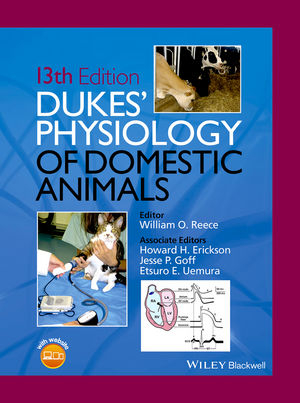
Dukes' Physiology of Domestic Animals (eBook)
John Wiley & Sons (Verlag)
978-1-118-50148-1 (ISBN)
This fully revised new edition of the classic reference on domestic animal physiology provides detailed descriptions of animal function and dysfunction, with an emphasis on clinical relevance and pedagogical features to enhance learning.
• Presents in-depth, comprehensive descriptions of domestic animal function and dysfunction
• Emphasizes clinical relevance, with clinical correlations, notes of relevance, and self-assessment questions featuring situations likely to be faced in practice
• Offers pedagogical features, including chapter outlines and introductions, key terms throughout the book, additional images, questions to enhance learning, and self-assessment exercises
• Distills the most useful information for ease of use, with improved continuity and reduced repetition
• Includes a companion website offering review questions and answers and the figures from the book in PowerPoint
William O. Reece, DVM, PhD, is University Professor Emeritus in the Department of Biomedical Sciences, College of Veterinary Medicine, Iowa State University, Ames, Iowa, USA.
Howard Erickson, DVM, PhD, is Professor Emeritus of Physiology in the Department of Anatomy and Physiology, College of Veterinary Medicine, Kansas State University, Manhattan, Kansas, USA.
Jesse P. Goff, DVM, PhD, is Professor and Anderson Chair in the Department of Biomedical Sciences, Iowa State University, College of Veterinary Medicine, Ames, Iowa, USA.
Etsuro E. Uemura, DVM, MS, PhD, is Professor in the Department of Biomedical Sciences, College of Veterinary Medicine, Iowa State University, Ames, Iowa, USA.
William O. Reece, DVM, PhD, is University Professor Emeritus in the Department of Biomedical Sciences, College of Veterinary Medicine, Iowa State University, Ames, Iowa, USA. Howard Erickson, DVM, PhD, is Professor Emeritus of Physiology in the Department of Anatomy and Physiology, College of Veterinary Medicine, Kansas State University, Manhattan, Kansas, USA. Jesse P. Goff, DVM, PhD, is Professor and Anderson Chair in the Department of Biomedical Sciences, Iowa State University, College of Veterinary Medicine, Ames, Iowa, USA. Etsuro E. Uemura, DVM, MS, PhD, is Professor in the Department of Biomedical Sciences, College of Veterinary Medicine, Iowa State University, Ames, Iowa, USA.
List of contributors, vii
Preface, ix
Acknowledgments, x
Tributes, xi
About the companion website, xii
Section I: Neurophysiology
(Section Editor: Etsuro E. Uemura)
1 Nervous Tissue, 3
Etsuro E. Uemura
2 Electrochemical Basis of Neuronal Function, 13
Etsuro E. Uemura
3 Synaptic Transmission, 23
Etsuro E. Uemura
4 Somatic and Visceral Senses, 32
Etsuro E. Uemura
5 Olfaction and Gustation, 43
Etsuro E. Uemura
6 Auditory System, 49
Etsuro E. Uemura
7 Visual System, 57
Etsuro E. Uemura
8 Motor System, 68
Etsuro E. Uemura
9 Vestibular System, 79
Etsuro E. Uemura
10 Autonomic Nervous System, 89
Etsuro E. Uemura
Section II: Body Fluids and Homeostasis
(Section Editor: William O. Reece)
11 Body Water: Properties and Functions, 103
William O. Reece
12 The Composition and Functions of Blood, 114
William O. Reece
13 Fundamentals of Acid-Base Balance, 137
William O. Reece
14 Body Temperature and Its Regulation, 149
William O. Reece
Section III: The Kidneys and Urinary System
(Section Editor: William O. Reece)
15 The Renal System: Structures and Function, 157
William O. Reece
16 Glomerular Filtration and Tubular Transport, 166
William O. Reece
17 Maintenance of Extracellular Fluid Hydration, 173
William O. Reece
18 Kidney Regulation of Extracellular Volume and Electrolytes, 180
William O. Reece
19 Micturition, Characteristics of Urine, and Renal Clearance, 188
William O. Reece
20 Kidney Function in Birds, 193
William O. Reece
Section IV: Respiration
(Section Editor: William O. Reece)
21 Overview of the Respiratory System, 203
William O. Reece
22 Physical and Mechanical Aspects of Respiration, 213
William O. Reece
23 Pulmonary Ventilation and Transport of Gases, 222
William O. Reece
24 Regulation of Respiration, 232
William O. Reece
25 Other Functions of the Respiratory System, 239
William O. Reece
26 Respiration in Birds, 245
John W. Ludders
Section V: Muscle Physiology
(Section Editor: William O. Reece)
27 Physiology of Skeletal Muscle, 263
William O. Reece
28 Physiology of Smooth Muscle, 274
William O. Reece
29 Physiology of Cardiac Muscle, Muscle Adaptations, and Muscle Disorders, 279
William O. Reece
Section VI: The Cardiovascular System
(Section Editor: Howard H. Erickson)
30 The Heart and Vasculature: Gross Structure and Basic Properties, 287
Dean H. Riedesel and Richard L. Engen
31 Electrophysiology of the Heart, 304
Robert F. Gilmour, Jr
32 The Electrocardiogram and Cardiac Arrhythmias, 315
Robert F. Gilmour, Jr and N. Sydney Moïse
33 Mechanical Activity of the Heart, 327
Dean H. Riedesel
34 Regulation of the Heart, 341
David D. Kline, Eileen M. Hasser and Cheryl M. Heesch
35 Control Mechanisms of the Circulatory System, 352
Cheryl M. Heesch, David D. Kline and Eileen M. Hasser
36 Microcirculation, Lymph, and Edema, 372
Luis A. Martinez?]Lemus and M. Harold Laughlin
37 Pulmonary Circulation, 386
David C. Poole and Howard H. Erickson
38 Special Circulations, 399
Eileen M. Hasser, Cheryl M. Heesch, David D. Kline and M. Harold Laughlin
39 Heart Sounds and Murmurs, 417
Michele Borgarelli and Jens Häggström
40 Hypertension, Heart Failure, and Shock, 429
Scott A. Brown
41 Exercise Physiology of Terrestrial Animals, 443
David C. Poole and Howard H. Erickson
Section VII: Digestion, Absorption, and Metabolism
(Section Editor: Jesse P. Goff)
42 Gastrointestinal Motility, 467
Jesse P. Goff
43 Secretory Activities of the Gastrointestinal Tract, 484
Jesse P. Goff
44 Digestion and Absorption of Nutrients, 502
Jesse P. Goff
45 Ruminant Digestive Physiology and Intestinal Microbiology, 522
Jesse P. Goff
46 Avian Digestion, 532
William O. Reece and Darrell W. Trampel
47 Disorders of Carbohydrate and Fat Metabolism, 541
Jesse P. Goff
48 Vitamins, 551
Jesse P. Goff
Section VIII: Minerals, Bones, and Joints
(Section Editor: Jesse P. Goff)
49 Minerals, 567
Jesse P. Goff
50 Cartilage, Bones, and Joints, 593
Jesse P. Goff
Section IX: Endocrinology, Reproduction, and Lactation
(Section Editor: Jesse P. Goff)
51 The Endocrine System, 617
Jesse P. Goff
52 Male Reproduction in Mammals, 654
William O. Reece
53 Female Reproduction in Mammals, 670
William O. Reece
54 Lactation, 694
Patrick J. Gorden and Leo L. Timms
55 Avian Reproduction, 715
Patricia A. Johnson
Index, 727
"Overall, this book provides a fulfilling overview of the physiology knowledge required for veterinary students during their time at university and in their future career. I like the fact that it is easy to use and feel that the self-evaluation sections will be particularly welcome for veterinary students." (Veterinary Record, 1 December 2015)
"It is certainly a textbook worth consideration for undergraduate or professional physiology courses and those interested in the comparative aspects of physiology." (Journal of the American Veterinary Medical Association, 15 September 2015)
1
Nervous Tissue
Etsuro E. Uemura
Iowa State University, Ames, IA, USA
- Division of the nervous system
- Cells of the nervous system
- Extracellular environment of the CNS
- Self-evaluation
The nervous system has two categories of cells, neurons (Greek neuron, nerve) and neuroglia (Greek glia, glue). Their names reflect the fact that neurons give rise to nerves, while neuroglia are thought of as cells simply holding neurons together. Neurons and neuroglia are far more complex in their shape than cells in any other tissue. Their morphological heterogeneity reflects the functional complexity of the nervous system. Neurons and neuroglia play different roles in the nervous tissue. Neurons are specialized in information processing. Specialized contact areas called synapses mediate signals from one neuron to others. Synapses are the basis of complex neuronal networks designed for information processing. Neurons stop dividing within a few months after birth. Therefore, if nerve damage involves cell bodies in the adult animal, resulting neuronal death will permanently change the structure and functions of the affected areas. Unlike neurons, neuroglia continue to divide. This glial capacity to divide is essential for their structural and functional support of neurons. Neurons and glial cells require a chemically stable environment. Endothelial cells of the central nervous system and the choroid plexus help maintain such an environment by regulating molecules secreted into the interstitial fluid and cerebrospinal fluid (CSF).
Division of the nervous system
- Differentiate between the central nervous system and the peripheral nervous system.
- What is the relationship between the autonomic and the central nervous systems?
The nervous system can be classified into three systems: the central nervous system, peripheral nervous system and autonomic nervous system. The central nervous system (CNS) is composed of the cerebrum, cerebellum, brainstem, and spinal cord. It is the central processing unit of the entire nervous system. All nervous tissue other than the cerebrum, brainstem, cerebellum, and spinal cord is referred to as the peripheral nervous system (PNS). The PNS comprises the nerves, ganglia (spinal, cranial, sympathetic trunk, collateral, terminal), and sensory receptors. The PNS conveys (i) sensory signals about the external and internal environment of the body to the CNS and (ii) motor signals from the CNS to the peripheral effectors (skeletal muscle, cardiac muscle, smooth muscle, secretory glands). Certain neural components of the CNS and PNS regulate the visceral organs, smooth muscles (e.g., vascular, pupillary dilator, pupillary sphincter, ciliary, orbital, arrector pili), and glands (salivary, lacrimal, nasal, adrenal). These neural components of the CNS and PNS are collectively referred to as the autonomic nervous system (ANS). The ANS is, in general, not under voluntary control, but rather its action is controlled by the hypothalamus. The ANS consists of many specialized neural components (e.g., nuclei, ganglia, nerves, tracts and visceral plexus). For example, the increased heart rate in the “fight or flight” response involves the hypothalamus (i.e., CNS), intermediolateral nucleus in the spinal cord (i.e., CNS), ganglia (i.e., PNS) and peripheral nerves (i.e., PNS).
Cells of the nervous system
- What are three different types of neurons?
- What are the functions of an axon and a dendrite?
- What is the axon hillock? What is its functional significance?
- What are the structural and functional differences between myelinated and nonmyelinated axons?
- Name the neuroglia of the CNS and PNS, and explain their functions.
- How do Schwann cells differ from oligodendrocytes?
- What are the bases of classifying peripheral nerve fibers?
Neurons and neuroglia are the two categories of cells of the nervous system. Neurons share certain universal cellular features with all other cells in the body; however, neurons have certain unique features that separate them from other cells. For example, they have distinctive cell shapes with a membrane capable of generating electrical impulses. They transfer impulses from one neuron to the next via synapses (Greek synapsis, a connection), the specialized contact areas between two neurons. Although transmission of impulses is a basic biological function performed by all neurons, their electrical property alone does not explain the diverse roles they play in a complex neural network. Neuroglia are the most abundant cells in nervous tissue (over 90%), filling essentially all the space in the nervous system not occupied by neurons and blood vessels. They provide structural, metabolic, and protective support for neurons.
Neurons
The most obvious difference between neurons and other cells in the body lies in their great variety of shapes and sizes. Neurons have highly irregular shapes with one or more cellular processes extending from the cell body (Figure 1.1). The neuronal cell body (also referred to as the soma or perikaryon) contains the same organelles found in other cells. However, the rough endoplasmic reticulum and polysomes (collectively referred to as Nissl substance) are especially abundant in perikarya. Each neuron has a single axon. The area of the cell body where an axon originates is the axon hillock. The axon hillock is also referred to as the trigger zone, as action potentials are generated here. Just distal to the axon hillock is the initial segment of the axon.
Figure 1.1 A cortical multipolar neuron stained with the Golgi silver impregnation method showing the perikaryon, axon, and dendrites. Only one axon emerges from the perikaryon. All other neuronal processes are dendrites.
Axons frequently branch at a distance from the cell body, forming synapses with other neurons, muscle cells, or glands. The remaining neuronal processes are dendrites (Greek dendron, tree) that resemble trees (Figure 1.1). Dendrites and perikarya are the primary receptive sites of impulses from other neurons. The number of dendrites varies depending on the type of neuron (Figure 1.2). Action potentials are generated at the axon hillock. An action potential travels along the axon at a speed that varies from 0.5 to 120 m/s. Larger axons, over 1 µm in diameter, are myelinated in both the CNS and PNS, while axons less than 1 µm in diameter are not myelinated. Myelinated axons conduct impulses much faster than nonmyelinated axons. There is a constant relationship between axon diameter, internodal length (i.e., length of each myelin sheath), and conduction velocity. Larger axons have longer internodes and faster conduction velocities. Neurons are contiguous not continuous and they communicate with each other via synapses. If a neuron is linked to more than one recipient neuron, its axon branches to make synaptic connections with all the recipient neurons. Neurons, like muscle cells, do not divide once they reach maturity. Therefore, any physical injury that leads to neuronal death will permanently change the structure and functions of the affected areas.
Figure 1.2 The classification of neurons is based on the number of cell processes emerging from the cell body. Cell bodies of unipolar neurons are present in the spinal and cranial ganglia. Cell bodies of bipolar neurons are present in the retina of the eye, spiral ganglia of the auditory nerve, vestibular ganglia of the vestibular nerve, and olfactory epithelium. The majority of neurons are multipolar neurons.
The color of fresh nervous tissue reflects neuronal cell bodies and axons. Areas with a high population of perikarya (e.g., cerebral cortex) appear gray and are referred to as the gray matter. In contrast, areas mainly made of myelinated axons appear white because of the presence of lipid in myelin. The name white matter is used to indicate such areas.
Classification of neurons
Neurons are classified into three types (unipolar, bipolar, and multipolar) based on the number of cellular processes extending from the cell body (Figure 1.2). Unipolar neurons have a single stem process that bifurcates to form two processes, the peripheral and central. Unipolar neurons innervate peripheral tissues, bringing somatic and visceral sensory information to the CNS. Thus they are also referred to as primary sensory neurons. Bipolar neurons have two processes. Bipolar neurons are located in the retina of the eye (see Figure 7.4), spiral ganglion of the cochlea (see Figure 6.2B), vestibular ganglion of the vestibular organ (see Figure 9.1), and olfactory epithelium (see Figure 5.2). Bipolar neurons are sensory neurons. Their peripheral processes innervate sensory receptors, bringing sensory signals to the CNS. An exception to this rule is the...
| Erscheint lt. Verlag | 1.4.2015 |
|---|---|
| Mitarbeit |
Stellvertretende Herausgeber: Howard H. Erickson, Jesse P. Goff, Etsuro E. Uemura |
| Sprache | englisch |
| Themenwelt | Medizin / Pharmazie |
| Veterinärmedizin ► Vorklinik ► Physiologie | |
| Schlagworte | Haustiere • <p>Animal physiology, domestic animal physiology, dog physiology, cat physiology, equine physiology, bovine physiology, swine physiology, avian physiology, structure and function</p> • Veterinäranatomie • Veterinäranatomie u. -physiologie • Veterinärmedizin • Veterinärphysiologie • Veterinäranatomie • Veterinäranatomie u. -physiologie • Veterinärmedizin • Veterinärphysiologie • Veterinary Anatomy & Physiology • Veterinary Medicine |
| ISBN-10 | 1-118-50148-9 / 1118501489 |
| ISBN-13 | 978-1-118-50148-1 / 9781118501481 |
| Informationen gemäß Produktsicherheitsverordnung (GPSR) | |
| Haben Sie eine Frage zum Produkt? |
 EPUB (Adobe DRM)
Kopierschutz: Adobe-DRM
Adobe-DRM ist ein Kopierschutz, der das eBook vor Mißbrauch schützen soll. Dabei wird das eBook bereits beim Download auf Ihre persönliche Adobe-ID autorisiert. Lesen können Sie das eBook dann nur auf den Geräten, welche ebenfalls auf Ihre Adobe-ID registriert sind.
Details zum Adobe-DRM
Dateiformat: EPUB (Electronic Publication)
EPUB ist ein offener Standard für eBooks und eignet sich besonders zur Darstellung von Belletristik und Sachbüchern. Der Fließtext wird dynamisch an die Display- und Schriftgröße angepasst. Auch für mobile Lesegeräte ist EPUB daher gut geeignet.
Systemvoraussetzungen:
PC/Mac: Mit einem PC oder Mac können Sie dieses eBook lesen. Sie benötigen eine
eReader: Dieses eBook kann mit (fast) allen eBook-Readern gelesen werden. Mit dem amazon-Kindle ist es aber nicht kompatibel.
Smartphone/Tablet: Egal ob Apple oder Android, dieses eBook können Sie lesen. Sie benötigen eine
Geräteliste und zusätzliche Hinweise
Buying eBooks from abroad
For tax law reasons we can sell eBooks just within Germany and Switzerland. Regrettably we cannot fulfill eBook-orders from other countries.
aus dem Bereich