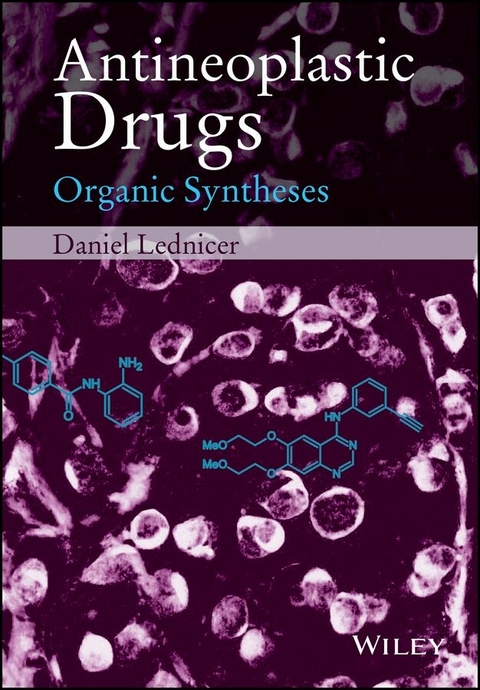
Antineoplastic Drugs (eBook)
John Wiley & Sons (Verlag)
978-1-118-89256-5 (ISBN)
The past decade has seen a significant increase of research aimed at discovering new drugs for treating cancer, and the increasing number of new antineoplastic drugs approved by regulatory agencies reflects this. Until now, details on the synthesis of these newer agents have been scattered in various journals and in US and European patents. This timely volume deals with the organic chemistry involved in the synthesis of the agents found within antineoplastic drugs, including descriptions of the synthetic schemes for the preparation of over 200 compounds that have been granted non-proprietary names. Compounds are collected in chapters based on the mechanism of action rather than on their chemical structures. Each individual chapter is preceded by a brief description of that mechanism and includes detailed flow charts of the preparation of those compounds accompanied by discussions of the organic chemistry involved in each step. The first half of this volume is dedicated to the syntheses of established chemotherapy drugs. Kinase inhibitors occupy the following chapters with the largest single chapter dealing with the fifty compounds that inhibit tyrosine kinase. This class stands out since over twenty compounds in this group have been approved for treating patients; a rare track record compared to any other class of therapeutic agents. Antineoplastic Drugs: Organic Syntheses is written to appeal to organic and medicinal chemists in industry and academia. It is beneficial to those composing grant proposals for NCI and related organizations. The book is accessible to advanced undergraduates as well as graduates and researchers as well as those with a thorough grasp of organic chemistry.
Dr Daniel Lednicer's career in both the private and public sectors has been devoted to the search for new therapeutic agents. He spent two decades at the bench as a chemist at the Upjohn Company. Following that, he served as director of chemical research at Mead Johnson, director of pharmaceutical sciences at Adria Laboratories, and pharmaceutical manager at Analytical Biochemistry Laboratories. Most recently, he was a project officer at the National Cancer Institute. Dr Lednicer is the acclaimed author of several books on drug synthesis and discovery, including 7 volumes of the series Organic Chemistry of Drug Synthesis (Wiley US).
Preface ix
Introduction xi
1 Alkylating Agents 1
1.1 bis-Chloroethyl Amines 1
1.2 Several Other Chloroethyl Agents 5
1.3 Platinum-Based Antineoplastic Agents 6
1.4 Miscellaneous Alkylating Agents 8
2 Antimetabolites 13
2.1 Introduction 13
2.2 Folate Antagonists 14
2.3 Pyrimidines and Purines 21
3 Hormone Blocking Anticancer Drugs 31
3.1 Introduction 31
3.2 Estrogen Antagonists 32
3.3 Androgen Antagonists 44
4 Topoisomerase Inhibitors 55
4.1 Introduction 55
4.2 Anthracyclines 56
4.3 Anthraquinones and Anthrapyrazoles 59
4.4 Camptothecins 65
4.5 Miscellaneous Topoisomerase Inhibitors 74
5 Mitotic Inhibitors 81
5.1 Introduction 81
5.2 Taxanes 82
5.3 Wholly Synthetic Compounds 86
6 Matrix Metalloproteinase Inhibitors 97
6.1 Introduction 97
6.2 Hydroxamates 98
7 Histone Deacetylase Inhibitors 109
7.1 Introduction 109
7.2 Hydroxamates 110
7.3 Phenylenediamines 113
8 Enzyme Inhibitor, Part I, Tyrosine Kinases 117
8.1 Introduction 117
8.2 Epidermal Growth Factor Inhibitors 118
8.3 VEGF 124
8.4 SRC Nonreceptor Tyrosine Kinase 134
8.5 PDGF 138
8.6 EGF 141
8.7 Other TKI 143
8.8 Janus Kinase Inhibitors 154
9 Enzyme Inhibitors: Part II Additional Targets 161
9.1 Serine-Threonine Kinase Inhibitors 161
9.2 Additional Enzyme Inhibitors 166
10 Miscellaneous Antineoplastic Agents 187
10.1 Acyclic 187
10.2 Monocyclic 188
10.3 Two Linked Rings 190
10.4 Rings on a Chain 191
10.5 Fused Rings 195
Appendix A 203
Combinatorial Chemistry 203
Index of Heterocyclic Sytheses 205
Subject Index 207
Introduction
Cancer has a long history as a scourge for mankind. Some prehistoric fossilized human bones, in fact, show growths that have been interpreted as malignant tumors. The term cancer actually encompasses a group of closely related diseases that have in common unregulated cell division. Many vital processes such as growth require the synthesis of new proteins. This process calls on instructions from DNA found in genes. In rough outline, cell division is normally directed by protein factors that are in turn controlled by two opposing genes. Proto-oncogenes control proteins that encourage cell proliferation, while those controlled by tumor suppressor genes tend to oppose the process. Any one of a number of stimuli, for example, chronic exposure to carcinogenic chemicals, can cause a proto-oncogene to mutate and become an oncogene. That oncogene then causes the proteins involved in cell division to become overactive. The cells whose growth has up to now been controlled escape the restraints on cell division and lose controls on proliferation. The now-cancerous cells often also lose many of functions they had played prior to becoming neoplastic. The absence of restraints in addition causes those cells to divide much more quickly than the normal progenitor; they then go on to form a malignant tumor. Untreated cancer virtually always causes premature death.
For centuries, the only means for treating the malignant tumors consisted of surgical extirpation of the lesion. Texts dating from Greco-Roman times describe excision of cancerous lesions; many of these sources refer to the recurrence of cancer within a short time after the surgery. Cancers of the circulatory system such as leukemias and lymphomas were considered a death warrant up to quite recent times because there was no visible tumor that could be removed. Today’s greatly advanced surgical technique and adjuncts such as the sterile operating field and anesthesia made surgical removal of malignant tumors practical; surgery for treating solid tumors is now still the first-line treatment after a carcinoma has been identified. Unless caught at a very early stage, many cancerous lesions spread to other parts of the body by splitting off malignant daughter cells in a process called metastasis. Metastases spread throughout the body via the lymphatic and sometimes the circulatory system. The fact that surgeons now take special measures to insure that all cancer cells are excised helps avoid the spread of the cancer to other locations. The principal targets of antineoplastic drugs now comprise first the circulatory system cancer tumors not susceptible to surgical excision such as leukemia; metastases from solid tumors comprise an equally important target for these drugs. Antineoplastic agents are in addition also used following surgery to kill any cancer cells that had been left behind. These drugs are also not infrequently used to shrink tumors prior to surgery.
The beginning of antineoplastic therapy can be ironically traced back to the First World War when the Germans followed up their use of chlorine as a poison gas by what came to be called sulfur mustard (I-1). The name is said to come from the yellow-brown appearance of the substance while still liquid and the mustard-like odor. Exposure to this gas, now classed as a cytotoxic agent, caused large painful skin blisters; afflicted troops often lost eyesight. (A very moving larger-than-life-size John Singer Sargent painting depicts a line of gassed and blinded Great War soldiers.) The inhalation of the gas led to blister-like lesions in the lung. Postwar studies on individuals who were exposed to mustard gas showed a lowering of hematopoiesis—that is, the formation of blood cells. This was confirmed during the early 1940s by the examination of individuals who had been exposed to an inadvertent release of mustard gas.
Scheme 1 Methchloramine.
Sulfur mustard is a liquid with a low boiling point that is difficult and dangerous to handle. The nitrogen analogue (1.2) is a solid as its hydrochloride salt is much easier to handle and thus safer. This prompted pharmacologists Goodman and Gilman to launch a study to determine whether this compound, subsequently dubbed methchloramine, had the same effect on cancer as its sulfur predecessor. They consequently studied the effect of this compound on lymphomas, malignancies of blood cells that had been implanted in mice. They found that methchloramine markedly reduced the mass of cancerous tissue in that in vivo disease model. They and a group of physicians went on to administer the drug to a lymphoma patient. The drug now granted the generic name mustine dramatically reduced the mass of cancerous tissues. The 1946 paper announcing that result is now considered to mark the beginning of antineoplastic drug therapy [2]. Methloramine (Mustargen®) is still commonly used as a chemotherapy drug. (The class of anticancer compounds that act by alkylating DNA will be found in Chapter 1.) That section deals largely with older compounds since there is currently little research devoted to antineoplastic agents that act by alkylating DNA.
The central circumstance that makes the search for new antineoplastic agents so difficult lies in the fact that the properties of cancer cells are almost identical to those of their cancer-free counterparts [1]. In addition to alkylating agents, several other classes of antineoplastic drugs rely on the fact that cancerous tissue turns over at a considerably higher rate than normal tissue. As a result, cytotoxic chemicals will to some degree have a greater effect on cancerous tissues than on normal cells. The common side effects of the administration of many antineoplastic agents, such as loss of hair, dry mouth, and dry tear ducts, demonstrate that the selectivity of those drugs is not perfect; the drugs also attack normal cells that are turning over quickly.
An alternate approach for treating cancer involves the use of antimetabolites. Folic acid and some of its metabolites are an essential factor for many bodily processes. This class of compounds, known as folates, is essential for building and repairing DNA. A group of antineoplastic drugs, most of which have chemical structures that mimic folates, act as metabolic inhibitors of folate synthesis. Chapter 2 treats antineoplastic drugs that act by inhibiting that process. Each of the two purines and three pyrimidines that comprise the coding bases in DNA in genes and the RNA that controls the construction of proteins is synthesized in the body by a set of specialized enzymes. Life as we know it is totally dependent on the six bases that form DNA and RNA. A collection of anticancer agents that inhibit the enzymes for building those substances is found in the same chapter.
Many of organs that comprise the sexual complex of women and men are studded with receptors for the agents that control their functions: the estrogens in women and androgens in men. Many, but not all, cancers of those organs retain those receptors and have become estrogen or androgen dependent. Chapter 3 describes hormone antagonists that have shown activity against hormone-dependent tumors. A sizeable number of those antineoplastic agents were elaborated in the 1970s up to the early 1990s as shown by the corresponding dates of the references.
When not involved in replication, DNA, a physically extremely long molecule, is supercoiled. The process of generating a new protein requires access to a relatively short sequence for copying to RNA that may be buried within the coil. The enzyme topoisomerase I expedites the process of bringing the required segment to the fore by cutting a strand in double-stranded DNA. The enzyme then temporarily marks the location of the cut and then reconnects the ends when the sequence has served its function. Closely related topoisomerase II cuts both strands at the same time. Topoisomerase inhibitors are discussed in Chapter 4.
The process of replication, called mitosis, involves the separation of the doubled cell nuclei. Chapter 5 describes drugs that interfere with this process. A set of very small fibers termed microfibers in the cell nucleus derived from the protein tubulin connect the doubled nuclei where they aid the separation of those entities. These structural elements are absorbed once mitosis is complete. One set of microtubules stabilizes the microfibers so that they are no longer absorbed, in effect halting mitosis. A second group of agents inhibit the formation of the microtubules.
A series of unrelated anticancer agents act at the level of the DNA within the cell nucleus. That DNA is tightly wrapped around a series of proteins that form a spindle-like structure known as histones. Reading the DNA code in response to a signal that calls for the production of a new protein is controlled by the series of acetyl groups attached to the histones. The enzyme histone deacetylase regulates the addition and deletion of those acetyl groups. Chapter 6 describes a number of inhibitors of the deacetylase enzyme that interfere with instructions for reading the genome.
Metalloproteinases are a family of related metal-containing enzymes that act on the extracellular matrix that holds cells together and in place. The process of dispersion of cancer to locations remote from the original tumor requires the disruption of the matrix. Chapter 7 describes a small group of compounds that inhibit those enzymes.
Kinases comprise a group of enzymes that connect a phosphate group to a specific amino acid on regulatory...
| Erscheint lt. Verlag | 11.3.2015 |
|---|---|
| Sprache | englisch |
| Themenwelt | Medizin / Pharmazie ► Gesundheitsfachberufe |
| Medizin / Pharmazie ► Medizinische Fachgebiete ► Pharmakologie / Pharmakotherapie | |
| Naturwissenschaften ► Biologie ► Biochemie | |
| Naturwissenschaften ► Chemie | |
| Technik | |
| Schlagworte | Antiandrogen • Antiestrogen • Antifolate • Antimetabolite • antineoplastic • Cancer • Chemie • Chemistry • Chemo • Chemotherapy • Hormone Antagonist • Kinase • Medical Science • Medizin • Metabolic Inhibitor • Organic Chemistry • Organische Chemie • Pharmaceutical & Medicinal Chemistry • Pharmacology & Pharmaceutical Medicine • Pharmakologie • Pharmakologie u. Pharmazeutische Medizin • Pharmazeutische Chemie • Pharmazeutische u. Medizinische Chemie • Tyrosine kinase |
| ISBN-10 | 1-118-89256-9 / 1118892569 |
| ISBN-13 | 978-1-118-89256-5 / 9781118892565 |
| Informationen gemäß Produktsicherheitsverordnung (GPSR) | |
| Haben Sie eine Frage zum Produkt? |
 EPUB (Adobe DRM)
Kopierschutz: Adobe-DRM
Adobe-DRM ist ein Kopierschutz, der das eBook vor Mißbrauch schützen soll. Dabei wird das eBook bereits beim Download auf Ihre persönliche Adobe-ID autorisiert. Lesen können Sie das eBook dann nur auf den Geräten, welche ebenfalls auf Ihre Adobe-ID registriert sind.
Details zum Adobe-DRM
Dateiformat: EPUB (Electronic Publication)
EPUB ist ein offener Standard für eBooks und eignet sich besonders zur Darstellung von Belletristik und Sachbüchern. Der Fließtext wird dynamisch an die Display- und Schriftgröße angepasst. Auch für mobile Lesegeräte ist EPUB daher gut geeignet.
Systemvoraussetzungen:
PC/Mac: Mit einem PC oder Mac können Sie dieses eBook lesen. Sie benötigen eine
eReader: Dieses eBook kann mit (fast) allen eBook-Readern gelesen werden. Mit dem amazon-Kindle ist es aber nicht kompatibel.
Smartphone/Tablet: Egal ob Apple oder Android, dieses eBook können Sie lesen. Sie benötigen eine
Geräteliste und zusätzliche Hinweise
Buying eBooks from abroad
For tax law reasons we can sell eBooks just within Germany and Switzerland. Regrettably we cannot fulfill eBook-orders from other countries.
aus dem Bereich