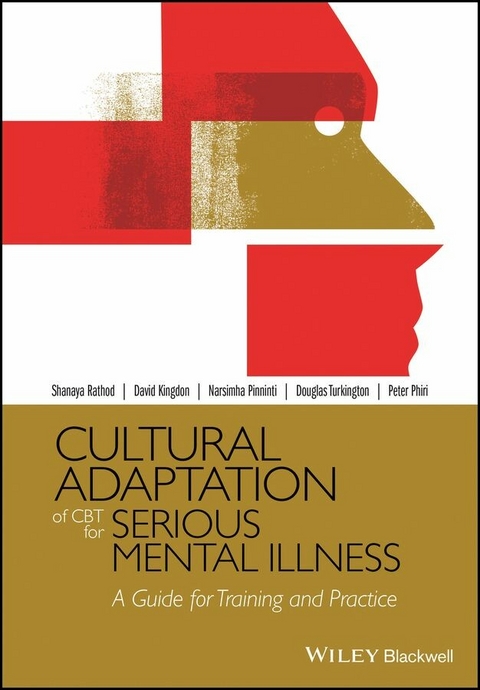
Cultural Adaptation of CBT for Serious Mental Illness (eBook)
John Wiley & Sons (Verlag)
978-1-118-97616-6 (ISBN)
- A comprehensive guide designed to enable CBT practitioners to effectively engage people from diverse cultural backgrounds by applying culturally-sensitive therapeutic techniques
- Adapts core CBT techniques including reattribution, normalization, explanation development, formulating, reality testing, inference chaining and resetting expectations
- High profile author team includes specialists in culturally-sensitive CBT along with world-renowned pioneers in the application of CBT to serious mental illness
- Contains the most up-to-date research on CBT in ethnic minority groups available
Dr Shanaya Rathod is Consultant Psychiatrist, Clinical Services Director, and Director of Research at Southern Health NHS Foundation Trust, UK. Dr Rathod has been Fellow of the National Institute for Health and Care Excellence. She has published a number of papers in peer reviewed journals, book chapters, and books, including Back to Life, Back to Normality: Cognitive Therapy, Recovery and Psychosis (2009).
David Kingdon is Professor of Mental Health Care Delivery at the University of Southampton, UK, and Honorary Consultant Adult Psychiatrist for Southern Health NHS Foundation Trust. He has previously worked as Medical Director for Nottingham Health Care Trust and Senior Medical Officer (Severe Mental Illness) in the UK Department of Health, UK. He now does policy and implementation work for NHS England and is editor of their mental health web sites.
Dr Narsimha R Pinninti is Professor of Psychiatry at the Rowan University School of Osteopathic Medicine and Chief Medical Officer for Twin Oaks Community Services in New Jersey, USA. A certified cognitive therapist and psychiatrist for the Assertive Community Treatment Team, Dr Pinninti has published over 40 articles in peer-reviewed journals and authored two manuals on how to teach CBT interventions for case managers and clients.
Douglas Turkington is Professor of Psychosocial Psychiatry at Newcastle University, UK. Professor Turkington is an expert on the efficacy and effectiveness of CBT in the treatment of schizophrenia. A fellow of the Royal College of Psychiatrists and founding fellow of the Faculty of Cognitive Therapy in Philadelphia, he has written more than 100 articles on the subject of CBT in schizophrenia.
Dr Peter Phiri, PhD, is CBT Specialist and Research & Development Manager (Interim) at Southern Health NHS Foundation Trust and Honorary Lecturer at the University of Southampton, UK. He is an accredited member of the British Association of Behavioural and Cognitive Psychotherapy.
A comprehensive guide designed to enable CBT practitioners to effectively engage people from diverse cultural backgrounds by applying culturally-sensitive therapeutic techniques Adapts core CBT techniques including reattribution, normalization, explanation development, formulating, reality testing, inference chaining and resetting expectations High profile author team includes specialists in culturally-sensitive CBT along with world-renowned pioneers in the application of CBT to serious mental illness Contains the most up-to-date research on CBT in ethnic minority groups available
Dr Shanaya Rathod is Consultant Psychiatrist, Clinical Services Director, and Director of Research at Southern Health NHS Foundation Trust, UK. Dr Rathod has been Fellow of the National Institute for Health and Care Excellence. She has published a number of papers in peer reviewed journals, book chapters, and books, including Back to Life, Back to Normality: Cognitive Therapy, Recovery and Psychosis (2009). David Kingdon is Professor of Mental Health Care Delivery at the University of Southampton, UK, and Honorary Consultant Adult Psychiatrist for Southern Health NHS Foundation Trust. He has previously worked as Medical Director for Nottingham Health Care Trust and Senior Medical Officer (Severe Mental Illness) in the UK Department of Health, UK. He now does policy and implementation work for NHS England and is editor of their mental health web sites. Dr Narsimha R Pinninti is Professor of Psychiatry at the Rowan University School of Osteopathic Medicine and Chief Medical Officer for Twin Oaks Community Services in New Jersey, USA. A certified cognitive therapist and psychiatrist for the Assertive Community Treatment Team, Dr Pinninti has published over 40 articles in peer-reviewed journals and authored two manuals on how to teach CBT interventions for case managers and clients. Douglas Turkington is Professor of Psychosocial Psychiatry at Newcastle University, UK. Professor Turkington is an expert on the efficacy and effectiveness of CBT in the treatment of schizophrenia. A fellow of the Royal College of Psychiatrists and founding fellow of the Faculty of Cognitive Therapy in Philadelphia, he has written more than 100 articles on the subject of CBT in schizophrenia. Dr Peter Phiri, PhD, is CBT Specialist and Research & Development Manager (Interim) at Southern Health NHS Foundation Trust and Honorary Lecturer at the University of Southampton, UK. He is an accredited member of the British Association of Behavioural and Cognitive Psychotherapy.
About the Authors vii
Foreword ix
Preface xi
Acknowledgements xiii
1 Introduction 1
2 Cultural Adaptation of Cognitive Behavioural Therapy: Principles and Challenges 14
3 Philosophical Orientation and Ethical and Service Considerations 46
4 The Therapeutic Relationship and Technical Adjustments 86
5 General Theoretical Modifications in Orienting Clients to Therapy 121
6 Individualized Case Formulation 135
7 Individualized Treatment Planning 165
8 Psychosis: Cultural Aspects of Presentation and Adaptations to Treatment 192
9 Depression: Cultural Aspects of Presentation and Adaptations to Treatment 227
10 Bipolar Affective Disorder: Cultural Aspects of Presentation and Adaptations to Treatment 248
11 Recovery, Relapse Prevention, and Finishing Therapy 273
12 Policy and Training Implications 293
Appendix
1 Social Factors: My Immigration Journey 306
2 Aida - Longitudinal Formulation 308
3 Setting Goals to Improve Quality of Life 310
4 Voices Diary 312
5 What Do Voices Say? 314
6 Working on Coping Strategies: Pleasant Events Schedule 315
7 Preventing a Relapse or Breakdown 317
8 Circle of Support 320
9 Relapse Prevention Plans 322
Index 326
1
Introduction
Globalization has meant that we live in a culturally rich and diverse world. Culture plays a very important role in influencing the way that people understand their psychological distress and seek help. Cultural factors influence how individuals and communities view the different interventions offered by health services. As we know, a number of culturally diverse communities find current practice of diagnosis and treatment in mental illness west-centric and not relevant to their cultural background. This can affect engagement of many individuals from minority cultural groups with services and can restrict the availability of treatment options. For this reason, practice in health services must also progress from the recognized Western traditions to incorporate the needs of culturally diverse populations.
In this chapter we introduce the concept of multiculturalism and globalization and start a dialogue about how culture influences epidemiology and outcomes in mental illness in multicultural societies. But before we do this, we define some commonly used terms that come up a lot in the following chapters as well. People use these terms which may seem straightforward in various ways like race, culture, and ethnicity. If you feel comfortable with your understanding of these, you might want to skip over them and move on but do come back if it emerges that your understanding is not quite as good as you thought or for clarification – we have had to do so at times whilst writing this book.
What Do the Terms Ethnicity, Race and Culture Mean?
A number of terms have been used, often interchangeably, when discussing culture in health and health care especially in relation to psychotherapy. These include ethnicity and race, culture, cultural sensitivity, cultural intelligence, cultural competence, and cultural adaptation. The following terms are used in different chapters of the book, and we define them here as we mean them to be understood with reference to their use elsewhere in the culture and ethnicity literature. There is undoubtedly sensitivity around discussion of these terms and individuals – academics and individuals from different cultural groups – often hold strong views about meaning and terminology. Some terms have become stigmatized and stigmatizing, used in very inappropriate ways with very negative connotations. Some terms are obviously wrong to use and others may be less so, especially to those who do not belong to the community concerned. We have tried to write in a way that avoids causing any offence to any reader but if any is incurred, it is not intended. We would be grateful if you were to let us know just as we strive with clients to ensure that the language we use with them is appropriate and non-stigmatizing.
Ethnicity and race
Defining ethnicity is complex. Fernando (1991) defines ethnicity as characterized by a sense of belonging, and determined by the identity of a group that shares common values and norms including language, religion, culture and racial background. A very similar conceptualization is provided by Tseng, Chang, and Nishjzono (2005). Ethnicity, of course, is relevant to both minority groups and majority groups in societies. Each has its own group identity affected by its prevalence in specific societies – whether in the majority or not.
Discussion of issues associated with race presents a dilemma in its own right as historical associations make them very, and appropriately, sensitive. In the context of this book, race is used in two general ways. A geographical stance is that race refers to human population groups that have inhabited a certain geographical location long enough to develop distinctive genetic compositions (Fernando, 2010). However, race can also be considered as a social construct that is created within a set of legal, economic, and sociopolitical contexts (Blank, Dabady, Citro, National Research Council (U.S.), & Panel on Methods for Assessing Discrimination, 2004).
Culture
Mason and Sawyer (2002) and Helman (1990) define culture as a value system that is transmitted through various avenues including beliefs, art, religion, mythology, language, rituals and so forth. Therefore, culture is a set of guidelines (both explicit and implicit) that individuals inherit and learn as members of a particular society. It informs how they view the world, how they experience it emotionally and how they behave towards other people: in relation to supernatural forces or Gods, and to the natural environment. Cultural beliefs are important in psychopathology and presentation of illness – signs and symptoms – and in relation to health services. They influence all aspects of health care from help-seeking behaviours and pathways into care, to engagement, choice of interventions, and termination of treatments. Race and ethnicity tend to be relatively fixed and enduring, whereas culture may be more flexible and dynamic, changing with circumstances.
Cultural sensitivity, intelligence, and competence
We refer to cultural sensitivity as the recognition of the diversity of viewpoints, attitudes, and lifestyles among different individuals. It includes the recognition that groups of people experience different types of stress in their living situations and utilize distinctive coping patterns (Tseng & Streltzer, 2006). Cultural sensitivity does not consider one’s culture or the culture of the majority ethnic group as superior in any way. The attitude is one of cultural neutrality, appreciation and understanding.
Cultural intelligence is a multidimensional construct that refers to an individual’s ability to work effectively in culturally diverse settings. It consists of four major components including cognitive, metacognitive, behavioural, and motivational cultural intelligence (Ang, Van Dyne, & Koh, 2006). Metacognitive intelligence stands for the processes through which individuals acquire knowledge and understanding of various cultures. The cognitive and behavioural components refer to the knowledge structure that one possesses about other cultures and the manifestations of culturally appropriate behaviours. Motivational cultural intelligence is the intensity and direction of the energy applied to thrive in multicultural situations. The conceptualizations of metacognitive, cognitive, and behavioural cultural intelligence closely resemble the awareness, knowledge, and skills factors in the model discussed earlier (Chao, Okazaki, & Hong, 2011).
Brown (2009) defined cultural competence as the capacity to be self-aware in regard to one’s own identities and cultural norms, sensitive to the realities of human difference, and having possession of an epistemology, that is, a philosophy of knowledge and understanding of difference. We can then allow for creative responses to the ways in which the strengths and resiliencies inherent in identities inform, transform, and are also distorted by distress and dysfunction.
Cultural adaptation
Cultural adaptation is ‘the systematic modification of an evidence-based treatment (EBT) or intervention (EBI) protocol to consider language, culture, and context in such a way that it is compatible with the client’s cultural patterns, meanings, and values’ (Bernal, Jimenez-Chafey, & Domenech Rodriguez, 2009). Cultural adaptation of an EBI would need to incorporate cultural competence, intelligence and cultural sensitivity as these would guide the adaptation process. Falicov (2009) described cultural adaptations to evidence-based interventions (EBIs) as procedures that maintain fidelity to the core elements of EBI while also adding certain cultural content to the intervention and/or its methods of engagement. We would also suggest that the success of such an adaptation should emulate, at least, the effectiveness of the original intervention.
Evidence-based practice
We have introduced the concept of evidence-based practice (EBP), so we need to describe it. The American Psychological Association Presidential Task Force on Evidence-Based Practice (2006) defined EBP as ‘the integration of the best available research with clinical expertise in the context of patient characteristics, culture and preferences.’ Empirically supported treatments (EST) and evidence-based treatments are terms used commonly in this context. However evidence derives not only from meta-analyses and randomized controlled trials (RCTs) but also from a range of methodologies including controlled and cohort studies, qualitative work, and, where little research is available, expert opinion. Evidence from a variety of sources is important in the area of culture and service delivery as RCTs may not always be possible to obtain. Even in the instances where RCTs have been done their relevance to long-term conditions with comorbidities or complex cultural and social situations may be limited. Thus, when we use the term ‘evidence-based practice,’ we believe that evidence has to weight the influence of different components and interpret the success of interventions. Client and carer choice are equally important influences, as are the practicalities of situations, for example, poverty and homelessness, that can impact on participation in interventions, and the availability of trained staff to provide them.
Globalization and Multiculturalism
Globalization can be understood as a phenomenon whereby an increased proportion of economic, educational, social, and cultural activity is carried out...
| Erscheint lt. Verlag | 4.3.2015 |
|---|---|
| Sprache | englisch |
| Themenwelt | Geisteswissenschaften ► Psychologie ► Klinische Psychologie |
| Medizin / Pharmazie ► Gesundheitsfachberufe | |
| Medizin / Pharmazie ► Medizinische Fachgebiete ► Psychiatrie / Psychotherapie | |
| Schlagworte | Clinical psychology • Cognitive behavioral therapy (CBT) • Diversity, Culture & Ethnicity • Klinische Psychologie • Kognitive Verhaltenstherapie • Kulturelle u. ethnische Vielfalt • Psychische Krankheit • Psychologie • Psychology • Psychology, therapy, ethnic minorities, diversity, psychiatry, psychosis, clinical psychology, social work, CBT • Psychotherapie • Psychotherapie u. Beratung • Psychotherapy & Counseling |
| ISBN-10 | 1-118-97616-9 / 1118976169 |
| ISBN-13 | 978-1-118-97616-6 / 9781118976166 |
| Informationen gemäß Produktsicherheitsverordnung (GPSR) | |
| Haben Sie eine Frage zum Produkt? |
 EPUB (Adobe DRM)
Kopierschutz: Adobe-DRM
Adobe-DRM ist ein Kopierschutz, der das eBook vor Mißbrauch schützen soll. Dabei wird das eBook bereits beim Download auf Ihre persönliche Adobe-ID autorisiert. Lesen können Sie das eBook dann nur auf den Geräten, welche ebenfalls auf Ihre Adobe-ID registriert sind.
Details zum Adobe-DRM
Dateiformat: EPUB (Electronic Publication)
EPUB ist ein offener Standard für eBooks und eignet sich besonders zur Darstellung von Belletristik und Sachbüchern. Der Fließtext wird dynamisch an die Display- und Schriftgröße angepasst. Auch für mobile Lesegeräte ist EPUB daher gut geeignet.
Systemvoraussetzungen:
PC/Mac: Mit einem PC oder Mac können Sie dieses eBook lesen. Sie benötigen eine
eReader: Dieses eBook kann mit (fast) allen eBook-Readern gelesen werden. Mit dem amazon-Kindle ist es aber nicht kompatibel.
Smartphone/Tablet: Egal ob Apple oder Android, dieses eBook können Sie lesen. Sie benötigen eine
Geräteliste und zusätzliche Hinweise
Buying eBooks from abroad
For tax law reasons we can sell eBooks just within Germany and Switzerland. Regrettably we cannot fulfill eBook-orders from other countries.
aus dem Bereich