Biomaterials for Artificial Organs (eBook)
320 Seiten
Elsevier Science (Verlag)
978-0-85709-084-3 (ISBN)
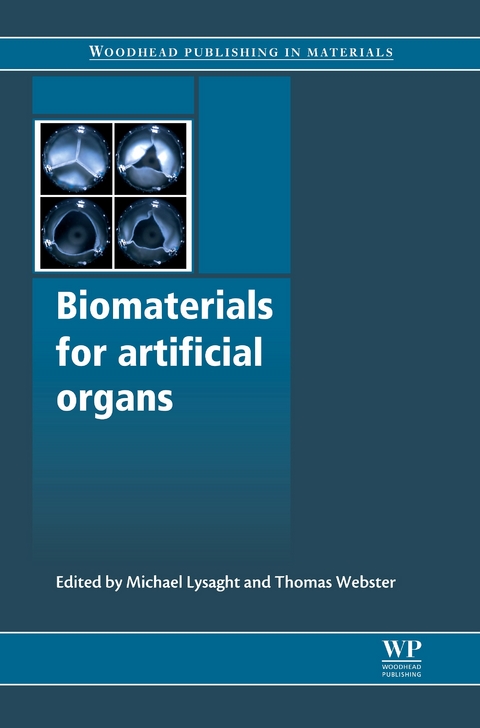
The worldwide demand for organ transplants far exceeds available donor organs. Consequently some patients die whilst waiting for a transplant. Synthetic alternatives are therefore imperative to improve the quality of, and in some cases, save people's lives. Advances in biomaterials have generated a range of materials and devices for use either outside the body or through implantation to replace or assist functions which may have been lost through disease or injury. Biomaterials for artificial organs reviews the latest developments in biomaterials and investigates how they can be used to improve the quality and efficiency of artificial organs.Part one discusses commodity biomaterials including membranes for oxygenators and plasmafilters, titanium and cobalt chromium alloys for hips and knees, polymeric joint-bearing surfaces for total joint replacements, biomaterials for pacemakers, defibrillators and neurostimulators and mechanical and bioprosthetic heart valves. Part two goes on to investigate advanced and next generation biomaterials including small intestinal submucosa and other decullarized matrix biomaterials for tissue repair, new ceramics and composites for joint replacement surgery, biomaterials for improving the blood and tissue compatibility of total artificial hearts (TAH) and ventricular assist devices (VAD), nanostructured biomaterials for artificial tissues and organs and matrices for tissue engineering and regenerative medicine.With its distinguished editors and international team of contributors Biomaterials for artificial organs is an invaluable resource to researchers, scientists and academics concerned with the advancement of artificial organs. - Reviews the latest developments in biomaterials and investigates how they can be used to improve the quality and efficiency of artificial organs- Discusses commodity biomaterials including membranes for oxygenators and cobalt chromium alloys for hips and knees and polymeric joint-bearing surfaces for total joint replacements- Further biomaterials utilised in pacemakers, defibrillators, neurostimulators and mechanical and bioprosthetic heart valve are also explored
| Erscheint lt. Verlag | 20.12.2010 |
|---|---|
| Sprache | englisch |
| Themenwelt | Medizin / Pharmazie ► Pflege |
| Medizin / Pharmazie ► Physiotherapie / Ergotherapie ► Orthopädie | |
| Technik ► Maschinenbau | |
| Technik ► Medizintechnik | |
| Technik ► Umwelttechnik / Biotechnologie | |
| ISBN-10 | 0-85709-084-4 / 0857090844 |
| ISBN-13 | 978-0-85709-084-3 / 9780857090843 |
| Informationen gemäß Produktsicherheitsverordnung (GPSR) | |
| Haben Sie eine Frage zum Produkt? |
 EPUB (Adobe DRM)
Kopierschutz: Adobe-DRM
Adobe-DRM ist ein Kopierschutz, der das eBook vor Mißbrauch schützen soll. Dabei wird das eBook bereits beim Download auf Ihre persönliche Adobe-ID autorisiert. Lesen können Sie das eBook dann nur auf den Geräten, welche ebenfalls auf Ihre Adobe-ID registriert sind.
Details zum Adobe-DRM
Dateiformat: EPUB (Electronic Publication)
EPUB ist ein offener Standard für eBooks und eignet sich besonders zur Darstellung von Belletristik und Sachbüchern. Der Fließtext wird dynamisch an die Display- und Schriftgröße angepasst. Auch für mobile Lesegeräte ist EPUB daher gut geeignet.
Systemvoraussetzungen:
PC/Mac: Mit einem PC oder Mac können Sie dieses eBook lesen. Sie benötigen eine
eReader: Dieses eBook kann mit (fast) allen eBook-Readern gelesen werden. Mit dem amazon-Kindle ist es aber nicht kompatibel.
Smartphone/Tablet: Egal ob Apple oder Android, dieses eBook können Sie lesen. Sie benötigen eine
Geräteliste und zusätzliche Hinweise
Buying eBooks from abroad
For tax law reasons we can sell eBooks just within Germany and Switzerland. Regrettably we cannot fulfill eBook-orders from other countries.
aus dem Bereich