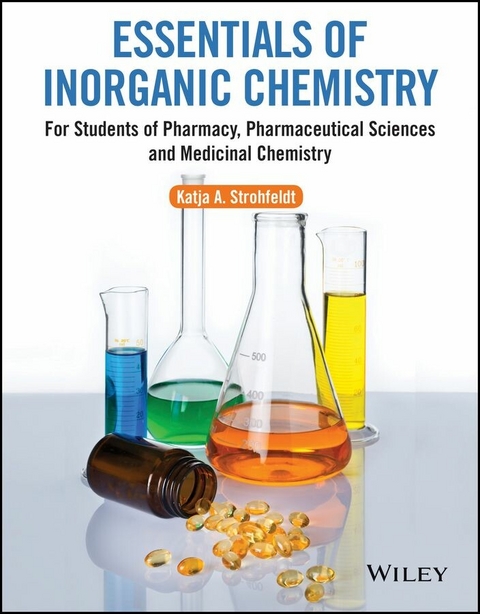
Essentials of Inorganic Chemistry (eBook)
John Wiley & Sons (Verlag)
978-1-118-69535-7 (ISBN)
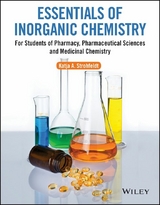
Katja A. Strohfeldt School of Pharmacy, University of Reading, UK
Preface
About the companion website
1 Introduction
1.1 Medicinal Inorganic Chemistry 3
1.2 Basic Inorganic Principles 6
1.3 Exercise 26
1.4 References and further reading 28
2 Alkali Metals
2.1 Alkali metal ions 3
2.2 Advantages and disadvantages using lithium-based drugs 20
2.3 Sodium: An essential ion in the human body 31
2.4 Potassium and its clinical application 43
2.5 Exercises 50
2.6 Case studies 52
2.7 References and further reading 54
3 Earth Alkaline Metals
3.1 Earth alkaline metal ions 3
3.2 Beryllium and chronic beryllium disease 9
3.3 Magnesium: Competition to Lithium? 10
3.4 Calcium: The key to many human functions 14
3.5 Barium 26
3.6 Exercises 27
3.7 Case studies 28
3.8 References and further reading 30
4 The Boron Group - Group 13
4.1 General Chemistry of Group 13 elements 4
4.2 Boron 10
4.3 Aluminium 13
4.4 Gallium 24
4.5 Exercises 27
4.6 Case studies 29
4.7 References and further reading 31
5 The Carbon Group
5.1 General Chemistry of Group 14 elements 3
5.2 Silicon-based drugs versus carbon-based analogues 8
5.3 Organogermanium compounds: Balancing act between an anti-cancer drug and an herbal supplement 19
5.4 Exercises 24
5.5 Cases studies 25
5.6 References and further reading 26
6 Group 15 Elements
6.1 Chemistry of Group 15 elements 4
6.2 Phosphorus 9
6.3 Arsenic 20
6.4 Exercise 30
6.5 Case studies 31
6.6 References and further reading 33
7 Transition Metals and d-Block metal chemistry
7.1 What are d-Block metals? 3
7.2 Group 10: Platinum anti-cancer agents 17
7.3 Iron and Ruthenium 41
7.4 The Coinage Metals 61
7.5 Group 12 elements: Zinc and its role in biological systems 78
7.6 Exercises 90
7.7 Case studies 92
7.8 References and further reading 96
8 Organometallic Chemistry
8.1 What is organometallic Chemistry? 2
8.2 What are Metallocenes? 6
8.3 Ferrocene 9
8.4 Titanocenes 21
8.5 Vanadocenes 32
8.6 Exercise 41
8.7 Case study - Titanium dioxide 42
References and further reading 43
9 The clinical use of lanthanoids
9.1 Biology and toxicology of lanthanoids 3
9.2 The clinical use of lanthanum carbonate 5
9.3 The clinical application of cerium salts 8
9.4 The use of gadolinium salts as MRI contrast agent 10
9.5 Exercises 14
9.6 Case study: Lanthanum carbonate tablets 15
9.7 References and further reading 16
10 Radioactive compounds and their clinical application
10.1 What is radioactivity? 2
10.2 Radiopharmacy: Dispensing and protection 18
10.3 Therapeutic use of radiopharmaceuticals 20
10.4 Radiopharmaceuticals for imaging 27
10.5 Exercises 41
10.6 Case studies 42
10.7 References and further reading 44
11 Chelation therapy
11.1 What is heavy metal poisoning? 1
11.2 What is chelation? 4
11.3 Chelation therapy 5
11.4 Exercises 11
11.5 Case studies 12
11.6 References and further reading 15
Index
"It would be a useful adjunct to more general chemistry texts for students in first and second years of study in pharmacy, pharmaceutical sciences, and medicinal chemistry, providing a framework to structure the more detailed but less contextualised information on inorganic pharmaceuticals they will doubtless be looking up on the internet." (Chemistry in Australia, 1 October 2015)
Chapter 1
Introduction
Many metal ions play a vital role in living organisms. Metal ions are also involved in a variety of processes within the human body, such as the oxygen transport or the formation of the framework for our bones. Haemoglobin is an iron-containing metalloprotein which carries oxygen from the lungs to the various tissues around the human body. Calcium (Ca) ions are a vital component of our bones. Elements such as copper (Cu), zinc (Zn) and manganese (Mn) are essential for a variety of catalytic processes (Figure 1.1).
Figure 1.1 Periodic table of elements showing metals (grey), semimetals (light grey) and nonmetals (white). Elements believed to be essential for bacteria, plants and animals are highlighted [1]
(Reproduced with permission from [1]. Copyright © 2013, Royal Society of Chemistry.)
Nevertheless, metals are very often perceived as toxic elements. Very often, the toxicity of a metal in a biological environment depends on the concentration present in the living organism. Some metal ions are essential for life, but concentrations too high can be highly toxic whilst too low concentrations can lead to deficiency resulting in disturbed biological processes [2]. The so-called Bertrand diagram visualises the relationship between the physiological response and the metal concentration. There are concentration ranges that allow the optimum physiological response, whilst concentrations above and below this range are detrimental to life. The form of this diagram can vary widely depending on the metal, and there are metals with no optimum concentration range [3]. Nevertheless, living organisms, including the human body, have also found very sophisticated solutions to mask the toxicity of those metals (Figure 1.2).
Figure 1.2 Bertrand diagram showing the relationship between the physiological response and metal concentration [4]
(Reproduced with permission from [4]. Copyright © 1994, John Wiley & Sons, Ltd.)
Researchers have questioned whether metal ions can and should be introduced into the human body artificially and, if so, what the consequences are. Indeed, the use of metals and metal complexes for clinical applications gives access to a wide range of new treatment options.
1.1 Medicinal inorganic chemistry
Medicinal inorganic chemistry can be broadly defined as the area of research concerned with metal ions and metal complexes and their clinical applications. Medicinal inorganic chemistry is a relatively new research area grown from the discovery of the anticancer agent cisplatin. Indeed, the therapeutic value of metal ions has been known for hundreds and thousands of years. Metals such as arsenic have been used in clinical studies more than 100 years ago, whilst silver, gold and iron have been involved in ‘magic cures’ and other therapeutic applications for more than 5000 years.
Nowadays, the area of metal-based drugs spans a wide range of clinical applications including the use of transition metals as anticancer agents, a variety of diagnostic agents such as gadolinium or technetium, lanthanum salts for the treatment of high phosphate levels and the use of gold compounds in the treatment of rheumatoid arthritis. In general, research areas include the development of metal-based therapeutic agents, the interaction of metals and proteins, metal chelation and general functions of metals in living systems [5].
1.1.1 Why use metal-based drugs?
Metal complexes exhibit unique properties, which, on one hand, allow metal ions to interact with biomolecules in a unique way and, on the other, allow scientists to safely administer even toxic metal ions to the human body. Coordination and redox behaviour, magnetic moments and radioactivity are the main unique properties displayed by metal centres together with the high aqueous solubility of their cations. The ability to be involved in reduction and oxidation reactions has led to the use of metal complexes in photodynamic therapy (PDT). In particular, transition metals are able to coordinate to electron-rich biomolecules such as DNA. This can lead to the deformation of DNA and ultimately to cell death. Therefore, transition metals are under scrutiny as potential anticancer agents. Metals that display a magnetic moment can be used as imaging reagents in magnetic resonance imaging (MRI). Many metals have radioactive isotopes, which can be used as so-called radiopharmaceuticals for therapy and imaging.
There is a huge array of clinical applications for most elements found in the periodic table of elements. This book tries to give an idea of the core concepts and elements routinely used for therapy or imaging.
1.2 Basic inorganic principles
It is important to understand the basic inorganic principles in order to evaluate the full potential of inorganic compounds in clinical applications. In the following sections, aspects such as atomic structures, chemical bonds and the set-up of the periodic table will be discussed.
1.2.1 Electronic structures of atoms
1.2.1.1 What is an atom
An atom is defined as the smallest unit that retains the properties of an element. The most famous definition has been published by Dalton in his Atomic Theory [6]:
All matter is composed of atoms and these cannot be made or destroyed. All atoms of the same element are identical and different elements have different types of atoms. Chemical reactions occur when atoms are rearranged [7].
After Dalton's time, research showed that atoms actually can be broken into smaller particles, and with the help of nuclear processes it is even possible to transform atoms. Nevertheless, these processes are not necessarily considered as chemical processes. Probably, a better definition is that atoms are units that cannot be created, destroyed or transformed into other atoms in a chemical reaction [8].
Atoms consist of three fundamental types of particles: protons, electrons and neutrons. Neutrons and protons have approximately the same mass and, in contrast to this, the mass of an electron is negligible. A proton carries a positive charge, a neutron has no charge and an electron is negatively charged. An atom contains equal numbers of protons and electrons and therefore, overall, an atom has no charge. The nucleus of an atom contains protons and neutrons only, and therefore is positively charged. The electrons occupy the region of space around the nucleus. Therefore, most of the mass is concentrated within the nucleus.
Figure 1.3 shows the typical shorthand writing method for elements, which can also be found in most periodic tables of elements. Z (atomic number) represents the number of protons and also electrons, as an element has no charge. The letter A stands for the mass number, which represents the number of protons and neutrons in the nucleus. The number of neutrons can be determined by calculating the difference between the mass number (A) and the atomic number (Z).
Figure 1.3 Shorthand writing of element symbol
Within an element, the atomic number (Z), that is, the number of protons and electrons, is always the same, but the number of neutrons and therefore the mass number (A) can vary. These possible versions of an element are called isotopes. Further discussion on radioisotopes and radioactivity can be found in Chapter 10.
Atoms of the same element can have different numbers of neutrons; the different possible versions of each element are called isotopes. The numbers of protons and electrons are the same for each isotope, as they define the element and its chemical behaviour.
For example, the most common isotope of hydrogen called protium has no neutrons at all. There are two other hydrogen isotopes: deuterium, with one neutron, and tritium, with two neutrons (Figure 1.4).
Figure 1.4 Isotopes of hydrogen
1.2.1.2 Bohr model of atoms
In 1913, Niels Bohr published his atomic model stating that electrons can only circle the nucleus on fixed orbits in which the electron has a fixed angular momentum. Each of these orbits has a certain radius (i.e. distance from the nucleus), which is proportional to its energy. Electrons therefore can only change between the fixed energy levels (quantisation of energy), which can be seen as light emission. These fixed energy levels are defined as the principal quantum number n, which is the only quantum number introduced by the Bohr model of the atom. Note that, as the value of n increases, the electron is further away from the nucleus. The further away the electron is from the nucleus, the less tightly bound the electron is to the nucleus (Figure 1.5).
Figure 1.5 Bohr model of the atom
1.2.1.3 Wave mechanics
In 1924, Louis de Brogli argued that all moving particles, especially electrons, show a certain degree of wave-like behaviour. Therefore, he proposed the idea of wave-like nature of electrons, which became known as the phenomenon of the wave–particle duality [9].
Schrödinger published in 1926 the famous wave equation named after him. Electrons are described as wave functions rather than defined particles. Using this approach, it was possible to explain the unanswered questions from Bohr's model of the atom. Nevertheless, if an electron has...
| Erscheint lt. Verlag | 30.1.2015 |
|---|---|
| Sprache | englisch |
| Themenwelt | Medizin / Pharmazie ► Gesundheitsfachberufe |
| Medizin / Pharmazie ► Medizinische Fachgebiete ► Pharmakologie / Pharmakotherapie | |
| Naturwissenschaften ► Chemie ► Anorganische Chemie | |
| Technik | |
| Schlagworte | Anorganische Chemie • Chemie • Chemistry • Essentials of Inorganic Chemistry, Katja Strohfeldt-Venables, inorganic chemistry, organometallic chemistry, radiochemistry, pharmaceutical, pharmacological properties, metal-based drugs, pharmaceutical sciences, medicinal chemistry • Inorganic Chemistry • Medical Science • Medizin • Pharmaceutical & Medicinal Chemistry • Pharmacology & Pharmaceutical Medicine • Pharmakologie u. Pharmazeutische Medizin • Pharmazeutische u. Medizinische Chemie |
| ISBN-10 | 1-118-69535-6 / 1118695356 |
| ISBN-13 | 978-1-118-69535-7 / 9781118695357 |
| Informationen gemäß Produktsicherheitsverordnung (GPSR) | |
| Haben Sie eine Frage zum Produkt? |
 EPUB (Adobe DRM)
Kopierschutz: Adobe-DRM
Adobe-DRM ist ein Kopierschutz, der das eBook vor Mißbrauch schützen soll. Dabei wird das eBook bereits beim Download auf Ihre persönliche Adobe-ID autorisiert. Lesen können Sie das eBook dann nur auf den Geräten, welche ebenfalls auf Ihre Adobe-ID registriert sind.
Details zum Adobe-DRM
Dateiformat: EPUB (Electronic Publication)
EPUB ist ein offener Standard für eBooks und eignet sich besonders zur Darstellung von Belletristik und Sachbüchern. Der Fließtext wird dynamisch an die Display- und Schriftgröße angepasst. Auch für mobile Lesegeräte ist EPUB daher gut geeignet.
Systemvoraussetzungen:
PC/Mac: Mit einem PC oder Mac können Sie dieses eBook lesen. Sie benötigen eine
eReader: Dieses eBook kann mit (fast) allen eBook-Readern gelesen werden. Mit dem amazon-Kindle ist es aber nicht kompatibel.
Smartphone/Tablet: Egal ob Apple oder Android, dieses eBook können Sie lesen. Sie benötigen eine
Geräteliste und zusätzliche Hinweise
Buying eBooks from abroad
For tax law reasons we can sell eBooks just within Germany and Switzerland. Regrettably we cannot fulfill eBook-orders from other countries.
aus dem Bereich