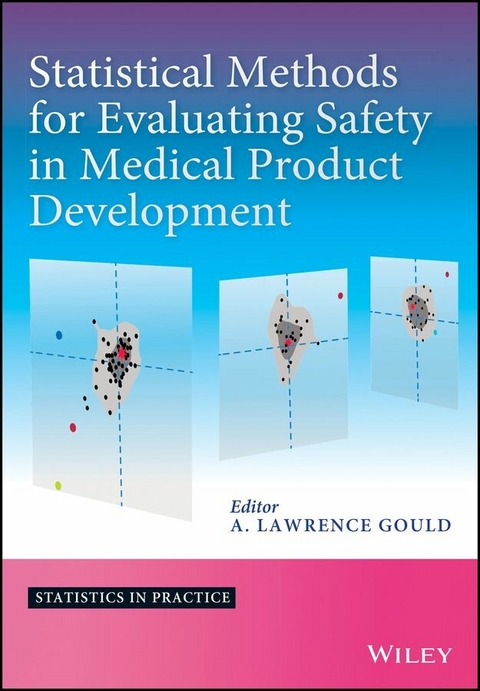
Statistical Methods for Evaluating Safety in Medical Product Development (eBook)
John Wiley & Sons (Verlag)
978-1-118-76310-0 (ISBN)
This book gives professionals in clinical research valuable information on the challenging issues of the design, execution, and management of clinical trials, and how to resolve these issues effectively. It also provides understanding and practical guidance on the application of contemporary statistical methods to contemporary issues in safety evaluation during medical product development. Each chapter provides sufficient detail to the reader to undertake the design and analysis of experiments at various stages of product development, including comprehensive references to the relevant literature.
- Provides a guide to statistical methods and application in medical product development
- Assists readers in undertaking design and analysis of experiments at various stages of product development
- Features case studies throughout the book, as well as, SAS and R code
This book gives professionals in clinical research valuable information on the challenging issues of the design, execution, and management of clinical trials, and how to resolve these issues effectively. It also provides understanding and practical guidance on the application of contemporary statistical methods to contemporary issues in safety evaluation during medical product development. Each chapter provides sufficient detail to the reader to undertake the design and analysis of experiments at various stages of product development, including comprehensive references to the relevant literature. Provides a guide to statistical methods and application in medical product development Assists readers in undertaking design and analysis of experiments at various stages of product development Features case studies throughout the book, as well as, SAS and R code
A. Lawrence Gould, Senior Director, Scientific Staff, Merck Research Laboratories, USA.
Preface xiii
List of Contributors xv
1 Introduction 1
A. Lawrence Gould
1.1 Introduction 1
1.2 Background and context 2
1.3 A fundamental principle for understanding safety evaluation 3
1.4 Stages of safety evaluation in drug development 4
1.5 National medical product safety monitoring strategy 5
1.6 Adverse events vs adverse drug reactions, and an overall view of safety evaluation 5
1.7 A brief historical perspective on safety evaluation 7
1.8 International conference on harmonization 8
1.9 ICH guidelines 9
References 11
2 Safety graphics 22
A. Lawrence Gould
2.1 Introduction 22
2.1.1 Example and general objectives 22
2.1.2 What is the graphic trying to say? 25
2.2 Principles and guidance for constructing effective graphics 26
2.2.1 General principles 26
2.3 Graphical displays for addressing specific issues 26
2.3.1 Frequency of adverse event reports or occurrences 26
2.3.2 Timing of adverse event reports or occurrences 33
2.3.3 Temporal variation of vital sign and laboratory measurements 36
2.3.4 Temporal variation of combinations of vital sign and laboratory measurements 39
2.3.5 Functional/multidimensional data 44
2.3.6 Multivariate outlier detection with multiplicity adjustment based on robust estimates of mean and covariance matrix 48
2.3.7 Monitoring individual patient trends 53
2.4 Discussion 53
References 60
3 QSAR modeling: prediction of biological activity from chemical structure 66
Andy Liaw and Vladimir Svetnik
3.1 Introduction 66
3.2 Data 67
3.2.1 Chemical descriptors 67
3.2.2 Activity data 68
3.3 Model building 69
3.3.1 Random forests 69
3.3.2 Stochastic gradient boosting 70
3.4 Model validation and interpretation 71
3.5 Data example 74
3.6 Discussion 76
References 81
4 Ethical and practical issues in phase 1 trials in healthy volunteers 84
Stephen Senn
4.1 Introduction 84
4.2 Ethical basics 85
4.3 Inferential matters 86
4.3.1 Analysis of serious side-effects 87
4.3.2 Timing of events 87
4.4 Design for subject safety 88
4.4.1 Dosing interval 88
4.4.2 Contemporary dosing 88
4.5 Analysis 89
4.5.1 Objectives of first-in-man trials 89
4.5.2 (In)adequacy of statistical analysis plans 89
4.5.3 'Formal' statistical analyses 90
4.6 Design for analysis 90
4.6.1 Treatment assignments and the role of placebo 90
4.6.2 Dose-escalation trial design issues 91
4.6.3 Precision at interim stages 93
4.7 Some final thoughts 94
4.7.1 Sharing information 94
4.8 Conclusions 96
4.9 Further reading 96
References 97
5 Phase 1 trials 99
A. Lawrence Gould
5.1 Introduction 99
5.2 Dose determined by toxicity 101
5.2.1 Algorithmic (rule-based) approaches 101
5.3 Model-based approaches 104
5.3.1 Basic CRM design 104
5.3.2 Adaptive refinement of dosage list 105
5.3.3 Hybrid designs 106
5.3.4 Comparisons with rule-based designs 107
5.4 Model-based designs with more than one treatment (or non-monotonic toxicity) 108
5.5 Designs considering toxicity and efficacy 110
5.5.1 Binary efficacy and toxicity considered jointly 110
5.5.2 Use of surrogate efficacy outcomes 112
5.5.3 Reduction of efficacy and toxicity outcomes to ordered categories 112
5.5.4 Binary toxicity and continuous efficacy 113
5.5.5 Time to occurrence of binary toxicity and efficacy endpoints 114
5.5.6 Determining dosage and treatment schedule 115
5.6 Combinations of active agents 117
5.7 Software 117
5.8 Discussion 117
References 118
6 Summarizing adverse event risk 122
A. Lawrence Gould
6.1 Introduction 122
6.2 Summarization of key features of adverse event occurrence 123
6.3 Confidence/credible intervals for risk differences and ratios 126
6.3.1 Metrics 126
6.3.2 Coverage and interpretation 126
6.3.3 Binomial model 127
6.3.4 Poisson model 140
6.3.5 Computational results 142
6.4 Screening for adverse events 142
6.4.1 Outline of approach 146
6.4.2 Distributional model 146
6.4.3 Specification of priors 148
6.4.4 Example 149
6.5 Discussion 151
References 177
7 Statistical analysis of recurrent adverse events 180
Liqun Diao, Richard J. Cook and Ker-Ai Lee
7.1 Introduction 180
7.2 Recurrent adverse event analysis 181
7.2.1 Statistical methods for a single sample 181
7.2.2 Recurrent event analysis and death 183
7.2.3 Summary statistics for recurrent adverse events 184
7.3 Comparisons of adverse event rates 185
7.4 Remarks on computing and an application 186
7.4.1 Computing and software 186
7.4.2 Illustration: Analyses of bleeding in a transfusion trial 188
7.5 Discussion 190
References 191
8 Cardiovascular toxicity, especially QT/QTc prolongation 193
Arne Ring and Robert Schall
8.1 Introduction 193
8.1.1 The QT interval as a biomarker of cardiovascular risk 193
8.1.2 Association of the QT interval with the heart rate 194
8.2 Implementation in preclinical and clinical drug development 194
8.2.1 Evaluations from sponsor perspective 194
8.2.2 Regulatory considerations on TQT trials 196
8.3 Design considerations for "Thorough QT trials" 198
8.3.1 Selection of therapeutic and supra-therapeutic exposure 198
8.3.2 Single-versus multiple-dose studies; co-administration of interacting drugs 199
8.3.3 Baseline measurements 199
8.3.4 Parallel versus cross-over design 200
8.3.5 Timing of ECG measurements 200
8.3.6 Sample size 200
8.3.7 Complex situations 200
8.3.8 TQT trials in patients 201
8.4 Statistical analysis: thorough QT/QTc study 201
8.4.1 Data 201
8.4.2 Heart rate correction 203
8.4.3 A general framework for the assessment of QT prolongation 208
8.4.4 Statistical inference: Proof of "Lack of QT prolongation" 211
8.4.5 Mixed models for data from TQT studies 212
8.5 Examples of ECG trial designs and analyses from the literature 215
8.5.1 Parallel trial: Nalmefene 215
8.5.2 Cross-over trial: Linagliptin 216
8.5.3 Cross-over with minor QTc effect: Sitagliptin 217
8.5.4 TQT study with heart rate changes but without QTc effect: Darifenacin 218
8.5.5 Trial with both changes in HR and QT(c): Tolterodine 218
8.5.6 Boosting the exposure with pharmacokinetic interactions: Domperidone 219
8.5.7 Double placebo TQT cross-over design 220
8.6 Other issues in cardiovascular safety 220
8.6.1 Rosiglitazone 221
8.6.2 Requirements of the FDA guidance 221
8.6.3 Impact on the development of antidiabetic drugs 223
8.6.4 General impact on biomarker validation 224
References 224
9 Hepatotoxicity 229
Donald C. Trost
9.1 Introduction 229
9.2 Liver biology and chemistry 230
9.2.1 Liver function 230
9.2.2 Liver pathology 232
9.2.3 Clinical laboratory tests for liver status 235
9.2.4 Other clinical manifestations of liver abnormalities 240
9.3 Drug-induced liver injury 240
9.3.1 Literature review 240
9.3.2 Liver toxicology 241
9.3.3 Clinical trial design 243
9.4 Classical statistical approaches to the detection of hepatic toxicity 245
9.4.1 Statistical distributions of analytes 245
9.4.2 Reference limits 245
9.4.3 Hy's rule and other empirical methods 252
9.5 Stochastic process models for liver homeostasis 253
9.5.1 The Ornstein-Uhlenbeck process model 253
9.5.2 OU data analysis 258
9.5.3 OU model applied to reference limits 263
9.6 Summary 265
References 266
10 Neurotoxicity 271
A. Lawrence Gould
10.1 Introduction 271
10.2 Multivariate longitudinal observations 272
10.3 Electroencephalograms (EEGs) 275
10.3.1 Special considerations 275
10.3.2 Mixed effect models 279
10.3.3 Spatial smoothing by incorporating spatial relationships of channels 281
10.3.4 Explicit adjustment for muscle-induced (non-EEG) artifacts 282
10.3.5 Potential extensions 285
10.4 Discussion 285
References 289
11 Safety monitoring 293
Jay Herson
11.1 Introduction 293
11.2 Planning for safety monitoring 294
11.3 Safety monitoring-sponsor view (masked, treatment groups pooled) 297
11.3.1 Frequentist methods for masked or pooled analysis 297
11.3.2 Likelihood methods for masked or pooled analysis 298
11.3.3 Bayesian methods for masked or pooled analysis 299
11.4 Safety monitoring-DMC view (partially or completely unmasked) 301
11.4.1 DMC data review operations 301
11.4.2 Types of safety data routinely reviewed 301
11.4.3 Assay sensitivity 302
11.4.4 Comparing safety between treatments 304
11.5 Future challenges in safety monitoring 312
11.5.1 Adaptive designs 312
11.5.2 Changes in the setting of clinical trials 313
11.5.3 New technologies 313
11.6 Conclusions 313
References 314
12 Sequential testing for safety evaluation 319
Jie Chen
12.1 Introduction 319
12.2 Sequential probability ratio test (SPRT) 320
12.2.1 Wald SPRT basics 320
12.2.2 SPRT for a single-parameter exponential family 321
12.2.3 A clinical trial example 322
12.2.4 Application to monitoring occurrence of adverse events 323
12.3 Sequential generalized likelihood ratio tests 325
12.3.1 Sequential GLR tests and stopping boundaries 325
12.3.2 Extension of sequential GLR tests to multiparameter exponential families 327
12.3.3 Implementation of sequential GLR tests 327
12.3.4 Example from Section 12.2.3, continued 328
12.4 Concluding remarks 330
References 331
13 Evaluation of post-marketing safety using spontaneous reporting databases 332
Ismaïl Ahmed, Bernard Bégaud and Pascale Tubert-Bitter
13.1 Introduction 332
13.2 Data structure 333
13.3 Disproportionality methods 334
13.3.1 Frequentist methods 334
13.3.2 Bayesian methods 335
13.4 Issues and biases 337
13.4.1 Notoriety bias 337
13.4.2 Dilution bias 338
13.4.3 Competition bias 338
13.5 Method comparisons 339
13.6 Further refinements 339
13.6.1 Recent improvements on the detection rule 339
13.6.2 Bayesian screening approach 340
13.6.3 Confounding and interactions 341
13.6.4 Comparison of two signals 341
13.6.5 An alternative approach 341
References 342
14 Pharmacovigilance using observational/longitudinal databases and web-based information 345
A. Lawrence Gould
14.1 Introduction 345
14.2 Methods based on observational databases 347
14.2.1 Disproportionality analysis with redefinition of report frequency table entries 347
14.2.2 LGPS and LEOPARD 350
14.2.3 Self-controlled case series (SCCS) 350
14.2.4 Case-control approach 351
14.2.5 Self-controlled cohort 352
14.2.6 Temporal pattern discovery 353
14.2.7 Unexpected temporal association rules 354
14.2.8 Time to onset for vaccine safety 355
14.3 Web-based pharmacovigilance (infodemiology and infoveillance) 356
14.4 Discussion 357
References 358
Index 361
Chapter 1
Introduction
A. Lawrence Gould
Merck Research Laboratories, 770 Sumneytown Pike, West Point, PA 19486, USA
1.1 Introduction
Many stakeholders have an interest in how pharmaceutical products are developed. These include the medical profession, regulators, legislators, the pharmaceutical industry, and, of course, the public who ultimately will use the products. The expectations of these stakeholders have become more demanding over time, especially with regard to product safety. The public perception of the safety of pharmaceutical products often is driven by publicity about the occurrence of adverse events among patients using the products that has on occasion led to withdrawal of the products from the market [1]. This circumstance usually pertains to products that have reached the marketplace and have had sufficient exposure among patients for rare and potentially serious harmful events to occur frequently enough to cause concern. However, the development of products can be suspended or terminated before they ever reach the market because of toxicities discovered during development [2–6]. These situations may or may not be made the object of intense public scrutiny, but they are important because failed products can have consumed possibly considerable resources that might have been allocated more productively to the development of products more likely to succeed by virtue of being less toxic or more beneficial.
Any biologically active pharmaceutical product potentially can harm as well as benefit its users. This can happen because a drug or biological agent has multiple mechanisms of action besides those involved in the therapeutic target, or idiosyncratically, possibly because of an immune response. It also can happen because of how the body reacts to non-pharmaceutical products, especially indwelling medical devices such as cardiovascular stents or artificial joints. Understanding how these potential harms can manifest themselves and at what stages of product development the potential for harm can be identified is critical to the development of products that provide real benefits to patients. Many potential products that enter development fail because of unanticipated safety issues. Some of these occur early in development, but some occur very late in development. It is important to be able to predict the likelihood of harm from potential products as early as possible in the development process, and certainly before they reach the marketplace and present unnecessary risks to large numbers of patients.
1.2 Background and context
The safety of drugs, vaccines, and medical devices has become the Pole Star of product development. Discovery and development of drugs and other pharmaceutical products takes a long time, costs a lot of money, and has a low probability of success [7]. Failures can occur often during the development process, especially for novel drugs [2, 3]. Product withdrawals also can occur after products have been approved for marketing although, adverse publicity notwithstanding, these are relatively rare. Of the 740 new molecular entities (NMEs) approved by the Food and Drug Administration (FDA) in the USA between 1980 and 2009, 118 were withdrawn from the market. Most of these withdrawals were for reasons other than safety. Only 26 NMEs (3.5% of the approvals during this period) were withdrawn for safety reasons [8].
Safety issues arising consequent to chronic treatment do not always appear evident during drug development, either by preclinical assays or in the clinical phase of development. At least for cardiovascular events there is a need for understanding of fundamental mechanisms of cardiovascular liability that provide a way to detect potential toxicities during development [9]. The possibility of using biomarkers as leading indicators of potential safety issues has become a subject of discussion in the recent literature [10, 11]. There also has emerged in recent years an increasing interest in the application of methods for preclinical safety pharmacology and computational toxicology [12–16].
There is an increasing appreciation and availability of sophisticated means for making measurements early in the drug development process to identify potential safety issues that may emerge later on. There also is a need for means to provide more realistic assessments of risks of adverse events than are provided by clinical trials that do not, ordinarily cannot, include patients across the spectrum of potential susceptibility to adverse events [17–19].
Advances in the sophistication of measurement and interpretation of data make it appropriate to consider how recent developments in statistical methods for modeling, design, and analysis can contribute to progress in drug development, especially with regard to evaluating safety. Many books, and many more articles, describe conventional strategies for evaluating the safety of pharmaceutical products at various stages of development. Balakrishnan et al. [20] provide an exhaustive collection (86 chapters) of statistical methods but without a focus on safety. Chow and Liu [21] focus on the design of clinical trials, but do not address safety in depth or describe the implementation of novel methods for dealing with new types of complex data. Everitt and Palmer [22] provide an exhaustive collection of statistical essays intended to give medical researchers and clinicians readable accounts statistical concepts as they apply in various areas of medical research, especially in various therapeutic areas. Gad [23] focuses primarily on non-clinical pharmacology and toxicology studies needed to support product development with some attention to safety assessment in humans during and after the clinical development process, but does not appear to be directed toward statistical methods that can be applied, except possibly for conventional methods; there do not appear to be any references to the statistical literature past 1994. Lachin [24] describes standard tools and more recent likelihood-based theories for assessing risks and relative risks in clinical investigations, especially two-group comparisons, sample size considerations, stratified-adjusted analyses, case–control and matched studies, and logistic regression. Moyé [25] covers a number of topics, but addresses safety fairly briefly from a monitoring point of view. Proschan et al. [26] address the theoretical and practical aspects of monitoring clinical trials, primarily with the aim of assessing efficacy, but also with recommendations for monitoring safety in ongoing trials. The book edited by Rao et al. [27] covers a substantial range of methods for addressing various aspects of the design and analysis of clinical trials, including early phase trials and post-marketing trials, but does not address safety as such. Senn [28] identifies and addresses various issues, including (briefly) safety.
1.3 A fundamental principle for understanding safety evaluation
The evaluation of efficacy differs fundamentally from the evaluation of safety of medical products, that is, drugs, vaccines, and medical devices. To simplify the presentation in what follows, the term “drug” or “therapy” generally be used; however, statements using these terms generally will apply to any medical product.
Efficacy is at least conceptually easy to evaluate because the criteria for assessing efficacy in a trial need to be specified explicitly at the outset. A trial is designed with the expectation that one or more specific null hypotheses of no difference between the effect of the test therapy and a control will be rejected on the basis of the observations made during the trial. An antidiabetic drug may be assessed in terms of change in HbA1c over a defined period of time, an antiarrhythmic drug may be assessed in terms of survival, an antidepressant may be assessed in terms of change in Hamilton Depression Rating Score after a few months of treatment, and so on. If there is more than one hypothesis to be tested, some adjustment for the fact that multiple tests are performed is made in the statistical analysis so that the probability of concluding that a test therapy is efficacious when it is not can be controlled at an acceptable level. What constitutes efficacy and what the expectations are at the outset are known. That is how the sample size for the trial is determined. This is the same whether the aim of the trial is to prove that a new therapy is superior to a control or, if not, that it is not materially inferior to the control.
Safety is different. Although a few hypotheses about specific safety issues can be identified at the outset of a trial, and are treated in the statistical analysis similarly (but not identically) to hypotheses about efficacy, most safety issues are not identified at the outset of the trial. Consequently, the basis for determining that a test therapy is or is not acceptably “safe” generally cannot be identified before undertaking the trial. The inference about safety rests on interpretation of the observations. This can be problematic for at least two reasons. Firstly, it amounts to using the same observations to generate and to test hypotheses, which violates a basic scientific principle [29]. Secondly, attempts to adjust for the multiplicity of tests that are carried out for the often substantial number of adverse events that emerge during a trial using the same approaches that would apply for evaluating efficacy can decrease the sensitivity of any comparison so much that no difference in toxicity risk can be detected. However, not...
| Erscheint lt. Verlag | 8.12.2014 |
|---|---|
| Reihe/Serie | Statistics in Practice |
| Statistics in Practice | Statistics in Practice |
| Sprache | englisch |
| Themenwelt | Mathematik / Informatik ► Mathematik ► Statistik |
| Mathematik / Informatik ► Mathematik ► Wahrscheinlichkeit / Kombinatorik | |
| Medizin / Pharmazie | |
| Technik | |
| Schlagworte | A. Lawrence Gould • Arzneimittelsicherheit • Biostatistics • Biostatistik • clinical trial design • clinical trial execution • Clinical Trial Management • Medical Product Development • Medical Product Safety • medical product safety evaluation • Medical Science • Medical Statistics & Epidemiology • Medizin • Medizinische Statistik u. Epidemiologie • Pharmacology & Pharmaceutical Medicine • Pharmakologie • Pharmakologie u. Pharmazeutische Medizin • Pharmazeutische Medizin • quantitative information evaluation • Statistical Methods for Evaluating Safety in Medical Product Development • Statistical Methods for Medical Product Development • Statistical Methods for Medical Product Development Safety • Statistics • Statistik |
| ISBN-10 | 1-118-76310-6 / 1118763106 |
| ISBN-13 | 978-1-118-76310-0 / 9781118763100 |
| Informationen gemäß Produktsicherheitsverordnung (GPSR) | |
| Haben Sie eine Frage zum Produkt? |
 EPUB (Adobe DRM)
Kopierschutz: Adobe-DRM
Adobe-DRM ist ein Kopierschutz, der das eBook vor Mißbrauch schützen soll. Dabei wird das eBook bereits beim Download auf Ihre persönliche Adobe-ID autorisiert. Lesen können Sie das eBook dann nur auf den Geräten, welche ebenfalls auf Ihre Adobe-ID registriert sind.
Details zum Adobe-DRM
Dateiformat: EPUB (Electronic Publication)
EPUB ist ein offener Standard für eBooks und eignet sich besonders zur Darstellung von Belletristik und Sachbüchern. Der Fließtext wird dynamisch an die Display- und Schriftgröße angepasst. Auch für mobile Lesegeräte ist EPUB daher gut geeignet.
Systemvoraussetzungen:
PC/Mac: Mit einem PC oder Mac können Sie dieses eBook lesen. Sie benötigen eine
eReader: Dieses eBook kann mit (fast) allen eBook-Readern gelesen werden. Mit dem amazon-Kindle ist es aber nicht kompatibel.
Smartphone/Tablet: Egal ob Apple oder Android, dieses eBook können Sie lesen. Sie benötigen eine
Geräteliste und zusätzliche Hinweise
Buying eBooks from abroad
For tax law reasons we can sell eBooks just within Germany and Switzerland. Regrettably we cannot fulfill eBook-orders from other countries.
aus dem Bereich