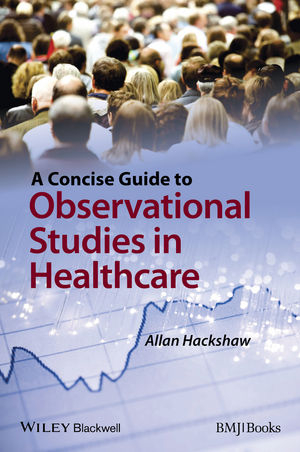
A Concise Guide to Observational Studies in Healthcare (eBook)
John Wiley & Sons (Verlag)
978-1-118-52697-2 (ISBN)
Allan Hackshaw, Deputy Director, Cancer Research UK & UCL Cancer Trials Centre, Cancer Institute, University College London, London, UK
A Concise Guide to Observational Studies in Healthcare provides busy healthcare professionals with an easy-to-read introduction and overview to conducting, analysing and assessing observational studies. It is a suitable introduction for anyone without prior knowledge of study design, analysis or conduct as the important concepts are presented throughout the text. It provides an overview to the features of design, analyses and conduct of observational studies, without using mathematical formulae, or complex statistics or terminology and is a useful guide for researchers conducting their own studies, those who participate in studies co-ordinated by others, or who read or review a published report of an observational study. Examples are based on clinical features of people, biomarkers, lifestyle habits and environmental exposures, and evaluating quality of care.
Allan Hackshaw, Deputy Director, Cancer Research UK & UCL Cancer Trials Centre, Cancer Institute, University College London, London, UK
Foreword vii
Preface viii
1 Fundamental concepts 1
2 Outcome measures risk factors and causality 26
3 Effect sizes 47
4 Regression analyses 66
5 Cross-sectional studies 82
6 Case-control studies 108
7 Cohort studies 135
8 Quality of care studies 157
9 Prognostic markers for predicting outcomes 171
10 Systematic reviews and meta-analyses 196
11 Conducting and reporting observational studies 216
Index 239
"A Concise Guide to Observational Studies in Healthcare" is a solid introduction to observational studies. Clinical trials are the gold standard, but with the price of gold what it is, observational studies are a legitimate and affordable way to answer many questions." (Journal of Clinical Research Best Practices 2016)
Chapter 1
Fundamental concepts
This chapter provides a summary background to observational studies, their main purposes, the common types of designs, and some key design features. Further details on design and analysis are illustrated using examples in later chapters, and from other textbooks [1–3].
1.1 Observational studies: purpose
Two distinct study designs are used in medical research: observational and experimental. Experimental studies, commonly called clinical trials, are specifically designed to intervene in some aspect of how the study participants live their life or how they are treated in order to evaluate a health-related outcome. A key feature of a clinical trial is that some or all participants receive an intervention that they would not normally be given. Observational studies, as the term implies, are not intentionally meant to intervene in the way individuals live or behave or how they are treated.1 Participants are free to choose their lifestyle habits and, with their physician, decide which interventions they receive when considering preventing or treating a disorder. Box 1.1 shows the most common purposes of observational studies.
Box 1.1 Common purposes of observational studies
- Examine the opinions of a single group of people on a health-related topic(s)
- Describe the health-related characteristics (e.g. demographics, lifestyle habits, genes, biological measurement, or imaging marker) of a single group of people
- Estimate the occurrence of a disorder at a given time, or trends over time
- Examine features of a disorder (e.g. how it affects patient’s lives, how they are managed/treated, and short- or long-term consequences)
- Find associations between the health-related characteristics among a single group of people or across two or more groups
- Examine risk factors (including casual factors) for a disorder or early death
- Examine prognostic factors (i.e. those that can predict the occurrence of a disorder or death from the disorder)
- Evaluate a healthcare intervention for prevention or treatment
Plan the use of future resources
Change public health education, policy, or practice
Change clinical practice
1.2 Specifying a clear research question: exposures and outcomes
The research question(s), which can also be referred to as objectives, purpose, aims, or hypotheses, should be clear, easy to read, and written in non-technical language where possible. They are usually developed to address a research issue that has not been examined before, to corroborate or refute previous evidence, or to examine a topic on which prior evidence has had shortcomings or been scientifically flawed.
There is a distinction between objectives and outcome measures (or endpoints). An outcome measure is the specific quantitative measure used to address the objective. For example, a study objective could be ‘to examine the smoking habits of adults’. Possible corresponding endpoints could be either ‘the proportion of all participants who report themselves as smokers’ or ‘the number of cigarettes smoked per day’, but they are quite different endpoints. Box 1.2 shows examples of objectives and outcome measures.
Box 1.2 Examples of objectives and outcome measures (endpoints)
| Objective | Outcome measure |
| To examine the effectiveness of statin therapy in people with no history of heart disease | Mean serum cholesterol level |
| To evaluate blood pressure as a risk factor for stroke | The occurrence (incidence) of stroke |
| To examine the smoking and alcohol drinking habits of medical students | The number of cigarettes smoked per day and the number of alcohol units consumed in a week |
| To determine whether there is an association between arthritis and coffee consumption | The occurrence of arthritis |
| To examine the association between age and blood pressure | Age and blood pressure measured on every subject |
It can be easy to specify the research question or objective for studies that involve simply describing the characteristics of a single group of people (e.g. demographics, or biological or physical measurements). For example:
- What proportion of pregnant women give birth at home?
- What is the distribution of blood pressure and serum cholesterol measurements among men and women aged over 50?
- Are patients satisfied with the quality of care received in a cancer clinic?
Clinical trials often have a single primary objective, occasionally two or three at most, each associated with an endpoint. However, there can be more flexibility on this for observational studies unless they have been designed to change a specific aspect of public health policy. Many observational studies have several objectives, some of which may only arise during the study or at the end, and they can also be exploratory.
Examining the effect of an exposure on an outcome
While some researchers seek only to describe the characteristics of a single group of people (the simplest study type), it is common to look at associations between two factors. Many research studies, both observational studies and clinical trials, are designed to:
Box 1.3 gives examples of these. To evaluate risk factors or causes of disease or early death, an outcome measure must be compared between two groups of people:
- Exposed group
- Unexposed group
Box 1.3 Examples of studies examining the effect of an exposure on an outcome
| Exposure | Outcome* |
| Exposures (characteristics) that cannot be changed or modified | Age | Heart disease |
| BRCA1/BRCA2 gene | Breast cancer |
| Family history | Alzheimer’s disease |
| Prostate specific antigen | Prostate cancer |
| Burn size after an accident | Mortality |
| Exposures (characteristics) that can be changed or modified | Alcohol | Arthritis (gout) |
| Frequent mobile phone use | Brain cancer |
| Working with asbestos | Mesothelioma |
| Body weight | Diabetes |
| Interventions | A new diet for obese people | Body weight |
| Epileptic drugs during pregnancy | Birth defect |
| Being treated in A&E at weekends | Death within 7 days |
A&E, accident and emergency department.
Body weight is highlighted to show that a factor can be either an outcome or exposure, depending on the research question:
- ‘What is the effect of body weight on the risk of developing diabetes?’
- ‘What is the effect of a new diet on body weight’
*The risk of developing the specified disorder, except body weight which is a continuous measurement so there is no direct concept of risk.
An exposure is often thought to be a factor that can be avoided or removed from our lives, such as a lifestyle habit or something encountered at work or in the environment, but it can be any of the following:
- Physical or clinical characteristic
- Gene or genetic mutation
- Biomarker (measured in blood, saliva, or tissue)
- Imaging marker
- Intervention for prevention or treatment
Also, a factor can be either an exposure or an outcome, depending on the research question (e.g. body weight in Box 1.3). Considering a research study in the context of examining the relationship between exposures and outcomes greatly helps to understand the design and analysis.
“Make everything else the same”: natural variation, confounding, and bias
An important consideration for all observational research studies is variability (natural variation). For example, smoking is a cause of lung cancer, but why do some people who have smoked 40 cigarettes a day for most of their adult lives not develop lung cancer, while others who have never smoked do? The answer is that people vary. They have different body characteristics (e.g. weight and blood pressure), different genetic make-up, and different lifestyles (e.g. diet, and exercise). People react to the same exposure in different ways.
When an association (risk or causal factor)2 is evaluated, it is essential to consider if the observed responses are consistent with natural variation or whether there really is an effect. Allowance must be made for variability in order to judge how much of the association seen at the end of a study is due to natural variation (i.e. chance) and how much is due to the effect of the risk factor of interest. The more variability there is, the harder it is to detect an association. Highly controlled studies (such as laboratory experiments or randomised clinical trials) have relatively less variation...
| Erscheint lt. Verlag | 30.12.2014 |
|---|---|
| Sprache | englisch |
| Themenwelt | Medizin / Pharmazie ► Allgemeines / Lexika |
| Medizin / Pharmazie ► Medizinische Fachgebiete | |
| Schlagworte | anyone • Busy • Clinical & Experimental Medical Research • Concepts • concise • Conduct • Design • easytoread • features • Guide • Healthcare • important • Introduction • Klinische u. experimentelle medizinische Forschung • Knowledge • Medical Professional Development • Medical Science • Medical Statistics & Epidemiology • Medizin • Medizinische Statistik u. Epidemiologie • observational • Overview • Perspektiven in medizinischen Berufen • Prior • Professionals • provides • Studies • Study • suitable |
| ISBN-10 | 1-118-52697-X / 111852697X |
| ISBN-13 | 978-1-118-52697-2 / 9781118526972 |
| Informationen gemäß Produktsicherheitsverordnung (GPSR) | |
| Haben Sie eine Frage zum Produkt? |
 EPUB (Adobe DRM)
Kopierschutz: Adobe-DRM
Adobe-DRM ist ein Kopierschutz, der das eBook vor Mißbrauch schützen soll. Dabei wird das eBook bereits beim Download auf Ihre persönliche Adobe-ID autorisiert. Lesen können Sie das eBook dann nur auf den Geräten, welche ebenfalls auf Ihre Adobe-ID registriert sind.
Details zum Adobe-DRM
Dateiformat: EPUB (Electronic Publication)
EPUB ist ein offener Standard für eBooks und eignet sich besonders zur Darstellung von Belletristik und Sachbüchern. Der Fließtext wird dynamisch an die Display- und Schriftgröße angepasst. Auch für mobile Lesegeräte ist EPUB daher gut geeignet.
Systemvoraussetzungen:
PC/Mac: Mit einem PC oder Mac können Sie dieses eBook lesen. Sie benötigen eine
eReader: Dieses eBook kann mit (fast) allen eBook-Readern gelesen werden. Mit dem amazon-Kindle ist es aber nicht kompatibel.
Smartphone/Tablet: Egal ob Apple oder Android, dieses eBook können Sie lesen. Sie benötigen eine
Geräteliste und zusätzliche Hinweise
Buying eBooks from abroad
For tax law reasons we can sell eBooks just within Germany and Switzerland. Regrettably we cannot fulfill eBook-orders from other countries.
aus dem Bereich