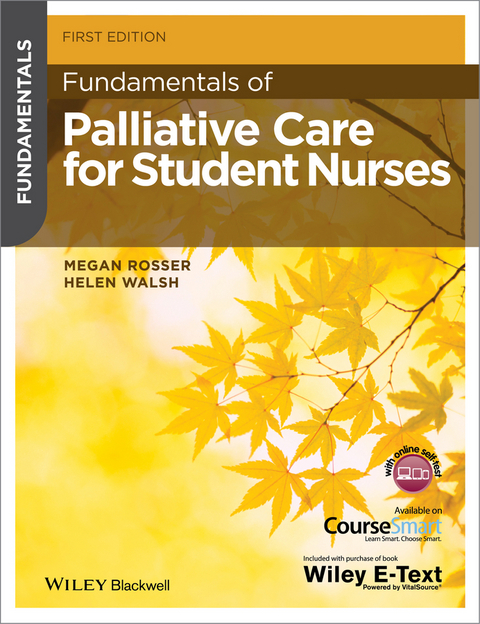
Fundamentals of Palliative Care for Student Nurses (eBook)
John Wiley & Sons (Verlag)
978-1-118-43779-7 (ISBN)
Fundamentals of Palliative Care for Student Nurses is a thorough yet accessible introduction and overview of a key area of the nursing programme. This textbook clearly explains the palliation of symptoms and the social context of death and dying. Engaging with the latest guidelines and curriculum, it highlights the practical and communicative skills required for induction programmes and continuing professional development.
KEY FEATURES:
- A full-colour, student-friendly, introduction to the essentials of palliative, or end of life care
- A topical and timely subject area, explored clearly and concisely
- Full of interactive pedagogy and features, including quizzes, multiple choice questions, vignettes/case studies and activities
- Features a companion website with links to further reading, additional activities and resources, and self-testing interactive multiple choice questions
Fundamentals of Palliative Care for Student Nurses focuses on this area with expert knowledge and compassion, preparing students in order to help them provide the best possible care for their patients and their families.
Megan Rosser is Director for CPD/Non Professional Undergraduate Programmes at Swansea University. She is an established palliative care practitioner and educationalist, with previous oncology training and experience. She is experienced in the provision of palliative nursing care in primary and secondary health care settings.
Helen C. Walsh is Tutor in Nursing at Swansea University. This involves teaching and its associated activities for students on a range of levels from health care support workers, pre and post registration and Masters. The majority of her teaching relates to palliative care and its associated subjects.
Fundamentals of Palliative Care for Student Nurses is a thorough yet accessible introduction and overview of a key area of the nursing programme. This textbook clearly explains the palliation of symptoms and the social context of death and dying. Engaging with the latest guidelines and curriculum, it highlights the practical and communicative skills required for induction programmes and continuing professional development. KEY FEATURES: A full-colour, student-friendly, introduction to the essentials of palliative, or end of life care A topical and timely subject area, explored clearly and concisely Full of interactive pedagogy and features, including quizzes, multiple choice questions, vignettes/case studies and activities Features a companion website with links to further reading, additional activities and resources, and self-testing interactive multiple choice questions Fundamentals of Palliative Care for Student Nurses focuses on this area with expert knowledge and compassion, preparing students in order to help them provide the best possible care for their patients and their families.
Megan Rosser is Director for CPD/Non Professional Undergraduate Programmes at Swansea University. She is an established palliative care practitioner and educationalist, with previous oncology training and experience. She is experienced in the provision of palliative nursing care in primary and secondary health care settings. Helen C. Walsh is Tutor in Nursing at Swansea University. This involves teaching and its associated activities for students on a range of levels from health care support workers, pre and post registration and Masters. The majority of her teaching relates to palliative care and its associated subjects.
Chapter 1
The development of palliative care
Introduction
This chapter explores the history and development of palliative care from the early days of the hospice movement through to the development of specialist palliative care and end of life care. It will track the extension of palliative care beyond cancer diagnosis, which is underpinned by the principle of provision of care according to need, not diagnosis. The differences between palliative care and other areas of care will be explored. The provision of palliative care for patients in minority groups is considered as well as the policies and strategies that have shaped the development of the speciality.
Learning outcomes
By the end of this chapter you will be able to
- identify key events in the development of hospice and palliative care;
- describe palliative care and specialist palliative care;
- identify the key principles of palliative care;
- discuss the provision of palliative care across care settings;
- discuss the extension of palliative care services beyond cancer diagnosis;
- discuss some of the challenges facing hard-to-reach groups requiring palliative care.
What is palliative care?
Simply put, palliative care ‘focuses on the relief of pain and other symptoms and problems experienced in serious illness. The goal of palliative care is to improve quality of life, by increasing comfort, promoting dignity and providing a support system to the person who is ill and those close to them.’ (dying matters 2012).
Since the development of St Christopher's hospice in 1967, the growth of palliative care has been driven by charities, health care providers and government policy. The significant early developments and key policies are presented in Figures 1.1 and 1.2.
Figure 1.1 The early development of palliative care services in the United Kingdom.
Figure 1.2 Key policy developments in palliative care in the United Kingdom.
Cicely Saunders the founder of the modern day hospice movement was driven by a profound Christian faith and a fundamental belief that ‘You matter because you are you, and you matter to the last moment of your life’. Whilst the influence of religion has diminished over time the central belief of the value of people is paramount to palliative care. Today there are over 200 inpatient units and palliative care is provided in a number of other care settings, including hospitals, the community and day care centres. Most hospices are independent, local charities, only receiving a minority of their funding from the NHS.
There are a number of definitions relating to the provision of palliative care and each is discussed in the following text.
Supportive care
Palliative care has come to be regarded as part of supportive care formally introduced by the National Institute for Clinical Excellence (NICE) in 2004. Supportive care describes all care provided to patients, friends and family throughout their illness, including the time before diagnosis has been reached, when patients may be undergoing a number of investigations. The aim of supportive care is to help the patients and their families to cope with their condition and treatment. It helps the patient to maximise the benefits of treatment and to live as well as possible with the effects of the disease (National Council for Palliative Care (NCPC) 2010). Figure 1.3 shows the components of supportive care.
Figure 1.3 The components of supportive care.
Palliative care
Palliative care is defined in Fact Box 1.1.
Fact Box 1.1
The World Health Organization (WHO) (2014) defines palliative care as:
‘an approach that improves the quality of life of patients and their families facing the problems associated with life-threatening illness, through the prevention and relief of suffering by means of early identification and impeccable assessment and treatment of pain and other problems, physical, psychosocial and spiritual.
The WHO principles of palliative care are listed in Fact Box 1.2:
Fact Box 1.2
The principles of palliative care
WHO principles of palliative care
- provides relief from pain and other distressing symptoms;
- affirms life and regards dying as a normal process;
- intends neither to hasten nor postpone death;
- integrates the psychological and spiritual aspects of patient care;
- offers a support system to help patients live as actively as possible until death;
- offers a support system to help the family cope during the patient's illness and in their own bereavement;
- uses a team approach to address the needs of patients and their families, including bereavement counselling, if indicated;
- will enhance quality of life, and may also positively influence the course of illness;
- is applicable early in the course of illness, in conjunction with other therapies that are intended to prolong life, such as chemotherapy or radiation therapy, and includes those investigations needed to better understand and manage distressing clinical complications.
These principles highlight an holistic, humanistic approach to caring for the whole person throughout their illness, rather than focusing on the disease or condition. Palliative care responds to the changing needs of the patient and family over time, recognising that the disease progression and the associated experiences are unique to each person.
Specialist palliative care
As the palliative care movement developed and grew there was an expressed need to differentiate between palliative care and specialist palliative care to ensure that patients and their families were receiving the most appropriate care. It was acknowledged that a minority of people with complex needs would require direct or indirect input from specialist teams, identified as ‘those services with palliative care as their core speciality with a high level of professional skills from trained staff and a high staff: patient ratio’ (NCHSPCS, 1995).
Once the differences between palliative and specialist palliative care had been established there was an expectation that everyone living with a life-threatening illness was entitled to receive appropriate palliative care regardless of health setting; therefore, each health professional has a duty to practice the palliative care approach as an integral component of good clinical practice, referring to specialist palliative practitioners when necessary (NCHSPCS, 1997).
End of life care
As the meaning of palliative care has developed beyond care provided for those who are dying it became necessary to coin a new definition – ‘end of life care’. This is acknowledged by the Department of Health (2008) as care that helps all those with advanced, progressive, incurable illness to live as well as possible until they die. It enables the supportive and palliative care needs of both patient and family to be identified and met throughout the last phase of life and into bereavement.
Where is palliative care provided?
Palliative care services have extended far beyond the hospices of the early movement (Figure 1.4).
Figure 1.4 Sites of palliative care provision.
As stated by NCHSPCS (1997) fundamental palliative care should be provided by the patient's primary carers, be it the ward teams or the district nurses or GPs. Specialist palliative care practitioners may be involved in the management of more challenging situations such as complex pain or symptom problems or complex psychological needs or family dynamics. Specialist practitioners should withdraw once the problem has settled or if the patient is admitted for specialist palliative care. Nowadays, hospices are used for specialist palliative care rather than respite, which was not the case in the early days. Respite is often provided by nursing homes, or by Marie Curie nurses who provide periods of respite overnight or during the day in the patient's home. Hospice at home teams may become involved towards the very end of the patient's life to enable them to die at home.
Widening access
Activity 1.1
- Make a list of people/patient groups who you have seen receive palliative care nursing
- Make a list of other people who you think might have unmet palliative care needs
- Why do you think this might happen?
Traditionally, palliative care was only offered to patients with a diagnosis of cancer; thankfully in 1998 the government stipulated that the principles and practice of palliative care should become needs led, integral to NHS practices and available to patients, wherever they are, irrespective of diagnosis (DH, 1998). This belief is echoed in the National Service Frameworks (NSF); for example, it is noted that people with heart failure have a worse quality of life than people with most other common medical conditions. There is marked impairment of...
| Erscheint lt. Verlag | 22.12.2014 |
|---|---|
| Reihe/Serie | Fundamentals |
| Fundamentals | Fundamentals |
| Sprache | englisch |
| Themenwelt | Medizin / Pharmazie ► Pflege ► Ausbildung / Prüfung |
| Medizin / Pharmazie ► Pflege ► Palliativpflege / Sterbebegleitung | |
| Schlagworte | Cancer & Palliative Care Nursing • Einführungen in die Krankenpflege • Einführungen in die Krankenpflege • Introductions to Nursing • Krankenpflege • Medical Science • Medizin • nursing • Palliative Care • palliative end of life care, student nurse, dying patients • Palliativmedizin • Pflege i. d. Krebs- u. Palliativmedizin |
| ISBN-10 | 1-118-43779-9 / 1118437799 |
| ISBN-13 | 978-1-118-43779-7 / 9781118437797 |
| Informationen gemäß Produktsicherheitsverordnung (GPSR) | |
| Haben Sie eine Frage zum Produkt? |
 EPUB (Adobe DRM)
Kopierschutz: Adobe-DRM
Adobe-DRM ist ein Kopierschutz, der das eBook vor Mißbrauch schützen soll. Dabei wird das eBook bereits beim Download auf Ihre persönliche Adobe-ID autorisiert. Lesen können Sie das eBook dann nur auf den Geräten, welche ebenfalls auf Ihre Adobe-ID registriert sind.
Details zum Adobe-DRM
Dateiformat: EPUB (Electronic Publication)
EPUB ist ein offener Standard für eBooks und eignet sich besonders zur Darstellung von Belletristik und Sachbüchern. Der Fließtext wird dynamisch an die Display- und Schriftgröße angepasst. Auch für mobile Lesegeräte ist EPUB daher gut geeignet.
Systemvoraussetzungen:
PC/Mac: Mit einem PC oder Mac können Sie dieses eBook lesen. Sie benötigen eine
eReader: Dieses eBook kann mit (fast) allen eBook-Readern gelesen werden. Mit dem amazon-Kindle ist es aber nicht kompatibel.
Smartphone/Tablet: Egal ob Apple oder Android, dieses eBook können Sie lesen. Sie benötigen eine
Geräteliste und zusätzliche Hinweise
Buying eBooks from abroad
For tax law reasons we can sell eBooks just within Germany and Switzerland. Regrettably we cannot fulfill eBook-orders from other countries.
aus dem Bereich