


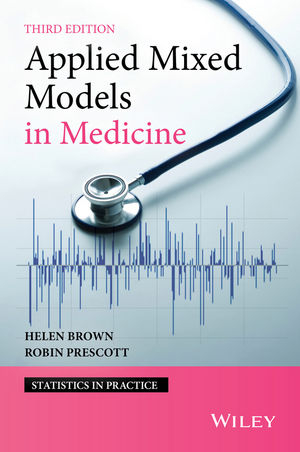
Applied Mixed Models in Medicine (eBook)
John Wiley & Sons (Verlag)
978-1-118-77824-1 (ISBN)
A fully updated edition of this key text on mixed models, focusing on applications in medical research
The application of mixed models is an increasingly popular way of analysing medical data, particularly in the pharmaceutical industry. A mixed model allows the incorporation of both fixed and random variables within a statistical analysis, enabling efficient inferences and more information to be gained from the data. There have been many recent advances in mixed modelling, particularly regarding the software and applications. This third edition of Brown and Prescott’s groundbreaking text provides an update on the latest developments, and includes guidance on the use of current SAS techniques across a wide range of applications.
- Presents an overview of the theory and applications of mixed models in medical research, including the latest developments and new sections on incomplete block designs and the analysis of bilateral data.
- Easily accessible to practitioners in any area where mixed models are used, including medical statisticians and economists.
- Includes numerous examples using real data from medical and health research, and epidemiology, illustrated with SAS code and output.
- Features the new version of SAS, including new graphics for model diagnostics and the procedure PROC MCMC.
- Supported by a website featuring computer code, data sets, and further material.
This third edition will appeal to applied statisticians working in medical research and the pharmaceutical industry, as well as teachers and students of statistics courses in mixed models. The book will also be of great value to a broad range of scientists, particularly those working in the medical and pharmaceutical areas.
A fully updated edition of this key text on mixed models, focusing on applications in medical research The application of mixed models is an increasingly popular way of analysing medical data, particularly in the pharmaceutical industry. A mixed model allows the incorporation of both fixed and random variables within a statistical analysis, enabling efficient inferences and more information to be gained from the data. There have been many recent advances in mixed modelling, particularly regarding the software and applications. This third edition of Brown and Prescott s groundbreaking text provides an update on the latest developments, and includes guidance on the use of current SAS techniques across a wide range of applications. Presents an overview of the theory and applications of mixed models in medical research, including the latest developments and new sections on incomplete block designs and the analysis of bilateral data. Easily accessible to practitioners in any area where mixed models are used, including medical statisticians and economists. Includes numerous examples using real data from medical and health research, and epidemiology, illustrated with SAS code and output. Features the new version of SAS, including new graphics for model diagnostics and the procedure PROC MCMC. Supported by a website featuring computer code, data sets, and further material. This third edition will appeal to applied statisticians working in medical research and the pharmaceutical industry, as well as teachers and students of statistics courses in mixed models. The book will also be of great value to a broad range of scientists, particularly those working in the medical and pharmaceutical areas.
Helen Brown, Principal Statistician, NHS Scotland, Edinburgh, UK. Robin Prescott, Medical Statistics Unit, University of Edinburgh Medical School, UK.
Preface to Second Edition xiii
Mixed Model Notation xvii
1 Introduction 1
1.1 The Use of Mixed Models 1
1.2 Introductory Example 3
1.3 A Multi-Centre Hypertension Trial 12
1.4 Repeated Measures Data 18
1.5 More about Mixed Models 22
1.6 Some Useful Definitions 27
2 Normal Mixed Models 33
2.1 Model Definition 33
2.2 Model Fitting Methods 45
2.3 The Bayesian Approach 56
2.4 Practical Application and Interpretation 70
2.5 Example 83
3 Generalised Linear Mixed Models 107
3.1 Generalised Linear Models 108
3.2 Generalised Linear Mixed Models 120
3.3 Practical Application and Interpretation 128
3.4 Example 137
4 Mixed Models for Categorical Data 153
4.1 Ordinal Logistic Regression (Fixed Effects Model) 153
4.2 Mixed Ordinal Logistic Regression 158
4.3 Mixed Models for Unordered Categorical Data 163
4.4 Practical Application and Interpretation 166
4.5 Example 169
5 Multi-Centre Trials and Meta-Analyses 183
5.1 Introduction to Multi-Centre Trials 183
5.2 The Implications of using Different Analysis Models 184
5.3 Example: A Multi-Centre Trial 188
5.4 Practical Application and Interpretation 195
5.5 Sample Size Estimation 197
5.6 Meta-Analysis 203
5.7 Example: Meta-analysis 204
6 Repeated Measures Data 215
6.1 Introduction 215
6.2 Covariance Pattern Models 218
6.3 Example: Covariance Pattern Models for Normal Data 228
6.4 Example: Covariance Pattern Models for Count Data 237
6.5 Random Coefficients Models 245
6.6 Examples of Random Coefficients Models 249
6.7 Sample Size Estimation 267
7 Cross-Over Trials 271
7.1 Introduction 271
7.2 Advantages of Mixed Models in Cross-Over Trials 272
7.3 The AB/BA Cross-Over Trial 272
7.4 Higher Order Complete Block Designs 279
7.5 Incomplete Block Designs 284
7.6 Optimal Designs 287
7.7 Covariance Pattern Models 290
7.8 Analysis of Binary Data 299
7.9 Analysis of Categorical Data 303
7.10 Use of Results from Random Effects Models in Trial Design307
7.11 General Points 308
8 Other Applications of Mixed Models 311
8.1 Trials with Repeated Measurements within Visits 311
8.2 Multi-Centre Trials with Repeated Measurements 330
8.3 Multi-Centre Cross-Over Trials 337
8.4 Hierarchical Multi-Centre Trials and Meta-Analysis 338
8.5 Matched Case-Control Studies 339
8.6 Different Variances for Treatment Groups in a SimpleBetween-Patient Trial 351
8.7 Estimating Variance Components in an Animal Physiology Trial355
8.8 Inter- and Intra-Observer Variation in Foetal ScanMeasurements 361
8.9 Components of Variation and Mean Estimates in a CardiologyExperiment 363
8.10 Cluster Sample Surveys 365
8.11 Small Area Mortality Estimates 367
8.12 Estimating Surgeon Performance 371
8.13 Event History Analysis 372
8.14 A Laboratory Study Using a Within-Subject FactorialDesign 375
8.15 Bioequivalence Studies with Replicate Cross-Over Designs378
8.16 Cluster Randomised Trials 392
8.17 Analysis of Bilateral Data xxx
8.18 Incomplete Block Designs xxx
9 Software for Fitting Mixed Models 401
9.1 Packages for Fitting Mixed Models 401
9.2 PROC MIXED 403
9.3 Using SAS to Fit Mixed Models to Non-Normal Data 423
9.4 PROC MCMC xxx
Glossary 431
References 435
Index 441
Preface to third edition
Analysis of variance and regression has for many years been the mainstay of statistical modelling. These techniques usually have as a basic assumption that the residual or error terms are independently and identically distributed. Mixed models are an important approach to modelling, which allows us to relax the independence assumption and take into account more complicated data structures in a flexible way. Sometimes, this interdependence of observations is modelled directly in a mixed model. For example, if a number of repeated measurements are made on a patient, then mixed models allow us to specify a pattern for the correlation between these measurements. In other contexts, such as the cross-over clinical trial, specifying that patient effects are normally distributed, rather than fixed as in the classical approach, induces observations on the same patient to be correlated.
There are many benefits to be gained from using mixed models. In some situations, the benefit will be an increase in the precision of our estimates. In others, we will be able to make wider inferences. We will sometimes be able to use a more appropriate model that will give us greater insight into what underpins the structure of the data. However, it is only the availability of software in versatile packages such as SAS® that has made these techniques widely accessible. It is now important that suitable information on their use becomes available so that they may be applied confidently on a routine basis.
Our intention in this book is to put all types of mixed models into a general framework and to consider the practical implications of their use. We aim to do this at a level that can be understood by applied statisticians and numerate scientists. Greatest emphasis is placed on skills required for the application of mixed models and interpretation of the results. An in-depth understanding of the mathematical theory underlying mixed models is not essential to gain these, but an awareness of the practical consequences of fitting different types of mixed models is necessary. While many publications are available on various aspects of mixed models, these generally relate to specific types of model and often differ in their use of terminology. Such publications are not always readily comprehensible to the applied statisticians who will be the most frequent users of the methods. An objective of this book is to help overcome this deficit.
Examples given will primarily relate to the medical field. However, the general concepts of mixed models apply equally to many other areas of application, for example, social sciences, agriculture, veterinary science and official statistics. (In the social sciences, mixed models are often referred to as ‘multi-level’ models.) Data are becoming easier to collect, with the consequence that datasets are now often large and complex. We believe that mixed models provide useful tools for modelling the complex structures that occur in such data.
The third edition of this book retains the structure of the first two, but there are further changes to reflect the continued evolution of SAS. This edition fully incorporates features of SAS up to version 9.3. Compared to what was available at the time of the previous edition, enhancements to SAS include improved graphical facilities. Importantly, there is also a new procedure, PROC MCMC, which facilitates Bayesian analysis. This has led to extensive changes in our coverage of Bayesian methods. SAS 9.3 and later versions now provide output both in text format from the output window and, additionally, as an HTML file in the results viewer. There have been accompanying minor changes in the details of outputs and graphs, such as labelling. Our approach to reporting SAS outputs in this edition has been to change our presentation from earlier editions only when we wish to highlight features that have changed substantially and, importantly, to facilitate the reader's use of mixed models, whatever their version of SAS.
During the drafting of this edition, SAS 9.4 became available. It is not fully incorporated into this book because its new features are focused more on the SAS high performance procedures than on improvements to the SAS/STAT procedures. These high performance procedures ‘provide predictive modelling tools that have been specially developed to take advantage of parallel processing in both multithread single-machine mode and distributed multi-machine mode’. Typically, the high performance procedures such as PROC HPLMIXED have a greatly reduced range of options compared to PROC MIXED and, consequently, are peripheral to the aims of this book. We do, however, consider some of the small modifications to improve procedures such as GLIMMIX and MCMC that are available in SAS/STAT® 12.1 and later versions.
Chapter 1 provides an introduction to the capabilities of mixed models, defines general concepts and gives their basic statistical properties. Chapter 2 defines models and fitting methods for normally distributed data. Chapter 3 first introduces generalised linear models that can be used for the analysis of data that are binomial or Poisson or from any other member of the exponential family of distributions. These methods are then extended to incorporate mixed models concepts under the heading of generalised linear mixed models. The fourth chapter examines how mixed models can be applied when the variable to be analysed is categorical. The main emphasis in these chapters, and indeed in the whole book, is on classical statistical approaches to inference, based on significance tests and confidence intervals. However, the Bayesian approach is also introduced in Chapter 2, since it has several potential advantages and its use is becoming more widespread. Although the overall emphasis of the book is on the application of mixed models techniques, these chapters can also be used as a reference guide to the underlying theory of mixed models.
Chapters 5–7 consider the practical implications of using mixed models for particular designs. Each design illustrates a different feature of mixed models.
Multi-centre trials and meta-analyses are considered in Chapter 5. These are examples of hierarchical data structures, and the use of a mixed model allows for any additional variation in treatment effects occurring between centres (or trials) and hence makes results more generalisable. The methods shown can be applied equally to any type of hierarchical data.
In Chapter 6, the uses of covariance pattern models and random coefficients models are described using the repeated measures design. These approaches take into account the correlated nature of the repeated observations and give more appropriate treatment effect estimates and standard errors. The material in this chapter will apply equally to any situation where repeated observations are made on the same units.
Chapter 7 considers cross-over designs where each patient may receive several treatments. In this design, more accurate treatment estimates are often achieved by fitting patient effects as random. This improvement in efficiency can occur for any dataset where a fixed effect is ‘crossed’ with a random effect.
In Chapter 8, a variety of other designs and data structures is considered. These either incorporate several of the design aspects covered in Chapters 5–7 or have structures that have arisen in a more unplanned manner. They help to illustrate the broad scope of application of mixed models. This chapter includes two new sections. We have added a section on the analysis of bilateral data, a common structure in some areas of medical research, but one that we had not previously addressed. There is also a substantial new section on incomplete block designs.
Chapter 9 gives information on software available for fitting mixed models. Most of the analyses in the book are carried out using PROC MIXED in SAS, supplemented by PROC GENMOD, PROC GLIMMIX, and PROC MCMC. This chapter introduces the basic syntax for these procedures. This information should be sufficient for fitting most of the analyses described, but the full SAS documentation should be referenced for those who wish to use more complex features. The SAS code used for most of the examples is supplied within the text. In addition, the example datasets and SAS code may be obtained electronically from www.wiley.com/go/brown/applied_mixed.
This book has been written to provide the reader with a thorough understanding of the concepts of mixed models, and we trust it will serve well for this purpose. However, readers wishing to take a shortcut to the fitting of normal mixed models should read Chapter 1 for an introduction, Section 2.4 for practical details, and the chapter relevant to their design. To fit non-normal or categorical mixed models, Section 3.3 or Section 4.4 should be read in addition to Section 2.4. In an attempt to make this book easier to use, we have presented at the beginning of the text a summary of the notation we have used, while at the end, we list some key definitions in a glossary.
Our writing of this book has been aided in many ways. The first edition evolved from a constantly changing set of course notes that accompanied a 3-day course on the subject, run regularly over the previous 6 years. The second edition was helped by many individuals who were kind enough to comment on the first...
| Erscheint lt. Verlag | 12.12.2014 |
|---|---|
| Reihe/Serie | Statistics in Practice |
| Statistics in Practice | Statistics in Practice |
| Sprache | englisch |
| Themenwelt | Mathematik / Informatik ► Mathematik ► Statistik |
| Mathematik / Informatik ► Mathematik ► Wahrscheinlichkeit / Kombinatorik | |
| Studium ► Querschnittsbereiche ► Epidemiologie / Med. Biometrie | |
| Technik | |
| Schlagworte | Biostatistics • Biostatistik • Clinical & Experimental Medical Research • Klinische u. experimentelle medizinische Forschung • Medical Science • Medizin • Mixed Models, Medicine, Biostatistics, statistical analysis • Probability & Mathematical Statistics • Statistics • Statistik • Wahrscheinlichkeitsrechnung u. mathematische Statistik |
| ISBN-10 | 1-118-77824-3 / 1118778243 |
| ISBN-13 | 978-1-118-77824-1 / 9781118778241 |
| Informationen gemäß Produktsicherheitsverordnung (GPSR) | |
| Haben Sie eine Frage zum Produkt? |
 EPUB (Adobe DRM)
Kopierschutz: Adobe-DRM
Adobe-DRM ist ein Kopierschutz, der das eBook vor Mißbrauch schützen soll. Dabei wird das eBook bereits beim Download auf Ihre persönliche Adobe-ID autorisiert. Lesen können Sie das eBook dann nur auf den Geräten, welche ebenfalls auf Ihre Adobe-ID registriert sind.
Details zum Adobe-DRM
Dateiformat: EPUB (Electronic Publication)
EPUB ist ein offener Standard für eBooks und eignet sich besonders zur Darstellung von Belletristik und Sachbüchern. Der Fließtext wird dynamisch an die Display- und Schriftgröße angepasst. Auch für mobile Lesegeräte ist EPUB daher gut geeignet.
Systemvoraussetzungen:
PC/Mac: Mit einem PC oder Mac können Sie dieses eBook lesen. Sie benötigen eine
eReader: Dieses eBook kann mit (fast) allen eBook-Readern gelesen werden. Mit dem amazon-Kindle ist es aber nicht kompatibel.
Smartphone/Tablet: Egal ob Apple oder Android, dieses eBook können Sie lesen. Sie benötigen eine
Geräteliste und zusätzliche Hinweise
Buying eBooks from abroad
For tax law reasons we can sell eBooks just within Germany and Switzerland. Regrettably we cannot fulfill eBook-orders from other countries.


