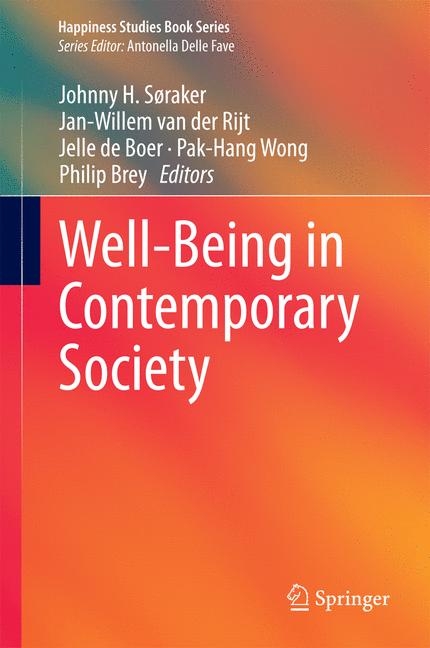
Well-Being in Contemporary Society (eBook)
XIV, 236 Seiten
Springer International Publishing (Verlag)
978-3-319-06459-8 (ISBN)
Dr. Johnny Hartz Søraker is Assistant Professor of Philosophy of technology at the Department of Philosophy, University of Twente. He defended his PhD cum laude at the same department, supervised by Prof. Dr. Philip Brey. The dissertation mainly dealt with the epistemology, ontology and ethics of virtual worlds, with a particular focus on their potential impact on personal well-being. Søraker's main research interests and publications lie in the intersections between Information Technology, on the one hand and both theoretical and practical philosophy, on the other. He often grounds his work in psychological research, especially work in the field of Positive Psychology and is developing this toward a comprehensive methodology entitled 'Prudential-Empirical Ethics of Technology (PEET)‟.
Jan-Willem van der Rijt is Lecturer in Political Philosophy at the Department of Philosophy of the University of Bayreuth. His work addresses issues related to the topics of freedom, happiness and dignity, and has appeared in journals such as Economics and Philosophy, Law and Philosophy, Ethical Theory and Moral Practice, and Theory and Decision. Van der Rijt is author of The Importance of Assent: A Theory of Coercion and Dignity (Springer 2012).
Jelle de Boer is a lecturer in philosophy at Delft University of Technology. His interests are in philosophy of social science, ethics and social theory. His recent topics of research concerned game theory and well-being. He has recently published in Philosopical Psychology, Biology and Philosophy, and Economics and Philosophy.
Pak-Hang Wong is a Research Fellow on Climate Geoengineering Governance at the Institute for Science, Innovation and Society (InSIS) and Oxford Uehiro Centre for Practical Ethics, University of Oxford. He works primarily on philosophy and ethics of technology, but he is also interested in climate ethics, social theory, digital media studies, and science and technology studies.
Philip Brey is professor of philosophy within the department of philosophy of the University of Twente. He has published extensively in the areas of well-being and technology, ethics of technology, and philosophy of information technology. He is co-editor of Brey, P, Briggle, A. and Spence, D. (eds.), The Good Life in a Technological Age (Routledge, 2012), which covers philosophical, psychological and economic approaches to well-being and technology.
Dr. Johnny Hartz Søraker is Assistant Professor of Philosophy of technology at the Department of Philosophy, University of Twente. He defended his PhD cum laude at the same department, supervised by Prof. Dr. Philip Brey. The dissertation mainly dealt with the epistemology, ontology and ethics of virtual worlds, with a particular focus on their potential impact on personal well-being. Søraker's main research interests and publications lie in the intersections between Information Technology, on the one hand and both theoretical and practical philosophy, on the other. He often grounds his work in psychological research, especially work in the field of Positive Psychology and is developing this toward a comprehensive methodology entitled „Prudential-Empirical Ethics of Technology (PEET)‟.Jan-Willem van der Rijt is Lecturer in Political Philosophy at the Department of Philosophy of the University of Bayreuth. His work addresses issues related to the topics of freedom, happiness and dignity, and has appeared in journals such as Economics and Philosophy, Law and Philosophy, Ethical Theory and Moral Practice, and Theory and Decision. Van der Rijt is author of The Importance of Assent: A Theory of Coercion and Dignity (Springer 2012).Jelle de Boer is a lecturer in philosophy at Delft University of Technology. His interests are in philosophy of social science, ethics and social theory. His recent topics of research concerned game theory and well-being. He has recently published in Philosopical Psychology, Biology and Philosophy, and Economics and Philosophy.Pak-Hang Wong is a Research Fellow on Climate Geoengineering Governance at the Institute for Science, Innovation and Society (InSIS) and Oxford Uehiro Centre for Practical Ethics, University of Oxford. He works primarily on philosophy and ethics of technology, but he is also interested in climate ethics, social theory, digital media studies, and science and technology studies.Philip Brey is professor of philosophy within the department of philosophy of the University of Twente. He has published extensively in the areas of well-being and technology, ethics of technology, and philosophy of information technology. He is co-editor of Brey, P, Briggle, A. and Spence, D. (eds.), The Good Life in a Technological Age (Routledge, 2012), which covers philosophical, psychological and economic approaches to well-being and technology.
Chapter 1. Introduction-Well-Being in Contemporary Society; Jelle de Boer, Jan-Willem van der Rijt, Johnny Hartz Søraker, Pak-Hang Wong and Philip Brey.- Chapter 2. Towards Consensus on Well-Being; Timothy Taylor.- Chapter 3. Towards a Widely Acceptable Framework for the Study of Personal Well-Being; Sam Wren-Lewis.- Chapter 4. Well-Being between Science and Philosophy; Raffaele Rodogno.- Chapter 5. Improving the Health Care Sector with a Hapiness-Based Approach: The Case of the Happiness Route; Laura Weiss, Sarah Kedzia, Aad Francissen and Gerben Westerhoff.- Chapter 6. Conflict, Commitment and Well-Being; Rixar Arlegi and Miriam Teschl.- Chapter 7. Can Technology make us Happy?: Ethics, Spectator's Happiness and the Value of Achievement; Andreas Spahn.- Chapter 8. A Biomedical Shortcut to (Fraudulent) Happiness? An Analysis of the Notions of Well-Being and Authenticity Underlying Objections to Mood Enhancement; Birgit Beck and Barbara Stroop.- Chapter 9. Increasing Societal Well-Being through Enhanced Empathy using Computer Games; Judith Annett and Stefan Berglund.- Chapter 10. Well-Being, Happiness and Sustainability; Bengt Brülde.- Chapter 11. The Political Pursuit of Happiness: A Popperian Perspective on Layard's Happiness Policy; Aloys Prinz and Björn Bünger.- Chapter 12. Measuring Quality of Life - and Idea Whose Times has Come? Agenda-Settings Dynamics in Britain and the European Union; Ian Bache.- Chapter 13. The Political Turn towards Happiness; Jan-Willem van der Rijt.
| Erscheint lt. Verlag | 3.11.2014 |
|---|---|
| Reihe/Serie | Happiness Studies Book Series | Happiness Studies Book Series |
| Zusatzinfo | XIV, 236 p. |
| Verlagsort | Cham |
| Sprache | englisch |
| Themenwelt | Geisteswissenschaften ► Philosophie ► Ethik |
| Medizin / Pharmazie | |
| Sozialwissenschaften ► Politik / Verwaltung | |
| Sozialwissenschaften ► Soziologie ► Empirische Sozialforschung | |
| Schlagworte | Commitment and Well-Being • Comparisons of Happiness • Happiness and Sustainability • Happiness and Technology • Happiness and Well-Being • Happiness and Work in the Social and Heath Care • Impact of Bargaining Power on Subjective Well-Being • Increasing Societal Happiness • Layard's Happiness Policy • Life Satisfaction • Measuring Quality of Life • Philosophical Well-Being • Political Pursuit of Happiness • Study of Personal Well-Being • The Happiness Route • The Nature of Well-Being • Value of Achievement |
| ISBN-10 | 3-319-06459-2 / 3319064592 |
| ISBN-13 | 978-3-319-06459-8 / 9783319064598 |
| Informationen gemäß Produktsicherheitsverordnung (GPSR) | |
| Haben Sie eine Frage zum Produkt? |
 PDF (Wasserzeichen)
DRM: Digitales Wasserzeichen
Dieses eBook enthält ein digitales Wasserzeichen und ist damit für Sie personalisiert. Bei einer missbräuchlichen Weitergabe des eBooks an Dritte ist eine Rückverfolgung an die Quelle möglich.
Dateiformat: PDF (Portable Document Format)
Mit einem festen Seitenlayout eignet sich die PDF besonders für Fachbücher mit Spalten, Tabellen und Abbildungen. Eine PDF kann auf fast allen Geräten angezeigt werden, ist aber für kleine Displays (Smartphone, eReader) nur eingeschränkt geeignet.
Systemvoraussetzungen:
PC/Mac: Mit einem PC oder Mac können Sie dieses eBook lesen. Sie benötigen dafür einen PDF-Viewer - z.B. den Adobe Reader oder Adobe Digital Editions.
eReader: Dieses eBook kann mit (fast) allen eBook-Readern gelesen werden. Mit dem amazon-Kindle ist es aber nicht kompatibel.
Smartphone/Tablet: Egal ob Apple oder Android, dieses eBook können Sie lesen. Sie benötigen dafür einen PDF-Viewer - z.B. die kostenlose Adobe Digital Editions-App.
Buying eBooks from abroad
For tax law reasons we can sell eBooks just within Germany and Switzerland. Regrettably we cannot fulfill eBook-orders from other countries.
aus dem Bereich