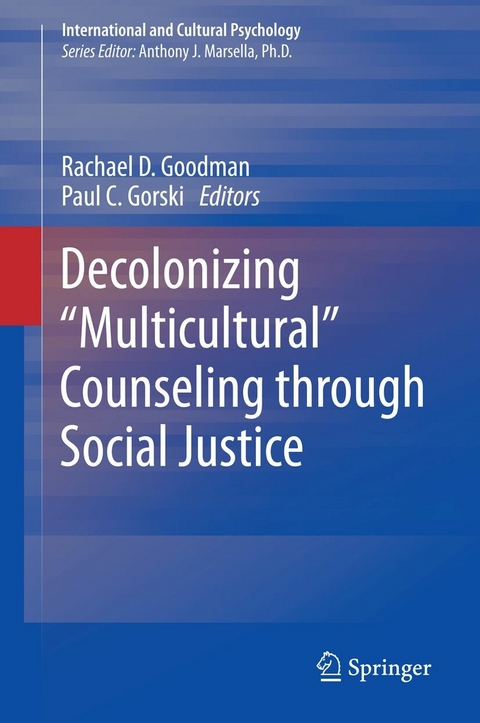
Decolonizing “Multicultural” Counseling through Social Justice (eBook)
174 Seiten
Springer New York (Verlag)
978-1-4939-1283-4 (ISBN)
Multicultural counseling and psychology evolved as a response to the Eurocentrism prevalent in the Western healing professions and has been used to challenge the Eurocentric, patriarchal, and heteronormative constructs commonly embedded in counseling and psychology. Ironically, some of the practices and paradigms commonly associated with “multiculturalism” reinforce the very hegemonic practices and paradigms that multicultural counseling and psychology approaches were created to correct.
In Decolonizing "Multicultural" Counseling through Social Justice, counseling and psychology scholars and practitioners examine this paradox through a social justice lens by questioning and challenging the infrastructure of dominance in society, as well as by challenging ourselves as practitioners, scholars, and activists to rethink our commitments. The authors analyze the ways well-meaning clinicians might marginalize clients and contribute to structural inequities despite multicultural or cross-cultural training, and offer new frameworks and skills to replace the essentializing and stereotyping practices that are widespread in the field. By addressing the power imbalances embedded in key areas of multicultural theory and practice, contributors present innovative methods for revising research paradigms, professional education, and hands-on practice to reflect a commitment to equity and social justice. Together, the chapters in this book model transformative practice in the clinic, the schools, the community, and the discipline. Among the topics covered:
- Rethinking racial identity development models.
- Queering multicultural competence in counseling.
- Developing a liberatory approach to trauma counseling.
- Decolonizing psychological practice in the context of poverty.
- Utilizing indigenous paradigms in counseling research.
- Addressing racism through intersectionality.
A mind-opening text for multicultural counseling and psychology courses as well as other foundational courses in counseling and psychology education, Decolonizing "Multicultural" Counseling through Social Justice challenges us to let go of simplistic approaches, however well-intended, and to embrace a more transformative approach to counseling and psychology practice and scholarship.
Multicultural counseling and psychology evolved as a response to the Eurocentrism prevalent in the Western healing professions and has been used to challenge the Eurocentric, patriarchal, and heteronormative constructs commonly embedded in counseling and psychology. Ironically, some of the practices and paradigms commonly associated with "e;multiculturalism"e; reinforce the very hegemonic practices and paradigms that multicultural counseling and psychology approaches were created to correct. In Decolonizing "e;Multicultural"e; Counseling through Social Justice, counseling and psychology scholars and practitioners examine this paradox through a social justice lens by questioning and challenging the infrastructure of dominance in society, as well as by challenging ourselves as practitioners, scholars, and activists to rethink our commitments. The authors analyze the ways well-meaning clinicians might marginalize clients and contribute to structural inequities despite multicultural or cross-cultural training, and offer new frameworks and skills to replace the essentializing and stereotyping practices that are widespread in the field. By addressing the power imbalances embedded in key areas of multicultural theory and practice, contributors present innovative methods for revising research paradigms, professional education, and hands-on practice to reflect a commitment to equity and social justice. Together, the chapters in this book model transformative practice in the clinic, the schools, the community, and the discipline. Among the topics covered: Rethinking racial identity development models.Queering multicultural competence in counseling.Developing a liberatory approach to trauma counseling.Decolonizing psychological practice in the context of poverty.Utilizing indigenous paradigms in counseling research.Addressing racism through intersectionality.A mind-opening text for multicultural counseling and psychology courses as well as other foundational courses in counseling and psychology education, Decolonizing "e;Multicultural"e; Counseling through Social Justice challenges us to let go of simplistic approaches, however well-intended, and to embrace a more transformative approach to counseling and psychology practice and scholarship.
Dr. Rachael D. Goodman is an Assistant Professor in the Counseling and Development Program at George Mason University. Dr. Goodman's interests focus on social justice issues in counseling, with an emphasis on trauma counseling, including historical/transgenerational trauma, systemic oppression/marginalization, immigrants and refugees, and disaster response/community outreach. Her research and clinical work has included outreach and trauma counseling among marginalized populations, particularly in communities that have experienced oppression or natural/human-made disaster. Currently, Dr. Goodman is conducting research using a community-based participatory research (CBPR) model, focused on the experiences of immigrant and refugee children and families, including transgenerational trauma and resilience.Paul C. Gorski is an Associate Professor of Integrative Studies at George Mason University, where he teachers courses on social justice, human rights, and animal rights. He is a Research Fellow in the Center for the Advance of Well-Being and on the board of directors of the International Association for Intercultural Education. His recent books include Reaching and Teaching Students in Poverty: Strategies for Erasing the Opportunity Gap, The Big Lies of School Reform (with Kristien Zenkov), The Poverty and Education Reader (with Julie Landsman), and Case Studies on Diversity and Social Justice Education (with Seema Pothini). He lives in Falls Church, Virginia, with his cats Unity and Buster.
Introduction: Toward a Decolonized Multicultural Counseling and Psychology.- The Application of Critical Consciousness and Intersectionality as Tools for Decolonizing Racial/Ethnic Identity Development Models in the Fields of Counseling and Psychology.- Queering Multicultural Competence in Counseling.- Colonialism and Multicultural Counseling Competence Research: A Liberatory Analysis.- A Liberatory Approach to Trauma Counseling: Decolonizing Our Trauma-Informed Practices.- Decolonizing Psychological Practice in the Context of Poverty.- Story Sciencing and Analyzing the Silent Narrative Between Words: Counseling Research from an Indigenous Perspective.- Decolonizing Alterity Models Within School Counseling Practice.- Decolonizing Multicultural Counseling and Psychology: Addressing Race Through Intersectionality.- (De)colonizing Culture in Community Psychology: Reflections from Critical Social Science.- Decolonizing Traditional Pedagogies and Practices in Counseling and Psychology Education: A Move Towards Social Justice and Action.
| Erscheint lt. Verlag | 3.11.2014 |
|---|---|
| Reihe/Serie | International and Cultural Psychology | International and Cultural Psychology |
| Zusatzinfo | XIV, 174 p. 2 illus. |
| Verlagsort | New York |
| Sprache | englisch |
| Themenwelt | Geisteswissenschaften ► Psychologie ► Sozialpsychologie |
| Medizin / Pharmazie ► Medizinische Fachgebiete ► Psychiatrie / Psychotherapie | |
| Schlagworte | Counseling paradigms • Decolonizing “Multicultural” Assessment • Decolonizing “Multicultural” Community Counseling • Decolonizing “Multicultural” Counseling Research • Decolonizing “Multicultural” School Counseling • Decolonizing “Multicultural” Views on Counseling Ethics • "Multicultural" approaches to crisis response • "Multicultural" approaches to disaster counseling • Multicultural Counseling • Social Justice • Transformative multiculturalism |
| ISBN-10 | 1-4939-1283-6 / 1493912836 |
| ISBN-13 | 978-1-4939-1283-4 / 9781493912834 |
| Informationen gemäß Produktsicherheitsverordnung (GPSR) | |
| Haben Sie eine Frage zum Produkt? |
 PDF (Wasserzeichen)
Größe: 2,9 MB
DRM: Digitales Wasserzeichen
Dieses eBook enthält ein digitales Wasserzeichen und ist damit für Sie personalisiert. Bei einer missbräuchlichen Weitergabe des eBooks an Dritte ist eine Rückverfolgung an die Quelle möglich.
Dateiformat: PDF (Portable Document Format)
Mit einem festen Seitenlayout eignet sich die PDF besonders für Fachbücher mit Spalten, Tabellen und Abbildungen. Eine PDF kann auf fast allen Geräten angezeigt werden, ist aber für kleine Displays (Smartphone, eReader) nur eingeschränkt geeignet.
Systemvoraussetzungen:
PC/Mac: Mit einem PC oder Mac können Sie dieses eBook lesen. Sie benötigen dafür einen PDF-Viewer - z.B. den Adobe Reader oder Adobe Digital Editions.
eReader: Dieses eBook kann mit (fast) allen eBook-Readern gelesen werden. Mit dem amazon-Kindle ist es aber nicht kompatibel.
Smartphone/Tablet: Egal ob Apple oder Android, dieses eBook können Sie lesen. Sie benötigen dafür einen PDF-Viewer - z.B. die kostenlose Adobe Digital Editions-App.
Buying eBooks from abroad
For tax law reasons we can sell eBooks just within Germany and Switzerland. Regrettably we cannot fulfill eBook-orders from other countries.
aus dem Bereich