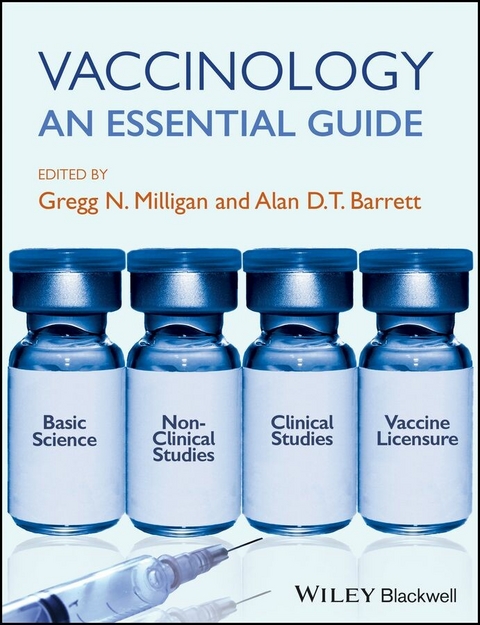
Vaccinology (eBook)
400 Seiten
Wiley-Blackwell (Verlag)
978-1-118-63652-7 (ISBN)
Vaccinology: An Essential Guide outlines in a clear, practical format the entire vaccine development process, from conceptualization and basic immunological principles through to clinical testing and licensing of vaccines. With an outstanding introduction to the history and practice of vaccinology, it also guides the reader through the basic science relating to host immune responses to pathogens.
Covering the safety, regulatory, ethical, and economic and geographical issues that drive vaccine development and trials, it also presents vaccine delivery strategies, novel vaccine platforms (including experimental vaccines and pathogens), antigen development and selection, vaccine modelling, and the development of vaccines against emerging pathogens and agents of bioterror. There are also sections devoted to veterinary vaccines and associated regulatory processes.
Vaccinology: An Essential Guide is a perfect tool for designed for undergraduate and graduate microbiologists and immunologists, as well as residents, fellows and trainees of infectious disease and vaccinology. It is also suitable for all those involved in designing and conducting clinical vaccine trials, and is the ideal companion to the larger reference book Vaccinology: Principles and Practice.
Alan D.T. Barrett, Ph.D., Professor, Department of Pathology, John D. Stobo, M.D. Chair in Vacinology and Director, Sealy Center for Vaccine Development, University of Texas Medical Branch at Galveston, Texas, USA Gregg N. Milligan, Professor, Department of Pediatrics and Senior Scientist, Sealy Center for Vaccine Development, University of Texas Medical Branch at Galveston, Texas, USA
Contributors vii
Preface ix
1 The history of vaccine development and the diseases vaccines prevent 1
Martin G. Myers
2 The vaccine development pathway 33
David W.C. Beasley
3 Control and eradication of human and animal diseases by vaccination 43
Nigel Bourne and Gregg N. Milligan
4 Pathogenesis of infectious diseases and mechanisms of immunity 59
Jere W. McBride and David H. Walker
5 The host immune response protective immunity and correlates of protection 73
Gregg N. Milligan
6 Adjuvants: making vaccines immunogenic 93
Gregg N. Milligan
7 Discovery and the basic science phase of vaccine development 109
Gavin C. Bowick
8 Microbial-based and material-based vaccine delivery systems 127
Alfredo G. Torres, Jai S. Rudra and Gregg N. Milligan
9 Licensed vaccines for humans 152
Alan D.T. Barrett
10 Veterinary vaccines 181
A. Paige Adams
11 Development of vaccines for microbial diseases 192
Dennis W. Trent and David W.C. Beasley
12 The regulatory path to vaccine licensure 212
Dennis W. Trent
13 Veterinary vaccines: regulations and impact on emerging infectious diseases 232
A. Paige Adams
14 Vaccine manufacturing 243
Dirk E. Teuwen and Alan D.T. Barrett
15 Clinical evaluation of vaccines 260
Richard E. Rupp and Bridget E. Hawkins
16 Vaccine recommendations and special populations 273
Richard E. Rupp and Bridget E. Hawkins
17 Vaccine safety 287
Dirk E. Teuwen and Alan D.T. Barrett
18 Understanding and measuring the dynamics of infectious disease transmission 304
Christine M. Arcari
19 Vaccines from a global perspective 319
Alan D.T. Barrett and Bridget E. Hawkins
20 Political ethical social and psychological aspects of vaccinology 335
Caroline M. Poland, Robert M. Jacobson, Douglas J. Opel, Edgar K. Marcuse and Gregory A. Poland
Index 358
"It can also serve as a useful reference for practicing physicians and veterinarians who would like to "boost" their knowledge of vaccines." (Clinical Infectious Diseases, 6 October 2015)
1
The History of Vaccine Development and the Diseases Vaccines Prevent
Martin G. Myers
Sealy Center for Vaccine Development, University of Texas Medical Branch, Galveston, TX, USA
Abbreviations
| CDC | US Centers for Disease Control and Prevention |
| CMI | Cell mediated immunity |
| CRS | Congenital rubella syndrome |
| HAV | Hepatitis A virus |
| HBIG | Hepatitis B immunoglobulin |
| HBsAg | Hepatitis B surface antigen |
| HBV | Hepatitis B virus |
| Hib | Haemophilus influenzae, Type b |
| HPV | Human papillomaviruses |
| IPD | Invasive pneumococcal disease |
| LAIV | Live attenuated influenza vaccine |
| MMR | Measles, mumps, and rubella |
| MMRV | Measles, mumps, rubella, and varicella |
| MVA | Modified Vaccinia Ankara |
| PCV7 | Heptavalent pneumococcal conjugate vaccine |
| PHN | Postherpetic neuralgia |
| PPS23 | 23-valent pneumococcal polysaccharide vaccine |
| PRP | Polyribosylribitol phosphate |
| SSPE | Subacute sclerosing panencephalitis |
| TIV | Trivalent inactivated influenza vaccine |
| VAPP | Vaccine-associated paralytic poliomyelitis |
| VZIG | Human anti-varicella immunoglobulin |
| VZV | Varicella zoster virus |
The 18th Century: Vaccines for Smallpox
“In 1736 I lost one of my sons, a fine boy of 4-years-old, by the smallpox…I long regretted bitterly and I still regret that I had not given it to him by inoculation; this I mention for the sake of parents, who omit that operation on the supposition that they should never forgive themselves if a child died under it; my example showing that the regret may be the same either way, and that therefore the safer should be chosen.”
Benjamin Franklin, Autobiography, 1791
Attempts to prevent infectious diseases date to antiquity. The first successful prevention strategy was “variolation,” the deliberate inoculation of people in the 16th century in India and China with the pus from smallpox sufferers. This was observed by Lady Mary Wortley Montague in 1716–1718 in Turkey, who had her children inoculated and introduced the method to England.
In 1721, Cotton Mather, an evangelical minister, persuaded a young physician named Zabdiel Boylston (the great-uncle of US President John Adams) to variolate 240 people in Boston, all but six of whom survived the procedure. In contrast, more than 30% died of naturally acquired smallpox. Although the two men were driven out of town and threatened with violence, ultimately variolation was widely used in Boston in the 18th century.
Diseases Caused by Bacteria and Viruses Where the Name of the Organism and the Disease Is Not the Same
- Chickenpox (varicella): Varicella zoster virus
- Diphtheria: Corynebacterium diphtheriae
- Intestinal tuberculosis: Mycobacterium bovis
- Pertussis (“whooping cough”): Bordetella pertussis
- Q fever: Coxiella burnetii
- Shingles: Varicella zoster virus
- Syphilis: Treponema pallidum
- Tetanus (“lockjaw”): Clostridium tetani
- Typhoid fever: Salmonella typhi
The vaccine era, however, really began in 1774 with the observation by a farmer named Benjamin Jesty that milkmaids who had had cowpox seemed to be immune to smallpox. He inoculated his wife and two sons about 22 years before Edward Jenner's first inoculation and publication in 1798. At some point in the 19th century, vaccinia virus (a mouse poxvirus) replaced cowpox in the vaccine.
Many lessons were learned from the smallpox vaccine: Initially, the vaccine was pus spread from a person who had been recently immunized to an unimmunized person, but syphilis also was passed this way. It was also recognized that loss of vaccine potency occurred after serial human passage (i.e., the virus changed when it was passed from human to human so that it was no longer immunogenic) so the vaccine began to be prepared in other animals; ultimately cattle were predominantly utilized. An imported batch of vaccine from Japan in the early 1900s caused an epizootic of Q fever (caused by Coxiella burnetii) among US cattle, which resulted in new quarantine laws and the creation of the US Department of Agriculture. In the 1920s, the need for standardization of vaccine production led to the designation of “strains” of vaccine viruses, such as the New York Board of Health strain in the USA and the Lister strain in Europe; both so-called strains, however, were a mix of viruses with different phenotypes, including many plaque variants with differing virulence. In 1903, the mandatory immunization of Massachusetts school children with smallpox vaccine in an attempt to protect the public health was found to be constitutional by the US Supreme Court. The successful demonstration of “ring immunization” (the identification, immunization, and quarantine of all contacts of cases and the contacts of contacts) as a tool permitted the elimination and ultimately the eradication of smallpox, which was officially declared by the World Health Organization in 1980, 4 years after the last case. In 2001, because of concerns of bioterrorism, the US government embarked on the development of smallpox vaccines employing modern techniques: the development of a new plaque purified seed virus, cultivated in tissue cultures and then the development and testing of a safer human replication deficient strain of virus in 2010, termed “modified vaccinia Ankara,” or MVA.
The 19th Century: New Understanding of Infectious Diseases and Immunity
The concept of attenuation (weakening the virulence of the bacterium or virus) preceded Louis Pasteur's observations with hog cholera, anthrax, and rabies attenuation and vaccination, but those observations began the quest by many scientists to identify and prevent infectious diseases in animals and humans by using killed or inactivated vaccines (normally by chemicals such as formalin) and live attenuated vaccines for hog cholera, cholera, typhoid fever, and plague. At about the same time, late in the 19th century and early in the 20th century, great strides were also made in recognizing serum and cellular immunity, which led to the development of the concepts of passive and active immunity.
Diphtheria and tetanus toxins were recognized as the causes of those diseases and that antiserum made in horses against the toxins (“antitoxin”) could neutralize the toxin effects; antitoxin was first used to prevent diphtheria in a child in 1891 and early vaccines against diphtheria and tetanus were developed at the beginning of the 20th century, which combined toxin with antitoxin.
The 20th Century: The Control of Diseases Using Vaccines
During the 20th century, many infectious diseases came under control in many countries because of clean water, improved sanitation, and pasteurization of milk, which reduced exposure to Brucella sp. (the cause of brucellosis, a disease of animals transmissible in milk to humans), Mycobacterium bovis (the cause of most cases of intestinal tuberculosis), and Salmonella typhi (the cause of typhoid fever). Unfortunately, paralytic poliomyelitis also arose during this same period because of these same reasons—improved sanitation had the indirect effect of children acquiring the viruses that cause polio at later ages, causing about 1% to develop paralytic disease.
But the greatest change to the occurrence of infectious diseases occurred when vaccines were developed and became widely used. In the second half of the 20th century, vaccines substantially increased the life expectancy of children and prolonged life throughout society. For example, in the USA alone, before vaccines, there were half-a-million cases of measles with about 500 deaths each year. In 1964–1965, about 4 years before the rubella vaccine became available, there were more than 12.5 million people infected, causing 20,000 babies with congenital rubella infection to be born; of the children born with congenital rubella, 11,600 were born blind, and 1,800 were mentally retarded. In 1952, there were more than 21,000 individuals paralyzed by poliomyelitis in the USA. An overview of the reduction of vaccine-preventable illnesses in the 20th century is shown in Table 1.1.
Table 1.1 Vaccine-Preventable Illnesses Before and Since Routine Childhood Vaccination in the USA
In 2005, the total savings from direct costs saved (such as hospitalizations, clinic visits, lost ability from illness or death to fully function in society) from the routinely recommended childhood vaccines in the USA were estimated to be $9.9 billion per year. If the...
| Erscheint lt. Verlag | 4.12.2014 |
|---|---|
| Sprache | englisch |
| Themenwelt | Medizin / Pharmazie ► Allgemeines / Lexika |
| Medizin / Pharmazie ► Medizinische Fachgebiete ► Pharmakologie / Pharmakotherapie | |
| Studium ► Querschnittsbereiche ► Infektiologie / Immunologie | |
| Schlagworte | Alan • complete • Different • Essential • everyone • Guide • History • immunological principles • Immunologie • immunology • Impfung • infectious disease • Infektionskrankheit • Infektionskrankheiten • Introduction • Medical Science • Medizin • Milligan • North America • Picture • Practice • Process • response • Textbook • Vaccine • vaccines • Vaccinology • World |
| ISBN-10 | 1-118-63652-X / 111863652X |
| ISBN-13 | 978-1-118-63652-7 / 9781118636527 |
| Informationen gemäß Produktsicherheitsverordnung (GPSR) | |
| Haben Sie eine Frage zum Produkt? |
 EPUB (Adobe DRM)
Kopierschutz: Adobe-DRM
Adobe-DRM ist ein Kopierschutz, der das eBook vor Mißbrauch schützen soll. Dabei wird das eBook bereits beim Download auf Ihre persönliche Adobe-ID autorisiert. Lesen können Sie das eBook dann nur auf den Geräten, welche ebenfalls auf Ihre Adobe-ID registriert sind.
Details zum Adobe-DRM
Dateiformat: EPUB (Electronic Publication)
EPUB ist ein offener Standard für eBooks und eignet sich besonders zur Darstellung von Belletristik und Sachbüchern. Der Fließtext wird dynamisch an die Display- und Schriftgröße angepasst. Auch für mobile Lesegeräte ist EPUB daher gut geeignet.
Systemvoraussetzungen:
PC/Mac: Mit einem PC oder Mac können Sie dieses eBook lesen. Sie benötigen eine
eReader: Dieses eBook kann mit (fast) allen eBook-Readern gelesen werden. Mit dem amazon-Kindle ist es aber nicht kompatibel.
Smartphone/Tablet: Egal ob Apple oder Android, dieses eBook können Sie lesen. Sie benötigen eine
Geräteliste und zusätzliche Hinweise
Buying eBooks from abroad
For tax law reasons we can sell eBooks just within Germany and Switzerland. Regrettably we cannot fulfill eBook-orders from other countries.
aus dem Bereich