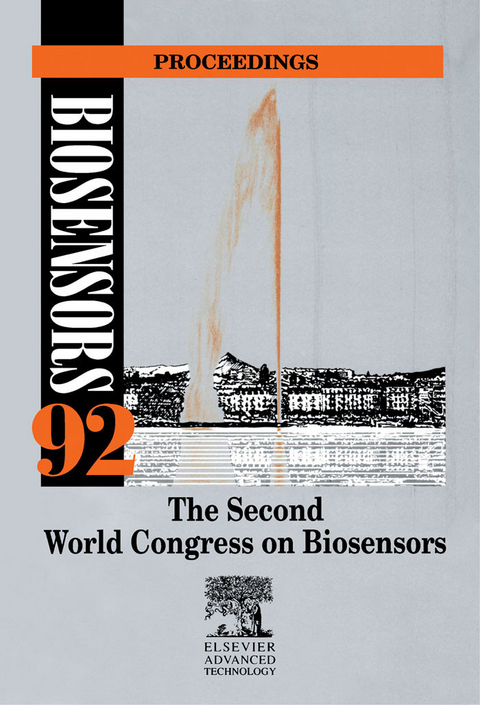
Biosensors 92 Proceedings (eBook)
572 Seiten
Elsevier Science (Verlag)
978-1-4832-9717-0 (ISBN)
Keeping up to date with new biosensors developments has been getting harder ... - one of the fastest moving fields of academic and industrial research in the world - a constant stream of new commercial applications - centres of research excellence all over Europe, North America and the Pacific Rim - enormous implications for monitoring personal health and fitness, the food we eat, the environment, health services and industry The answer came on 20-22 May 1992, with BIOSENSORS 92. With a core of invited speakers and over 220 original contributed papers from 24 countries, BIOSENSORS 92 was the largest and most comprehensive event of its kind - a response to the growing importance of biosensors as a powerful new technology. Elsevier Advanced Technology, the organizers of BIOSENSORS 92, have now published the proceedings of this important event. Biosensors 92 Proceedings contains over 150 papers presenting current research and developments straight from those who are leading the way in: - Enzyme-based Sensors - Affinity Sensors - Environmental Monitoring using Biosensors - Biosensors and Bioelectronics Biosensors 92 Proceedings - Your key to current awareness in sensor technology for just GBP90 [dollar rate subject to current GBP/$ exchange rate].
Front Cover 1
Biosensors '92 Proceedings 2
Copyright Page 3
Table of Contents 4
PART I: SYMPOSIUM I: ENZYME-BASED SENSORS ORAL PRESENTATIONS 16
CHAPTER 1.ENZYME - BASED (FIBRE) OPTIC SENSORS 18
CHAPTER 2. Luciferase-based sensors 19
1. INTRODUCTION 19
2. ENZYM E SOURCE S 20
3. DESIGN OF THE LUCIFERASE-BIOSENSOR 21
4. PREPARATION OF THE SENSING TIP 22
5. POTENTIALITIES AND PERFORMANCES OF THE LUCIFERASE BASED BIOSENSOR 23
6. CONCLUSIONS AND TRENDS 25
7. REFERENCES 25
CHAPTER 3. Chemically Constructed Amperometric Ultramicrobiosensors 27
1. INTRODUCTION 27
2. RESULTS AND DISCUSSION 28
3. CONCLUSION 33
REFERENCES 34
CHAPTER 4. Modelling of processes in enzyme electrodes 35
1. INTRODUCTIO N 35
2. THE PROBLEM 36
3. HOMOGENEOUS MEDIATION 37
4. MEMBRANE ENZYME ELECTRODES 39
5. ENZYME MEMBRANE ELECTRODES 40
6. CONCLUSION 41
ACKNOWLEDGEMENTS 41
REFERENCES 41
CHAPTER 5. A COMPARISON : SENSING OF ETHANOL BY MEANS OF ENZYMATIC RECOGNITION AND BY CHEMICAL RECOGNITION IN AN OPTODE 43
Introduction 43
Experimental and Application 45
Results and Discussion 46
Conclusion 49
Acknowledgement: 49
References 49
CHAPTER 6. Fiber-optic glucose and creatinine biosensors based on oxygen optrodes as transducers 51
1. INTRODUCTION 51
2. BIOSENSORS BASED ON OXYGEN OPTRODES 53
3. DESIGN, SYNTHESIS AND EVALUATION OF LUMINOPHORES 53
4. IMMOBILIZATION OF LUMINOPHORES 54
5. DESIGN AND PERFORMANCE OF GLUCOSE AND CREATININE BIOSENSORS 56
6. ACKNOWLEDGEMENTS: 56
7. REFERENCES 56
CHAPTER 7. A Highly Selective Methanol Determination System based on Chemiluminescence using Flow Injection Analysis 57
1. INTRODUCTION 57
2. EXPERIMENTA L 58
3. RESUL T 59
4. CONCLUSION 61
PREFERENCES 61
CHAPTER 8. Fiber-optic urea sensor using ammonium ion selective membrane covered with urease-immobilized membrane 62
INTRODUCTION 62
EXPERIMENTAL 62
RESULTS AND DISCUSSION 63
REFERENCES 65
CHAPTER 9. Developmen t of a miniaturized glucose monitor for whole blood measurements. 66
1. Introduction 66
2. Materials and Methods 67
3. Results 69
4. Discussion 70
5. Acknowledgements 71
6. References 71
CHAPTER 10. Development and application of a new enzyme sensor type based on the MOS-capacitance structure for bioprocess control 72
INTRODUCTION 72
OBSERVATIONS WITH MOS-CHIPS 72
PH-SENSITIVE MOS-CAP-BIOSENSORS 73
PF-SENSITIVE MOS-CAP-BIOSENSORS 73
CONCLUSIONS 73
ACKNOWLEDGEMEN T 74
REFERENCES 74
CHAPTER 11. Stainless steel electrodes in enzyme-based potentiometric and pH-stat biosensors 80
1. INTRODUCTIO N 80
2. EXPERIMENTAL 81
3. RESULTS 83
4. DISCUSSION 87
5. REFERENCES 87
CHAPTER 12. CONTINUOUS NON-DILUTED SERUM SAMPLE MEASUREMENT WITH ANISFET GLUCOSE SENSOR 88
Introduction 88
Experimental 89
Conclusions 90
Acknowledgment 90
References 90
CHAPTER 13. Mixed Mode Sensor leads to pH-controlled Membrane Conductivity Measurement 91
1. INTRODUCTION AND MOTIVATION 91
2. EXPERIMENTAL 93
3. CONCLUSION 96
Acknowledgment 97
References 97
CHAPTER 14. Thin-film Conductometric Biosensors for Glucose and Urea Determination. 98
INTRODUCTION 98
EXPERIMENTAL 99
RESULTS AND DISCUSSION 100
CONCLUSION 105
REFERENCES 105
CHAPTER 15. Microfabricated conductimetric biosensors based on ph-sensitive hydrogels 106
Introduction 106
Experimental 107
Sensor chip fabrication 108
Discussion 109
Conclusion 110
Acknowledgment 110
References 111
CHAPTER 16. Stable mediated enzyme electrode in flow injection analysis system used for on-line bioprocess monitoring 112
1. INTRODUCTION 112
2. EXPERIMENTAL SET-UP 113
3. RESULTS AND DISCUSSION 113
4. REFERENCES 114
CHAPTER 17. Development of a stable ferrocene-mediated glucose biosensor using an anionic ion exchange polymer blend 115
1. INTRODUCTION 115
2. MATERIALS AND METHODS. 116
3. RESULTS AND DISCUSSION 118
4. CONCLUSION 120
5. ACKNOWLEDGMENTS 120
6. REFERENCES 120
CHAPTER 18. AMPEROMETRIC BIOSENSOR FOR FREE CHOLESTEROL BASED ON ELECTRICAL COMMUNICATION BETWEEN HORSERADISH PEROXIDASE AND NOVEL REDOX POLYMERS 121
Introduction 121
Experimental 122
Equipment 123
Results and Discussion 123
Redox Polymers 123
Conclusion 126
References 127
CHAPTER 19. Amperometric Biosensors Based on Electrocatalytic Regeneration of NAD+ at Redox Polymer-Modified Electrodes 128
Introduction 128
Biosensors based on chemically modified carbon paste electrodes 132
Acknowledgment 134
References 135
Amperometric Biosensors for Detection of L- and D-Amino Acids on Co- Immobilized Peroxidase and L- and D-Amino Acid Oxidases in Carbon Paste Electrodes 136
Introduction 136
References 142
CHAPTER 20. CONTINUOUS MONITORING OF LACTAT E IN SEPSIS AND SHOCK WITH SUBCUTANEOUS MICRODIALYSIS : EXPERIMENTAL AND CLINICAL STUDIES 144
INTRODUCTION 144
METHODS 145
EXPERIMENTAL SEPSIS MODEL 146
CLINICAL STUDIES 146
RESULT 147
CLINICAL STUDIES 148
DISCUSSION 149
ACKNOWLEDGEMENTS 151
REFERENCES 151
CHAPTER 21. In vivo Evaluation of an Electroenzymatic Glucose Sensor Implanted in Subcutaneous Tissue 152
1. INTRODUCTION 152
2. FABRICATION 153
3. IN VITRO EVALUATION 153
4. IN-VIVO (RABBIT) EVALUATIO N 154
5. IN VIVO (HUMAN) EVALUATION 155
6. CONCLUSIONS 157
7. REFERENCES 157
CHAPTER 22. Development of a Needle Type Biosensor for analysis of sugars in fruits 159
1. Introduction 159
2. Materials and Method 159
3. Results and Discussions 160
4. References 161
CHAPTER 23. Glucose sensing carbon paste electrode by using polyethylen e glycol-modifie d glucose oxidase 166
1. INTRODUCTION 166
2. EXPERIMENTAL 166
3. RESULTS AND DISCUSSION 167
4. CONCLUSION 169
5. REFERENCES 169
CHAPTER 24. Development and characterisation of an enzyme electrode for the application to undiluted media 170
1. INTRODUCTION 170
2. EXPERIMENTAL 170
3. RESULTS 171
CHAPTER 25. Anaerobic Operation of a Glucose Sensor by Use of Pulse Techniques 173
1. INTRODUCTIO N 173
2. Theoretical Background 174
3. SENSOR REALISATION AND MEASUREMENT SET-UP 175
4. EXPERIMENTAL 175
5. CONCLUSIO N 179
CHAPTER 26. Extended Shelf Life of Enzyme Based Biosensors using a Novel Stabilisation System 180
1. INTRODUCTION 180
2. MATERIALS AND METHODS 181
3. RESULTS AND DISCUSSION 183
REFERENCES 187
CHAPTER 27. MULTI-ENZYME SENSORS - ENZYME ACTIVATION FOR ACTIVATOR AND ENYZME ACTIVITY DETERMINATION- 188
1. Measuring principle 188
2. Results 189
CHAPTER 28. Enzyme electrodes for biotechnology and environmental control 190
1. Introduction 190
2. Fia-system for biosensors on the basis of oxygen indication 191
3. Highly sensitive phosphate sensor 192
CHAPTER 29. Application of A Novel Polymer with Biocompatibility and Diffusion-Limiting Effect to Construct A Glucose Sensor 193
INTRODUCTION 193
EXPERIMENTAL 194
RESULTS AND DISCUSSION 196
CONCLUSION 198
ACKNOWLEDGMENT 199
REFERENCE 199
CHAPTER 30. Flow-injection amperometrie biosensing of copper(II) ions using a contact-type of an apoenzyme sensor 200
1. INTRODUCTION 201
2. EXPERIMENTAL 201
3. RESULTS AND DISCUSSION 203
REFERENCES 206
CHAPTER 31. BIOSENSOR — ACTUATOR SYSTEMS FOR PRECISE ENZYMATIC DETERMINTIONS 208
1 . INTRODUCTION 208
2 . MICROFLOW TITRATIONS 208
3 · MEASURING SET UP 210
4 . PRELIMINARY INVESTIGATIONS 211
5 · SEPARATION BY GAS DIALYSIS 212
6.. ENZYMATIC ASSAYS 213
7 . RESULTS AND DISCUSSION 214
8. REFERENCES 216
PART II: SYMPOSIUM I: ENZYME-BASED SENSORS POSTER PRESENTATIONS 218
CHAPTER 32. Model analysis of mediated enzyme electrodes with a conducting polymer 219
CHAPTER 33. EH2YHE ELECTRODES WITH PTFE MODIFIED CARBOH BLACF MEDIATOR MATRIX AND THEIR APPLICATION IN GLUCOSE BIOSENSORS 220
CHAPTER 34. THE MASS PRODUCTION OF BIOSENSORS 221
CHAPTER 35. Mediated amperometric determination of xylose and glucose with an immobilized aldose dehydrogenase electrode 222
CHAPTER 36. Selectivity of conducting polymer modified electrodes and their application in amino acid biosensors 223
CHAPTER 37. Novel approaches for the use of mediators in enzyme electrodes 224
CHAPTER 38. Study on mutiple-enzyme electrode for sucrose determination 225
CHAPTER 39. Vitamin C sensor based on the cyclic reaction of L-ascorbic acid and dehydroascorbic acid using dithiothreithol 226
CHAPTER 40. An Activated Carbon Electrode Biosensor for Sucrose 227
CHAPTER 41. An enzym e electrode for hydrogen peroxide based on peroxidase immobilized on glassy carbon electrode 228
Experimental 228
Results 228
References 228
CHAPTER 42. Chemical modified carbon glucose sensor used in rapid estimation of glucose in inosine fermentation 229
CHAPTER 43. BIOAMPEROMETRIC SENSORS BASED ON IMMOBILIZATION OF ENZYMES 230
CHAPTER 44. Amperometric glutathione electrode 231
CHAPTER 45. On-Line Determination of Glucose in Fermentation Processes. Development of an Extremely Simplified Flow-Injection System with Amperometric Detection 232
CHAPTER 46. Continuous Determination of Glucose and Lactate in a Mammalian Cell Culture Fermentation Process 233
CHAPTER 47. Use of on-line tubular ion-exchanger to enhance selectivity of membrane electrode detectors in flow-injection enzymatic analysis: Application to determination of L-glutamine in bioreactor media. 234
RESULTS 234
CHAPTER 48. DETERMINATION OF PENICILLIN IN BATCH SAMPLES AND WITH VARIOUS FIA SYSTEMS USING FAST RESPONDING ENZYME GLASS ELECTRODES. 235
CHAPTER 49. INVESTIGATION OF OPTIMUM CONDITIONS FOR THE DETECTION OF UREA BY ENFETs 237
CHAPTER 50. A computerized and temperature compensated enzyme electrode (model GA-I) for blood sugar determination 238
CHAPTER 51. Development of dissolved oxygen detector for flow injection analysis and its application to L-glutamate analysis 240
CHAPTER 52. Characteristics of biosensors using ß-chitin membrane as a possible carrier of bioactive materials 241
CHAPTER 53. A PROTOTYPE OF ENZYMATIC SENSORS TO DETERMINE GLYCEROL AND PROPYLENE GLYCOL IN TOBACCO CASING. 242
CHAPTER 54. On-line Determination of Ethanol in Brewery Processes Based on Sample Extraction by Continuous Pervaporation 243
CHAPTER 55. A BIOSENSOR BASED ON MONOMOLECULAR FILMS OF GLUCOSE OXYDASE 244
CHAPTER 56. Amplification of enzyme electrode response by biocatalytic preconcentration of intermediates 245
CHAPTER 57. Covalent binding of urease on ammonium selective potentiometric membranes 246
CHAPTER 58. Disposable multisubstrate biosensors for fish freshness determination 247
CHAPTER 59. BIOSENSOR FOR DIRECT DETERMINATION IN UNDILUTED BIOLOGICAL FLUIDS. 248
CHAPTER 60. FIBRE-OPTIC ENZYME BIOSENSOR BASED ON QUENCHEDLUMINESCENCE OXYGEN DETECTION AND LIFE-TIME MEASUREMENTS. 249
CHAPTER 61. A Novel Optical Biosensor for the Determination of Glucose, Fructose, Gluconolactone and Sorbitol 250
CHAPTER 62. Optical Sensor for Organic Ammonium Ions and Its Application to Lysine Biosensing 251
CHAPTER 63. Fiuorecsent determination of glucose by an enzyme sensor 252
CHAPTER 64. Wavelength-Modulated Fluorimetry in Analysis of Steroid Hormones in Pharmaceutical Products 253
CHAPTER 65. Surface-Micromachined Ultrasonic Lamb Wave Devices for Biosensor Applications 254
Introduction 254
Fabrication 254
Conclusion 255
CHAPTER 66. Enzyme Membranes of Biosensor Application Prepared by Direct Plasma Irradiation 256
CHAPTER 67. DRY CHEMISTRY SENSING OF ANALYTES USING INTEGRAL THRESHOLD DETECTION 257
CHAPTER 68. A Calorimetric Biosensor for the Detection and Determination of Enantiomeric Excesses 258
CHAPTER 69. An integrated thermopile sensor as transducer for biosensing 260
CHAPTER 70. HYPOXANTHINE MONITORING FOR DETECTION OF ASPHYXIA IN NEWBORN INFANTS 262
CHAPTER 71. Improved multiple chip-electrode arrays with modified enzyme polymer layers 263
CHAPTER 72. A flow injection creatinine analyzer based on creatinine deiminase, leucine dehydrogenase and L-amino acid oxidase 264
CHAPTER 73. STUDYING THE BIENZYME REACTION WITH AMPEROMETRIC DETECTION FOR MEASURING MALTOSE 265
CHAPTER 74. L· IACTATE ELECTROCHEMICAL BIOSENSOR: PERFORMANCE EVALUATION AND THE APPLICATION IN MONITORING OF MILK MICROBIAL ATTACK 266
PART III: SYMPOSIUM II: AFFINITY SENSORS ORAL PRESENTATIONS 268
CHAPTER 75. Single-step electrochemical immunoassay 269
1. INTRODUCTION 269
2. EXPERIMENTAL MODEL 270
3. GENERATING THE ELECTROACTIVE SPECIES 271
4. MIGRATION OF REAGENTS 273
5. ACKNOWLEDGMENT 276
6. REFERENCES 276
CHAPTER 76. Real-time biospecific interaction analysis 277
1. INTRODUCTION 277
2. THE ANALYTICAL SYSTEM 278
3. REAL-TIME BIA APPLICATION AREAS. 279
4. CONCLUSIONS 282
REFERENCES 283
CHAPTER 77. RECEPTOR-BASED SENSORS 284
CHAPTER 78. A new geometry of the ion-step based Ion Responding Immun o Sensor (IRIS) : The 'ball and tip' disposable biosensor 285
1. INTRODUCTION 285
2. METHOD 285
3. RESULTS AND DISCUSSION 286
4. CONCLUSIO N 287
5. REFERENCES 287
CHAPTER 79. IMMDNOELECTRODES FOR THYROTROPHIN MEASUREMENT 288
EXPERIMENTAL METHODS 289
REFERENCES 289
CHAPTER 80. Avidi n modified glassy carbon electrodes: Towards a multivalent immunosensor 291
1. Introduction 291
2. Material and Methods 291
3. Results and Discussion 293
4. Conclusion and Outlook 295
5. References 295
CHAPTER 81. Development of a multi-array PZ-immuno biosensor system for the fast assay of human growth hormone 296
INTRODUCTION 296
MATERIALS AND METHODS 296
RESULTS AND DISCUSSION 300
CONCLUSIONS 303
References 303
CHAPTER 82. An immunosensor using a quartz Lamb wave device 304
1.INTRODUCTION 304
2.QUARTZ LAMB WAVE DEVICE 305
3.PR0CEDURE FOR ANTIGEN ADSORBED LATEX 307
4.MASS SENSITIVITY OF THE QUARTZ LAMB WAVE DEVICE 307
5.EXPERIMENT FOR AN IMMUNOREACTION MEASUREMENT 308
6.RESULTS AND DISCUSSION 309
7.CONCLUSION 310
8.REFERENCES 310
CHAPTER 83. GRAVIMETRIC BIOSENSORS BASED ON ACOUSTIC WAVES IN THIN POLYMER LAYERS 311
1. INTRODUCTION 311
2. POLYMER FILM SYSTEM 313
3. OSCILLATOR ELECTRONICS 314
4. MEASUREMENT SYSTEM 314
5. THEORY OF THE DEVICE 314
6. SYSTEM PROPERTIES 315
7. RESULTS USING PROTEINS 317
8. RESULTS USING MASS ENHANCING PARTICLES 317
9. CONCLUSIONS 318
REFERENCES 318
CHAPTER 84. High sensitive detection system of allergen using antibody immobilize d onto bacterial magnetic particles 319
1. INTRODUCTION 319
2. EXPERIMENTAL 320
3. RESULTS AND DISCUSSION 321
REFERENCES 324
CHAPTER 85. EVANESCENT WAVE FIBER OPTIC BIOSENSOR 325
INTRODUCTION 325
METHODS 326
RESULTS 328
DISCUSSION 331
ACKNOWLEDGEMENTS 332
REFERENCES 332
CHAPTER 86. A rapid particle-based immunoassay system using fluorescence transfer detection William Bains and John Golby 333
1. INTRODUCTION 333
2. ASSAY CONCEPT. 333
3. EXPERIMENTAL IMPLEMENTATION 334
4. RESULTS 336
5. DISCUSSION 338
6. ACKNOWLEDGEMENTS 339
7. REFERENCES 339
CHAPTER 87. Characterization of Biomembrane s by Spectral Ellipsometry and Interferometry as a Tool in Biosensor Application 340
1. Introduction 340
2. Experimental Method s and Materials 341
3· Result s and Discussion 342
Experiments on a planar solid phase immuno assay 345
Acknowledgements 347
References 347
CHAPTER 88. Interferometric immunoassay in a FIA-system A sensitive and rapid approach in label-free immunosensing 348
Introduction 349
Results 351
Discussion 354
Conclusion 355
Acknowledgements 355
Literature 355
CHAPTER 89. The difference interferometer: a highly sensitive optical probe for molecular surface-coverage detection 356
1. Introduction 356
2. Sensor design and operating principle 357
3. Sensitivity and dynamic range of the affinity sensor 359
4. Response characteristics of the affinity sensor 360
5. Preparation of the sensor chips 362
6. Experimental resolution of the sensor system 362
7. Conclusions and prospects 363
Acknowledgement 363
References 363
CHAPTER 90. The Difference Interferometer: Application as a Direct Immunosensor 364
1. Introduction 364
2. Experimental 365
3. Results and Discussion 367
4. Conclusion 371
References 372
CHAPTER 91. Optical Waveguide Interferometric Immunosensor 373
1. Introduction 373
2. Sensitivity 373
3. Waveguide structure and apparatus 375
4. Results and discussion 376
Conclusions 378
References 379
CHAPTER 92. Enhanced Surface Plasmon Resonance Inhibition Test (ESPRIT) by using Latex Particles 380
1. INTRODUCTION 380
2. MATERIALS AND METHODS 381
3. RESULTS AND DISCUSSION 384
CONCLUSIONS 386
REFERENCES 387
CHAPTER 93. Immunosensors in medical diagnostics - major hurdles to commercial success 388
1. INTRODUCTION 388
2. BUSINESS ANALYSIS => CONCEPT SPECIFICATION
3. SYSTEMS TECHNOLOGY => PROTOTYPE
4. SYSTEMS TECHNOLOGY => PROTOTYPE
PART IV: SYMPOSIUM II: AFFINITY SENSORS POSTER PRESENTATIONS 396
CHAPTER 94. Immunoelectrochemical sensor for the detection of bacteria 397
CHAPTER 95. Immunosensors - a New Tool for Viral Disease Diagnosis 398
CHAPTER 96. Potentiometric Immunoassay (PIA) - Mixed Potential Modulation by an Antigen/Antibody Reaction 399
CHAPTER 97. MEDIATORLESS ELECTROENZYMIC REDUCTION OF HYDROGEN PEROXIDE AT PLATINISED CARBON ELECTRODES = APPLICATION TO IMMUNOASSAY 400
CHAPTER 98. AMPLIFIED ENZYME IMMUNOASSAY USING THERMOPHILIC B—NADH OXIDASE 401
CHAPTER 99. Development of an automatic flow injection electrochemical analysis system for phenol and its application to the construction of an immunosensor for human IgG 402
CHAPTER 100. Synthetic mini-antibodies in biosensors 403
CHAPTER 101. Determination of enzyme activities after immunological recognition by antienzyme antibodies 404
CHAPTER 102. KINETICS OF BINDING OF SMALL MOLECULAR WEIGHT ANTIGENS TO IMMOBILIZED ANTIBODIES IN FLOW. 405
CHAPTER 103. Lactose sensors based on transport proteins: Comparative electrochemical and ellipsometric studies of supported planar lipid bilayers 406
CHAPTER 104. THE DESIGN OF AN IMMUNOSENSOR FOR MEASURING NICOTINE IN TOBACCO SMOKE: IMMUNOLOGICAL ASPECTS. 407
CHAPTER 105. A Novel Optical Immunosensor System for the Determination of IgG in Serum Samples 408
CHAPTER 106. APPLICATION OF MINI-ANTIBODIES IN A SURFACE PLASMON RESONANCE SENSOR 409
CHAPTER 107. DNA DETECTION WITH SURFACE PLASMON RESONANCE 410
INTRODUCTION 410
RESULTS 410
CONCLUSION 410
CHAPTER 108. Fluorescence Energy Transfer Biosensor 411
CHAPTER 109. Grating coupler immunosensors for pesticide detection 412
CHAPTER 110. Integrated Optical Biosensors Using Interferometry 413
CHAPTER 111. Optimised reflectometric detection of human pregnancy hormone using label amplification. 414
CHAPTER 112. STUDY OF IMMUNOGLOBULIN G THIN LAYERS OBTAINED BY THE LANGMUIR-BLODGETT METHOD: APPLICATION TO IMMUNOSENSORS 415
PART V: SYMPOSIUM III: BIOSENSORS AND BIOELECTRONICS ORAL PRESENTATIONS 416
CHAPTER 113. Micromachined Biosensors 417
1. Introduction 417
2. Electrochemical Flow Cell 417
3. Integration of Enzyme Immobilized Column and Electrochemical Flow Cell 420
4. Integration of Enzymatic Reactor and Chemiluminescence Detector 421
5. Conclusion 423
References 423
CHAPTER 114. Mathematical modeling for lipid coated AT-cut quartz crystal ethanol vapour sensor 424
1. INTRODUCTION 424
2. EXPERIMENTAL 426
3.RESULT AND DISCUSSION 427
4. CONCLUSION 429
CHAPTER 115. Characterizing of liquor odorants by pattern analysis of the response from an AT-cut quartz odorant sensor array 430
1. INTRODUCTION 430
2. EXPERIMENTAL 431
3.RESULT AND DISCUSSION 433
4.C0NCLUSI0N 437
CHAPTER 117. Taste sensing using electric potential changes in lipid membranes 438
1. Introduction 438
2. Materials and Methods 439
4. Application to foods 440
3. Responses to primary taste 441
5. Improvement of sensor 442
6- Conclusion 444
References 445
CHAPTER 118. DEVELOPMENT OF MICROBIOELECTRODE MODIFIED BY MIXING PLANT TISSUE AND CARBON PASTE AND ITS APPLICATIONIN IN-VIVO DOPAMINE MONITORING 446
Introduction 446
Experimental Section 447
RESULT AND DISCUSSION 448
CONCLUSION 453
REFERENCES 453
CHAPTER 118. The use of Chemically Modified Electrodes for Detectors of Bionedical Substances in Liquid Chroaatography and Flow Injection Analysis 454
REFERENCES 458
CHAPTER 119. Optimized biosensor for whole blood measurements using a new blood-compatible membrane 460
1. Introduction 460
2. Materials and methods 461
3. Results 463
4. Discussion 466
5. Acknowledgements 467
6. References 467
CHAPTER 120. APPLICATIONS AND MARKETS FOR BIOSENSORS IN THE 1990s 468
1. Introduction 468
2. Medical applications 469
3. Other applications 472
4. Summary 475
Reference 475
CHAPTER 121. PROTECTION OF BIOSENSOR INVENTIONS 476
INTRODUCTION 476
COPYRIGHT 482
PHYSICAL PROPERTY 482
CHAPTER 122. MINIATURIZED BIOSENSORS FOR INTEGRATION ON FLEXIBLE POLYMER CARRIERS FOR IN VIVO APPLICATIONS 484
1. Introduction 484
2. Methods 485
3. Experimental 487
4. Summary 487
5. References 488
CHAPTER 123. Why use a Delicate Biosensor for Monitoring? Alternative Routes by Miniaturizing and Speeding up the Classic Analytical Techniques. 489
Introduction 489
Conclusion 492
References 493
CHAPTER 124. DEVELOPMENT OF DIRECTLY-SENSING EQUIPMENT FOR IN-SITU HEPATOCYTES OBSERVATION 495
INTRODUCTION 495
EQUIPMENT CONSTRUCTION 496
OBSERVATION USING THE EQUIPMENT 496
CONCLUSIO N 497
REFERENCE 498
CHAPTER 125. A Miniature Fiber Optic Absorbance Sensor for 99mTc Imaging Agents 501
INTRODUCTION AND BACKGROUND 501
RESULTS AND DISCUSSION 503
CONCLUSIONS 507
ACKNOWLEDGEMENTS 507
REFERENCES AND NOTES 508
CHAPTER 126. Optical Sensors for Biotechnological Applications 509
Biooptodes based on optical chemosensors 509
Fiber optic immuno sensors 510
References 513
PART VI: SYMPOSIUM III: BIOSENSORS AND BIOELECTRONICS POSTER PRESENTATIONS 516
CHAPTER 127. Integrated-optics sensors for lipid-active substances 517
CHAPTER 128. NMR STUDIES OF THE INTERACTION OF CATECHOLAMINES AND RELATED PHENOLIC COMPOUNDS WITH PNVP POLYMERS USED IN ANALYTE SELECTIVE MICROELECTRODE 518
CHAPTER 129. THIN-FILM CLARK-TYPE OXYGEN SENSOR BASED ON NOVEL POLYMER MEMBRANE SYSTEMS FOR IN VIVO AND BIOSENSOR APPLICATIONS 519
CHAPTER 130. Electrochemical Glucose Sensor in Catheter Form 520
References 520
CHAPTER 131. A NEW PRINCIPLE FOR AN ELECTROCHEMICAL OXYGEN SENSOR 521
References 521
CHAPTER 132. Coupling living cells to ISFET devices: on -line detection of electrochemical cell activity 522
CHAPTER 133. Online Monitoring of Glucose in batch fermentations of Escherichia coli with a commercially available biosensor analyzer - fermentation control system 523
CHAPTER 134. Implementation of a Thermal Biosensor in Process environment Online monitoring of penicillin V in production scale fermentations 524
introduction 524
CHAPTER 135. Flow Injection Analysis of Short Chain Fatty Acids in Dairy Products Based on the Use of a Microbial Electrode 525
CHAPTER 136. New Immobilization Techniques for Enzymes: A Strategy to optimize Biosensors 526
CHAPTER 137. Multi-Component Analysis using Biosensors 527
Acknowledgement 527
CHAPTER 138. Matrix-assisted Laser Desorption/Ionization Mass Spectrometry 528
CHAPTER 139. CHARACTERISATION OF BIOSENSOR MATERIALS USING FOURIER TRANSFORM INFRARED SPECTROSCOPY 529
CHAPTER 140. Amperometric glucose oxidase/hydrogen peroxide glucose sensors: the influence of hydrogen peroxide on the function and its potential use in sensor sterilization 530
CHAPTER 141. CRYSTALLINE BACTERIAL SURFACE LAYERS (S-LAYERS) USED IN BIOSENSOR DEVELOPMENT: 531
PART VII: MINI SYMPOSIUM: ENVIRONMENTAL MONITORING ORAL PRESENTATIONS 532
CHAPTER 142. Voltammetric Immunosensor for the Determination of Herbicide Traces in Waters 533
CHAPTER 143. Rapid IC50 estimation and on-line toxicity monitoring with the RODTOX, an activated sludge based biosensor 535
1. INTRODUCTION 535
2. MATERIALS AND METHODS 536
3. RESULTS 537
4. DISCUSSION 541
5. CONCLUSIONS 541
6. REFERENCES 542
CHAPTER 144. PLANT TISSUE- BASED OSCILLATOR 543
1. INTRODUCTION 543
2. EXPERIMENTAL 545
3. RESULTS AND DISCUSSION 545
4. CONCLUDING REMARKS 547
5. REFERENCES 547
CHAPTER 145. Highly Sensitive Determination of Phosphate Ions Based on the Immobilized Enzyme-Chemi luminescence System 548
1. INTRODUCTION 548
2. MATERIALS AND METHOD 549
3. RESULTS AND DISCUSSION 550
CHAPTER 146. OPTICAL SENSORS BASED ON DNA RECOMBINANT MICROBES FOR THE DETECTION OF TOXIC COMPOUNDS 554
1. INTRODUCTION 554
2. MATERIALS AND METHOD 555
3. RESULTS AND DISCUSSION 556
CHAPTER 147. Development of a Flow Injection Immuno-Analysis for Pesticide Determination - First Studies- 560
1. Introduction 560
2. Fluoroimmunoassays 561
3. Flow-Injection Immunoanalysis 561
PART VIII: MINI SYMPOSIUM: ENVIRONMENTAL MONITORING POSTER PRESENTATIONS 564
CHAPTER 148. A spectrophotometrically interrogated microbial biosensor for toxins 565
CHAPTER 149. Detection of herbicides via photosystem II and bacterial luciferase 566
INTRODUCTION 566
CHAPTER 150. A biosensor for triazine herbicides based on chlorophyll fluorescence in photosystem 2. 567
CHAPTER 151. DEVELOPMENT AND APPLICATION OF MICROBIAL SENSOR SYSTEM FOR DETERMINATION OF BOD 568
CHAPTER 152. Construction of organic phosphate biosensor by the use of alkaline phosphatase and some enzymes 570
CHAPTER 153. THE ANTICHOLINESTERASE ACTIVITY MEASURE AND ITS SIGNIFICANCE IN THE WATER ENVIRONMENTAL ANALYSES 571
CHAPTER 154. Detection of pesticides based on enzyme inhibition 573
| Erscheint lt. Verlag | 29.7.2016 |
|---|---|
| Sprache | englisch |
| Themenwelt | Medizin / Pharmazie ► Allgemeines / Lexika |
| Naturwissenschaften ► Biologie | |
| Technik ► Umwelttechnik / Biotechnologie | |
| ISBN-10 | 1-4832-9717-9 / 1483297179 |
| ISBN-13 | 978-1-4832-9717-0 / 9781483297170 |
| Informationen gemäß Produktsicherheitsverordnung (GPSR) | |
| Haben Sie eine Frage zum Produkt? |
 PDF (Adobe DRM)
Kopierschutz: Adobe-DRM
Adobe-DRM ist ein Kopierschutz, der das eBook vor Mißbrauch schützen soll. Dabei wird das eBook bereits beim Download auf Ihre persönliche Adobe-ID autorisiert. Lesen können Sie das eBook dann nur auf den Geräten, welche ebenfalls auf Ihre Adobe-ID registriert sind.
Details zum Adobe-DRM
Dateiformat: PDF (Portable Document Format)
Mit einem festen Seitenlayout eignet sich die PDF besonders für Fachbücher mit Spalten, Tabellen und Abbildungen. Eine PDF kann auf fast allen Geräten angezeigt werden, ist aber für kleine Displays (Smartphone, eReader) nur eingeschränkt geeignet.
Systemvoraussetzungen:
PC/Mac: Mit einem PC oder Mac können Sie dieses eBook lesen. Sie benötigen eine
eReader: Dieses eBook kann mit (fast) allen eBook-Readern gelesen werden. Mit dem amazon-Kindle ist es aber nicht kompatibel.
Smartphone/Tablet: Egal ob Apple oder Android, dieses eBook können Sie lesen. Sie benötigen eine
Geräteliste und zusätzliche Hinweise
Buying eBooks from abroad
For tax law reasons we can sell eBooks just within Germany and Switzerland. Regrettably we cannot fulfill eBook-orders from other countries.
aus dem Bereich