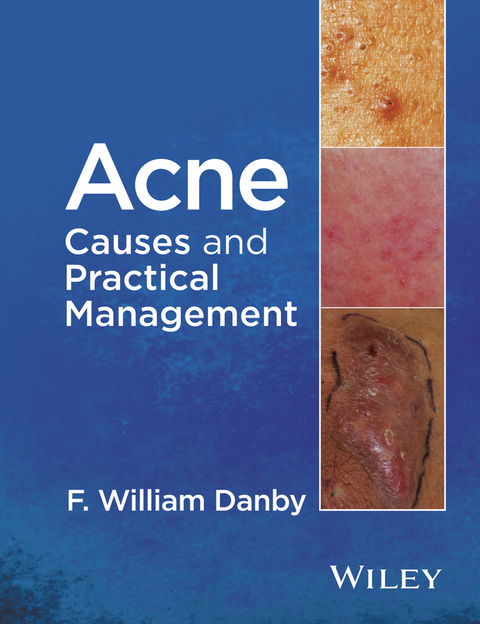
Acne (eBook)
John Wiley & Sons (Verlag)
978-1-118-27236-7 (ISBN)
Learn to accurately diagnose, prevent and treat all three acnes using both traditional and novel approaches to understanding the causes and selecting the most effective treatments.
Acne vulgaris is an extremely common condition. It is troublesome to manage, often persisting into middle age. Exact causes are becoming clear and include several hormonal stimulants, some triggered by the Western diet, and a pathogen ignored for decades. Acnes rosacea and inversa (hidradenitis suppurativa) are discussed from entirely new viewpoints.
Acne: Causes and Practical Management will provide readers at all levels with a practical, well-illustrated approach to fully understanding of these disorders, a faster and more cost-effective management regimen and the rationales for their prevention.
In full colour throughout and with over 200 excellent clinical images, key highlights include:
- Full coverage of all acne presentations – acne vulgaris, acne rosacea and acne inversa
- An integrated view of the causes of the varied and overlapping acnes
- Preventive, novel and curative approaches to treatment
- Medical, surgical, dietary and integrated components of management
- Highly practical focus on treatment based on emerging pathogenetic concepts
Brought to you by one of the world’s leading authorities on the subject, Acne: Causes and Practical Management willbe an essentialpurchase for the dermatologist.
Learn to accurately diagnose, prevent and treat all three acnes using both traditional and novel approaches to understanding the causes and selecting the most effective treatments. Acne vulgaris is an extremely common condition. It is troublesome to manage, often persisting into middle age. Exact causes are becoming clear and include several hormonal stimulants, some triggered by the Western diet, and a pathogen ignored for decades. Acnes rosacea and inversa (hidradenitis suppurativa) are discussed from entirely new viewpoints. Acne: Causes and Practical Management will provide readers at all levels with a practical, well-illustrated approach to fully understanding these disorders; a faster and more cost-effective management regimen and the rationales for their prevention. In full colour throughout and with over 200 excellent clinical images, key highlights include: Full coverage of all acne presentations acne vulgaris, acne rosacea and acne inversa (hidradenitis suppurativa) An integrated view of the causes of the varied and overlapping acnes Preventive, novel and curative approaches to treatment Medical, surgical, and dietary components of management, fully integrated Highly practical focus on prevention, treatment and prophylaxis based on emerging pathogenetic concepts Brought to you by one of the world s leading authorities on the subject, Acne: Causes and Practical Management will be a valuable re-education for the dermatologist and all those who treat or suffer from these three conditions.
F. William Danby, MD, FRCPC is Adjunct Assistant Professor of Dermatology, Geisel School of Medicine at Dartmouth, Hanover, New Hampshire, USA.
Preface
This book came to be written for one very simple reason. Somebody suggested that Martin Sugden, my initial contact at Wiley, approach me to write it. While I had considered the possibility of a book—indeed, friends and colleagues had encouraged me to take the leap—the search for a publisher seemed daunting and life’s other commitments (plus a serious lifelong expertise in procrastination) ruled.
Martin’s invitation arrived at a time when, as the reader will see, there are very significant new thoughts and understandings arriving in the world of the acnes. Indeed, some have not reached the shores of North America, some have not yet been published, and some have just recently popped up as novel considerations. The field is moving fast enough that leaving something out is all but inevitable, and if you find I missed something you consider significant, please do let me know your thoughts. Now seems like a great time to start a file for a second edition.
All of this new material needs to be sifted and evaluated for logical consistency with the whole, and such reflection and consideration takes time. For me such time is usually stolen from the beginning of the day’s busy activities, in the shower. Indeed, it would not be too big a stretch to say that this present effort was written, or at least conceived and conceptualized and seriously mulled over, during about 40 years of morning showers.
Ultimately, this book is written for our patients. We commonly use the phrase “suffering from acne,” but usually without thinking how deeply the suffering goes.
As a teenager with bad skin, Janis Ian knew about that. She composed and sang “At Seventeen” in the early 1970s. Her poignant lyrics are a lesson in the impact of acne on self-image.
I learned the truth at seventeen
That love was meant for beauty queens
And high school girls with clear skinned smiles
Who married young and then retired.
The valentines I never knew,
The Friday night charades of youth,
Were spent on one more beautiful.
At seventeen I learned the truth…
And those of us with ravaged faces,
Lacking in the social graces,
Desperately remained at home
Inventing lovers on the phone
Who called to say “come dance with me”
And murmured vague obscenities.
It isn’t all it seems at seventeen…
To those of us who knew the pain
Of valentines that never came
And those whose names were never called
When choosing sides for basketball.
It was long ago and far away,
the world was younger than today
when dreams were all they gave for free
to ugly duckling girls like me…
These lyrics have haunted me for decades while I’ve looked for explanations in the hope that the “ugly ducklings” of both sexes can eventually be spared the pains brought on by “the blight of youth.”
My initial interest in hormones, the fuel of the acnes, was “by exclusion” rather than by choice. As final-year dermatology residents in Toronto, we were each expected to write a review on a “basic science” topic. The only subject that was of any marginal interest to me and had not been dealt with by my senior residents was “Hormones and the Skin.” It has been a long road from 24-hour urine collections for ketogenic steroids, through the early days of dialyzable free testosterone, to the newly revealed mysteries of FoxO1 and mTORC1.
The original stimulus to look into diet as a cause of acne came from the first dermatologist in our family, my father. He had a case of a young dairy farmer whose well water was contaminated by agricultural bromides (see “The Farmer’s Boys,” Section 2.3.1). That original question got me wondering about diet as a cause of acne, partly because I was curious about the role of chocolate, and that led in due course to this book being written. I set up a semiquantitative patient questionnaire that included just about all common foods and drinks. I suspected the relationship between acne and milk after about two years of patient interviews done over 35 years ago. Osler’s admonition to “Listen to your patient, he is telling you the diagnosis” led not to the diagnosis but to a strong suspicion of the etiology of acne.
Already interested in “hormones in the skin,” I had been keeping an eye on the literature. I was unaware of the presence of hormones in milk until Janet Darling’s early 1970s papers came to my attention. “Chance favored the prepared mind,” and I found that a Pasadena dermatologist named Jerome Fisher had been studying acne, milk, and the steroid hormones he suspected in milk for years, since the early 1960s. A reference to his work appeared in Time magazine in 1966. I contacted him in 1979 and he sent me the carbon copies of his unpublished 1965 manuscript. Charles Bird at Queen’s Endocrinology did our first ‘free T’ assays. Thus, steroid hormones remained my prime suspects. By 2000 I felt that I was in a position to propose a formal study, so I asked for a meeting with Walter Willett, professor and head of the School of Nutrition at the Harvard School of Public Health.
That study was underway at Harvard in 2002 when Loren Cordain’s paper raised the question of the role of a low-glycemic-load (or Paleolithic) diet in preventing acne and other Western diseases. It had not occurred to the multinational team of which Cordain was a member that the absence of acne might have been due to the absence of dairy products. A phone call confirmed that the dairy intake of these tribes was indeed exceptionally low (in the New Guinea group) and absolute zero (in the Paraguay group). In late 2002 Clement Adebamowo, the Harvard group’s principal investigator, produced preliminary evidence of the epidemiological link between milk and acne in the Nurses Health Study data. In early 2005, the first of three papers demonstrating the significant association was published.
Meanwhile, another member of the Papua–Paraguay team returned to Australia and was involved in the design and conduct of several clinical studies that linked low-glycemic diets to clinical improvement of acne in a small number of young men. This reinforced the Australian thesis that the prime dietary mover of acne was the high glycemic load of the Western diet. Indeed, the most active collaborator, Robyn Smith, was awarded her PhD on the strength of that high-glycemic-load theory just a few short years after Clement Adebamowo earned his ScD based on the dairy and milk association with acne. Their contributions are reviewed in Appendix B.
Subsequently, Professor Bodo Melnik has presented us with what appear to be the pieces of the jigsaw puzzle that allow us to see almost the complete picture.
Understanding the complex relationships that form the background for these three diseases is essential in order to provide the “deliverable,” that is, a book on the acnes that will be, in Martin’s succinct description, “practical.” Within that word are several messages, including the need to write for a broad audience, from researcher to patient, and from busy dermatologists to patients’ parents. The researcher will need to forgive the helping hand of explanation that is occasionally extended to bring readers up to speed, and the beginner in the field will need to put up with (or look up) some unavoidable jargon. If and where I fail, always remember that Wikipedia is your friend, and deserves your support. While much of the book provides the necessary basic science to help with comprehension of the mechanisms discussed, this is not an academic text. Others are better at that than I. Nor will this be a catalog of every paper written on each and every aspect of these disorders, supplemented with my comments. It is instead my personal view, from the practical side, an overarching synthesis supported by selected references.
The first aim of this book is to provide practical guidance to managing the three acnes. There are several other books on acne that aim at being practical, so why is this book different? Simple. Because I believe that the longstanding concepts of the acnes’ cause and development, as still held by other authors are, in a word, outdated. That leads to the second aim of the book, to update the concepts upon which therapy must be based. The third and most important aim is to encourage prevention of the processes that lead to and perpetuate the acnes, ultimately making active, expensive, drug-based therapy unnecessary.
My intent is to provide the practical options, as I see them, for both patients and prescribers. At the same time I hope it will serve to nudge scholars and researchers in directions that remain both unexplored and promising.
It will also guide you to cost-effective therapy. I am not interested in marketing anything. I have no present financial interest in anything I am discussing, but if you look up the medical literature you will find that I was involved in paid clinical trials in the distant past. That means I may annoy some of my colleagues. My challenge will be to disagree without being disagreeable. Because this work describes three variants of a single disorder, there are shared features and shared pathogenic processes. This leads to unavoidable duplication. The alternative would be to lead the reader on a merry chase...
| Erscheint lt. Verlag | 19.11.2014 |
|---|---|
| Sprache | englisch |
| Themenwelt | Medizin / Pharmazie ► Medizinische Fachgebiete ► Dermatologie |
| Schlagworte | acne • acne hormones • acne inversa • Acne rosacea • Acne vulgaris • Akne • Allgemeinpraxis, hausärztliche Praxis • Allgemeinpraxis, hausärztliche Praxis • Dermatologie • Dermatology • General Practice/Family Practice • Medical Science • Medizin • Skin |
| ISBN-10 | 1-118-27236-6 / 1118272366 |
| ISBN-13 | 978-1-118-27236-7 / 9781118272367 |
| Informationen gemäß Produktsicherheitsverordnung (GPSR) | |
| Haben Sie eine Frage zum Produkt? |
 EPUB (Adobe DRM)
Kopierschutz: Adobe-DRM
Adobe-DRM ist ein Kopierschutz, der das eBook vor Mißbrauch schützen soll. Dabei wird das eBook bereits beim Download auf Ihre persönliche Adobe-ID autorisiert. Lesen können Sie das eBook dann nur auf den Geräten, welche ebenfalls auf Ihre Adobe-ID registriert sind.
Details zum Adobe-DRM
Dateiformat: EPUB (Electronic Publication)
EPUB ist ein offener Standard für eBooks und eignet sich besonders zur Darstellung von Belletristik und Sachbüchern. Der Fließtext wird dynamisch an die Display- und Schriftgröße angepasst. Auch für mobile Lesegeräte ist EPUB daher gut geeignet.
Systemvoraussetzungen:
PC/Mac: Mit einem PC oder Mac können Sie dieses eBook lesen. Sie benötigen eine
eReader: Dieses eBook kann mit (fast) allen eBook-Readern gelesen werden. Mit dem amazon-Kindle ist es aber nicht kompatibel.
Smartphone/Tablet: Egal ob Apple oder Android, dieses eBook können Sie lesen. Sie benötigen eine
Geräteliste und zusätzliche Hinweise
Buying eBooks from abroad
For tax law reasons we can sell eBooks just within Germany and Switzerland. Regrettably we cannot fulfill eBook-orders from other countries.
aus dem Bereich