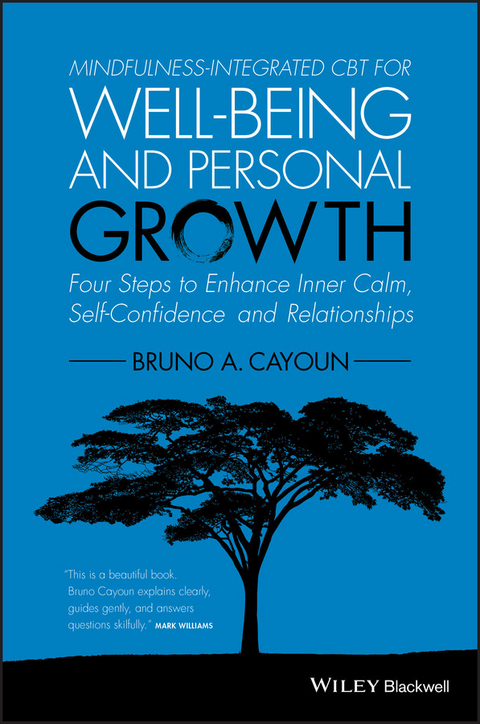
Mindfulness-integrated CBT for Well-being and Personal Growth (eBook)
John Wiley & Sons (Verlag)
978-1-118-50912-8 (ISBN)
This is a clear, streamlined guide to using Mindfulness-integrated Cognitive Behavior Therapy (MiCBT) to improve well-being and manage a range of personal and interpersonal difficulties.
- Integrates the core principles of Eastern mindfulness with the Western evidence-based principles of CBT
- Provides simple and practical, step-by-step guidance to understanding and implementing the four stages of MiCBT with helpful FAQ sections, success stories from patients, and free access on the companion website to the author’s MP3 audio instructions for basic and advanced mindfulness meditation techniques
- Written by the foremost expert in this area, with over 25 years’ experience in mindfulness meditation and training from around the world
- Perfect for individuals working toward self-improvement on their own, as well as professionals assisting clients in individual or group therapy
Dr Bruno Cayoun is Director of the MiCBT Institute and a clinical psychologist in private practice in Hobart, Australia. He is the principal developer of Mindfulness-integrated Cognitive Behavior Therapy (MiCBT) and has been teaching this approach to mental health professionals internationally since 2003. He has practiced mindfulness meditation for over 25 years and has undergone extensive training in France, Nepal, India, and Australia. Dr Cayoun supervises mindfulness research at the MiCBT Institute and in collaboration with several universities in Australia. He is the author of Mindfulness-integrated CBT: Principles and Practice (Wiley Blackwell, 2011), as well a range of MiCBT resources for professionals.
This is a clear, streamlined guide to using Mindfulness-integrated Cognitive Behavior Therapy (MiCBT) to improve well-being and manage a range of personal and interpersonal difficulties. Integrates the core principles of Eastern mindfulness with the Western evidence-based principles of CBT Provides simple and practical, step-by-step guidance to understanding and implementing the four stages of MiCBT with helpful FAQ sections, success stories from patients, and free access on the companion website to the author s MP3 audio instructions for basic and advanced mindfulness meditation techniques Written by the foremost expert in this area, with over 25 years experience in mindfulness meditation and training from around the world Perfect for individuals working toward self-improvement on their own, as well as professionals assisting clients in individual or group therapy
DR BRUNO CAYOUN is Director of the MiCBT Institute and a clinical psychologist in private practice in Hobart, Australia. He is the principal developer of Mindfulness-integrated Cognitive Behavior Therapy (MiCBT) and has been teaching this approach to mental health professionals internationally since 2003. He has practiced mindfulness meditation for over 25 years and has undergone extensive training in France, Nepal, India, and Australia. Dr Cayoun supervises mindfulness research at the MiCBT Institute and in collaboration with several universities in Australia. He is the author of Mindfulness-integrated CBT: Principles and Practice (Wiley Blackwell, 2011), as well a range of MiCBT resources for professionals.
About the Author vii
Foreword viii
Acknowledgements ix
Introduction 1
Step 1 Personal Stage 7
1 Committing to Learn and Change 9
2 Week 1: Establishing Self-Care and Feeling Grounded 22
3 Inheritance and Maintenance of Unhappiness 30
4 Integrating Western Science and Eastern Wisdom 45
5 Week 2: Regulating Attention and Gaining Mastery Over Your Mind 60
6 Learning About Your Mind 81
7 Week 3: Understanding and Regulating Emotions 92
8 The Deeper Nature of Your Emotions 108
9 Week 4: Applying Mindfulness Skills in Daily Life 119
Step 2 Exposure Stage 145
10 Week 5: Regulating Behavior to Overcome Avoidance 147
11 Week 6: Improving Self-Confidence 168
Step 3 Interpersonal Stage 187
12 Week 7: Improving Relationships with Interpersonal Mindfulness 189
13 Week 8: Improving Relationships with Mindful Communication 212
Step 4 Empathic Stage 233
14 Week 9: Feeling Compassionate and Connected with Others 235
Shaping Your Future 263
15 Maintaining Well-Being and Personal Growth 265
Index 289
"This is a beautiful book. Bruno Cayoun has distilled the deepest wisdom of an ancient Buddhist meditation tradition and combined it with the best modern clinical science to offer this program. As he says, with mindfulness training, you can tune your attention so that you can perceive your experiences, understand them and respond to them without needing to react in order to change them. He explains clearly, guides gently, and answers questions skilfully. Using problems as tools through which to learn, he shows you a way to respond wisely to difficulties that can destroy the quality of your personal, family and working life. With this book as a trusted guide, he invites you to discover how you can let go of suffering, restore equilibrium, and rediscover peace. Teachers, students and practitioners everywhere, whether new to or experienced in the practice of mindfulness, will greatly value this book." --Mark Williams, Emeritus Professor of Clinical Psychology, University of Oxford, and Co-author of The Mindful Way Workbook
"Bruno Cayoun is a master of mindful living. Here he skillfully blends age-old wisdom, recent research, and practical methods into four essentially helpful steps for all who wish to live a fulfilling life. I have learnt heaps from it - and am sure you will, too." --George W Burns, Adjunct Professor of Psychology, Cairnmillar Institute, Melbourne, Australia, Author of 101 Healing Stories and Happiness, Healing, Enhancement
"This book marries powerful tools from Buddhist meditative practice with contemporary behavioral science for a comprehensive look at transforming suffering. The result is an important contribution to a growing interdisciplinary field." --Sharon Salzberg, Co-Founder of the Insight Meditation Society and author of Real Happiness at Work
"What an amazing book! I could feel the years of wisdom and practice flowing out of each chapter. Mindfulness-integrated Cognitive Behavior Therapy is a jewel that honours both the Buddhist and Western psychological traditions of turning suffering into well-being. You will treasure what Bruno Cayoun offers whether you are looking for a way through personal distress or wish to learn how to bring the elements of Buddhist Psychology into your professional work. Each chapter clearly describes how to cultivate the ancient practice of meditation and supports the practice with solid science. The "question and answer" sections are informative, gentle and direct their guidance making them indispensable to novice and ongoing practitioners alike. You will find this book opens the gate to a sustainable way of living with challenges and a quiet, composed approach to life as it presents itself to you, moment by moment. All you have to do is walk in." --Lynette Monteiro, PhD, Co-Director of Ottawa Mindfulness Clinic, Clinical Professor, University of Ottawa, Co-Author of Mindfulness Starts Here: An eight-week guide to skillful living
At last! A self-help book incorporating mindfulness that does not treat the reader as a simpleton. Dr Cayoun carefully explains the science behind practicing mindfulness combined with right thinking to live a happier and more satisfying life. It is highly practical with easy exercises and lots of guidance from a perspective informed by Buddhist spirituality and Clinical Psychology.--Dr Bruce A Stevens, Associate Professor in Clinical Psychology, University of Canberra, Co-author of Happy Ever After? A Practical Guide to Relationship Counselling for Clinical Psychologists
Introduction
If we don’t change, we don’t grow. If we don’t grow, we aren’t really living.
—Gail Sheehy
We all have a fundamental yearning for long-lasting well-being. No matter what we do, we usually do it with the belief that it will either relieve us of unhappiness or increase our happiness. But happiness is more than the mere absence of unhappiness. As you have opened this book, the chances are that this is already clear to you.
When we feel a moment of joy, how long does it last? We may ask ourselves, “Now I have a job and a partner who I love, why do I feel more frustrated than when I didn’t?” We may reflect, “I have everything to be happy about and yet I feel so stressed and my sleep is so restless,” or, “I have many friends who care for me but I can’t really be honest about what’s going on with anyone; I feel very alone.” The problems increase when we can’t make sense of our life or when we don’t have a clear sense of purpose. This is even more so after losing someone we love or having to let go of a valued lifestyle.
Even happiness leads to suffering when it is based on particular conditions. This is not a paradox. It is simply because the conditions that allow us to be happy at a given time will change, sooner or later. They are simply impermanent. Accordingly, what we generally define as “feeling happy” is also impermanent. So, is there such a thing as real happiness? One that lasts, that we can rely on, that we are certain will be here tomorrow? Unless we outgrow the thinking, feeling and behavior patterns that contribute to our dissatisfaction, the momentary joy that we experience hardly makes up for the stresses of daily life.
Our desire to grow mentally and emotionally increases once our physical growth is complete. Whether this is out of inspiration or desperation, the process and need for growth never ends. It is part of our life, part of evolution. This applies to consciousness and wisdom. Committing to grow is the will to benefit both others and ourselves. As such, it is an act of generosity and kindness. Have you ever thought, “I want to be a better person”? In saying so, most people mean, “I want to grow,” or, “I want to be wiser and enjoy life more.” If this applies to you, then you are one of the people for whom I wrote this book, in an attempt to share the best of my knowledge, practice and experience so that you might fulfill this wish and benefit others by the same token.
This book, along with the accompanying audio instructions for your training, contains all you will need to develop invaluable mental, emotional and behavioral skills – skills that we don’t inherit or learn through reading or observing others, no matter how blessed we may have been with kind and mindful parents and grandparents. The step-by-step experiential approach will expand your understanding of your experiences and those of others. It will enable you to witness rapid change, day after day, within a few weeks. Across countries and cultures, people of all ages (from about age 7), even those with severe and often chronic mental health problems, report remarkable benefits in a relatively short period of time.
You may have heard from the media, a family member, a friend or even a therapist, that the practice of mindfulness has the potential to assist in feeling peaceful and being more present in our experiences. Accordingly, it is increasingly included in well-being and personal growth programs. You may also have done some practice yourself. To be mindful is to be attuned to the events that are taking place in the present moment in a way that is the least judgmental and the most objective as possible. With mindfulness, we become attuned in such a way that we can perceive our experiences, understand them and respond to them without needing to react in order to change them. This includes experiences that are taking place within the mind and body. Reliable research is now showing evidence that people can learn mindfulness skills and benefit from them through self-help programs, [1] such as the one described in this book.
Mindfulness training has found its place at the very core of therapeutic programs [2, 3] and is currently one of the most discussed approaches for general well-being and personal growth for the general public [4]. Courses are offered in schools to improve students’ attentiveness and well-being, [5] to help health professionals cope better with work stress [6] and improve their therapeutic efficacy, [7] and to improve staff’s quality of life in companies such as Google [8] and in the US military [9].
This book will guide you through a set of evidence-based methods grouped in a unique approach called Mindfulness-integrated Cognitive Behavior Therapy (or MiCBT), for the purpose of increasing your well-being and contributing to your personal growth. MiCBT (pronounced M-I-C-B-T) is a sophisticated integration of mindfulness training, in the Burmese Vipassana tradition, [10] with well-established and novel techniques used in Cognitive Behavior Therapy (CBT).
MiCBT is a four-stage approach that has its origins in my own practice and transformative experience of mindfulness meditation, in the Burmese Vipassana tradition, in March 1989. The subsequent 11 years of study and theoretical conceptualization led me to integrate mindfulness and CBT – two important Eastern and Western psychological systems for reducing suffering. The trials of this approach in clinical settings started in 2001, initially with groups of people who had problems managing anger or anxiety. It took another three years of testing and refining the four stages before every skill taught in the program was rendered universally understandable, testable and applicable for a wide range of people and difficulties.
The efficacy of MiCBT has also been informed by 13 years of modification based on peoples’ feedback, supervision of psychology interns and experienced therapists, as well as empirical studies [11]. The program has been used successfully in both clinical and nonclinical settings since 2001. Over the years, it has become clear that one of the reasons for the success of this program is its ability to help people grow. In therapeutic settings, they outgrow the fundamental causes of their long-lived problems and move on to a more fulfilling life.
In this program, you will learn to practice mindfulness meditation, as taught for the past 2,500 years, and use Western psychological skills to change unhelpful habits of mind and emotional reactivity. You will be able to investigate and understand the deeper reality underlying your experiences in order to create or enhance your inner calm, self-confidence and the quality of your relationships. This will take between eight and twelve weeks, depending on what suits you best.
Stage 1 will teach you mindfulness skills, to notice and let go of unhelpful thoughts and emotions in order to address life’s challenges successfully. You will learn deep insight and equanimity, and realize that you don’t have to be prey to every thought that enters your mind and every emotion that you feel. During Stage 2, you will make use of these self-regulation skills in daily situations that you might be avoiding to prevent discomfort. In Stage 3, you will learn to develop better interpersonal understanding and communication skills in the face of tense situations, and learn to not react to others’ reactivity. With Stage 4, you will learn to increase your capacity to be kind to yourself and compassionate to others in your daily actions, leading to a deep sense of care and connectedness with people.
This book is written primarily to improve your emotional well-being and sense of contentment, whether you suffer from psychological and emotional difficulties or not. However, a note of caution is important at this stage. If you are experiencing severe psychological symptoms, I urge you to seek professional help and follow your therapist’s advice. No matter how useful a book and audio instructions may be, they don’t match the knowledgeable input and training of a skilled therapist. On the other hand, your therapist may agree to assist you in your use of the MiCBT program described in this book. In this case, she or he may benefit from reading my previous book [10] which was principally written for psychologists and other mental health professionals intending to implement MiCBT with their clients.
How to use this book
This book is intended to serve two purposes. As a self-help book for well-being and personal growth, it is a realistic and practical guide for you to develop the skills on your own. You will feel as if a guide is accompanying you, week after week, until the program ends. The second purpose is the book’s use as a helpful assistant if you are undertaking MiCBT with a therapist to resolve psychological conditions. It will help clarify concepts and tasks, and provide a wider understanding of the skills that you will learn than a therapist is usually able to provide within the time constraints of therapy sessions. If you have had long-term mental health issues, I encourage you to work initially with a therapist. You will then have the book as ongoing supporting material.
Whatever your need and purpose may be, you can use this book in several ways, but here is the way it is intended to be used....
| Erscheint lt. Verlag | 21.11.2014 |
|---|---|
| Sprache | englisch |
| Themenwelt | Geisteswissenschaften ► Psychologie ► Allgemeine Psychologie |
| Geisteswissenschaften ► Psychologie ► Verhaltenstherapie | |
| Medizin / Pharmazie ► Medizinische Fachgebiete ► Psychiatrie / Psychotherapie | |
| Schlagworte | Achtsamkeit • Clinical psychology • Cognitive behavioral therapy (CBT) • Cognitive Psychology • Klinische Psychologie • Kognitive Psychologie • Kognitive Verhaltenstherapie • <p>Cognitive behavior therapy, BF Skinner, operant conditioning, mindfulness meditation, MiCBT, interpersonal skills, well-being, happiness, empathy, Buddhist meditation, psychological therapies, mental health, positive psychology, self-confidence, psychology, group therapy</p> • Psychologie • Psychology |
| ISBN-10 | 1-118-50912-9 / 1118509129 |
| ISBN-13 | 978-1-118-50912-8 / 9781118509128 |
| Informationen gemäß Produktsicherheitsverordnung (GPSR) | |
| Haben Sie eine Frage zum Produkt? |
 EPUB (Adobe DRM)
Kopierschutz: Adobe-DRM
Adobe-DRM ist ein Kopierschutz, der das eBook vor Mißbrauch schützen soll. Dabei wird das eBook bereits beim Download auf Ihre persönliche Adobe-ID autorisiert. Lesen können Sie das eBook dann nur auf den Geräten, welche ebenfalls auf Ihre Adobe-ID registriert sind.
Details zum Adobe-DRM
Dateiformat: EPUB (Electronic Publication)
EPUB ist ein offener Standard für eBooks und eignet sich besonders zur Darstellung von Belletristik und Sachbüchern. Der Fließtext wird dynamisch an die Display- und Schriftgröße angepasst. Auch für mobile Lesegeräte ist EPUB daher gut geeignet.
Systemvoraussetzungen:
PC/Mac: Mit einem PC oder Mac können Sie dieses eBook lesen. Sie benötigen eine
eReader: Dieses eBook kann mit (fast) allen eBook-Readern gelesen werden. Mit dem amazon-Kindle ist es aber nicht kompatibel.
Smartphone/Tablet: Egal ob Apple oder Android, dieses eBook können Sie lesen. Sie benötigen eine
Geräteliste und zusätzliche Hinweise
Buying eBooks from abroad
For tax law reasons we can sell eBooks just within Germany and Switzerland. Regrettably we cannot fulfill eBook-orders from other countries.
aus dem Bereich