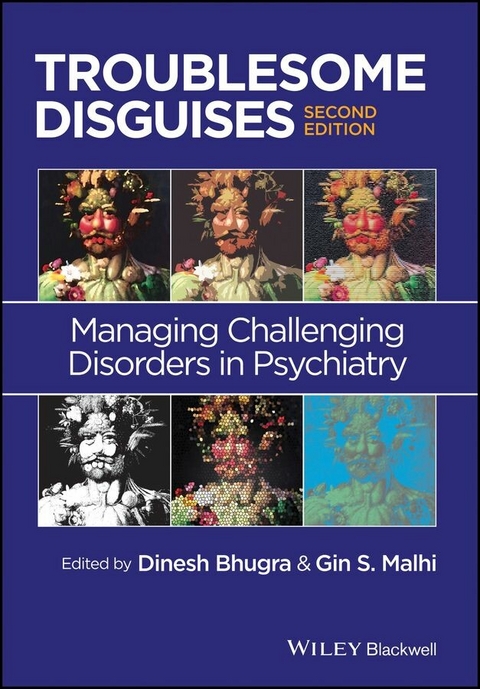
Troublesome Disguises (eBook)
John Wiley & Sons (Verlag)
978-1-118-79960-4 (ISBN)
Troublesome Disguises examines psychiatric conditions which are not necessarily uncommon, rare or exotic but are challenging for the clinician who may struggle to reach a diagnosis and to set up management strategies.
However, with familiarity, these conditions can and should be recognised. This new edition is an exercise in consciousness-raising as well as a warning to beware of diagnostic systems which, despite their many virtues, may become too influential and may perpetuate errors which are to the detriment of patients.
For the clinician struggling to understand and treat patients who fail to fit the usual diagnostic categories, Troublesome Disguises provides wise instruction in the virtue of entertaining doubts, as well as practical advice for the assessment and management of atypical cases.
Dinesh Bhugra, Professor of Mental Health and Cultural Diversity, Institute of Psychiatry, King’s College London, UK
Gin S. Malhi, Professor of Psychiatry, Sydney Medical School, The University of Sydney and Head of Department, Royal North Shore Hospital, Sydney, Australia
Troublesome Disguises examines psychiatric conditions which are not necessarily uncommon, rare or exotic but are challenging for the clinician who may struggle to reach a diagnosis and to set up management strategies.However, with familiarity, these conditions can and should be recognised. This new edition is an exercise in consciousness-raising as well as a warning to beware of diagnostic systems which, despite their many virtues, may become too influential and may perpetuate errors which are to the detriment of patients.For the clinician struggling to understand and treat patients who fail to fit the usual diagnostic categories, Troublesome Disguises provides wise instruction in the virtue of entertaining doubts, as well as practical advice for the assessment and management of atypical cases.
Dinesh Bhugra, Professor of Mental Health and Cultural Diversity, Institute of Psychiatry, King's College London, UK Gin S. Malhi, Professor of Psychiatry, Sydney Medical School, The University of Sydney and Head of Department, Royal North Shore Hospital, Sydney, Australia
Contributors vii
Preface xi
Part I: Challenging psychiatric conditions
1 Shared pathologies 3
German E. Berrios and Ivana S. Marková
2 Paraphrenia 16
Richard Atkinson, David Jolley, and Alistair Burns
3 Brief reactive psychoses 27
Jüergen Zielasek and Wolfgang Gaebel
4 Cycloid psychoses 44
Andrea Schmitt, Berend Malchow, Peter Falkai, and Alkomiet Hasan
5 Borderline personality disorder 57
John M. Oldham
6 Recurrent self-harm 67
Rohan Borschmann and Paul Moran
7 Finding the truth in the lies: A practical guide to the assessment of malingering 85
Holly Tabernik and Michael J. Vitacco
8 Recurrent brief depression: "This too shall pass"? 100
David S. Baldwin and Julia M. Sinclair
9 Conversion disorders 114
Santosh K. Chaturvedi and Soumya Parameshwaran
10 ADHD controversies: more or less diagnosis? 129
Florence Levy
11 Post-traumatic stress disorder: Biological dysfunction or social construction? 140
Richard A. Bryant
12 Bipolar disorder: A troubled diagnosis 153
Gin S. Malhi and Michael Berk
Part II: Rare psychotic disorders
13 Misidentification delusions 169
Michael H. Connors, Robyn Langdon, and Max Coltheart
14 Delirium 186
Sean P. Heffernan, Esther Oh, Constantine Lyketsos, and Karin Neufeld
15 Paraphilias and culture 199
Oyedeji Ayonrinde and Dinesh Bhugra
16 Pseudodementia: History, mystery and positivity 218
Alistair Burns and David Jolley
17 Culture-bound syndromes 231
Oyedeji Ayonrinde and Dinesh Bhugra
18 Delusional infestations 252
Julio Torales
19 Baffling clinical encounters: Navigating a pain and psychiatric quichua syndrome 262
Sioui Maldonado-Bouchard, Lise Bouchard, and Mario Incayawar
Index 273
Chapter 1
Shared pathologies
German E. Berrios1 and Ivana S. Marková2
1 Emeritus Chair of the Epistemology of Psychiatry, Emeritus Consultant Neuropsychiatrist, Department of Psychiatry, University of Cambridge, Cambridge, UK
2 Reader/Honorary Consultant in Psychiatry, Centre for Health and Population Sciences, Hull York Medical School, University of Hull, Hull, UK
Definition
Until recently “Shared Pathologies” was the official DSM-IV-T [1] name for clinical phenomena having in common the fact that persons, through their socio-emotional relationships, may share mental symptoms or disorders similar in form and/or content. Such temporal concurrence has led clinicians to calling such complaints shared, communicated, transferred, or passed on. Although the A + B combination (folie à deux) is the commonest form of the disorder, this can also occur in families (folie à famille) or even larger social groups (schools or other institutions). This, together with the fact that the terms shared and communicated are (covertly) explanatory, has impeded the formulation of an adequate operational definition.
Both clinically and historically, folie à deux remains the core clinical phenomenon. Recently, in U.S. psychiatry, the category “297.3 Shared Psychotic Disorder (Folie à Deux)” [1] has been replaced by “298.8 (F28) 4. Delusional symptoms in partner of individual with delusional disorder” [2].
A similar concept appears in the blue (descriptive) World Health Organization (WHO) book [3]: “F24 Induced delusional disorder: A delusional disorder shared by two or more people with close emotional links. Only one of the people suffers from a genuine psychotic disorder; the delusions are induced in the other(s) and usually disappear when the people are separated. Includes: folie à deux; induced paranoid or psychotic disorder.”
And in the green (research criteria) WHO book [4]: “F24 Induced delusional disorder”:
- The individual(s) must develop a delusion or delusional system originally held by someone else with a disorder classified in F20—F23.
- The people concerned must have an unusually close relationship with one another, and be relatively isolated from other people.
- The individual(s) must not have held the belief in question before contact with the other person, and must not have suffered from any other disorder classified in F20—F23 in the past.
However, clinical experience suggests the existence of other presentations. For example, cases have also been reported of “contagious” obsessionality and hypochondriacal and suicidal behavior. Furthermore, if “communication” or “transfer” is to be considered as a definitional criterion, then phenomena such as the transfer of anesthesia or motor paralysis from one side of the body to the other (with the help of magnets) or indeed from one patient to another have to be included.
Lack of an adequate operational definition has precluded meaningful epidemiological research. It would be hasty, however, to conclude that the shared pathologies are clinical curiosities. Indeed, their peculiar multi-subject structure calls into question the individualistic metaphysics on which the definition of mental disorder is currently based, and challenges the plausibility of current neurobiological models of mental disorders (more on this below).
History
It is now about 150 years since folie à deux entered the nosological catalogue. Historians disagree on who reported it first. For example, Lazarus [5] states, “it was originally described by Lasègue and Falret” but Gralnick [6] and Cousin and Trémine [7] have shown that it all depends on how “locus classicus” is defined. The latter is a notion that can be characterized as resulting from the historical convergence of a name, a concept or mechanism, and a behavior [8]. Thus, if “contagion” [9] is considered as the concept involved in the convergence then Hoffbauer should be considered as the initiator; if “induction” were to be considered instead then it would be Lehmann. If the emphasis was to be on the behavior involved then the first to report the phenomenon would have to be Baillarger or Dagron. Finally, if the term folie à deux itself is to be used as a criterion then Lasègue & Falret should claim the accolade.
Deciding on priority has bedeviled the history of folie à deux since its inception. The official story goes that although some earlier alienists may have noticed folie à deux it was Lasègue and Falret who, in presenting a case to the Société Médico Psychologique in 1873, rounded it off as a new clinical phenomenon [6, 10]. Lasègue & Falret went on to publish the same paper in 1877 in two Journals: Archives Générales de Médecine [11] and Annales Médico-Psychologiques [12].
The historical reality is more complex. In his “Rectificatory note concerning the history of communicated insanity—folie à deux,” Régis [13] noticed that Lehmann had identified Baillarger as the “first” who had reported cases suffering from this disorder in 1857. Régis went on to confirm this claim and stated that in his “Quelques exemples de folie communiquée” [14] Baillarger had not only reported four cases but also provided the very diagnostic criteria that were to reappear in the work by Lasègue and Falret [11, 12]. In the debate that followed Arnaud [15] tried to redefine the locus classicus in favor of Lasègue and Falret: “the scientific era in the study of folie à deux only starts in 1873”; and Halberstadt agreed [9]. But what did Arnaud mean by “scientific era”? Why did he dismiss Baillarger’s report as “non-scientific”? It must be concluded that in Arnaud’s hands the term scientific was little more than a rhetorical device used to resolve an ongoing rivalry between two psychiatric coteries.
Soon enough a small industry developed around folie à deux. According to the phenomenology of the cases found and the transmission mechanisms proposed, four types were described: folie imposée (as described by Lasègue and Falret [11, 12]; folie simultanée (reported by Régis in his doctoral thesis of 1880) [16]; folie communiquée (reported by Marandon de Montyel in 1881) [17] and folie induite [18]. By the turn of the century, the main risk factors had also been listed: association, dominance, lack of blood relationship, premorbid-personality, gender, and type of delusion [19].
The concept of folie à deux crossed the English Channel swiftly. Savage wrote on it in the Journal of Mental Science [19], Tuke in the British Medical Journal [20] and in Brain [21], and Ireland [22] included a discussion in his book The Blot upon the Brain. By the end of the 19th century, all that could realistically be said on the subject had been summarized by Tuke [23]:
- The influence of the insane upon the sane is very rare, except under certain conditions, which can he laid down with tolerable accuracy;
- As an almost universal rule, those who become insane in consequence of association with the insane, are neurotic or somewhat feebleminded;
- More women become affected than men;
- It is more likely that an insane person able to pass muster, as being in the possession of his intellect, should influence another in the direction of his delusion, than if he is outrageously insane. There must be some method in his madness;
- The most common form which cases of communicated insanity assume is that of delusion, and specially delusion of persecution, or of being entitled to property of which they are defrauded by their enemies. Acute mania, profound melancholia, and dementia, are not likely to communicate themselves. If they exert a prejudicial effect, it is by the distress these conditions cause in the minds of near relatives;
- A young person is more likely to adopt the delusion, of an old person than vice versa, specially if the latter be a relative with whom he or she has grown up from infancy;
- It simplifies the comprehension of this affection, to start from the acknowledged influence which a sane person may exert upon another sane person. It is not a long road from this to the acceptance of a plausible delusion, impressed upon the hearer with all the force of connection and the vividness of a vital truth;
- It is not easy to determine to what extent the person who is the second to become insane , affects in his turn the mental condition of the primary agent. Our own cases do not clearly point to this action, but there have been instances in which this has occurred, the result being that the first lunatic has modified his delusions in some measure, and the co-partnership, so to speak, in mental disorder, presents a more plausible aspect of the original delusion (Vol. 1, p. 241).
Current publications do little more than repeat what has been said in the classic texts.
Clinical phenomena
According to the received view, the clinical categories folie à deux and folie communiquée were first constructed in France by Lasègue...
| Erscheint lt. Verlag | 17.11.2014 |
|---|---|
| Sprache | englisch |
| Themenwelt | Medizin / Pharmazie ► Gesundheitsfachberufe |
| Medizin / Pharmazie ► Medizinische Fachgebiete ► Psychiatrie / Psychotherapie | |
| Schlagworte | Book • Complex • Conditions • Deal • diagnoses • Diagnostic • difficult • Dilemma • Edition • examines common • Experts • internationally • Medical Science • Medizin • Psychiatric • Psychiatrie • psychiatrists • Psychiatry • recognized • Rewritten • Second • sophisticated • Team • troublesome disguises |
| ISBN-10 | 1-118-79960-7 / 1118799607 |
| ISBN-13 | 978-1-118-79960-4 / 9781118799604 |
| Informationen gemäß Produktsicherheitsverordnung (GPSR) | |
| Haben Sie eine Frage zum Produkt? |
 EPUB (Adobe DRM)
Kopierschutz: Adobe-DRM
Adobe-DRM ist ein Kopierschutz, der das eBook vor Mißbrauch schützen soll. Dabei wird das eBook bereits beim Download auf Ihre persönliche Adobe-ID autorisiert. Lesen können Sie das eBook dann nur auf den Geräten, welche ebenfalls auf Ihre Adobe-ID registriert sind.
Details zum Adobe-DRM
Dateiformat: EPUB (Electronic Publication)
EPUB ist ein offener Standard für eBooks und eignet sich besonders zur Darstellung von Belletristik und Sachbüchern. Der Fließtext wird dynamisch an die Display- und Schriftgröße angepasst. Auch für mobile Lesegeräte ist EPUB daher gut geeignet.
Systemvoraussetzungen:
PC/Mac: Mit einem PC oder Mac können Sie dieses eBook lesen. Sie benötigen eine
eReader: Dieses eBook kann mit (fast) allen eBook-Readern gelesen werden. Mit dem amazon-Kindle ist es aber nicht kompatibel.
Smartphone/Tablet: Egal ob Apple oder Android, dieses eBook können Sie lesen. Sie benötigen eine
Geräteliste und zusätzliche Hinweise
Buying eBooks from abroad
For tax law reasons we can sell eBooks just within Germany and Switzerland. Regrettably we cannot fulfill eBook-orders from other countries.
aus dem Bereich