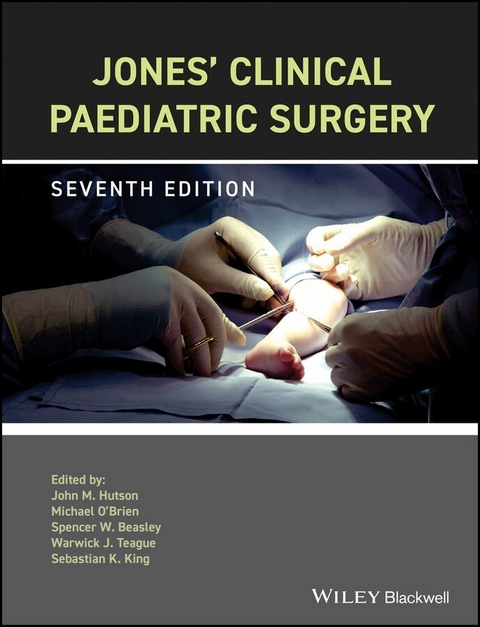
Jones' Clinical Paediatric Surgery (eBook)
John Wiley & Sons (Verlag)
978-1-118-77728-2 (ISBN)
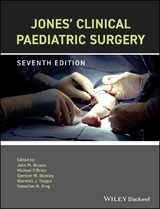
Jones' Clinical Paediatric Surgery provides clear-sighted advice on the surgical options available for young patients.
Building on the popular and successful style of previous editions, this fully revised seventh edition employs a systematic approach to the childhood diseases that need surgical treatment. It includes more case vignettes and colour photographs, expanded coverage on the use of imaging, and updated approaches to management including laparoscopic operations. Key subject areas are supported by case vignettes in a familiar format similar to what might appear in an OSCE viva.
Jones' Clinical Paediatric Surgery is the ideal guide for paeditricians, surgeons and trainees, as well as primary care physicians, junior doctors and medical students.
John M. Hutson, Department of Paediatrics, University of Melbourne, Melbourne, Victoria, Australia; Chair of Paediatric Surgery, Royal Children's Hospital, Parkville, Victoria, Australia Michael O'Brien, Department of Paediatric Urology, Royal Children's Hospital, Parkville, Victoria, Australia; Chief of Division of Surgery, Royal Children's Hospital, Parkville, Victoria, Australia Spencer W. Beasley, Professor of Paediatric Surgery, Christchurch School of Medicine, University of Otago, Christchurch, New Zealand; Clinical Director, Department of Paediatric Surgery, Christchurch Hospital, Christchurch, New Zealand Warwick J. Teague, Department of Paediatric and Neonatal Surgery, Royal Children's Hospital, Parkville, Victoria, Australia Sebastian K. King, Department of Paediatric and Neonatal Surgery, Royal Children's Hospital, Parkville, Victoria, Australia
Contributors vii
Foreword to the first edition by
Mark M Ravitch viii
Tribute to Mr Peter Jones ix
Preface to the seventh edition x
Acknowledgements xi
Part I: Introduction
1 Antenatal Diagnosis: Surgical Aspects 3
2 The care and transport of the newborn 7
3 The Child in Hospital 13
Part II: Neonatal Emergencies
4 Respiratory distress in the newborn 19
5 Congenital Diaphragmatic Hernia 26
6 Oesophageal Atresia and Tracheo-oesophageal Fistula 30
7 Bowel Obstruction 35
8 Abdominal Wall Defects 45
9 Spina Bifida 50
10 Disorders of sex development 57
11 Anorectal Malformations 62
Part III: Head and Neck
12 The Scalp Skull and Brain 69
13 The Eye 80
14 The Ear Nose and Throat 91
15 Cleft Lip Palate and Craniofacial Anomalies 97
16 Abnormalities of the Neck and Face 106
Part IV: Abdomen
17 The Umbilicus 117
18 Vomiting in the First Months of Life 121
19 Intussusception 126
20 Abdominal Pain: Appendicitis? 130
21 Recurrent Abdominal Pain 136
22 Constipation 139
23 Bleeding from the Alimentary Canal 142
24 Inflammatory Bowel Disease 147
25 The Child with an Abdominal Mass 153
26 Spleen, Pancreas and Biliary Tract 158
27 Anus, Perineum and Female Genitalia 164
28 Undescended Testes and Varicocele 171
29 Inguinal Region and Acute Scrotum 175
30 The Penis 183
Part V: Urinary Tract
31 Urinary Tract Infection 191
32 Vesico-ureteric Reflux (VUR) 197
33 Urinary Tract Dilatation 202
34 The Child with Wetting 209
35 The Child with Haematuria 215
Part VI: Trauma
36 Trauma in Childhood 221
37 Head Injuries 228
38 Abdominal and Thoracic Trauma 235
39 Foreign Bodies 241
40 The Ingestion of Corrosives 247
41 Burns 249
Part VII: Orthopaedics
42 Neonatal Orthopaedics 257
43 Orthopaedics in the Infant and Toddler 262
44 Orthopaedics in the Child 267
45 Orthopaedics in the Teenager 275
46 The Hand 280
Part VIII: Chest
47 The Breast 287
48 Chest Wall Deformities 290
49 Lungs, Pleura and Mediastinum 294
Part IX: Skin and Soft Tissues
50 Vascular and Pigmented Naevi 303
51 Soft Tissue Lumps 308
52 Answers to Case Questions 311
Index 317
Chapter 1
Antenatal Diagnosis: Surgical Aspects
Case 1
At 18 weeks' gestation, right fetal hydronephrosis is diagnosed on ultrasonography.
- Q 1.1 Discuss the further management during pregnancy.
- Q 1.2 Does antenatal diagnosis improve the postnatal outlook for this condition?
Case 2
An exomphalos is diagnosed on the 18-week ultrasound scan.
- Q 2.1 What further evaluation is required at this stage?
- Q 2.2 Does this anomaly influence the timing and mode of delivery?
Antenatal diagnosis is one of the most rapidly developing fields in medical practice. While the genetic and biochemical evaluation of the developing fetus provides the key to many medical diagnoses, the development of accurate ultrasound has provided the impetus to the diagnosis of surgical fetal anomalies. At first, it was expected that antenatal diagnosis of fetal problems would lead to better treatment and an improved outcome. In some cases, this is true. Antenatally diagnosed fetuses with gastroschisis are now routinely delivered in a tertiary-level obstetric hospital with neonatal intensive care in order to prevent hypothermia and delays in surgical treatment, and the results of treatment have improved. In other cases, such as congenital diaphragmatic hernia, these expectations have not been fulfilled because antenatal diagnosis has revealed a number of complex and lethal anomalies which in the past never survived the pregnancy and were recorded in the statistics of fetal death in utero and stillbirth.
Indications and timing for antenatal ultrasound
Most pregnancies are now assessed with a mid-trimester morphology ultrasound scan, which is usually performed at 18–20 weeks' gestation [Fig.1.1]. The main purpose of this examination is to assess the obstetric parameters of the pregnancy, but the increasingly important secondary role of this study is to screen the fetus for anomalies. Most fetal anomalies can be diagnosed at 18 weeks, but some only become apparent later in the pregnancy. Renal anomalies are best seen on a 30-week ultrasound scan, as urine flow is low before 24 weeks. Earlier transvaginal scanning may be performed in special circumstances, such as a previous pregnancy with neural tube defect, and increasingly to detect early signs of aneuploidy. Fetal magnetic resonance imaging is increasingly being used to assess the developing fetus in cases of suspected or confirmed fetal anomalies without exposing the fetus or mother to ionising radiation.
Figure 1.1 (a) Encephalocele shown in a cross section of the fetal head. The sac protruding through the posterior skull defect is arrowed. (b) Bilateral hydronephrosis shown in an upper abdominal section. The dilated renal pelvis containing clear fluid is marked. (c) The irregular outline of the free-floating bowel in the amniotic cavity of a term baby with gastroschisis. (d) A longitudinal section through a 14-week fetus showing a large exomphalos. The head is seen to the left of the picture. The large sac (marked) is seen between blurred (moving) images of the arms and legs.
Natural history of fetal anomalies
Before the advent of ultrasonography (as earlier), paediatric surgeons saw only a selected group of infants with congenital anomalies. These babies had survived the pregnancy and lived long enough after birth to reach surgical attention. Thus, the babies coming to surgical treatment were already a selected group, mostly with a good prognosis.
Antenatal diagnosis has exposed surgeons to a new group of conditions with a poor prognosis, and at last, the full spectrum of pathology is coming to surgical attention. For example, posterior urethral valve causing obstruction of the urinary tract was thought to be rare, with an incidence of 1:5000 male births; most cases did well with postnatal valve resection. It is now known that the true incidence of urethral valve is 1:2500 male births, and these additional cases did not come to surgical attention as they developed intrauterine renal failure, with either fetal death or early neonatal death from respiratory failure because of Potter syndrome. It was thought that antenatal diagnosis would improve the outcome of such congenital anomalies, but the overall results have appeared to become worse with the inclusion of these severe new cases.
In the same way, antenatal diagnosis has exposed the significant hidden mortality of congenital diaphragmatic hernia [Fig. 1.2]. Previously, congenital diaphragmatic hernia diagnosed after birth was not commonly associated with multiple congenital anomalies, but now, antenatal diagnosis has uncovered a more severe subgroup with associated chromosomal anomalies and multiple developmental defects. It is now apparent that the earlier the congenital diaphragmatic hernia is diagnosed in utero, the worse the outcome.
Figure 1.2 Cross section of a uterus with marked polyhydramnios. The fetal chest is seen in cross section within the uterus. The fluid-filled cavity within the left side of the chest is the stomach protruding through a congenital diaphragmatic hernia (arrow).
Despite these problems, there are many advantages in antenatal diagnosis. The outcomes of many congenital anomalies are improved by prior knowledge of them before birth.
Management following antenatal diagnosis
Fetal management
Cases diagnosed antenatally may be classified into three groups:
Good prognosis
In some cases, such as a unilateral hydronephrosis, there is no role for active antenatal management, and the main task is to document the progress of the condition through pregnancy with serial ultrasound scans. The detailed diagnosis is made with the more sophisticated range of tests available after birth, and the incidence of urinary tract infections (UTIs) may be reduced with prophylactic antibiotics commenced at birth. Thus, a child with severe vesicoureteric reflux may go through the first year of life without any UTIs. If the parents receive counselling by an experienced surgeon, they have time to understand the condition, its treatment and prognosis. With such preparation, the family may cope better with the birth of a baby with a congenital anomaly.
The paediatric surgeon also has an important role to play in advising the obstetrician on the prognosis of a particular condition. Some cases of exomphalos are easy to repair, whereas in others, the defect may be so large that primary repair will be difficult. In addition, there may be major chromosomal and cardiac anomalies, which may alter the outcome. In other conditions, the outlook for a congenital defect may change as treatment improves. Gastroschisis was a lethal condition before 1970, but now, management has changed and there is a 95% survival rate. In those cases with a good prognosis, fetal intervention is not indicated, and the pregnancy should be allowed to continue to close to term. The mode of delivery will usually be determined on obstetric grounds. Babies with exomphalos may be delivered by vaginal delivery if the birth process is easy. Primary caesarean section may be indicated for major exomphalos to prevent rupture of the exomphalos and damage to the organs such as the liver, as well as for obstetric indications. There is evidence that in fetuses with large neural tube defects, further nerve damage may occur at vaginal delivery, and caesarean section may be preferred in this circumstance. If urgent neonatal surgery is required, for example, in gastroschisis, the baby should be delivered at a tertiary obstetric unit with appropriate neonatal intensive care. In other cases (e.g. cleft lip and palate), where urgent surgery is not required but good family and nursing support is important, delivery closer to the family's home may be more appropriate. Antenatal planning and family counselling give us the opportunity to make the appropriate arrangements for the birth. A baby born with gastroschisis in the middle of winter in a bush nursing hospital in the mountains, many hours away from surgical care, may have a very different prognosis from a baby with the same condition born at a major neonatal centre.
Poor prognosis
Anencephaly, congenital diaphragmatic hernia with major chromosomal anomalies or urethral valve with early intrauterine renal failure are examples of conditions with a poor prognosis. These are lethal conditions, and the outcome is predetermined before the diagnosis is made.
Late deterioration
In most cases, initial assessment of the fetal anomaly will indicate a good prognosis with no reason for interference. However, later in gestation, the fetus may deteriorate, and some action must be undertaken to prevent a lethal outcome. An example would be posterior urethral valve causing lower urinary tract obstruction. Early in the pregnancy, renal function may be acceptable with good amniotic fluid volumes, but on follow-up ultrasound assessment, there may be loss of amniotic fluid with oligohydramnios as a sign of renal failure. There are several approaches to this problem. If the gestation is at a viable stage, for example, 36 weeks, labour may be induced, and the urethral valve treated at birth. If the risks of premature delivery are higher, for example, at 28 weeks' gestation, temporary relief may be obtained by...
| Erscheint lt. Verlag | 17.11.2014 |
|---|---|
| Sprache | englisch |
| Themenwelt | Medizin / Pharmazie ► Medizinische Fachgebiete ► Chirurgie |
| Medizin / Pharmazie ► Medizinische Fachgebiete ► Pädiatrie | |
| Schlagworte | Allg. Chirurgie • Approach • APPROACHES • available • CASE • Childhood • Clinical • Diseases • Editions • general surgery • Jones • laparoscopic operations • Medical Science • Medizin • Pädiatrie • Pädiatrie • Paediatric • Pediatrics • Popular • previous • Seventh • Style • surgery provides clearsighted • surgical • Systematic • Treatment • use • young patients |
| ISBN-10 | 1-118-77728-X / 111877728X |
| ISBN-13 | 978-1-118-77728-2 / 9781118777282 |
| Informationen gemäß Produktsicherheitsverordnung (GPSR) | |
| Haben Sie eine Frage zum Produkt? |
 EPUB (Adobe DRM)
Kopierschutz: Adobe-DRM
Adobe-DRM ist ein Kopierschutz, der das eBook vor Mißbrauch schützen soll. Dabei wird das eBook bereits beim Download auf Ihre persönliche Adobe-ID autorisiert. Lesen können Sie das eBook dann nur auf den Geräten, welche ebenfalls auf Ihre Adobe-ID registriert sind.
Details zum Adobe-DRM
Dateiformat: EPUB (Electronic Publication)
EPUB ist ein offener Standard für eBooks und eignet sich besonders zur Darstellung von Belletristik und Sachbüchern. Der Fließtext wird dynamisch an die Display- und Schriftgröße angepasst. Auch für mobile Lesegeräte ist EPUB daher gut geeignet.
Systemvoraussetzungen:
PC/Mac: Mit einem PC oder Mac können Sie dieses eBook lesen. Sie benötigen eine
eReader: Dieses eBook kann mit (fast) allen eBook-Readern gelesen werden. Mit dem amazon-Kindle ist es aber nicht kompatibel.
Smartphone/Tablet: Egal ob Apple oder Android, dieses eBook können Sie lesen. Sie benötigen eine
Geräteliste und zusätzliche Hinweise
Buying eBooks from abroad
For tax law reasons we can sell eBooks just within Germany and Switzerland. Regrettably we cannot fulfill eBook-orders from other countries.
aus dem Bereich