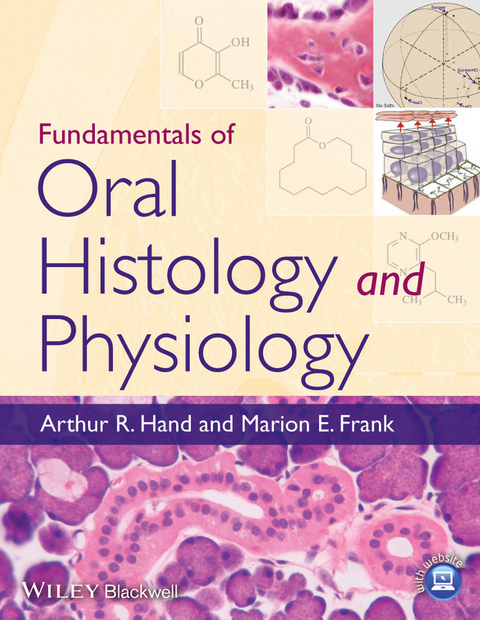
Fundamentals of Oral Histology and Physiology (eBook)
John Wiley & Sons (Verlag)
978-1-118-93830-0 (ISBN)
Fundamentals of Oral Histology and Physiology is a landmark new text streamlining the essentials of histology and physiology into one clinically accessible textbook. Written for predoctoral dental students, the book brings together structure, function, and clinical correlations for maximum retention and ease of use.
Assuming a background in basic biologic sciences, this text focuses on the histology and physiology that students need to know to practice dentistry and to understand and evaluate the current literature, without repeating basic information learned in other courses. Fundamentals of Oral Histology and Physiology concentrates on Oral Structures and Features, including Development, Teeth, Tooth and Jaw Support, Mucosal Structure and Function, and Effectors.Arthur R. Hand, DDS, is Professor of Craniofacial Sciences and Cell Biology at the University of Connecticut Health Center. He has more than 180 peer-reviewed publications, was the founding editor of Advances in Dental Research, and serves or has served on the editorial boards of The Journal of Oral Science, Journal of Dental Research, Journal of Histochemistry and Cytochemistry, Biotechnic & Histochemistry and Acta Histochemica et Cytochemica. Prior to his position in academia, he spent 21 years as a scientist in the intramural research program of the National Institute of Dental and Craniofacial Research. He has directed a course for 1st year dental students on Oral Histology and Physiology for more than 15 years.
Marion E. Frank, PhD, is Professor of Oral Health and Diagnostic Sciences and Director of the Center for Chemosensory Sciences at the University of Connecticut Health Center. Her basic and clinical research in the chemical senses is reported in more than 65 peer-reviewed publications and she has served on the editorial boards of the Journal of General Physiology, Journal of Neurophysiolgy and Chemical Senses. She obtained her doctorate from Brown University and began her academic career at the Rockefeller University before joining the School of Dental Medicine to teach Oral Physiology and Neuroscience and lead the research team of the NIH-sponsored Connecticut Chemosensory Clinical Research Center in Farmington.
Arthur R. Hand, DDS, is Professor of Craniofacial Sciences and Cell Biology at the University of Connecticut Health Center. He has more than 180 peer-reviewed publications, was the founding editor of Advances in Dental Research, and serves or has served on the editorial boards of The Journal of Oral Science, Journal of Dental Research, Journal of Histochemistry and Cytochemistry, Biotechnic & Histochemistry and Acta Histochemica et Cytochemica. Prior to his position in academia, he spent 21 years as a scientist in the intramural research program of the National Institute of Dental and Craniofacial Research. He has directed a course for 1st year dental students on Oral Histology and Physiology for more than 15 years. Marion E. Frank, PhD, is Professor of Oral Health and Diagnostic Sciences and Director of the Center for Chemosensory Sciences at the University of Connecticut Health Center. Her basic and clinical research in the chemical senses is reported in more than 65 peer-reviewed publications and she has served on the editorial boards of the Journal of General Physiology, Journal of Neurophysiolgy and Chemical Senses. She obtained her doctorate from Brown University and began her academic career at the Rockefeller University before joining the School of Dental Medicine to teach Oral Physiology and Neuroscience and lead the research team of the NIH-sponsored Connecticut Chemosensory Clinical Research Center in Farmington.
Contributor List viii
Preface ix
1 Oral Structures and Tissues 1
Arthur R. Hand and Marion E. Frank
The oral cavity 1
Oral mucosa 3
Teeth 4
Supporting tissues of the teeth 5
Salivary glands 5
Temporomandibular joint 7
PART I DEVELOPMENT
Chapter 2 Development of the Head, Face, and Mouth 13
Joseph A. Grasso
Introduction 13
Early events establishing the head region 13
Development of the pharyngeal region
and the pharyngeal arches 19
Development of the face and jaws 26
Clinical correlations 40
Chapter 3 Tooth Development 44
Martyn T. Cobourne and Paul T. Sharpe
The histology of tooth development 44
The biology of early tooth development 47
The molecular control of early tooth development 51
Clinical correlations 54
PART II THE TEETH
Chapter 4 Enamel 63
Arthur R. Hand
Enamel structure, composition, and properties 63
Enamel formation 69
Clinical correlations 79
Chapter 5 Dentin, Pulp, and Tooth Pain 85
Michel Goldberg
Evolution of dental structures 85
Dentin structure and composition 85
Dentin formation 90
Pulp structure and function 97
Pulp vascularization 100
Innervation of the dentin and pulp 102
Mechanisms of tooth pain 103
Clinical correlations 105
PART III TOOTH AND JAW SUPPORT
Chapter 6 Structure and Physiology of the Periodontium 115
Arthur R. Hand
Cementum structure, composition and formation 115
Periodontal ligament structure and function 122
Sensory functions of the periodontal ligament 128
Structure and function of alveolar bone 128
Clinical correlations 132
Chapter 7 Tooth Eruption and Shedding 136
Arthur R. Hand
Normal eruption sequence 136
Histology of tooth eruption 138
Cellular and molecular mechanisms of tooth eruption 144
Structure and formation of the dentogingival junction 144
Clinical correlations 147
Chapter 8 Temporomandibular Joint 149
Felipe Porto
Structure of the TMJ 149
TMJ histology 153
Function (biomechanics) of the TMJ 154
Clinical correlations 156
PART IV MUCOSAL STRUCTURE AND FUNCTION
Chapter 9 Oral Mucosa and Mucosal Sensation 165
Ellen Eisenberg, Easwar natarajan, and Bradley K. Formaker
The oral cavity - anatomy 165
Oral mucosa 169
Stratified squamous epithelium - general principles /and differentiation 171
The epithelial-stromal interface 175
Non-keratinocytes 176
Types of oral mucosa 176
Oral sensation 179
Clinical correlations 182
Chapter 10 Chemoreception and Perception 191
Marion E. Frank
Taste 191
Smell 205
Oral chemosensation 216
Clinical correlations 217
PART V ORAL EFFECTORS
Chapter 11 Salivary Glands, Salivary Secretion, and Saliva 223
Arthur R. Hand
Structure 223
Development 230
Major glands 231
Minor glands 232
Salivary secretion 233
Saliva composition and function 235
Diagnostic and forensic uses of saliva 238
Clinical correlations 238
Chapter 12 Orofacial Pain, Touch and Thermosensation, and Sensorimotor Functions 241
Barry J. Sessle
Sensory functions 241
Sensorimotor functions and motor control 251
Clinical correlations 258
Chapter 13 Anatomy and Physiology of Speech Production 263
Janet Rovalino
Phonation and vocal tract modulations 263
Articulation 267
Clinical correlations 269
Index 274
Chapter 1
Oral Structures and Tissues
Arthur R. Hand1 and Marion E. Frank2
1 Department of Craniofacial Sciences and Cell Biology, School of Dental Medicine, University of Connecticut
2 Department of Oral Health and Diagnostic Sciences, University of Connecticut
The oral cavity and its component cells, tissues, and structures constitute a unique and complex organ system and environment. Of necessity, we study its various parts individually, but the health and function of the components of the oral cavity depend upon and influence one another. Importantly, the oral cavity relies on as well as influences the health and function of the entire body.
The oral cavity is the gateway to the body, and most of the substances that enter our bodies do so through the oral cavity. It is exposed to the physical insults of mastication, hard objects and various food substances, and extremes of temperature. A variety of chemicals, including those present in foods and drinks and produced by commensal and pathogenic organisms, affect the oral cavity. It functions in alimentation, respiration, innate and immune defense, special and general sensation, speech, and human interactions. The tissues and structures of the oral cavity are subject to unique as well as general disease processes. Diseases originating in the oral cavity can have systemic effects; likewise, systemic diseases can affect the oral cavity and the first signs and symptoms of many diseases may appear in the mouth.
The oral cavity
The readily visible components of the oral cavity include the lips (labia), the inside of the cheeks (bucca), the teeth and gums (gingivae), the hard and soft palates, the floor of the mouth, and the tongue (Fig. 1.1). Not visible, but clearly important, are the muscles, nerves, blood vessels, glands, joints, and especially the bones of the upper (maxilla) and lower (mandible) jaws that provide support for and function with the visible components. The oral cavity begins at the junction of the vermilion border of the lips and the mucosa lining the inside of the lips, and extends posteriorly to the palatoglossal folds or arch. Beyond the palatoglossal folds are the palatopharyngeal folds and the beginning of the oropharynx, where the digestive and respiratory tracts come together. The palatine tonsils are located in the tonsillar fauces between the palatoglossal and palatopharyngeal folds. The lymphoid tissue of the palatine tonsils, along with that of the pharyngeal tonsil (adenoids) and the lingual tonsils, guards the entrance to the oropharynx. Anteriorly, the respiratory tract (nasal cavity) is separated from the oral cavity by the hard palate, and posteriorly by the soft palate. The hard palate has an arch-like shape that varies in width and height among individuals. It also plays an important role in manipulation and mastication of food, and in speech. The soft palate functions to seal the oropharynx from the nasopharynx during swallowing and speech. However, during exhalation, receptor cells that detect odors in the olfactory mucosa are activated by oral vapors moving from the posterior oral to posterior nasal cavity through the nasopharynx, effectively expanding the mouth. It is this retronasal route that gives food and drink the odors that contribute much to flavor perception.
Figure 1.1 Diagram illustrating the anatomy and main structures of the oral cavity.
(Modified from Tortora, G.J. & Grabowski, S.R. 2000. Principles of Anatomy and Physiology, 9th edition, Wiley, New York. Reproduced by permission of John Wiley & Sons.)
The lips and cheeks are separated from the alveolar processes of the maxilla and mandible that support and hold the teeth by a space called the vestibule. The vestibule is limited posteriorly by the ramus of the mandible, and superiorly and inferiorly by the mucolabial and mucobuccal folds. The mucosal lining of the vestibule is continuous with the mucosa of the lips and cheeks, and with the mucosa covering the alveolar processes (Fig. 1.2). Folds (frena [singular, frenum]) of the mucosa, located at the midline and in the canine regions, extend across the vestibule to anchor the lips and cheek to the maxilla and mandible. The secretions of the parotid salivary gland enter the vestibule through its main duct, which opens at the parotid papilla on the buccal mucosa opposite the maxillary second molar tooth.
Figure 1.2 Oral mucosa, gingivae and mandibular teeth. Blood vessels visible through the thin non-keratinized epithelium of the alveolar mucosa give it a redder color than the gingivae with their thicker keratinized epithelium.
The mucosa surrounding the necks, or cervical regions of the teeth, is called the gingivae. The attached gingiva is clearly demarcated from the alveolar mucosa at the mucogingival junction. The attached gingiva is firmly bound to the bone of the alveolar process, and through the junctional epithelium is bound to and creates a seal around each tooth. The free gingiva is separated from the tooth by the gingival sulcus or crevice, and forms the interdental papilla between adjacent teeth.
The tongue occupies the space within the maxillary and mandibular arches, from the floor of the mouth to the hard and soft palates. The mucosa of the dorsal surface of the tongue has several types of specialized structures called papillae that function in the manipulation of food and in taste. The tongue also is critical for forming proper speech sounds. The anterior portion of the tongue is anchored to the floor of the mouth by the lingual frenum. The ducts of the submandibular and sublingual salivary glands open on either side of the lingual frenum at the sublingual caruncle; smaller ducts of the sublingual gland open along the sublingual fold on each side of the floor of the mouth.
Oral mucosa
Mucosa is a wet, soft tissue membrane that lines an internal body space, e.g., the oral cavity, the gastrointestinal, urinary, and reproductive tracts. The oral mucosa consists of three layers: a surface epithelium; a supporting lamina propria consisting of a layer of loose connective tissue (papillary layer) just below the epithelium and a deeper layer of dense irregular connective tissue (reticular layer); and an underlying submucosa consisting of dense irregular connective tissue (Fig. 1.3). The submucosa frequently contains minor salivary glands, and in some locations may contain adipose tissue. In some regions of the oral cavity, the submucosa may be absent, and the mucosa is bound to either bone or muscle by the lamina propria.
Figure 1.3 Light micrograph showing the layers and components of the oral mucosa. A submucosa is not present in all regions of the oral cavity.
Three subtypes of mucosa are found in the oral cavity. Lining or moveable mucosa has a stratified squamous non-keratinized epithelium, and is found on the inside of the lips and cheeks, in the vestibules and the floor of the mouth, and on the alveolar processes, the ventral surface of the tongue, and the soft palate. Masticatory mucosa has a stratified squamous keratinized or parakeratinized epithelium, and is found on surfaces subjected to the stresses induced by chewing our food (mastication), the hard palate and the gingivae. Specialized mucosa is found on the dorsal surface of the tongue. This mucosa is considered specialized because it forms four different types of papillae, three of which have taste buds through which taste sensations are received. Multiple fungiform papillae dot the dorsal anterior lingual surface, whereas two series of papillae with associated trenches or troughs, the medial circumvallate and lateral foliate papillae, are found far posterior near the base of the tongue (Fig. 1.4). The walls of the trenches are lined with specialized mucosa containing taste buds. The ducts of minor salivary glands (von Ebner’s glands) open into the trenches, and substances present in the trenches are flushed out by their secretions. Because the mucosa of the tongue has a stratified squamous keratinized epithelium, and because it plays an important role in mastication of food, this mucosa also may be classified as masticatory mucosa.
Figure 1.4 Light micrograph of a section through a foliate papillary trench of the tongue of a hamster....
| Erscheint lt. Verlag | 13.11.2014 |
|---|---|
| Sprache | englisch |
| Themenwelt | Medizin / Pharmazie ► Allgemeines / Lexika |
| Studium ► 1. Studienabschnitt (Vorklinik) ► Histologie / Embryologie | |
| Medizin / Pharmazie ► Zahnmedizin ► Chirurgie | |
| Schlagworte | dentistry • Einführung i. d. Zahnmedizin • Einführung i. d. Zahnmedizin • Introductions to Dentistry • <p>Oral Development, Tooth Structure and Composition, Periodontal Structure and Function, Tooth Shedding and Eruption, Temporomandibular Joint, Taste and Olfaction, Salivary Glands and Saliva, Oral Pain and Sensorimotor Function, Speech Production, Tooth and Oral Mucosa Histology</p> • Mundheilkunde • Mundheilkunde / Anatomie u. Physiologie • Oral Anatomy & Physiology • Oral Sciences & Technology • Wissenschaft u. Technologie der Mundheilkunde • Zahnmedizin |
| ISBN-10 | 1-118-93830-5 / 1118938305 |
| ISBN-13 | 978-1-118-93830-0 / 9781118938300 |
| Informationen gemäß Produktsicherheitsverordnung (GPSR) | |
| Haben Sie eine Frage zum Produkt? |
 EPUB (Adobe DRM)
Kopierschutz: Adobe-DRM
Adobe-DRM ist ein Kopierschutz, der das eBook vor Mißbrauch schützen soll. Dabei wird das eBook bereits beim Download auf Ihre persönliche Adobe-ID autorisiert. Lesen können Sie das eBook dann nur auf den Geräten, welche ebenfalls auf Ihre Adobe-ID registriert sind.
Details zum Adobe-DRM
Dateiformat: EPUB (Electronic Publication)
EPUB ist ein offener Standard für eBooks und eignet sich besonders zur Darstellung von Belletristik und Sachbüchern. Der Fließtext wird dynamisch an die Display- und Schriftgröße angepasst. Auch für mobile Lesegeräte ist EPUB daher gut geeignet.
Systemvoraussetzungen:
PC/Mac: Mit einem PC oder Mac können Sie dieses eBook lesen. Sie benötigen eine
eReader: Dieses eBook kann mit (fast) allen eBook-Readern gelesen werden. Mit dem amazon-Kindle ist es aber nicht kompatibel.
Smartphone/Tablet: Egal ob Apple oder Android, dieses eBook können Sie lesen. Sie benötigen eine
Geräteliste und zusätzliche Hinweise
Buying eBooks from abroad
For tax law reasons we can sell eBooks just within Germany and Switzerland. Regrettably we cannot fulfill eBook-orders from other countries.
aus dem Bereich