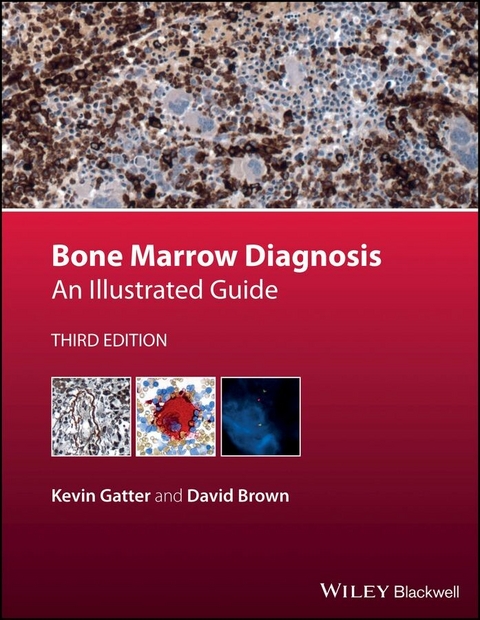
Bone Marrow Diagnosis (eBook)
John Wiley & Sons (Verlag)
978-1-118-95204-7 (ISBN)

Bone Marrow Diagnosis is an essential resource for all those who need to report bone marrow trephine biopsies. The text will be succinct and concentrates on the core information necessary to make an accurate diagnosis. Each diagnostic entity will be accompanied by high quality images which show typical and more unusual examples of histological features.
Each section will be comprehensively revised by an international team of authors. Over 900 high quality colour images will accompany each diagnostic entity. There will be coverage of cytology in sections relating to myeloid dysplasias and acute leukaemias, as well as incorporating new WHO classification of lymphomas and leukaemias.
The digitally photographed and remastered images in this new edition will be of the highest quality, put onto disk directly from the microscope in digital format and reproduced in print form. The text will give comparisons of the common methods of sample collection, fixation and staining, and a clear description of how to examine a trephine section. It will cover the disorders of bone marrow, discussing the clinical features, histopathology of bone marrow and diagnostic problems of each condition. Chapters close with a summary of key points. The consistent approach to describing each condition makes this a valuable reference tool for the trainee and practicing histopathologists, pathologists and haematologists.
Kevin C Gatter, Nuffield Department of Clinical Laboratory Sciences, John Radcliffe Hospital, Oxford, UKKevin Gatter is Professor of Pathology and Head of the Nuffield Department of Clinical Laboratory Sciences at the John Radcliffe Hospital. He has published textbooks on bone marrow diagnosis, skin lymphoma and lymphoma classification. His research interests include lymphoma diagnosis, medical informatics and angiogenesis in malignancy. He is honorary director of the ICRF Tumour Pathology Unit and Honorary Consultant in Pathology at the John Radcliffe Hospital.
Preface to the third edition vi
Preface to the first edition vii
1 Introduction 1
2 The normal bone marrow 4
3 Infections including human immunodeficiency virus 18
4 Anaemias and aplasias 32
5 The myelodysplastic syndromes 42
6 Myeloproliferative neoplasms 49
7 Acute leukaemia 69
8 Lymphomas: an overview 89
9 Precursor B and T lymphoblastic leukaemia (acute lymphoblastic leukaemia) and lymphoblastic lymphoma 101
10 Mature B cell neoplasms 108
11 Mature T and NK cell neoplasms 161
12 Hodgkin lymphoma 179
13 Metastatic disease 188
14 Bone stroma and miscellaneous changes 196
15 Technical considerations 209
Index 215
CHAPTER 1
Introduction
During the late 1950s, McFarland and Dameshek introduced an acceptable means of obtaining bone marrow core biopsies.1 This advance made it possible for the histopathologist to diagnose a wide range of haematopathological disorders including the leukaemias, lymphoproliferative and myeloproliferative disease, myelodysplasia, metastases and reactive disorders.
Most biopsies are taken from the posterior superior iliac spine. Ideally in an adult the core of tissue should be at least 1 cm in length. This often raises the question: ‘But what is the minimum you need?’ There is no standard answer. Although half a crushed marrow space full of carcinoma is diagnostic, in most cases a good rule of thumb is a minimum of five complete marrow spaces for most haematological diagnoses. An aspirate is usually taken from the same site before the biopsy is removed (but from a different needle track, or the biopsy may be a haemorrhagic mess). The haematologist will usually make about 10 smear preparations from the marrow particles that have been aspirated and either discard or send the remainder for histology. We find it useful to have both of these types of specimen since there are occasions when only an aspirate is available, in which case it is then important to have built up experience examining aspirate preparations for which trephines have been available for comparison.
The trephine biopsy has a number of advantages over the aspirate specimen. The most important is to enable examination of the topographical distribution of the cellular constituents of the marrow, their relationships to the bony trabeculae and an assessment of marrow cellularity. Furthermore, in diseases which produce fibrosis, e.g. Hodgkin lymphoma or myeloproliferative disorders, an aspirate often fails to produce an adequate diagnostic sample (‘a dry tap’).
Close liaison with haematologists is important since it makes the reporting of trephine biopsies easier and ensures that misdiagnoses are kept to a minimum. Many if not most authorities recommend reporting of the trephine biopsy alongside the aspirate, either by yourself or with the haematologist. However, this does not seem to be common practice and, as workloads and specialist referrals rise, will inevitably decline. You can report safely most trephines on their own provided you know your limitations and keep a good dialogue open with your clinicians. Multidisciplinary team meetings are also invaluable, allowing for a review of all malignant haematological diagnoses and discussion of diagnostically difficult cases. The authors appreciate that many trainee histopathologists who see only occasional trephine biopsies find it difficult to observe any order, even in a normal marrow, and often give up on this subspecialty as being ‘too difficult’. Our advice is to persist and spend time initially on examining as many normal/reactive marrows as possible.
There has been debate involving the embedding medium for bone marrow biopsies. There are essentially two schools of thought: those who believe that the biopsies should be embedded in plastic and those who believe paraffin embedding with decalcification to be superior. The reason for this divergence is related to the nature of the biopsy itself, which consists of both hard tissue (i.e. bone) and soft tissue (i.e. marrow and fat). In order to cut intact sections one can either make the biopsy material uniformly soft (by decalcification) or uniformly hard (by resin embedding).
Unfortunately, decalcification inevitably produces some tissue distortion and plastic embedding limits the range of immunohistochemical studies. The debate over which is superior continues, with vociferous advocates on either side.2–6 The advantages and disadvantages of each approach are summarized in Table 1.1.
Table 1.1 Comparison of the relative advantages and disadvantages of paraffin and plastic embedding of bone marrow trephine biopsies.
| Paraffin embedding | Resin/plastic embedding |
|---|
| Advantages |
|
|
| Disadvantages |
|
|
We believe that, with a little extra care, it is possible to provide sections, from paraffin-embedded trephines, which meet the practical requirements of the diagnostic haematologist.7
Just as there has been division among pathologists regarding the best embedding medium, so too has there been debate over the most appropriate general stain. This inevitably involves an element of personal preference. The well-established place of the H&E stain in general diagnostic pathology has assured it of much support as the primary stain in bone marrow histology. We believe that a good Giemsa stain provides more information than its H&E counterpart, e.g. in identifying cell lineage, the detection of fibrosis and the estimation of iron stores. A good Giemsa stain requires fastidious technical preparation (see Chapter 15). The results are worth the initial perseverance required by both the technical staff and the pathologist to become familiar with it. When indicated, we include a reticulin stain in our bone marrow set.
Reasons for Performing Bone Marrow Biopsies
The majority of bone marrow biopsies are performed for the following reasons.8
- Dry tap. The commonest diagnoses are:
- fibrosis (Hodgkin lymphoma, metastatic cancer, primary myelofibrosis);
- hairy cell leukaemia;
- extreme hypercellularity (‘packed marrow’) such as may be seen in cases of leukaemia and lymphoma.
- Assessment of cellularity:
- extent of infiltration by leukaemia, lymphoma and myeloma;
- amount of residual marrow;
- assessment of marrow post chemotherapy and after engraftment;
- investigation of cytopenias.
- Identification of focal disease:
- metastatic cancer, lymphomas, granulomas.
- Lymphoma staging.
- Assessment of HIV and its opportunistic infections.
How to Examine a Trephine Section
It is important to have an organized approach to the examination of bone marrow sections in order not to miss diagnostic features. One possible scheme is based on an assessment of cellularity, topography, morphology and accessory structures, as illustrated in Tables 1.2–1.5 with a selection of some common pathological conditions.
Tables 1.2–1.5 A scheme for assessing the bone marrow trephine with some common pathological conditions as examples.
Table 1.2
| Assessment of cellularity |
|---|
| Hypocellular | Aplastic anaemia Hairy cell leukaemia Acute myeloid leukaemia |
| Normocellular | Be aware of subtle infiltrates such as myeloma |
| Hypercellular |
| Homogeneous | Non-Hodgkin lymphoma Acute leukaemias |
| Heterogeneous | Reactive Myeloproliferative neoplasia Myelodysplasias Metastatic cancer Small cell tumours of childhood |
Table 1.3
| Topography (distribution) of cellular elements |
|---|
| Are all cell types present? Are any particular cells present in abnormal numbers? e.g. increased granulocytes in chronic granulocytic leukaemia Prominent mast cells in Waldenström's macroglobulinaemia Normal cellular distribution Granulocytes Paratrabecular, peri-arterial Erythroid Intertrabecular Megakaryocytes Intertrabecular and peri-sinusoidal Common abnormal patterns Myelodysplasia/myeloproliferation Paratrabecular erythroid and megakaryocytic colonies Megakaryocytic clustering Non-Hodgkin lymphoma Follicular lymphoma has a paratrabecular pattern CLL is usually diffuse or nodular |
Table 1.4
| Assessment of cell morphology |
|---|
| Atypia Abnormal megakaryocytes in myeloproliferation and myelodysplasia Maturation abnormalities Maturation arrest, e.g. drug induced Asynchronous maturation in... |
| Erscheint lt. Verlag | 10.11.2014 |
|---|---|
| Sprache | englisch |
| Themenwelt | Medizin / Pharmazie ► Allgemeines / Lexika |
| Medizinische Fachgebiete ► Innere Medizin ► Endokrinologie | |
| Studium ► 2. Studienabschnitt (Klinik) ► Anamnese / Körperliche Untersuchung | |
| Studium ► 2. Studienabschnitt (Klinik) ► Pathologie | |
| Schlagworte | Approach • biopsies • Bone marrow • Chapters • clear • Collection • Common • comparisons • comprehensively • Core • Description • Essential • information necessary • Medical Science • Medizin • Methods • Pathologie • Pathologists • Pathology • provides • Range • resource • Sample • section • succinct • trephine • whilst |
| ISBN-10 | 1-118-95204-9 / 1118952049 |
| ISBN-13 | 978-1-118-95204-7 / 9781118952047 |
| Informationen gemäß Produktsicherheitsverordnung (GPSR) | |
| Haben Sie eine Frage zum Produkt? |
 EPUB (Adobe DRM)
Kopierschutz: Adobe-DRM
Adobe-DRM ist ein Kopierschutz, der das eBook vor Mißbrauch schützen soll. Dabei wird das eBook bereits beim Download auf Ihre persönliche Adobe-ID autorisiert. Lesen können Sie das eBook dann nur auf den Geräten, welche ebenfalls auf Ihre Adobe-ID registriert sind.
Details zum Adobe-DRM
Dateiformat: EPUB (Electronic Publication)
EPUB ist ein offener Standard für eBooks und eignet sich besonders zur Darstellung von Belletristik und Sachbüchern. Der Fließtext wird dynamisch an die Display- und Schriftgröße angepasst. Auch für mobile Lesegeräte ist EPUB daher gut geeignet.
Systemvoraussetzungen:
PC/Mac: Mit einem PC oder Mac können Sie dieses eBook lesen. Sie benötigen eine
eReader: Dieses eBook kann mit (fast) allen eBook-Readern gelesen werden. Mit dem amazon-Kindle ist es aber nicht kompatibel.
Smartphone/Tablet: Egal ob Apple oder Android, dieses eBook können Sie lesen. Sie benötigen eine
Geräteliste und zusätzliche Hinweise
Buying eBooks from abroad
For tax law reasons we can sell eBooks just within Germany and Switzerland. Regrettably we cannot fulfill eBook-orders from other countries.
aus dem Bereich