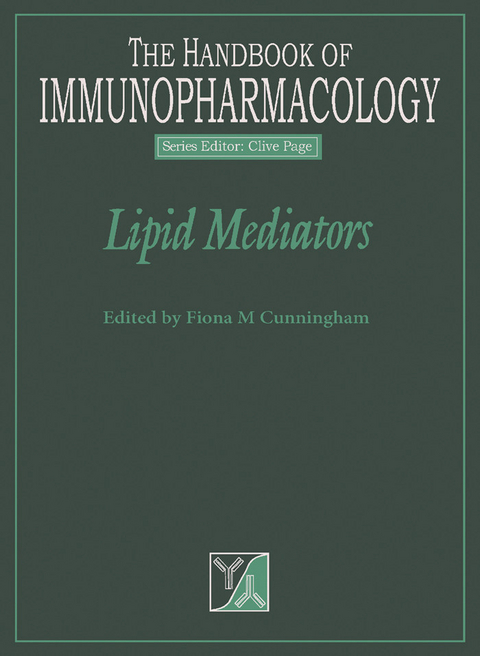
Lipid Mediators (eBook)
392 Seiten
Elsevier Science (Verlag)
978-1-4832-1763-5 (ISBN)
The Handbook of Immunopharmacology: Lipid Mediators covers a comprehensive overview of lipid mediators, from synthesis through to inhibition. The book discusses the metabolism of arachidonic acid; the measurement of fatty acids and their metabolites; and the biological properties of cyclooxygenase products. The text also describes other essential fatty acids, their metabolites and cell-cell interactions; the inhibitors of fatty acid-derived mediators; as well as the biosynthesis and catabolism of platelet-activating factor. The cellular sources of platelet-activating factor and related lipids; the biological properties of platelet-activating factor; and the effects of platelet-activating factor receptor antagonists are also considered. Immunopharmacologists, immunologists, and pharmacologists will find the book invaluable.
Front Cover 1
Lipid Mediators 4
Copyright Page 5
Table of Contents 6
Contributors 12
Series Preface 14
Preface 16
Chapter 1. Metabolism of Arachidonic Acid: An Overview 18
1. Introduction 19
2. Mechanisms Involved in Bioavailability of Arachidonic Acid for Eicosanoid Production 19
3. Enzymic Conversion of Arachidonic Acid to Prostaglandins and Related "Prostanoids" 22
4. Lipoxygenase Pathways 29
5. "Crossover" Products 36
6. Alternative Substrates to Arachidonic Acid in the Formation of Eicosanoids 36
7. Mode of Action of Anti-inflammatory Drugs 37
8. Concluding Remarks 39
9. References 39
Chapter 2. Measurement of Fatty Acids and Their Metabolites 50
1. Introduction 50
2. Approaches to Assays 51
3. Methodology 58
4. Group Analysis 71
5. Concluding Remarks 73
6. References 73
Chapter 3. Biological Properties of Cyclooxygenase Products 78
1. In the Cardiovascular System 79
2. In Inflammation 83
3. In the Immune System 85
4. In the Central Nervous System 86
5. In Pain Perception 88
6. In the Gastrointestinal Tract 91
7. In Fever 95
8. In the Kidney 96
9. In Reproduction and Parturition 98
10. Acknowledgements 99
11. References 100
Chapter 4. Other Essential Fatty Acids Their Metabolites and Cell-Cell Interactions 116
1. Introduction 116
2. Prostaglandin 12 Synthesis by Endothelial Cells 117
3. Other Sources of Prostaglandin I2 117
4. Conversion of Prostaglandin I2 and 6-Ketoprostaglandin F1a to 6-Ketoprostaglandin E1 118
5. The Lipoxygenase Pathway 120
6. Vessel Wall Lipoxygenase Metabolism of Linoleic Acid 123
7. Role of 13-Hydroxyoctadecadienoic Acid in Cell Adhesion Molecule Expression 124
8. 13-Hydroxyoctadecadienoic Acid and Cell–Cell Interactions in vivo 125
9. 13-Hydroxyoctadecadienoic Acid and the Atherosclerotic Prone Watanabe Rabbit 126
10. Dietary Modifications of Linoleic and Arachidonic Acid Metabolism in Endothelial Cells 127
11. Concluding Remarks 130
12. Acknowledgements 130
13. References 130
Chapter 5. Inhibitors of Fatty Acid-Derived Mediators 136
1. General Introduction 137
2. Inhibitors of Arachidonic Acid Release 138
3. Cyclooxygenase Inhibitors 145
4. Selective 5-Lipoxygenase Inhibitors 150
5. Dual Inhibitors of 5-Lipoxygenase and Cyclooxygenase 153
6. Thromboxane Synthetase Inhibitors 155
7. Receptor Antagonists - Cyclooxygenase Pathway 160
8. Receptor Antagonists - Lipoxygenase Pathway 166
9. Potential Novel Agents/Future Directions 177
10. Conclusions 178
11. Acknowledgements 179
12. References 179
Chapter 6. Biosynthesis and Catabolism of Platelet-Activating Factor 200
1. Introduction 200
2. Biosynthesis of Platelet-Activating Factor 201
3. Catabolism of Platelet-Activating Factor and Related Metabolites 205
4. Regulation of Platelet-Activating Factor Metabolism 207
5. Acknowledgements 208
6. References 208
Chapter 7. Cellular Sources of Platelet-Activating Pactor and Related Lipids 212
I. Introduction 212
2. Detection and Measurement of Platelet-Activating Factor and Related Analogues 214
3. Synthesis and Release of Platelet-Activating Factor and Related Analogues 217
4. Stimulation of Inflammatory Cells to Produce Platelet Activating Factor and Related Analogues 222
5. Transcellular Biosynthesis of Platelet-Activating Factor 228
6. Other Cellular Sources of Platelet-Activating Factor 229
7. Synthesis of Platelet-Activating Factor and Related Analogues with Other Lipid Mediators 229
8. Conclusions 230
9. References 231
Chapter 8. Biological Properties of Platelet-Activating Factor 240
1. Introduction 242
2. Cellular Actions 243
3. Organ Systems 257
4. Pathophysiology 274
5. Perspectives 287
6. Acknowledgements 288
7. References 288
Chapter 9. Platelet-Activating Factor: Receptors and Receptor Antagonists 316
1. Introduction 316
2. Existence of Platelet-Activating Factor Receptors 317
3. Platelet-Activating Factor Receptor Antagonists 318
4. Multiple Conformational States of Platelet-Activating Factor Receptors 349
5. Endogenous Modulator(s) of Platelet-Activating Factor Receptors 350
6. Existence of Intracellular Platelet-Activating Factor Receptors 351
7. Possible Functions of Intracellular Platelet-Activating Factor Receptors 352
8. Heterogeneity of Platelet-Activating Factor Receptors 353
9. Solubilization and Identification of Platelet-Activating Factor Receptors 356
10. The Cloned Platelet-Aaivating Factor Receptor 357
11. Signal Transduction Mechanisms 357
12. Priming Effects of Platelet-Activating Factor 362
13. Desensitization 364
14. Conclusion 365
15. Acknowledgements 366
16. References 366
Glossary 380
Key to Illustrations 386
Index 392
| Erscheint lt. Verlag | 27.10.2016 |
|---|---|
| Sprache | englisch |
| Themenwelt | Sachbuch/Ratgeber ► Gesundheit / Leben / Psychologie ► Krankheiten / Heilverfahren |
| Medizin / Pharmazie ► Allgemeines / Lexika | |
| Medizin / Pharmazie ► Medizinische Fachgebiete | |
| Naturwissenschaften ► Biologie ► Biochemie | |
| Naturwissenschaften ► Physik / Astronomie ► Angewandte Physik | |
| Technik | |
| ISBN-10 | 1-4832-1763-9 / 1483217639 |
| ISBN-13 | 978-1-4832-1763-5 / 9781483217635 |
| Informationen gemäß Produktsicherheitsverordnung (GPSR) | |
| Haben Sie eine Frage zum Produkt? |
 PDF (Adobe DRM)
Kopierschutz: Adobe-DRM
Adobe-DRM ist ein Kopierschutz, der das eBook vor Mißbrauch schützen soll. Dabei wird das eBook bereits beim Download auf Ihre persönliche Adobe-ID autorisiert. Lesen können Sie das eBook dann nur auf den Geräten, welche ebenfalls auf Ihre Adobe-ID registriert sind.
Details zum Adobe-DRM
Dateiformat: PDF (Portable Document Format)
Mit einem festen Seitenlayout eignet sich die PDF besonders für Fachbücher mit Spalten, Tabellen und Abbildungen. Eine PDF kann auf fast allen Geräten angezeigt werden, ist aber für kleine Displays (Smartphone, eReader) nur eingeschränkt geeignet.
Systemvoraussetzungen:
PC/Mac: Mit einem PC oder Mac können Sie dieses eBook lesen. Sie benötigen eine
eReader: Dieses eBook kann mit (fast) allen eBook-Readern gelesen werden. Mit dem amazon-Kindle ist es aber nicht kompatibel.
Smartphone/Tablet: Egal ob Apple oder Android, dieses eBook können Sie lesen. Sie benötigen eine
Geräteliste und zusätzliche Hinweise
Buying eBooks from abroad
For tax law reasons we can sell eBooks just within Germany and Switzerland. Regrettably we cannot fulfill eBook-orders from other countries.
aus dem Bereich