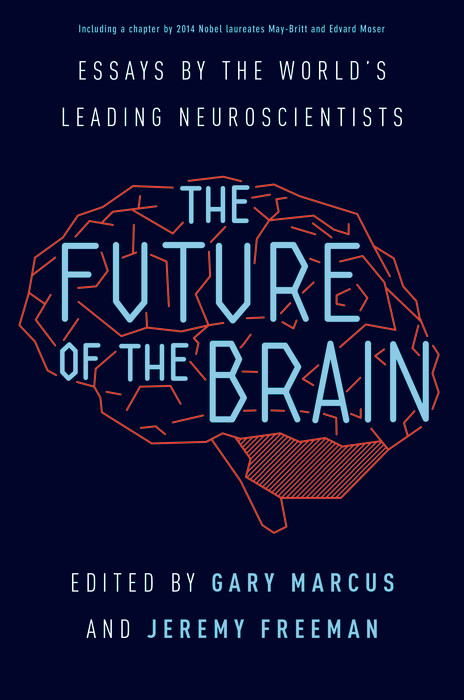
The Future of the Brain (eBook)
Princeton University Press (Verlag)
9781400851935 (ISBN)
Gary Marcus is professor of psychology and neural science at New York University. His books include Guitar Zero: The Science of Becoming Musical at Any Age and Kluge: The Haphazard Evolution of the Human Mind. Jeremy Freeman is a neuroscientist at the Howard Hughes Medical Institute's Janelia Farm Research Campus.
The world's top experts take readers to the very frontiers of brain scienceIncludes a chapter by 2014 Nobel laureates May-Britt Moser and Edvard MoserAn unprecedented look at the quest to unravel the mysteries of the human brain, The Future of the Brain takes readers to the absolute frontiers of science. Original essays by leading researchers such as Christof Koch, George Church, Olaf Sporns, and May-Britt and Edvard Moser describe the spectacular technological advances that will enable us to map the more than eighty-five billion neurons in the brain, as well as the challenges that lie ahead in understanding the anticipated deluge of data and the prospects for building working simulations of the human brain. A must-read for anyone trying to understand ambitious new research programs such as the Obama administration's BRAIN Initiative and the European Union's Human Brain Project, The Future of the Brain sheds light on the breathtaking implications of brain science for medicine, psychiatry, and even human consciousness itself.Contributors include: Misha Ahrens, Ned Block, Matteo Carandini, George Church, John Donoghue, Chris Eliasmith, Simon Fisher, Mike Hawrylycz, Sean Hill, Christof Koch, Leah Krubitzer, Michel Maharbiz, Kevin Mitchell, Edvard Moser, May-Britt Moser, David Poeppel, Krishna Shenoy, Olaf Sporns, Anthony Zador.
Gary Marcus is professor of psychology and neural science at New York University. His books include Guitar Zero: The Science of Becoming Musical at Any Age and Kluge: The Haphazard Evolution of the Human Mind. Jeremy Freeman is a neuroscientist at the Howard Hughes Medical Institute's Janelia Farm Research Campus.
| Erscheint lt. Verlag | 24.11.2014 |
|---|---|
| Co-Autor | May-Britt Moser, Edvard I. Moser |
| Zusatzinfo | 9 color + 20 b/w illus. |
| Verlagsort | Princeton |
| Sprache | englisch |
| Themenwelt | Sachbuch/Ratgeber ► Natur / Technik |
| Geisteswissenschaften ► Psychologie ► Allgemeine Psychologie | |
| Geisteswissenschaften ► Psychologie ► Verhaltenstherapie | |
| Medizin / Pharmazie ► Medizinische Fachgebiete ► Neurologie | |
| Naturwissenschaften ► Biologie ► Humanbiologie | |
| Naturwissenschaften ► Biologie ► Zoologie | |
| Technik | |
| Schlagworte | Action potential • Activation • algorithm • Allen Institute for Brain Science • Analogy • anatomy • Antibody • Artificial Neural Network • Autism • Behavior • Biological neural network • Biology • brain • BRAIN Initiative • Brain Mapping • Causality • cell type • Channelrhodopsin • chemical synapse • Christof Koch • clinical trial • Cognition • Cognitive Neuroscience • cognitive science • Computation • computer simulation • connectome • Consciousness • Diagnosis • Disease • electrode • Electroencephalography • Emergence • Encoding (memory) • entorhinal cortex • Epilepsy • foxp2 • functional magnetic resonance imaging • gene expression • genomics • Grid cell • Halorhodopsin • High- and low-level • hippocampus • Human Brain • human genome • In situ • In situ Hybridization • Instance (computer science) • Ion channel • Laboratory mouse • lesion • Limitation • machine learning • Magnetic Resonance Imaging • magnetoencephalography • Measurement • Medical Imaging • Mental disorder • microscope • Microscopy • model organism • Molecule • Motor Control • Neocortex • nervous system • Neuroanatomy • neuroimaging • Neuron • Neuroscience • neuroscientist • Neurotechnology • Neurotransmission • New York University • Nucleotide • Olaf Sporns • organism • perception • Positron Emission Tomography • prefrontal cortex • Processing (Chinese materia medica) • Protein • retina • Schizophrenia • Scientist • sequencing • Simulation • Stimulation • Stimulus (physiology) • Striatum • Symptom • Technology • Thalamus • Thought • Transistor • Underpinning • Visual cortex • Visual Field • whole genome sequencing • Wiring (development platform) |
| ISBN-13 | 9781400851935 / 9781400851935 |
| Informationen gemäß Produktsicherheitsverordnung (GPSR) | |
| Haben Sie eine Frage zum Produkt? |
 PDF (Wasserzeichen)
Größe: 5,2 MB
DRM: Digitales Wasserzeichen
Dieses eBook enthält ein digitales Wasserzeichen und ist damit für Sie personalisiert. Bei einer missbräuchlichen Weitergabe des eBooks an Dritte ist eine Rückverfolgung an die Quelle möglich.
Dateiformat: PDF (Portable Document Format)
Mit einem festen Seitenlayout eignet sich die PDF besonders für Fachbücher mit Spalten, Tabellen und Abbildungen. Eine PDF kann auf fast allen Geräten angezeigt werden, ist aber für kleine Displays (Smartphone, eReader) nur eingeschränkt geeignet.
Systemvoraussetzungen:
PC/Mac: Mit einem PC oder Mac können Sie dieses eBook lesen. Sie benötigen dafür einen PDF-Viewer - z.B. den Adobe Reader oder Adobe Digital Editions.
eReader: Dieses eBook kann mit (fast) allen eBook-Readern gelesen werden. Mit dem amazon-Kindle ist es aber nicht kompatibel.
Smartphone/Tablet: Egal ob Apple oder Android, dieses eBook können Sie lesen. Sie benötigen dafür einen PDF-Viewer - z.B. die kostenlose Adobe Digital Editions-App.
Buying eBooks from abroad
For tax law reasons we can sell eBooks just within Germany and Switzerland. Regrettably we cannot fulfill eBook-orders from other countries.
 EPUB (Adobe DRM)
Kopierschutz: Adobe-DRM
Adobe-DRM ist ein Kopierschutz, der das eBook vor Mißbrauch schützen soll. Dabei wird das eBook bereits beim Download auf Ihre persönliche Adobe-ID autorisiert. Lesen können Sie das eBook dann nur auf den Geräten, welche ebenfalls auf Ihre Adobe-ID registriert sind.
Details zum Adobe-DRM
Dateiformat: EPUB (Electronic Publication)
EPUB ist ein offener Standard für eBooks und eignet sich besonders zur Darstellung von Belletristik und Sachbüchern. Der Fließtext wird dynamisch an die Display- und Schriftgröße angepasst. Auch für mobile Lesegeräte ist EPUB daher gut geeignet.
Systemvoraussetzungen:
PC/Mac: Mit einem PC oder Mac können Sie dieses eBook lesen. Sie benötigen eine
eReader: Dieses eBook kann mit (fast) allen eBook-Readern gelesen werden. Mit dem amazon-Kindle ist es aber nicht kompatibel.
Smartphone/Tablet: Egal ob Apple oder Android, dieses eBook können Sie lesen. Sie benötigen eine
Geräteliste und zusätzliche Hinweise
Buying eBooks from abroad
For tax law reasons we can sell eBooks just within Germany and Switzerland. Regrettably we cannot fulfill eBook-orders from other countries.
aus dem Bereich