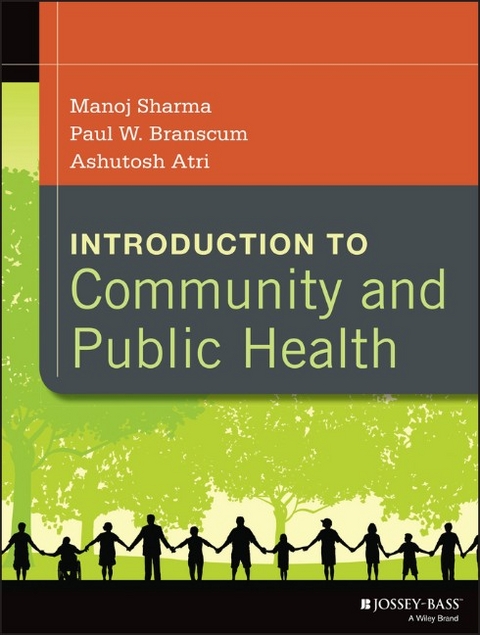
Introduction to Community and Public Health (eBook)
John Wiley & Sons (Verlag)
978-1-118-44838-0 (ISBN)
Introduction to Community and Public Health covers the basics in each area of community and public health as identified by the Association of Schools of Public Health. In a student-friendly approach, authors Manoj Sharma, Paul W. Branscum, and Ashutosh Atri discuss epidemiology, biostatistics, social and behavioral sciences, environmental health, and healthy policy and management. Written to serve both graduate and undergraduate public health students, as well as to help prepare for the Certified in Public Health (CPH) exam, Certified Health Education Specialist (CHES) exam and Master certified in Health Education Specialist (MCHES) exam, the book covers each of these five core disciplines, plus other important topics such as:
- Population dynamics and control
- Air, water, and noise pollution, and other environmental issues
- Program planning, budgeting, management, and evaluation
- Systems thinking and leadership in community and public health
Students will gain insight into the descriptive, inferential, and analytical aspects of community and public health, as well as models, methods, and theories in health education and health promotion. Introduction to Community and Public Health provides the foundation necessary to build the skills of tomorrow's community and public health leaders.
Manoj Sharma, MBBS, MCHES, PHD, FAAHB is a professor at the Jackson State University's MPH and Dr. PH programs in Behavioral Health Promotion & Education
Paul W. Branscum, PHD, RD, is an assistant professor in the Department of Health and Exercise Science at the University of Oklahoma.
Ashutosh Atri, MD, MS, is a practicing psychiatrist in Kearney, Nebraska, and has completed graduate training in health promotion and education from the University of Cincinnati.
Manoj Sharma, MBBS, MCHES, PHD, FAAHB is a professor at the Jackson State University's MPH and Dr. PH programs in Behavioral Health Promotion & Education Paul W. Branscum, PHD, RD, is an assistant professor in the Department of Health and Exercise Science at the University of Oklahoma. Ashutosh Atri, MD, MS, is a practicing psychiatrist in Kearney, Nebraska, and has completed graduate training in health promotion and education from the University of Cincinnati.
Figures and Tables
Figures
- 1.1 One of the Many Dimensions of Health
- 1.2 Community Health Is About Promoting Health for Groups of Individuals
- 1.3 A Nigerian Boy Receiving a Smallpox Vaccination in 1967, an Example of an Organized Public Health Effort
- 1.4 Health Education Is About Facilitating Voluntary Health Behavior Change
- 1.5 Factors Affecting the Health of a Community
- 1.6 A Local Health Inspector Inspecting a Kitchen for Food Safety
- 1.7 Vaccination Was a Major Milestone in the History of Community and Public Health
- 2.1 Waterborne Transmission of Cholera Was First Recognized in Europe in the Mid-1800s, by John Snow
- 2.2 Bacteria: Examples of a Biological Agent
- 2.3 Page One of the US Death Certificate
- 2.4 Incidence Rates of Breast Cancer in Women by Race— United States, 1999– 2007
- 2.5 The Relationship Between Flowing Water and Accumulated Water Is Analogous to the Relationship Between Incidence (New Water Flowing) and Prevalence (Total Accumulated Water)
- 2.6 The Secular Trend in Tetanus Cases— United States, 1947– 2009
- 3.1 Schematic Diagram of the Case-Control Study
- 3.2 Confounding
- 3.3 Schematic Diagram of the Cohort Study
- 3.4 An Image from a 1950s Cohort Study Conducted with Miners Exposed to Airborne Particulates in Diatomaceous Earth Mining and Processing Plants
- 3.5 Schematic Diagram of a Randomized Clinical Trial
- 3.6 Relationship of Infectious Diseases, Communicable Diseases, and Contagious Diseases
- 3.7 A Transmission Electron Micrograph of Measles Virus, a Paramyxovirus Transmitted by Direct Projection of Droplets
- 4.1 Graph of a Normal Distribution
- 4.2 Positively Skewed and Negatively Skewed Distributions
- 4.3 Bar Graph of a Hypothetical Distribution of Race in a Group (n = 20)
- 4.4 Pie Chart of a Hypothetical Distribution of Race in a Group (n = 20)
- 4.5 Histogram of a Hypothetical Age Distribution in a Group of College Students
- 4.6 Stem and Leaf Display of Hypothetical Data (n = 12)
- 4.7 Box and Whisker Plot for Hypothetical Data
- 5.1 Box and Whisker Plot of Hypothetical Posttest Knowledge Scores for Three Groups (n = 30)
- 6.1 The Ecological Model
- 6.2 Social Support Has Been Shown to Be a Major Determinant of Mental and Physical Health
- 7.1 Diagram for Prioritizing Epidemiological Factors
- 7.2 Program Planning Is About Involving Community Members as Important Stakeholders, and People Working Together as a Team
- 7.3 Program Planning Is About Diversity, and Involving Community Members of All Different Backgrounds
- 7.4 Diagram for Prioritizing Health Issues
- 8.1 According to the Health Belief Model, Teenagers Will Continue to Text While Driving If They Do Not Perceive Themselves to Be at Risk of Any Harm
- 8.2 According to Social Cognitive Theory, Children Who Observe Their Parents Obeying Traffic Laws, Such as Waiting for a Walk Light to Cross the Street, Will Likely Repeat This Behavior Later in Life
- 8.3 Adopter Categories on a Bell Curve
- 8.4 Rate of Adoption
- 9.1 Overview of the 4Mat Model of Learning
- 9.2 Lectures Can Be an Effective Way to Disseminate Large Amounts of Information to Large Groups
- 9.3 Diaphragmatic Breathing Can Be a Simple and Easy Way to Promote Stress Reduction
- 9.4 Using the Beach as a Peaceful Setting Is a Common Strategy in Guided Imagery
- 10.1 Demographic Transition
- 10.2 World Population: Past Estimates and Future Projections
- 10.3 Fertility Rates in the United States, 1917– 1997
- 10.4 A Combined Oral Contraceptive Pill
- 10.5 An Intrauterine Device (IUD) with Progestogen
- 10.6 An Opened Latex Condom and a Pregnancy Test (Showing the Sample Well): Items That May Be Used by the Sexually Active Individual
- 11.1 A Roadside Vendor Cooking Jalebi, a Popular Sweet Dish in South Asia
- 11.2 Mean Air Pollution (Particulate Matter of 10 μm or Less) in 13 Cities
- 11.3 Smog in Beijing: Air Pollution Remains a Major Issue for Many Nations
- 11.4 Workers Wearing Protective Clothing to Avoid Contamination from Hazardous Waste
- 11.5 Components of Integrated Solid Waste Management
- 12.1 Preventing Drinking and Driving Can Save Many Lives
- 12.2 The Four Components of Integrated Pest Management
- 12.3 Three Mile Island Nuclear Power Plant near Middletown, Pennsylvania: Site of a Partial Meltdown in 1979
- 12.4 Homes North of Charleston, South Carolina, Damaged by Hurricane Hugo in 1989
- 12.5 The Three Phases of Disaster Management
- 12.6 A CDC Employee Demonstrating the Proper Way to Wear Personal Protective Equipment
- 13.1 Screening Exercise Conducted by CDC Nurses to Help Employees Monitor Their Blood Pressure
- 13.2 A Young Girl with Diabetes Performs Self-Monitoring of Her Blood Glucose Level, an Important Aspect of Diabetic Preventive Care
- 13.3 Four Components of the US Health Care System
- 13.4 One of Insurers' Many Cost Containment Strategies Is to Preferentially Cover Cheaper, Generic Versions of More Expensive, Brand Name Medications
- 14.1 Basic Schematic of a Logic Model
- 14.2 Sample Gantt Chart for a One-Year Childhood Obesity Prevention Program
- 14.3 Example of a One-Year Budget: Projected and Actual at Six Months
- 14.4 Essential Elements of a SWOT Analysis
- 14.5 Using a SWOT Analysis to Develop Organizational Strategies
- 14.6 Using a SWOT Analysis to Create Public Health Strategies
- 14.7 Outline for a Projected Sex Education Program Budget
- 15.1 NCHL Health Leadership Competency Model
Tables
- 1.1 Differences Between Medicine and Community and Public Health
- 1.2 Factors Affecting Community Health
- 1.3 Topic Areas in Healthy People 2020
- 1.4 Ten Public Health Achievements Between 1900 and 1999 in the United States
- 1.5 Summary of the Timeline of Community and Public Health
- 1.6 Current Challenges in Community and Public Health
- 2.1 Summary of the Uses of Epidemiology
- 2.2 Agent Factors in the Epidemiological Triad, with Examples
- 2.3 Host Factors in the Epidemiological Triad, with Examples
- 2.4 Environmental Factors in the Epidemiological Triad, with Examples
- 2.5 Age-Adjusted (to 2000 US Standard Population) Prevalence of Coronary Heart Disease by Age and Sex— United States, 2006– 2010
- 3.1 Framework of a Case-Control Study
- 3.2 Advantages and Disadvantages of the Case-Control Study
- 3.3 Framework of a Cohort Study
- 3.4 Advantages and Disadvantages of the Cohort Study
- 3.5 Hypothetical Data for the Relationship Between a Study Factor and a Health Outcome over One Year of a Cohort Study
- 3.6 Advantages and Disadvantages of the Randomized Clinical Trial
- 3.7 Routes of Transmission for Infectious Diseases
- 3.8 Complete Immunization Schedule: United States
- 3.9 Differences Between Infectious Diseases and Chronic Diseases
- 3.10 Common Chronic Diseases and Their Risk Factors
- 4.1 Four Scales of Measurement
- 4.2 Frequency Distribution Table of Age in a Sample of 100 Employees at a Worksite
- 4.3 Frequency Distribution Table of Age in a Sample of 100 Employees at a Worksite, with Cumulative Frequency, Relative Frequency, and Cumulative Relative Frequency
- 4.4 Hypothetical Distribution of Race in a Group (n = 20)
- 4.5 Hypothetical Age Distribution in a Group of College Students
- 4.6 Raw Data for Schoolchildren (n = 25)
- 5.1 Two Types of Error When Making a Statistical Decision
- 5.2 Hypothetical Knowledge Scores for a Theory-Based Educational Program and a Knowledge-Based Educational Program (n = 20)
- 5.3 Means and Standard Deviations of Hypothetical Knowledge Scores for the Two Groups (n = 20)
- 5.4 Summary of t-Test on Hypothetical Knowledge Scores for the Two Groups (n = 20)
- 5.5 Hypothetical Pretest and Posttest Knowledge Scores for a Theory-Based Educational Program (n = 10)
- 5.6 Means and Standard Deviations of Hypothetical Pretest and Posttest Knowledge Scores for a Theory-Based Educational Program (n = 10)
- 5.7 Summary of a Paired t-Test on Hypothetical Pretest and Posttest Knowledge Scores (n = 10)
- 5.8 Hypothetical Posttest Knowledge Scores for Three Groups (n = 30)
- 5.9 Means and Standard Deviations on Hypothetical Posttest Knowledge Scores for Three Groups (n = 30)
- 5.10 ANOVA Summary Table for the Hypothetical Posttest Knowledge Scores for Three Groups (n =...
| Erscheint lt. Verlag | 8.7.2014 |
|---|---|
| Sprache | englisch |
| Themenwelt | Medizin / Pharmazie ► Allgemeines / Lexika |
| Medizin / Pharmazie ► Pflege | |
| Studium ► Querschnittsbereiche ► Prävention / Gesundheitsförderung | |
| Schlagworte | Ãffentlicher Gesundheitsdienst u. Gesundheitspolitik • Allg. Public Health • Ashutosh Atri • community health care • community health issues • community health outreach • community health systems • Gesundheits- u. Sozialwesen • Health & Social Care • Health Communication • introduction to community and public health • Krankenpflege • Krankenpflege im öffentl. Gesundheitswesen, Hausbesuchsdienst • Krankenpflege im öffentl. Gesundheitswesen, Hausbesuchsdienst • Manoj Sharma • nursing • Öffentlicher Gesundheitsdienst u. Gesundheitspolitik • Paul W. Branscum • Population health • Public Health • public health dangers • public health disciplines • Public health education • public health essentials • Public Health General • Public Health Leadership • Public Health Nursing & Health Visiting • Public health policy • Public health promotion • Public Health Services & Policy • Public health systems • public health textbook • social health |
| ISBN-10 | 1-118-44838-3 / 1118448383 |
| ISBN-13 | 978-1-118-44838-0 / 9781118448380 |
| Informationen gemäß Produktsicherheitsverordnung (GPSR) | |
| Haben Sie eine Frage zum Produkt? |
 EPUB (Adobe DRM)
Kopierschutz: Adobe-DRM
Adobe-DRM ist ein Kopierschutz, der das eBook vor Mißbrauch schützen soll. Dabei wird das eBook bereits beim Download auf Ihre persönliche Adobe-ID autorisiert. Lesen können Sie das eBook dann nur auf den Geräten, welche ebenfalls auf Ihre Adobe-ID registriert sind.
Details zum Adobe-DRM
Dateiformat: EPUB (Electronic Publication)
EPUB ist ein offener Standard für eBooks und eignet sich besonders zur Darstellung von Belletristik und Sachbüchern. Der Fließtext wird dynamisch an die Display- und Schriftgröße angepasst. Auch für mobile Lesegeräte ist EPUB daher gut geeignet.
Systemvoraussetzungen:
PC/Mac: Mit einem PC oder Mac können Sie dieses eBook lesen. Sie benötigen eine
eReader: Dieses eBook kann mit (fast) allen eBook-Readern gelesen werden. Mit dem amazon-Kindle ist es aber nicht kompatibel.
Smartphone/Tablet: Egal ob Apple oder Android, dieses eBook können Sie lesen. Sie benötigen eine
Geräteliste und zusätzliche Hinweise
Buying eBooks from abroad
For tax law reasons we can sell eBooks just within Germany and Switzerland. Regrettably we cannot fulfill eBook-orders from other countries.
aus dem Bereich