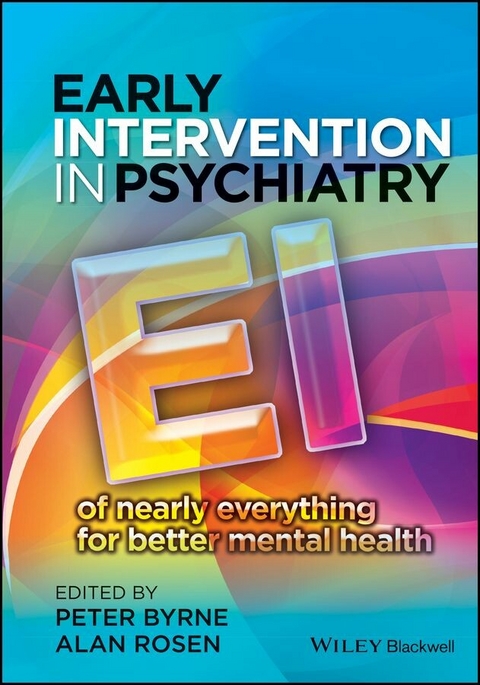
Early Intervention in Psychiatry (eBook)
Early intervention (EI) is the single most important advance in mental health care in recent decades, representing a key shift in both theoretical standpoint and service delivery.
Early Intervention in Psychiatry clearly describes best practice for extending this approach to all psychiatric disorders. Beginning with the rationale for EI, it informs interventions in people from all age groups across the lifespan, from perinatal to old age. It addresses EI in specific settings, such as primary health care, community health, the general hospital, non-government agencies, and in social movements, and for specific disorders including depression and anxiety, alcohol and substance use, childhood disorders, psychoses, bipolar disorders, eating disorders and borderline personality disorders.
Early Intervention in Psychiatry is an essential guide for all psychiatrists, general practitioners, family physicians and public health doctors. It is also a valuable resource for mental health professionals and primary care colleagues, including nurses, social workers, psychologists, occupational therapists, vocational rehabilitation specialists, peer and support workers and for mental health commissioners and policy-makers.
Peter Byrne, Homerton University Hospital, London; Royal College of Psychiatrists, UK
Alan Rosen, School of Public Health, University of Wollongong; Brain and Mind Research Institute, University of Sydney; Mental Health Commission of New South Wales, Australia
Early intervention (EI) is the single most important advance in mental health care in recent decades, representing a key shift in both theoretical standpoint and service delivery.Early Intervention in Psychiatry clearly describes best practice for extending this approach to all psychiatric disorders. Beginning with the rationale for EI, it informs interventions in people from all age groups across the lifespan, from perinatal to old age. It addresses EI in specific settings, such as primary health care, community health, the general hospital, non-government agencies, and in social movements, and for specific disorders including depression and anxiety, alcohol and substance use, childhood disorders, psychoses, bipolar disorders, eating disorders and borderline personality disorders.Early Intervention in Psychiatry is an essential guide for all psychiatrists, general practitioners, family physicians and public health doctors. It is also a valuable resource for mental health professionals and primary care colleagues, including nurses, social workers, psychologists, occupational therapists, vocational rehabilitation specialists, peer and support workers and for mental health commissioners and policy-makers.
Peter Byrne, Homerton University Hospital, London; Royal College of Psychiatrists, UK Alan Rosen, School of Public Health, University of Wollongong; Brain and Mind Research Institute, University of Sydney; Mental Health Commission of New South Wales, Australia
List of Contributors ix
Foreword xiii
Part I The Rationale for Early Intervention in NearlyEverything
1 Introduction 3
Peter Byrne and Alan Rosen
2 How Early Intervention Can Turn Things Upside Down and Turn aPatient Into a Psychiatrist 10
Nick Meinhold
3 Involving the Family in Early Interventions 20
Gr´ainne Fadden
4 Do Early Intervention Services for Psychosis Represent Valuefor Money? 33
Paul McCrone and Martin Knapp
Part II Early Intervention Across the Lifespan
5 Perinatal Preventive Interventions in Psychiatry: A ClinicalPerspective 45
Martin St-Andr´e, Hannah Schwartz and Keiko Yoshida
6 Psychiatry and Intervention in Infancy and Early Childhood57
Jane Barlow
7 Early Intervention for Young People with Mental Illness68
Tom Callaly
8 Transiting Out of Child and Adolescent Mental Health Services- Influences on Continuities and Discontinuities in MentalHealth Care 79
Linda Dowdney and Helen Bruce
9 Adults of Working Age 92
Karl Marlowe
10 Early Intervention in Older Adults - A Focus onAlzheimer's Dementia 103
Brian Lawlor and Celia O'Hare
Part III Early Intervention in Specific Settings
11 Primary Prevention of Mental Disorders 119
Inge Petersen, Arvin Bhana, Crick Lund and Helen Herrman
12 Early Intervention in Mental Health Problems: The Role of theVoluntary Sector 134
Andrew McCulloch, Isabella Goldie and Sophie Bridger
13 Why Primary Care Matters for Early Intervention in Psychiatry147
David Shiers and Helen Lester
14 Early Intervention in the General Hospital 160
Peter Byrne and Iyas Assalman
15 Early Intervention Services versus Generic Community MentalHealth Services: A Paradigm Shift 169
Marco Armando, Franco De Crescenzo and MaximilianBirchwood
Part IV Early Intervention in Specific Disorders
16 Prevention and Early Intervention in Depression and AnxietyDisorders 187
Irwin Nazareth and Tony Kendrick
17 Alcohol and Substance Use Prevention and Early Intervention201
Nicola C. Newton, Mark Deady and Maree Teesson
18 Early Intervention in Childhood Disorders 218
Rajeev Jairam and Garry Walter
19 Early Intervention for Delirium 234
David Meagher and Walter Cullen
20 Early Intervention for Self-Harm and Suicidality 255
Sarah Steeg, Jayne Cooper and Nav Kapur
21 Early Intervention in Bipolar Disorder 267
Paddy Power, Philippe Conus, Craig Macneil and Jan Scott
22 Early Intervention in Eating Disorders 288
Leora Pinhas, Jennifer Wong and D. Blake Woodside
23 Early Intervention to Reduce Violence and Offending Outcomesin Young People with Mental Disorders 305
Rick Fraser, Rosemary Purcell and Danny Sullivan
24 Early Intervention for Borderline Personality Disorder318
Andrew M. Chanen and Louise McCutcheon
Part V Conclusions
25 Early Intervention and the Power of Social Movements: UKDevelopment of Early Intervention in Psychosis as a Social Movementand its Implications for Leadership 337
David Shiers and Jo Smith
26 Challenging Stigma 358
Amy C. Watson, Patrick Corrigan and Kristin Kosyluk
27 Conclusion: Towards Standards for Early Prevention andIntervention of Nearly Everything for Better Mental Health Services373
Alan Rosen and Peter Byrne
Afterword for Early Intervention of Nearly Everything for BetterMental Health Services 396
Patrick McGorry
Index 400
CHAPTER 1
Introduction
Peter Byrne1,2 and Alan Rosen3,4,5
1 Homerton University Hospital, London
2 Royal College of Psychiatrists, UK
3 School of Public Health, University of Wollongong
4 Brain and Mind Research Institute, University of Sydney
5 Mental Health Commission of New South Wales, Australia
Early intervention (EI) is arguably the single most important advance in mental health care of the past decade. In terms of all-time advances in mental health care delivery, EI is up there with the consumer, family, recovery, and human rights for psychiatric disability movements, person-centred and holistic integrated services, effective psychotropic medications and psychotherapeutic interventions, evidence-based psychosocial interventions and mobile assertive community-centred service delivery systems. EI represents a key shift in both theoretical standpoint and service delivery, and marks an end to the first era of community psychiatry – where we set up ‘accessible’ clinical structures by locality, and patients were expected to adapt to these. With EI, practitioners reconfigure how they work to engage, negotiate and agree interventions support and care with their service users. From a general practitioner (GP) perspective, some modern community mental health teams (CMHTs) have ‘raised the bar’ to focus only on those with severe mental illness (SMI), now implicitly or formally defined as established psychotic disorders. Many CMHTs decline people in crisis or in the early stages of illness: by the time their referral is accepted later on, engagement is harder and many interventions have a reduced efficacy. Like all useful ideas, EI is a simple one and has instant appeal to people in early stages of illness (crucially often before insight is lost) and to their families. Key clinicians, notably GPs and mental health professionals also have a strong self-interest in designing and supporting efficient EI services. It is both self-evident to them, and increasingly evident from emerging studies, that such timely approaches could save much harder and longer clinical endeavour further down the track. We list the key pioneers later (Chapter 27), many of whom have contributed to this book. Their work, along with impressive citations at the end of each chapter, should persuade readers new to EI that this will be a key component of the twenty-first century mental health care. This book's main aim is to affirm for every clinician, every purchaser of services and other interested parties the high value of EI in most care settings from cradle to grave.
Prevention
Caplan's three levels of prevention are well described [1, 2]. Primary prevention prevents the disorder from occurring in the first place, secondary restores health from an existing disorder, while tertiary attempts to claw back better function from persistent or long-term disorders. In mental health service delivery, most effort and money are devoted to tertiary prevention/maintenance treatment, where the quality of rehabilitation may be so variable that the term ‘rehabilitation’ may sometimes be a euphemism for habitual low-grade custodial care. Secondary prevention is the early recognition and treatment of psychiatric disorders: to date, the best evidence and best practice has been implemented in EI for psychosis in young people (see Chapters 7, 9, 15 and 21). This book will inform interventions in people from all age groups, building on the core components of excellent services: engaging, low (negative) impact practices that are culture- and age-sensitive with robust crisis interventions, assertive case management, flexible home visiting, family consultations and in and out of hours, active response services. EI teams should have a low threshold to identify individuals warranting assessment, monitoring and sometimes treatment, reduce stigma in patients and their local community, engage individuals with emerging symptoms and their family carers in low-key pre-emptive services even if formal treatment is not indicated, not wanted or not available, locally or anywhere. Their primary aim is to treat vigorously the first signs of the disorder in the first 3 years (‘the critical period’). In managing a complex mix of possible noncases and cases, medication is only one option and part of phase-specific organic and psychosocial interventions: comprehensive therapeutic assessment, crisis intervention, education, family work, cognitive behavioural therapy, assertive community treatment, substance misuse and vocational interventions, to name but eight.
Overview: structure of this book
EI principles also support service users and carers in their individual recovery models, and dare to aim for full remission or generate hope that their symptoms do not develop into lifelong disability. A large part of primary care, child psychiatry and consultation–liaison (general hospital) psychiatry works as secondary prevention, but within large caseloads across secondary services including CMHTs, there are many opportunities for EI. This book's approach will be:
- Across the age spans, identifying the best EI practices in specific groups.
- Comprehensive: most common psychiatric disorders will be addressed – that is the ‘nearly everything’ of our subtitle. Because most psychiatric subspecialities have developed in isolation, they may be unaware of hard-won lessons from other colleagues in engaging and managing people from different demographic groups and cultures. Whether your patient is 8 or 80, there is much to be gained from an EI ethos.
- Evidence based, with an emphasis on outcomes (e.g. improvements in symptoms, social functioning, concordance, quality of life, service satisfaction) and outputs (e.g. interventions, contacts with services, clear care pathways that encourage referrals). Where these are available and reliable, screening instruments will be discussed.
- International, with authors and promising studies and experiences recounted from Asia, Australasia, Europe and North America.
- Practical: though it is challenging to cross different cultures and diverse health care provision, authors will try to answer readers' questions about how excellent EI service configurations might look (Section III), and which clinicians are best placed to intervene.
- Interdisciplinary and collaborative: this book was written for all interdisciplinary team members, our mental health and primary care colleagues (nurses, social workers, psychologists, occupational therapists, vocational rehabilitation and supported housing specialists, peer workers etc.), doctors (psychiatrists, GPs, public health doctors, paediatricians, adolescent specialists, physicians, geriatricians and more), managers, purchasers/commissioners and other health care providers. The book will also be useful to trainees in these disciplines, postgraduate students and commentators and to service user and family groups.
- Flexible and holistic: one of the key lessons from EI Psychosis Teams internationally has been NOT to send young people elsewhere (to another service) to address their substance misuse problems, or to separate organisations to deal with educational/training, housing, relationship problems. Although we did not brief authors about physical health care, this was raised frequently by the individual authors, and new approaches are set out later.
- Pragmatic: for clinicians with scarce resources, prioritising early identification (precursor symptoms and prodromes) to reduce current long durations of untreated illness and to set out core interventions that reduce psychological morbidity.
- Future proof: where evidence appears relatively sparse (e.g. eating disorders, learning disability, bipolar disorder) or where research continues apace (e.g. psychosis, dementia, delirium), expert clinicians will summarise the advances and predict where best practice will lie in the future. Though it may be attractive to researchers, the book is aimed primarily at clinicians, service planners and providers.
We begin with contributions from two key groups, whose interests mostly overlap – service users (consumers) and carers (families) – before hearing the economic arguments in the fourth chapter. The next six chapters have artificially divided the life span into five stages. Our needs change as we attach, individuate, enter adolescence then adulthood, before biology and our environment act upon us in middle age through to later life. We also include a key chapter on transition – from children's services to general adult psychiatry as Chapter 8. As health care providers this is an inevitable transition that should herald an orderly handover of care. Certainly in Europe, and we believe elsewhere, clinicians have not managed this well, and there are lessons to learn. Although artificial, we have laid out settings and levels of prevention in the next five chapters. We accept the same patients are attending GPs (Chapter 13) as are admitted to general hospitals (Chapter 14), and every one of them benefits from primary prevention (Chapter 11) and voluntary sector activities (Chapter 12). Though this might seem theoretical, we think the principles that drive the evidence might be similar but the different settings require different strategies to deliver EI. Not least, each setting has a different story to tell about the institutional and other obstacles...
| Erscheint lt. Verlag | 26.9.2014 |
|---|---|
| Sprache | englisch |
| Themenwelt | Medizin / Pharmazie ► Gesundheitsfachberufe |
| Medizin / Pharmazie ► Medizinische Fachgebiete ► Psychiatrie / Psychotherapie | |
| Schlagworte | Advance • Approach • Best • Care • Clearly • Clinical psychology • Delivery • describes • disorders • Ei • groups • Health • important • informs • Intervention • key shift • Klinische Psychologie • Medical Science • Medizin • Mental • Practice • Psychiatric • Psychiatrie • Psychiatry • Psychologie • Psychology • Rationale • recent decades • Single • Social Psychiatry • Sozialpsychiatrie • Standpoint • Theoretical |
| ISBN-13 | 9781118387771 / 9781118387771 |
| Informationen gemäß Produktsicherheitsverordnung (GPSR) | |
| Haben Sie eine Frage zum Produkt? |
 EPUB (Adobe DRM)
Kopierschutz: Adobe-DRM
Adobe-DRM ist ein Kopierschutz, der das eBook vor Mißbrauch schützen soll. Dabei wird das eBook bereits beim Download auf Ihre persönliche Adobe-ID autorisiert. Lesen können Sie das eBook dann nur auf den Geräten, welche ebenfalls auf Ihre Adobe-ID registriert sind.
Details zum Adobe-DRM
Dateiformat: EPUB (Electronic Publication)
EPUB ist ein offener Standard für eBooks und eignet sich besonders zur Darstellung von Belletristik und Sachbüchern. Der Fließtext wird dynamisch an die Display- und Schriftgröße angepasst. Auch für mobile Lesegeräte ist EPUB daher gut geeignet.
Systemvoraussetzungen:
PC/Mac: Mit einem PC oder Mac können Sie dieses eBook lesen. Sie benötigen eine
eReader: Dieses eBook kann mit (fast) allen eBook-Readern gelesen werden. Mit dem amazon-Kindle ist es aber nicht kompatibel.
Smartphone/Tablet: Egal ob Apple oder Android, dieses eBook können Sie lesen. Sie benötigen eine
Geräteliste und zusätzliche Hinweise
Buying eBooks from abroad
For tax law reasons we can sell eBooks just within Germany and Switzerland. Regrettably we cannot fulfill eBook-orders from other countries.
aus dem Bereich