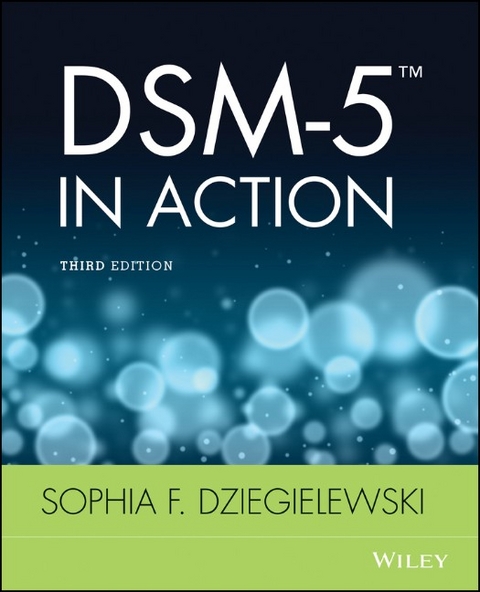
DSM-5 in Action (eBook)
John Wiley & Sons (Verlag)
978-1-118-76066-6 (ISBN)
By demystifying the DSM-5, author Sophia Dziegielewski goes beyond the traditional diagnostic assessment and suggests both treatment plans and practice strategy. She covers the changes in criteria to the DSM-5 and what those changes mean for mental health professionals. This resource has been updated to include:
- New and updated treatment plans
- All treatment plans, interventions strategies, applications, and practice implications are evidence based
- Instructions on doing diagnostic assessments and differential diagnosis using the DSM-5
- Changes to coding and billing using the DSM-5 and ICD-10
The book includes robust tools for students, instructors, and new graduates seeking licensure. DSM-5 in Action makes the DSM-5 accessible to all practitioners, allowing for more accurate, comprehensive care.
SOPHIA F. DZIEGIELEWSKI, PHD, LCSW is Professor and Associate Director for Research in the School of Social Work at the University of Central Florida where she also serves as Chair of the University Institutional Review Board. She is also the Editor of the Journal of Social Service Research. She is the recipient of numerous awards and supports her research and practice activity with over 120 publications, including seven textbooks, seventy-nine articles, numerous book chapters, and over 400 workshops and community presentations. Her research focuses on the areas of health and mental health. As a licensed social worker, she also remains active in clinical practice.
Full exploitation of the DSM-5 allows for more comprehensive care By demystifying the DSM-5, author Sophia Dziegielewski goes beyond the traditional diagnostic assessment and suggests both treatment plans and practice strategy. She covers the changes in criteria to the DSM-5 and what those changes mean for mental health professionals. This resource has been updated to include: New and updated treatment plans All treatment plans, interventions strategies, applications, and practice implications are evidence based Instructions on doing diagnostic assessments and differential diagnosis using the DSM-5 Changes to coding and billing using the DSM-5 and ICD-10 The book includes robust tools for students, instructors, and new graduates seeking licensure. DSM-5 in Action makes the DSM-5 accessible to all practitioners, allowing for more accurate, comprehensive care.
SOPHIA F. DZIEGIELEWSKI, PHD, LCSW is Professor and Associate Director for Research in the School of Social Work at the University of Central Florida where she also serves as Chair of the University Institutional Review Board. She is also the Editor of the Journal of Social Service Research. She is the recipient of numerous awards and supports her research and practice activity with over 120 publications, including seven textbooks, seventy-nine articles, numerous book chapters, and over 400 workshops and community presentations. Her research focuses on the areas of health and mental health. As a licensed social worker, she also remains active in clinical practice.
"This book is a thoroughly researched and organized approach to understanding the DSM-5 and how to use its diagnostic criteria to create a treatment plan/practice strategy. It is easy to read and understand, and the case examples and treatment plans are well done." (Doody 2016)
Preface
The pages that follow will introduce the reader to the diagnostic assessment, with its obvious strengths as well as its limitations. Although the concept of diagnosis and assessment is rich in tradition, the connection between diagnostic procedures and behavioral-based outcomes calls for a practice strategy that recognizes the importance of the relationship between the problems and concerns of the person and his or her environment. Continually assessing and reassessing how to best address context changes related to emotional, physical, and situational factors regarding client well-being is paramount.
This book stresses a multidisciplinary and interdisciplinary focus that invites all medically and nonmedically trained professionals, social workers, and other mental health practitioners to join in a collaborative team-based approach. By working together, teams best serve clients' needs by providing a comprehensive diagnostic assessment that ensures high-quality care.
This book utilizes the diagnostic nomenclature outlined in the Diagnostic and Statistical Manual of Mental Disorders (DSM) and goes beyond the DSM to clearly suggest treatment planning and application. The diagnostic assessment is embedded in the use of supporting texts, also referred to as the bibles of mental health, such as the Diagnostic and Statistical Manual of Mental Disorders, 5th ed. (DSM-5; American Psychiatric Association, 2013) and the International Classification of Diseases, ninth and 10th editions (ICD-9-CM and ICD-10-CM; World Health Organization, 1993, 2008). These books have been the standards for mental health practice for decades. Therefore, it should come as no surprise to mental health professionals that the new edition, the DSM-5, which crosswalks insurance billing with the ICD-10, with its latest mandatory requirement for usage in October 2015, will bring what some consider earth-shaking changes.
Familiarity with these books is important for completing the diagnostic assessment, and all mental health professionals need to understand this information and how to incorporate it to provide a competent, efficient, and effective practice strategy. To assist in this process, this book outlines the basic diagnostic information related to the DSM-5 and suggests treatment strategy.
Similar to previous editions, this edition of this text continues to serve as a handbook that extends beyond just learning the criteria for a diagnosis. After providing an overview of the basics, the text extends to treatment strategy with the creation of treatment plans, including suggestions for individualizing the best therapeutic services available. In using the DSM, concerns remain about misdiagnosis, overdiagnosis, and labeling clients—all practices that can have severe repercussions personally, medically, socially, and occupationally—and the need for informed, ethical practice has never been more important. The early stages of transition to the DSM-5 will require balancing the knowledge of both books, the DSM-IV-TR and DSM-5. Mental health practitioners believe strongly in allowing ethical principles, environmental factors, and a respect for cultural diversity to guide all practice decisions. From this perspective, the diagnostic assessment described in this book embodies concepts such as individual dignity, worth, respect, and nonjudgmental attitudes.
For social workers and other mental health counselors (often referred to as practitioners), recognizing these values is the cornerstone from which all treatment planning and intervention is built. Many times these concepts remain subjective and require professional acknowledgment, interpretation, and application extending beyond the formal diagnostic criteria and requiring interpretation and application strategies that lead to efficient and effective practice strategy. What is most important to remember is that the DSM, regardless of the version, does not suggest treatment. My hope is that this book will help to further the crosswalk as the DSM works with the ICD in terms of billing and that this book will outline a comprehensive diagnostic assessment leading directly to the treatment and treatment planning essential for the implementation of practice strategy.
Overview
To start this endeavor, the four chapters of Section I introduce the reader to the major diagnostic assessment schemes utilized in the profession and through this diagnostic lens outline both support and resistance issues. In these introductory chapters, the basics of diagnosis and assessment are exemplified in relation to how these terms are applied in current health and mental health practice. The learning process begins with an understanding of how terms such as diagnosis and assessment are combined in relation to current health and mental health practice. A historical perspective provides the background of the DSM, comparing the similarities and differences from previous editions and the rationale for the latest version, the DSM-5. Further, this section summarizes the current expectations and controversies surrounding the DSM-5. Taken into account in DSM-5 is the importance of including supporting information, such as use of the dimensional assessment, crosscutting of symptoms, and use of the Cultural Formulation Interview (CFI). It ends with an overview of how the “In Action” connection is made, linking the diagnostic impression to treatment planning and practice strategy. Case examples show the application of the theoretical concepts and demonstrate how these principles relate to practice strategy.
Section II provides comprehensive diagnostic information for each selected category of disorder, identifying commonly seen psychiatric mental health conditions. Each chapter contains Quick References designed to highlight the most important diagnostic criteria clearly and concisely. The case examples show how the criteria can manifest. For each category of disorders outlined in the application chapters, at least one disorder highlights the “In Action” focus of the book. The case example provides a comprehensive diagnostic assessment and treatment plan that reflects the related practice strategy.
Additional treatment plans were one of the most popular features of previous editions of this book, and they have been expanded. Treatment planning is essential to practice strategy, and regardless of whether the DSM or the ICD is used for diagnostic purposes, the treatment plans and intervention strategy will remain similar. Therefore, the appendix covers selected disorders not addressed in the individual chapters, and also added are selected quick references that clearly outline the criteria. Each treatment plan explains the signs and symptoms that should be recorded, what the short- and long-range goals for the client are, and what needs to be done by the client, the practitioner, and the family.
Uniqueness of This Book
What remains unique about this book is that it challenges the practitioner to synthesize information into a complete diagnostic assessment that bridges the diagnostic assessment to current treatment planning and practice strategy. Each chapter, along with the quick references, is designed to give health and mental health practitioners a sense of hands-on learning and participation. This book is not meant to include all aspects of a mental disorder and its subsequent treatment. Rather, it provides a framework for approaching the disorder, with suggestions for the treatment that will follow.
Therefore, this book provides a reader-friendly comprehensive reference to the most commonly diagnosed mental disorders, as well as specific applications designed to show how to apply the diagnostic framework toward current practice strategy. Each disorder was carefully selected, based on what is most often seen in the field and taught in the graduate-level classroom. In addition, based on the prevalence of these diagnoses, the disorders covered in this book are often included on social work and other mental health–related licensing exams.
On a personal note, I believe creating a reader-friendly, practice-based handbook of this nature is never easy—nor should it be. Creating the best diagnostic assessment takes a lot of hard work, and all practice wisdom must be grounded in individualized, evidence-based practice strategy. Therefore, the actual drafting of chapters of this edition from the first proposal to the end product covered a span of well over 4 years, with numerous rewrites and edits. This book represents more than 25 years of my professional practice and teaching experience. In addition, I have worked with all the contributing authors of the application chapters, all are fellow practitioners in the area, and together we have spent countless hours deciding on how best to transcribe practice experience into the written word. All the contributors to this text are passionate about our profession and agree that much needs to be learned from the clients served. We all believe strongly that diagnostic skill will always fall short if it is not linked to practice strategy.
Case examples are used throughout this book to help the reader see the interface between what is written in the text and how it applies to practice. Many of the struggles that other professionals have noted are highlighted, and the case examples present information in a practical and informative way that is sensitive to the client's best interests while taking into account the reality of the practice environment....
| Erscheint lt. Verlag | 24.9.2014 |
|---|---|
| Sprache | englisch |
| Themenwelt | Geisteswissenschaften ► Psychologie ► Persönlichkeitsstörungen |
| Medizin / Pharmazie ► Medizinische Fachgebiete ► Psychiatrie / Psychotherapie | |
| Studium ► 2. Studienabschnitt (Klinik) ► Anamnese / Körperliche Untersuchung | |
| Schlagworte | Abnormal Psychology • assessment models • Clinical psychology • DSM-5 billing changes • DSM-5 changes • DSM-5 clinical assessment • DSM-5 coding • DSM-5 demystified • DSM-5 diagnostics • DSM-5 in Action • DSM-5 new categories • DSM-5 treatment plans • DSM-V • evidence-based practice • Klinische Psychologie • mental health clinician • mental health diagnosis • mental health practice • mental health practitioner • mental health reference • new DSM • Psychiatry • Psychologie • Psychology • Psychopathologie • Social Policy & Welfare • Social Work • Sophia Dziegielewski • Sozialarbeit • Sozialpolitik u. Wohlfahrt • understanding the DSM-5 |
| ISBN-10 | 1-118-76066-2 / 1118760662 |
| ISBN-13 | 978-1-118-76066-6 / 9781118760666 |
| Informationen gemäß Produktsicherheitsverordnung (GPSR) | |
| Haben Sie eine Frage zum Produkt? |
 EPUB (Adobe DRM)
Kopierschutz: Adobe-DRM
Adobe-DRM ist ein Kopierschutz, der das eBook vor Mißbrauch schützen soll. Dabei wird das eBook bereits beim Download auf Ihre persönliche Adobe-ID autorisiert. Lesen können Sie das eBook dann nur auf den Geräten, welche ebenfalls auf Ihre Adobe-ID registriert sind.
Details zum Adobe-DRM
Dateiformat: EPUB (Electronic Publication)
EPUB ist ein offener Standard für eBooks und eignet sich besonders zur Darstellung von Belletristik und Sachbüchern. Der Fließtext wird dynamisch an die Display- und Schriftgröße angepasst. Auch für mobile Lesegeräte ist EPUB daher gut geeignet.
Systemvoraussetzungen:
PC/Mac: Mit einem PC oder Mac können Sie dieses eBook lesen. Sie benötigen eine
eReader: Dieses eBook kann mit (fast) allen eBook-Readern gelesen werden. Mit dem amazon-Kindle ist es aber nicht kompatibel.
Smartphone/Tablet: Egal ob Apple oder Android, dieses eBook können Sie lesen. Sie benötigen eine
Geräteliste und zusätzliche Hinweise
Buying eBooks from abroad
For tax law reasons we can sell eBooks just within Germany and Switzerland. Regrettably we cannot fulfill eBook-orders from other countries.
aus dem Bereich