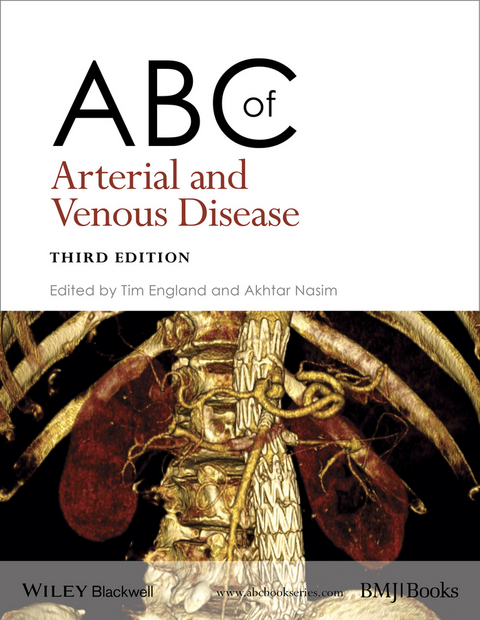
ABC of Arterial and Venous Disease (eBook)
John Wiley & Sons (Verlag)
978-1-118-74190-0 (ISBN)
ABC of Arterial and Venous Disease provides a structured, practical approach to clinical assessment, investigation and management of the most commonly presenting arterial and venous disorders,
Structural and functional abnormalities of arteries and veins manifest clinically in a broad spectrum of disorders, including cerebrovascular and carotid artery disease, abdominal aortic aneurysms, acute and chronic limb ischaemia, vasculitis and varicose veins, This revised edition incorporates new chapters on coronary artery disease and acute coronary syndrome, visceral artery stenosis and mesenteric ischaemia, and arteriovenous malformations, Many of these common or chronic conditions first present for initial assessment by primary health care professionals, Case vignettes have been added to relevant chapters to aid understanding and decision making,
Fully up to date and from an expert editor and contributor team, ABC of Arterial and Venous Disease remains a useful resource for non-specialist doctors such as general practitioners, family physicians and junior doctors in training, It is also a relevant guide for all other primary health care professionals working within the multidisciplinary teams responsible for patients with chronic arterial and venous disorders,
Tim England, Clinical Associate Professor and Honorary Consultant Stroke Physician, Division of Medical Sciences and Graduate Entry Medicine, School of Medicine, University of Nottingham; Royal Derby Hospital Centre, UK
Akhtar Nasim, Consultant Vascular Surgeon, University Hospitals of Leicester; Honorary Senior Lecturer, University of Leicester; Director, Leicester Abdominal Aortic Aneurysm (AAA) Screening Programme, Leicester, UK
ABC of Arterial and Venous Disease provides a structured, practical approach to clinical assessment, investigation and management of the most commonly presenting arterial and venous disorders. Structural and functional abnormalities of arteries and veins manifest clinically in a broad spectrum of disorders, including cerebrovascular and carotid artery disease, abdominal aortic aneurysms, acute and chronic limb ischaemia, vasculitis and varicose veins. This revised edition incorporates new chapters on coronary artery disease and acute coronary syndrome, visceral artery stenosis and mesenteric ischaemia, and arteriovenous malformations. Many of these common or chronic conditions first present for initial assessment by primary health care professionals. Case vignettes have been added to relevant chapters to aid understanding and decision making. Fully up to date and from an expert editor and contributor team, ABC of Arterial and Venous Disease remains a useful resource for non-specialist doctors such as general practitioners, family physicians and junior doctors in training. It is also a relevant guide for all other primary health care professionals working within the multidisciplinary teams responsible for patients with chronic arterial and venous disorders.
Tim England, Clinical Associate Professor and Honorary Consultant Stroke Physician, Division of Medical Sciences and Graduate Entry Medicine, School of Medicine, University of Nottingham; Royal Derby Hospital Centre, UK Akhtar Nasim, Consultant Vascular Surgeon, University Hospitals of Leicester; Honorary Senior Lecturer, University of Leicester; Director, Leicester Abdominal Aortic Aneurysm (AAA) Screening Programme, Leicester, UK
Preface, vii
Contributors, viii
1 Pathogenesis of Atherosclerosis and Methods of Arterial and Venous Assessment, 1
Mario De Nunzio and Timothy J. England
2 Cerebrovascular and Carotid Artery Disease, 9
Timothy J. England, Nishath Altaf, and Shane MacSweeney
3 Coronary Artery Disease and Acute Coronary Syndrome, 17
Asif Adnan and David Adlam
4 Abdominal Aortic Aneurysms, 25
David A. Sidloff, Nikesh Dattani, and Matthew J. Bown
5 Visceral Artery Stenosis and Mesenteric Ischaemia, 31
Daryll Baker
6 Acute Limb Ischaemia, 37
Christos D. Karkos and Thomas E. Kalogirou
7 Chronic Lower Limb Ischaemia, 44
Harjeet Rayt and Robert S.M. Davies
8 VenousThromboembolic Disease, 50
Harjeet Rayt and Akhtar Nasim
9 Varicose Veins, 56
Greg S. McMahon and Mark J. McCarthy
10 Lower Limb Ulceration, 62
Huw O.B. Davies and J. Mark Scriven
11 Lymphoedema, 68
Vaughan L. Keeley and Ruth A. England
12 Vasculitis, 73
Matthew D. Morgan, Stuart W. Smith, and Janson C.H. Leung
13 Vascular Anomalies, 81
E. Kate Waters and William D. Adair
14 Secondary Prevention and Antiplatelet Therapy in Peripheral Arterial Disease, 87
Richard Donnelly
15 Anticoagulants in Venous and Arterial Disease, 94
Sue Pavord and Amy Webster
Index, 101
Chapter 1
Pathogenesis of Atherosclerosis and Methods of Arterial and Venous Assessment
Mario De Nunzio1 and Timothy J. England2
1Derby Hospitals NHS Foundation Trust, Royal Derby Hospital, UK
2Division of Medical Sciences & GEM, School of Medicine, University of Nottingham, UK
Overview
- Atherosclerosis is a chronic inflammatory disorder
- The ankle–brachial pressure index (ABPI), calculated from the ratio of ankle systolic blood pressure (SBP) to brachial SBP, is a sensitive marker of arterial insufficiency in the lower limb
- Blood velocity increases through an area of narrowing. Typically, a 2-fold increase in peak systolic velocity compared with the velocity in a proximal adjacent segment of the same artery usually signifies a stenosis of 50% or more
- In detecting femoral and popliteal artery disease, duplex ultrasonography has a sensitivity of 80% and a specificity of 90–100%
- The introduction of multidetector computed tomography (MDCT) has had a dramatic effect on vascular imaging. Computed tomography pulmonary angiography (CTPA) for suspected pulmonary embolism (PE) is a good example, but computed tomography angiography (CTA) and magnetic resonance angiography (MRA) are widely used to investigate large artery pathology
- Colour duplex scanning is both sensitive and specific (90–100% in most series) for detecting proximal deep vein thrombosis (DVT).
Pathogenesis of atherosclerosis
Atherosclerosis is a chronic inflammatory disorder that results in hardening and thickening of arterial walls. Although it inevitably accompanies aging, it is not a degenerative process. The initial insult, called a ‘fatty streak’, is a purely inflammatory lesion and has been observed in infants. Over many years, circulating monocyte-derived macrophages adhere to and invade the arterial wall. An inflammatory response, proliferation of vascular smooth muscle cells and deposition of cholesterol and other lipids create arterial plaques. The insult creates a prothrombotic environment and induces the release of inflammatory mediators including cytokines, growth factors and hydrolytic enzymes. Over time, the plaques narrow the arterial lumen (and at times dilate it) and subsequently rupture, causing platelet activation, aggregation and resultant thrombus and embolus formation (Figure 1.1). It remains unclear as to what causes a stable plaque to rupture but it may be due to mechanical stress (e.g. hypertension) and the large lipid core redistributing shear stress over weakened areas of a thin fibrous cap.
Figure 1.1 Spontaneous rupture or fissuring of an atherosclerotic plaque exposes the lipid-rich core and triggers platelet activation and platelet aggregation. The platelet GP IIb/IIIa receptor activation binds fibrinogen and leads to intravascular thrombus formation, resulting in complete or near-complete vessel occlusion. Clinically, this often presents with a life-threatening unstable event such as an acute coronary syndrome, acute limb ischaemia or stroke.
It is recognised that increasing age, a genetic predisposition, male sex, hypertension, lipid abnormalities (in particular, LDL-cholesterol), diabetes, chronic high alcohol intake and cigarette smoking (causing an increase in free radicals) increase the risk of atherogenesis and endothelial dysfunction. Atherosclerosis mainly affects large and medium-sized arteries at places of arterial branching (e.g. carotid bifurcation). Symptoms occur when there is insufficient blood flow to the vascular bed as a result of
- in situ thrombotic arterial occlusion,
- low flow distal to an occluded or severely narrowed artery or
- embolism from an atherosclerotic plaque or thrombus.
Clots occurring in the venous system are often evaluated referencing the principles of Virchow's triad, the three broad categories that contribute to thrombosis: venous stasis due to prolonged immobility, endothelial and vessel wall injury, for example, due to radiation or medical devices, and hypercoagulability states such as patients with malignancy or clotting factor deficiency.
Investigating vascular disease
Diagnostic and therapeutic decisions in patients with vascular disease are guided primarily by the history and physical examination. However, the accuracy and accessibility of non-invasive investigations have greatly increased due to technological advances in computed tomography (CT) and magnetic resonance (MR) scanning. Computed tomography angiography (CTA) and magnetic resonance angiography (MRA) continue to evolve rapidly and are best described as ‘minimally invasive’ techniques when used with intravenous (i.v.) contrast. This chapter describes the main investigative techniques used in arterial and venous diseases.
Principles of vascular ultrasound
In its simplest form, ultrasound is transmitted as a continuous beam from a probe that contains two piezoelectric crystals. The transmitting crystal produces ultrasound at a fixed frequency (set by the operator according to the depth of the vessel being examined), while the receiving crystal vibrates in response to reflected waves and produces an output voltage. Conventional B-mode (brightness mode) ultrasonography records the ultrasound waves reflected from tissue interfaces and a two-dimensional picture is built according to the reflective properties of the tissues.
Ultrasound signals reflected off stationary surfaces have the same frequency with which they were transmitted, but the principle underlying Doppler ultrasonography is that signals reflected from moving objects, e.g. red blood cells, undergo a frequency shift in proportion to the velocity of the target. The output from a continuous-wave Doppler ultrasound is most frequently presented as an audible signal (e.g. a hand-held pencil Doppler, Figure 1.2), so that a sound is heard whenever there is movement of blood in the vessel being examined. With continuous-wave ultrasonography, there is little scope for restricting the area of tissue that is being examined because any sound waves that are intercepted by the receiving crystal will produce an output signal. The solution is to use pulsed ultrasound. This enables the investigator to focus on a specific tissue plane by transmitting a pulse of ultrasound and closing the receiver except when signals from a predetermined depth are returning. For example, the centre of an artery and the areas close to the vessel wall can be examined in turn.
Figure 1.2 A hand-held pencil Doppler being used to measure the ankle–brachial pressure index.
Examination of an arterial stenosis shows an increase in blood velocity through the area of narrowing. The site(s) of any stenotic lesions can be identified by serial placement of the Doppler probe along the extremities. Criteria to define a stenosis vary between laboratories, but a 2-fold increase in peak systolic velocity compared with the velocity in a proximal adjacent segment of the artery usually signifies a stenosis of ≥50% (Table 1.1). The normal (triphasic) Doppler velocity waveform is made up of three components that correspond to different phases of arterial flow (Figure 1.3):
- Rapid antegrade flow reaching a peak during systole
- Transient reversal of flow during early diastole
- Slow antegrade flow during late diastole.
Table 1.1 Relationship between increased blood velocity and degree of stenosis.
| Diameter of stenosis (%) | Peak systolic velocity (m/s)* | Peak diastolic velocity (m/s)* | Internal carotid: common carotid artery ratio† |
| 0–39 | <1.1 | <0.45 | <1.8 |
| 4–59 | 1.1–1.49 | <0.45 | <1.8 |
| 60–79 | 1.5–2.49 | 0.45–1.4 | 1.8–3.7 |
| 80–99 | 2.5–6.1 | >1.4 | >3.7 |
| >99 (critical) | Very low | NA | NA |
* Measured in the lower part of the internal carotid artery.
† Ratio of peak systolic velocity in internal carotid artery stenosis relative to the velocity in the proximal common carotid artery.
Figure 1.3 Doppler velocity waveforms: (a) a triphasic waveform in a normal artery; (b) a biphasic waveform, with increased velocity, through a mild stenosis; (c) a monophasic waveform, with a marked increase in velocity, through a tight stenosis; and (d) a dampened monophasic waveform, with reduced velocity, recorded distal to a tight stenosis.
Doppler examination of an artery distal to a stenosis shows characteristic changes in the velocity profile (Figure 1.3d):
- The rate of rise is delayed and the amplitude decreased
- The transient flow reversal in early diastole is lost
- In severe disease conditions, the Doppler waveform flattens; in critical limb ischaemia, it may be undetectable.
Investigations of arterial disease
Ankle–brachial pressure index
Under normal conditions, systolic blood pressure (SBP) in the legs is equal to or slightly greater than the SBP in the upper limbs. In the presence of an arterial stenosis, a...
| Erscheint lt. Verlag | 25.9.2014 |
|---|---|
| Reihe/Serie | ABC Series |
| ABC Series | ABC Series |
| Sprache | englisch |
| Themenwelt | Medizin / Pharmazie ► Allgemeines / Lexika |
| Medizinische Fachgebiete ► Chirurgie ► Herz- / Thorax- / Gefäßchirurgie | |
| Medizinische Fachgebiete ► Innere Medizin ► Kardiologie / Angiologie | |
| Schlagworte | ABC • Abnormalities • Allgemeine u. Innere Medizin • Approach • Arterial • Arteries • Artery • Assessment • broad • Care • Chapters • Chronic • clinically • commonly • coronary • Disease • disorders • Edition • First • Functional • GefäÃmedizin • Gefäßmedizin • General & Internal Medicine • Hämatologie • Hämatologie • Health • Hematology • incorporates • Kardiovaskuläre Erkrankung • Krankenpflege • Manifest • Medical Science • Medizin • New • Practical • spectrum • vascular medicine • Veins |
| ISBN-10 | 1-118-74190-0 / 1118741900 |
| ISBN-13 | 978-1-118-74190-0 / 9781118741900 |
| Informationen gemäß Produktsicherheitsverordnung (GPSR) | |
| Haben Sie eine Frage zum Produkt? |
 EPUB (Adobe DRM)
Kopierschutz: Adobe-DRM
Adobe-DRM ist ein Kopierschutz, der das eBook vor Mißbrauch schützen soll. Dabei wird das eBook bereits beim Download auf Ihre persönliche Adobe-ID autorisiert. Lesen können Sie das eBook dann nur auf den Geräten, welche ebenfalls auf Ihre Adobe-ID registriert sind.
Details zum Adobe-DRM
Dateiformat: EPUB (Electronic Publication)
EPUB ist ein offener Standard für eBooks und eignet sich besonders zur Darstellung von Belletristik und Sachbüchern. Der Fließtext wird dynamisch an die Display- und Schriftgröße angepasst. Auch für mobile Lesegeräte ist EPUB daher gut geeignet.
Systemvoraussetzungen:
PC/Mac: Mit einem PC oder Mac können Sie dieses eBook lesen. Sie benötigen eine
eReader: Dieses eBook kann mit (fast) allen eBook-Readern gelesen werden. Mit dem amazon-Kindle ist es aber nicht kompatibel.
Smartphone/Tablet: Egal ob Apple oder Android, dieses eBook können Sie lesen. Sie benötigen eine
Geräteliste und zusätzliche Hinweise
Buying eBooks from abroad
For tax law reasons we can sell eBooks just within Germany and Switzerland. Regrettably we cannot fulfill eBook-orders from other countries.
aus dem Bereich