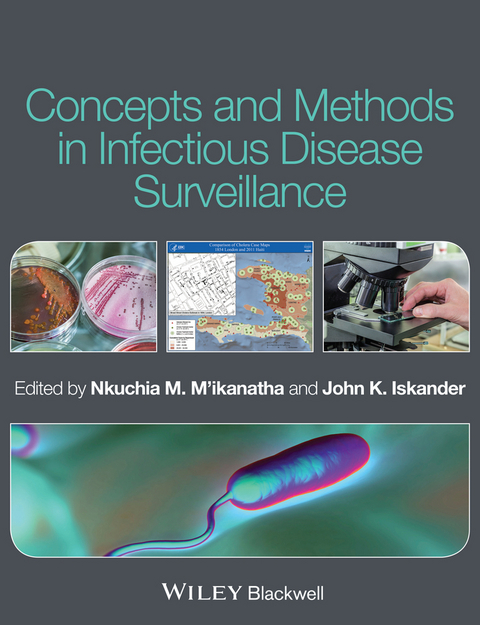
Concepts and Methods in Infectious Disease Surveillance (eBook)
John Wiley & Sons (Verlag)
978-1-118-92863-9 (ISBN)
Infectious disease surveillance has evolved at an extraordinary pace during the past several decades, and continues to do so. It is increasingly used to inform public health practice in addition to its use as a tool for early detection of epidemics. It is therefore crucial that students of public health and epidemiology have a sound understanding of the concepts and principles that underpin modern surveillance of infectious disease.
Written by leaders in the field, who have vast hands-on experience in conducting surveillance and teaching applied public health, Concepts and Methods in Infectious Disease Surveillance is comprised of four sections. The first section provides an overview, a description of systems used by public health jurisdictions in the United States and legal considerations for surveillance. The second section presents chapters on major program-area or disease-specific surveillance systems, including those that monitor bacterial infections, foodborne diseases, healthcare-associated infections, and HIV/AIDS. THe following section is devoted to methods for conducting surveillance and also approaches for data analysis, communication and the use of traditional and social media. A concluding chapter showcases lessons learned from the New York City Department of Health’s experience in surveillance and epidemiology training.
This comprehensive new book covers major topics at an introductory to intermediate level, and will be an excellent resource for instructors. Suitable for use in graduate level courses in public health, human and veterinary medicine, and in undergraduate programs in public-health-oriented disciplines, Concepts and Methods in Infectious Disease Surveillance is also a useful primer for frontline public health practitioners, hospital epidemiologists, infection control practitioners, laboratorians in public health settings, infectious disease researchers, and medical and public health informaticians interested in a concise overview of infectious disease surveillance.
Infectious disease surveillance has evolved at an extraordinary pace during the past several decades, and continues to do so. It is increasingly used to inform public health practice in addition to its use as a tool for early detection of epidemics. It is therefore crucial that students of public health and epidemiology have a sound understanding of the concepts and principles that underpin modern surveillance of infectious disease. Written by leaders in the field, who have vast hands-on experience in conducting surveillance and teaching applied public health, Concepts and Methods in Infectious Disease Surveillance is comprised of four sections. The first section provides an overview, a description of systems used by public health jurisdictions in the United States and legal considerations for surveillance. The second section presents chapters on major program-area or disease-specific surveillance systems, including those that monitor bacterial infections, foodborne diseases, healthcare-associated infections, and HIV/AIDS. The following section is devoted to methods for conducting surveillance and also approaches for data analysis. A concluding section summarizes communication of surveillance findings, including the use of traditional and social media, in addition to showcasing lessons learned from the New York City Department of Health s experience in surveillance and epidemiology training. This comprehensive new book covers major topics at an introductory to intermediate level, and will be an excellent resource for instructors. Suitable for use in graduate level courses in public health, human and veterinary medicine, and in undergraduate programs in public-health-oriented disciplines, Concepts and Methods in Infectious Disease Surveillance is also a useful primer for frontline public health practitioners, hospital epidemiologists, infection control practitioners, laboratorians in public health settings, infectious disease researchers, and medical and public health informaticians interested in a concise overview of infectious disease surveillance.
Nkuchia M. M'ikanatha, Division of Infectious Disease Epidemiology, Pennsylvania Department of Health, Harrisburg, Pennsylvania, USA. John K. Iskander, Medical Epidemiologist, Division of Infectious Disase Epidemiology, Pennsylvania Department of Health, Harrisburg, Pennsylvania and Acting Director, CDC Immunization Safety Office, Atlanta, USA.
Section A: Introduction
1. Surveillance as a Foundation for Infectious Disease Prevention and Control
Nkuchia M. M'ikanatha and John K. Iskander
2. The Legal Basis for Public Health Surveillance
Gail Horlick and Jean O'Connor
3. National, State, and Local Public Health Surveillance Systems
Ruth Jajosky and Jennifer Ward
4. Quarantine and the Role of Surveillance in Nineteenth-Century Public Health
David S. Barnes
Section B: Specific Surveillance Systems
5. Surveillance for Vaccine-preventable Diseases and Immunization
Daniel Payne
6. Surveillance for Seasonal and Novel Influenza Viruses
Bruno Ciancio and Piotr Kramarz
7. Surveillance for Bacterial Infections of Public Health Importance
Lee H. Harrison and Gayle Fischer Langley
8. Surveillance for Foodborne Diseases
Elaine Scallan and Casey Barton Behravesh
9. Surveillance of Healthcare-associated Infections
Lennox K. Archibald and Theresa J. McCann
10. Surveillance for Zoonotic Diseases
Linda Capewell Pimentel and Ethel V.Taylor
11. Surveillance of Viral Hepatitis Infections
Daniel R. Church, Gillian A. Haney, Monina Klevens, Alfred DeMaria Jr
12. Surveillance for Sexually Transmitted Diseases
Elizabeth Torrone and Kyle Bernstein
13. Surveillance for HIV/AIDS
Eve D. Mokotoff and James J. Gibson
14. Public Health Surveillance for Tuberculosis
Lori R. Armstrong and Roque Miramontes
Section C: Methods Used in Surveillance and Data Analysis
15. Analysis and Interpretation of Surveillance Data
Louisa E. Chapman and James N. Tyson
16. Global Surveillance for Emerging Infectious Diseases
Jennifer Nuzzo
17. Infectious Diseases Surveillance and Global Security
David L. Blazes and Sheri Lewis
18. Electronic information systems in surveillance: Implementation of the National Electronic Disease Surveillance System in South Carolina
Eric Brenner
19. Electronic Information Systems in Surveillance: Electronic Laboratory Reporting
Richard S. Hopkins and Nkuchia M. M'ikanatha
20. Use of Geographic Information Systems in Infectious Disease Surveillance
Rebecca J. Eisen and Lars Eisen
Section D: Cross-cutting Issues in Infectious Disease Surveillance
21. Communication of Surveillance Findings
Brian G. Southwell and Bridget J. Kelly
22. Lessons Learned in Epidemiology and Surveillance Training in New York City
Elizabeth Chuang and Carolyn Greene
Acronyms and Abbreviations
| AAP | American Academy of Pediatrics |
| AAVLD | American Association of Veterinary Laboratory Diagnosticians |
| ABCs | Active Bacterial Cores |
| ACA | Affordable Care Act |
| ACIP | Advisory Committee on Immunization Practices |
| ACOG | American College of Obstetricians and Gynecologists |
| ADAP | AIDS Drug Assistance Program |
| AFB | Acid-fast bacillus |
| AGE | Acute gastroenteritis |
| AIDS | Acquired immunodeficiency syndrome |
| ALT | Alanine transaminase |
| AMA | American Medical Association |
| APACHE II | Acute Physiology and Chronic Health Evaluation |
| APEC EIN | Asia Pacific Economic Council's Emerging Infections Network |
| APHA | American Public Health Association |
| ARCHES | Applied Research, Community Health Epidemiology, and Surveillance |
| ARI | Acute respiratory infection |
| ART | Antiretroviral treatments |
| ASA | American Society of Anesthesiologists |
| ASC | Area surveillance coordinators |
| ASM | American Society of Microbiology |
| AST | Aspartate transaminase |
| AVMA | American Veterinary Medical Association |
| BPHT | Bureau of Public Health Training |
| BSE | Bovine spongiform encephalopathy |
| CCs | Collaborating centres |
| CDA | Clinical Document Architecture |
| CDC | Centers for Disease Control and Prevention |
| CHD | County health department |
| CHIP | Comprehensive Hospital Infections Project |
| CIR | Citywide Immunization Registry |
| CQI | Continuous quality improvement |
| CSTE | Council of State and Territorial Epidemiologists |
| DADE | Division of Acute Disease Epidemiology |
| DALYs | Disability-adjusted life years |
| DHEC | Department of Health and Environmental Control |
| DIS | Disease intervention specialist |
| DoD | U.S. Department of Defense |
| DOH | Department of health |
| DOHMH | Department of Health and Mental Hygiene (New York City) |
| DoI | Data of interest |
| DOT | Directly observed therapy |
| DRC | Democratic Republic of Congo |
| DSMB | Data safety monitoring board |
| EAIDSNet | East African Integrated Disease Surveillance Network |
| EARS | Early Aberration Reporting System |
| ECDC | European Centre for Disease Prevention and Control |
| ED | Emergency department |
| eHARS | Enhanced HIV/AIDS Reporting System |
| EHR | Electronic health record |
| EID | Emerging infectious disease |
| EIP | Emerging Infections Program |
| EIS | Epidemic Intelligence Service |
| EISN | European Influenza Surveillance Network |
| ELC | Epidemiology and Laboratory Capacity for Infectious Diseases |
| ELR | Electronic laboratory reporting |
| EMR | Electronic medical record |
| EMRO | Regional Office for Eastern Mediterranean |
| EPI | Expanded Program on Immunization |
| EPT | Emerging Pandemics Threat |
| ERL | Essential Regulatory Laboratory |
| ESSENCE | Electronic Surveillance System for the Early Notification of Community-based Epidemics |
| EU | European Union |
| EURO | The Regional Office for Europe |
| FAO | Food and Agriculture Organization |
| FDA | Food and Drug Administration |
| FELTP | Field Epidemiology Laboratory Training Program |
| FETP | Field Epidemiology Training Program |
| FLDOH | Florida Department of Health |
| FU-1 | Follow-up 1 form of the RVCT |
| FU-2 | Follow-up 2 form of the RVCT |
| GABG | Coronary artery bypass graft |
| GAS | Group A Streptococcus |
| GBS | Group B Streptococcus |
| GDD | Global Disease Detection Program |
| GDDER | Global Disease Detection Program and Emergency Response |
| GEIS | Global Emerging Infections Surveillance and Response System |
| GGT | Gamma glutamyl transpeptidase |
| GIS | Geographic information system |
| GISP | Gonococcal Isolate Surveillance Project |
| GISRS | Global Influenza Surveillance and Response System |
| GLEWS | Global Early Warning and Response System |
| GoARN | Global Outbreak Alert and Response Network |
| GPHIN | Global Public Health Intelligence Network (Public Health Agency of Canada) |
| GPS | Global Positioning System |
| GRASP | Geospatial Research, Analysis and Service Program |
| HAA | Hepatitis-associated antigen |
| HAART | Highly active antiretroviral therapy |
| HAI | Healthcare-associated infections |
| HAV | Hepatitis A virus |
| HBsAg | Hepatitis B surface antigen |
| HCV | Hepatitis C virus |
| HDV | Hepatitis D virus |
| HEV | Hepatitis E virus |
| HI | Hemagglutination inhibition |
| HIPAA | Health Insurance Portability and Accountability Act |
| HIV | Human immunodeficiency virus |
| HL7 | Health Level 7 International |
| HPV | Human papillomavirus |
| HRTP | Health Research Training Program |
| IAP | Intrapartum antibiotic prophylaxis |
| ICD | International Classification of Diseases |
| ICU | Intensive care units |
| IDSA | Infectious Diseases Society of America |
| IDU | Intravenous drug users |
| IGRA | Interferon-gamma release assay |
| IHR | International Health Regulations |
| IHSP | Influenza Hospitalization Surveillance Project |
| ILI | Influenza-like illness |
| IPD | Invasive pneumococcal disease |
| IS | Intussusception |
| ISO | International Organization for Standardization |
| IT |
| Erscheint lt. Verlag | 20.8.2014 |
|---|---|
| Sprache | englisch |
| Themenwelt | Medizin / Pharmazie ► Allgemeines / Lexika |
| Medizin / Pharmazie ► Medizinische Fachgebiete | |
| Studium ► Querschnittsbereiche ► Infektiologie / Immunologie | |
| Schlagworte | associate director • centers • Concepts • Consultant • decades • Disease Control • extraordinary • Harrisburg • Health • infectious disease • Infektionskrankheit • Infektionskrankheiten • Medical • Medical Science • Medizin • nkuchia • Office • Pace • Pennsylvania • Public • Science • Surveillance |
| ISBN-10 | 1-118-92863-6 / 1118928636 |
| ISBN-13 | 978-1-118-92863-9 / 9781118928639 |
| Informationen gemäß Produktsicherheitsverordnung (GPSR) | |
| Haben Sie eine Frage zum Produkt? |
 EPUB (Adobe DRM)
Kopierschutz: Adobe-DRM
Adobe-DRM ist ein Kopierschutz, der das eBook vor Mißbrauch schützen soll. Dabei wird das eBook bereits beim Download auf Ihre persönliche Adobe-ID autorisiert. Lesen können Sie das eBook dann nur auf den Geräten, welche ebenfalls auf Ihre Adobe-ID registriert sind.
Details zum Adobe-DRM
Dateiformat: EPUB (Electronic Publication)
EPUB ist ein offener Standard für eBooks und eignet sich besonders zur Darstellung von Belletristik und Sachbüchern. Der Fließtext wird dynamisch an die Display- und Schriftgröße angepasst. Auch für mobile Lesegeräte ist EPUB daher gut geeignet.
Systemvoraussetzungen:
PC/Mac: Mit einem PC oder Mac können Sie dieses eBook lesen. Sie benötigen eine
eReader: Dieses eBook kann mit (fast) allen eBook-Readern gelesen werden. Mit dem amazon-Kindle ist es aber nicht kompatibel.
Smartphone/Tablet: Egal ob Apple oder Android, dieses eBook können Sie lesen. Sie benötigen eine
Geräteliste und zusätzliche Hinweise
Buying eBooks from abroad
For tax law reasons we can sell eBooks just within Germany and Switzerland. Regrettably we cannot fulfill eBook-orders from other countries.
aus dem Bereich