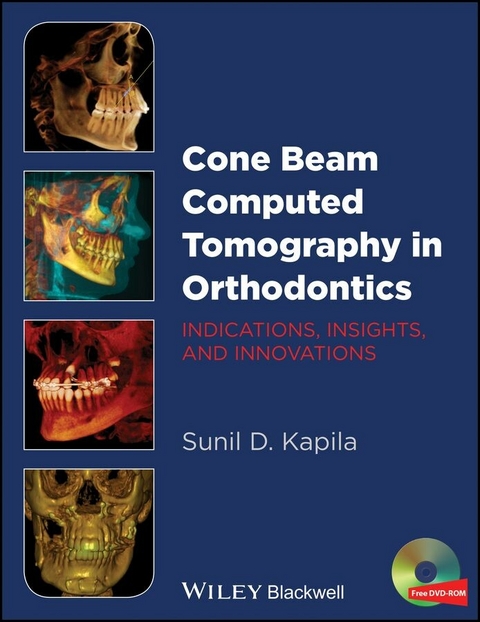
Cone Beam Computed Tomography in Orthodontics (eBook)
John Wiley & Sons (Verlag)
978-1-118-64659-5 (ISBN)
Since its introduction to dentistry, cone beam computed tomography (CBCT) has undergone a rapid evolution and considerable integration into orthodontics. However, despite the increasing popularity of CBCT and progress in applying it to clinical orthodontics, the profession has lacked a cohesive, comprehensive and objective reference that provides clinicians with the background needed to utilize this technology optimally for treating their patients. Cone Beam Computed Tomography in Orthodontics provides timely, impartial, and state-of-the-art information on the indications and protocols for CBCT imaging in orthodontics, clinical insights gained from these images, and innovations driven by these insights. As such, it is the most current and authoritative textbook on CBCT in orthodontics. Additionally, two DVDs include more than 15 hours of video presentations on related subjects from the 39th Annual Moyers Symposium and 38th Annual International Conference on Craniofacial Research.
Cone Beam Computed Tomography in Orthodontics is organized to progress sequentially through specific topics so as to build the knowledgebase logically in this important and rapidly evolving field. Part I provides the foundational information on CBCT technology, including radiation exposure and risks, and future evolutions in computed tomography. Part II presents the Principles and Protocols for CBCT Imaging in Orthodontics, focusing on developing evidence-based criteria for CBCT imaging, the medico-legal implications of CBCT to the professional and the protocols and integration of this technology in orthodontic practice. Part III provides critical information on CBCT-based Diagnosis and Treatment Planning that includes how to interpret CBCT scans, identify incidental pathologies and the possible other uses of this technology. Part IV covers practical aspects of CBCT's Clinical Applications and Treatment Outcomes that encompasses a range of topics, including root morphology and position, treatment of impacted teeth, virtual surgical treatment planning and outcomes, and more.
Sunil Kapila, D.D.S., M.S., Ph.D., is Robert W. Browne Endowed Professor and Chair, Department of Orthodontics and Pediatric Dentistry, the University of Michigan School of Dentistry in Ann Arbor, Michigan. He also serves as the Graduate Orthodontics Program Director at the University of Michigan. Dr. Kapila is the director of the Moyers Symposium, a prestigious conference held at the University of Michigan, which each year focuses on a specific topic in orthodontics, dentofacial orthopedics and craniofacial biology.
Sunil Kapila, D.D.S., M.S., Ph.D., is Robert W. Browne Endowed Professor and Chair, Department of Orthodontics and Pediatric Dentistry, the University of Michigan School of Dentistry in Ann Arbor, Michigan. He also serves as the Graduate Orthodontics Program Director at the University of Michigan. Dr. Kapila is the director of the Moyers Symposium, a prestigious conference held at the University of Michigan, which each year focuses on a specific topic in orthodontics, dentofacial orthopedics and craniofacial biology.
List of Contributors ix
Preface xiii
Acknowledgments xv
Part 1 Technology Assessment and Enhancements 3
1 Contemporary Concepts of Cone Beam Computed Tomography in Orthodontics 5
Sunil D. Kapila
2 Functional and Technical Characteristics of Different Cone Beam Computed Tomography Units 43
Om P. Kharbanda, Neeraj Wadhawan, Rajiv Balachandran, Devasenathipathy Kandasamy, and Sunil D. Kapila
3 Cone Beam Computed Tomography in Orthodontics: Perspectives on Radiation Risk 67
Sharon L. Brooks and John B. Ludlow
4 Rational Basis for Transitioning from 2D to 3D Radiographic Imaging in Orthodontic Practice and Research 81
Birte Melsen and Michel Dalstra
5 The Future of Cone Beam Computed Tomography and 3D Imaging in Orthodontics 103
Michael W. Vannier and Bin Jiang
Part 2 Protocols and Principles for Cone Beam Computed Tomography Imaging in Orthodontics 113
6 Development of Evidence-Based Selection Criteria for Cone Beam Computed Tomography in Orthodontics 115
William C. Scarfe, Kirt E. Simmons, and Carla A. Evans
7 To Scan or Not to Scan: Medico-Legal Implications 127
Bernard Friedland
8 Protocols for the Use of Cone Beam Computed Tomography in Orthodontic Practice 139
Aaron D. Molen
Part 3 Diagnosis and Treatment Planning 165
9 How to Interpret Cone Beam Computed Tomography Scans 167
Christos Angelopoulos
10 Detection of Incidental Findings in Cone Beam Computed Tomography Imaging and Their Clinical Implications 185
Erika Benavides and Paul C. Edwards
11 3D Orthodontic Diagnosis and Treatment Planning 221
Juan Martin Palomo, Manish Valiathan, and Mark G. Hans
12 Application of 3D TMJ Imaging to TMJDs, TMJ Functional Analyses, and Orthodontic Treatment Outcomes 247
Anna-Kari Hajati, Lucia H.S. Cevidanes, Laura Iwasaki, Jeffrey C. Nickel, and Sunil D. Kapila
13 Characterization of the Upper Airway Morphology and Its Changes in the Apneic Patient Using Cone Beam Computed Tomography 273
R. Scott Conley, Paolo M. Cattaneo, and Bruce S. Haskell
14 Alveolar Boundary Conditions in Orthodontic Diagnosis and Treatment Planning 293
Sunil D. Kapila and Jeanne M. Nervina
Part 4 Clinical Applications and Treatment Outcomes 317
15 Assessment of Root Position and Morphology by Cone Beam Computed Tomography 319
Jeanne M. Nervina and Sunil D. Kapila
16 3D Image-Aided Diagnosis and Treatment of Impacted and Transposed Teeth 349
Sunil D. Kapila and Jeanne M. Nervina
17 Assessment of Maxillary Transverse Deficiency and Treatment Outcomes by Cone Beam Computed Tomography 383
Jeanne M. Nervina, Sunil D. Kapila, and Carlos Flores-Mir
18 Planning and Placing Temporary Anchorage Devices with the Aid of Cone Beam Computed Tomography
Imaging 411
Sebastian Baumgaertel
19 3D Planning and Treatment Outcomes of Bone Anchored Maxillary Protraction 427
Tung Nguyen
20 Applications of Cone Beam Computed Tomography to Orthognathic Surgery Treatment Planning 437
Sean P. Edwards and R. Scott Conley
21 3D Diagnosis and Management of Facial Asymmetries 453
Abeer AlHadidi, Lucia H.S. Cevidanes, and Beatriz Paniagua
22 3D Assessment of Orthognathic Surgical Outcomes 463
Yoon-Ji R. Kim, Yang-Ho Park, Leonardo Koerich de Paula, and R. Scott Conley
23 3D Imaging in Diagnosis and Treatment Planning of Craniofacial Anomalies 485
Snehlata Oberoi, Jeanne M. Nervina, and Karin Vargervik
Index 509
1
Contemporary Concepts of Cone Beam Computed Tomography in Orthodontics
Sunil D. Kapila, BDS, MS, PhD
Introduction
Truly transformative innovations are rare in most fields, but their emergence can generate a buzz that reverberates across disciplines. This is true especially in medicine and dentistry, which would stagnate without groundbreaking technologies that improve diagnosis, treatment planning, and prevention of disease. Among the advances in healthcare, radiological innovations are uniquely important as they have propelled advances in virtually most medical and dental specialties directly or indirectly. In this book, we examine how this technological cross-pollination works by detailing the broad impact of three-dimensional (3D) radiographic imaging on orthodontic diagnosis and treatment planning.
Several different technologies, including structured light, laser surface imaging, magnetic resonance imaging (MRI), computed tomography (CT), and cone beam computed tomography (CBCT), are currently available for 3D imaging. While these technologies differ in their operational details, all of them generate 3D images using the same general principles. In each of these imaging modalities, an emitted energy beam passing through or reflected from the body is modified by the structures that it encounters. A specialized sensor captures the modified energy beam, which then is converted into a 3D image by sophisticated software. Surface models, such as dental casts or slices through the 3D volume, which clearly display internal structures, can then be generated to improve diagnosis and treatment planning. Factors such as the desired image resolution, radiation exposure, soft tissue versus hard tissue visualization, and region of interest are used to determine which imaging modality is suited best for any given patient. Because of the need for orthodontists to image the craniofacial skeleton optimally and derive volumetric information, X-ray–based imaging is the best choice among these imaging technologies. Within the volumetric 3D imaging subset, CBCT, as opposed to the more expensive CT or MRI or higher radiation CT technologies, currently is the most preferred approach for such imaging.
Since the introduction of CBCT to dentistry, which first was discussed comprehensively at the 2002 symposium “Craniofacial Imaging in the 21st Century” and documented in the proceedings of the meeting (Kapila & Farman, 2003), this technology has undergone a rapid evolution and considerable integration into orthodontics (Kapila et al., 2011). Typically the pattern of integration of a new technology into a discipline, such as CBCT's utilization in dentistry, starts with early enthusiastic adopters who hope to extend the technology's boundaries beyond its capabilities or utility, while others wait for evidence to justify the use of such technology and still others remain skeptical that the new technology will have any impact on their modality of practice, patient care, or treatment outcomes. Given the exponentially increasing research and clinical information on CBCT, it is likely that the latter group is dwindling as more clinicians begin to recognize the usefulness of CBCT, at least for patients presenting with specific clinical challenges. On the other end of the spectrum, the routine use of CBCT on every orthodontic patient remains a controversial issue since it is not clear that the information derived from CBCT enhances diagnosis or helps in modifying treatments in several case types, which is important particularly when weighed against the risks of radiation exposure.
This varied utilization of CBCT among clinicians exists within the context of research evidence, published case reports, or anecdotal observations on topics ranging from impacted teeth to temporomandibular joint (TMJ) morphology, many of which suggest that important information indeed can be obtained through CBCT imaging. Nevertheless, scientific evidence that the utilization of CBCT alters diagnosis and improves treatment plans or outcomes has only recently begun to emerge for some of its suggested applications. Also, for several of these recommendations in which the use of CBCT is logical and/or supported by scientific evidence, the specific indications for acquisition of CBCT images and protocols for imaging and extracting appropriate information have not been resolved fully. Finally, the information obtained from CBCT imaging requires a substantial level of expertise for interpretation that orthodontists currently may not have achieved (Ahmed et al., 2012), which has attendant medico-legal implications. Thus, despite the rapidly increasing popularity of CBCT and progress in understanding and applying it to clinical orthodontics, and possibly because of the large quantities of often disparate information on this imaging technology, a cohesive, comprehensive, and objective approach to its uses and advantages in orthodontic applications currently is lacking.
This textbook provides detailed, impartial, and state-of-the-art insights, indications, protocols, procedures, innovations, and medico-legal implications of CBCT. The insights gained from CBCT are contributing to novel or refined approaches to diagnosis, treatment, and biomechanic planning (Chapters 9–23), assessment of treatment outcomes (Chapters 12–15, 17, 19–23), and providing opportunities for novel areas of research (Chapters 4, 5, 12–23). These insights have been facilitated largely by the relative advantages of CBCT imaging over radiographic two-dimensional (2D) imaging.
This chapter provides an essential overview of the topics presented in this book with the goal of highlighting the current knowledge on CBCT technology, its applications in defining 3D craniofacial anatomy and treatment outcomes, incidental findings and their medico-legal implications, and evidence-based indications and protocols for clinical applications of CBCT. In reading this chapter and book, it will become apparent that while some applications and areas have advanced sufficiently with demonstrated scientific evidence for the efficacy of CBCT in enhancing diagnosis and treatment planning, the use of CBCT in other clinical situations still is evolving. Thus, depending on where this field is in specific types of cases, the topics may range from current science to implied clinical applications to actual utility in patients who present with specific clinical findings. It is likely that as the field advances and more evidence of the efficacy of CBCT emerges, its applications in orthodontics will increase or be modified. This will enable clinicians to realize the ultimate goal of increased treatment efficiency or outcomes or both in many more clinical scenarios.
Evolution in and Basics of CBCT Technology
CBCT technology owes its inception to the discovery of X-rays by the physicist Wilhelm Conrad Röntgen in 1895, which enabled the first ever non-invasive visualization inside the human body. The discovery of X-rays was a landmark achievement in the medical field and contributed to innovative changes in how medicine and surgery are practiced. Since its initial discovery, radiographic imaging has found widespread applications in many healthcare fields. Although the images derived from the original planar X-ray technology have proven to be valuable diagnostically, they are 2D images of 3D objects, which have inherent caveats and considerable loss of information that could be of value in clinical practice or in research discoveries. Other limitations of 2D radiographic imaging include magnification, geometric distortion, superimposition of structures, projective displacements (which may elongate or foreshorten an object's perceived dimensions), rotational errors, and linear projective transformation (Tsao et al., 1983; Quintero et al., 1999; Adams et al., 2004).
The subsequent exponential advances in computer hardware and software technologies and electrical engineering resulted in the next significant breakthrough in radiography, namely, the development of CT independently by Hounsfield and Cormack in the early 1970s (Raju, 1999; Oransky, 2004). This technological advancement enabled the generation of 3D images and the ability to view an object in its entirety from all possible viewpoints. The advantages of CT relative to 2D radiography resulted in its rapid adoption in many medical and dental fields. Successive enhancements in CT technology attributable to improvements in hardware have resulted in units with faster scanning times and relatively high image quality. In the two decades following the introduction of CT, the spiral or helical CT in effect became the standard instrument for medical imaging, which was supplanted by the multislice CT (MSCT) or multirow detector CT (MDCT) in 1998. Although medical CT has been used for craniofacial imaging from its earliest days, its utilization for this purpose increased only when high-resolution scanners with slice thicknesses of 2 mm were developed in the 1980s (Mozzo et al., 1998). However, due to the high levels of radiation, cost of the imaging units, and inaccessibility, use of medical CT for craniofacial imaging generally has been limited to patients for whom the risk-benefit ratio was considered favorable, such as for those with craniofacial anomalies, trauma, or cancer.
CBCT scanners were developed for craniofacial imaging in the late 1990s, in part to overcome several of the limitations of MSCT. In 2001, the Food and Drug Administration (FDA) approved CBCT scanners...
| Erscheint lt. Verlag | 29.8.2014 |
|---|---|
| Sprache | englisch |
| Themenwelt | Medizin / Pharmazie ► Allgemeines / Lexika |
| Medizin / Pharmazie ► Zahnmedizin | |
| Schlagworte | Background • beam • CBCT • Clinicians • cohesive • Computertomographie • Cone • considerable • dentistry • increasing • Integration • Introduction • Mund-, Kiefer- u. Gesichtschirurgie • Objective • optimally • Oral & Maxillofacial Surgery • Oral Sciences & Technology • Orthodontics • Orthodontik • patients • popularity • Profession • Progress • provides • Reference • Technology • Tomography • Wissenschaft u. Technologie der Mundheilkunde • Zahnmedizin |
| ISBN-10 | 1-118-64659-2 / 1118646592 |
| ISBN-13 | 978-1-118-64659-5 / 9781118646595 |
| Informationen gemäß Produktsicherheitsverordnung (GPSR) | |
| Haben Sie eine Frage zum Produkt? |
 EPUB (Adobe DRM)
Kopierschutz: Adobe-DRM
Adobe-DRM ist ein Kopierschutz, der das eBook vor Mißbrauch schützen soll. Dabei wird das eBook bereits beim Download auf Ihre persönliche Adobe-ID autorisiert. Lesen können Sie das eBook dann nur auf den Geräten, welche ebenfalls auf Ihre Adobe-ID registriert sind.
Details zum Adobe-DRM
Dateiformat: EPUB (Electronic Publication)
EPUB ist ein offener Standard für eBooks und eignet sich besonders zur Darstellung von Belletristik und Sachbüchern. Der Fließtext wird dynamisch an die Display- und Schriftgröße angepasst. Auch für mobile Lesegeräte ist EPUB daher gut geeignet.
Systemvoraussetzungen:
PC/Mac: Mit einem PC oder Mac können Sie dieses eBook lesen. Sie benötigen eine
eReader: Dieses eBook kann mit (fast) allen eBook-Readern gelesen werden. Mit dem amazon-Kindle ist es aber nicht kompatibel.
Smartphone/Tablet: Egal ob Apple oder Android, dieses eBook können Sie lesen. Sie benötigen eine
Geräteliste und zusätzliche Hinweise
Buying eBooks from abroad
For tax law reasons we can sell eBooks just within Germany and Switzerland. Regrettably we cannot fulfill eBook-orders from other countries.
aus dem Bereich