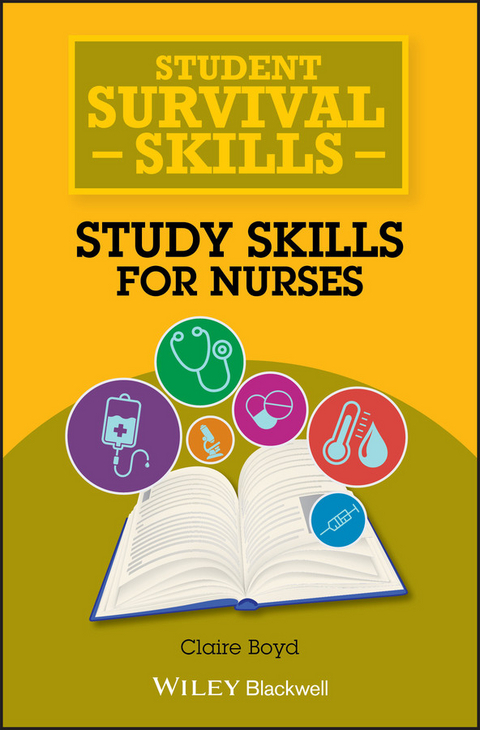
Study Skills for Nurses (eBook)
John Wiley & Sons (Verlag)
978-1-118-65741-6 (ISBN)
Survive academic study with this snappy guide to research techniques and strategies for all student nurses.
Providing words of wisdom and tips from real student nurses, Study Skills for Nurses enables you to develop your own individual ways of studying for those all important projects, with exercises, step-by-step guides and tricks to help you get ahead.
Special features
- Developed by students for students
- Clear, straightforward and jargon-free
- Ties in with the NMC standards for pre-registration education and the Essential Skills Clusters.
- Takes away the fear of study and independent research projects, making it approachable, easy and fun
Survive academic study with this snappy guide to research techniques and strategies for all student nurses. Providing words of wisdom and tips from real student nurses, Study Skills for Nurses enables you to develop your own individual ways of studying for those all important projects, with exercises, step-by-step guides and tricks to help you get ahead. Special features Developed by students for students Clear, straightforward and jargon-free Ties in with the NMC standards for pre-registration education and the Essential Skills Clusters. Takes away the fear of study and independent research projects, making it approachable, easy and fun
Claire Boyd is a Practice Development Trainer at North Bristol NHS Trust, Bristol, UK.
Preface vii
Introduction ix
Acknowledgements xiv
1 Learning At University 1
2 Understanding How You Learn 17
3 Taking Control 31
4 Information Skills 43
by Beverley Murray, edited by Claire Boyd
5 Reading Effectively 57
by Claire Boyd and Beverley Murray
6 Making Notes 81
7 Plagiarism And Referencing 99
8 Writing Skills 111
9 Oral Presentations 145
10 Preparing For Exams 163
11 Writing A Portfolio 171
12 Learning In Practice 183
13 Minimising Stress 197
Answers To Activities And Test Your Knowledge 207
Appendices
Appendix 1: Examples of Question Frameworks 230
Appendix 2: Glossary of Evidence Types 231
Appendix 3: Help With Analysis of Results 232
Appendix 4: The New NHS In 2013: What It Means For You 233
Index 236
"I would recommend this book and also this series of books
to student nurses at any point of their training. I have found it
an invaluable book which does not blind you with too much
information in one go, a pit stop book well worth investing in. I
keep a copy in my bag when ever I am on placement."
(Nursing Times, 16 December 2014)
Introduction
Hello, my name is Claire Boyd and I am a Practice Development Trainer, working for one of the largest teaching hospitals in the south west of England, in one of Europe’s most modern hospital environments: Southmead Hospital, Bristol.
It took a lot of hard work to achieve my lifelong ambition of becoming a nurse. I have also studied for my Certificate in Education and as a holistic therapist for massage, aromatherapy and other well-being courses. I am not a quick learner, more of a ‘plodder’, and at university it was important for me to find a means of study that would suit me. It also had to be around my family and my other commitments (I was fostering children at the start of my nurse training; 44 of in all, but not all at the same time)!
On my first day at university, and as the enormity of the next couple of years hit home, I realised that I would have to get myself organised. I purchased a book on study skills which explained that I would need to study during my optimum learning times when I would be ‘fresh and alert’. This quickly enabled me to see that ‘one fit does not suit all’. When fresh I would be working on the wards and I was unable to find any helpful study skills book that really understood learning from the nursing perspective.
I was able to find my own learning plan, usually from 12 midnight until 2 a.m., which most literature will tell you is ‘how not to do it’. This was the only time I could study in a quiet environment, when all the family were in bed, and I could really learn. Some people like to have music or the television on when they are studying, but I need absolute quiet. You take your life in your own hands if you talk to me when I have my nose in an academic book! This taught me the importance of finding your own groove, and what works best for you, the individual.
Keeping to the theme of study skills books on the market, many student nurses tell me that these books mainly do not cater for the student nurse, as they tell me ‘we are not the same as other university students’. These are some of the reasons they give.
- When on placement, we are working full time and have to study around those hours.
- Working in our clinical placements we have the added pressure of being responsible for the patients’ well-being.
- We are accountable and responsible for our own actions.
- Every day is different; there is so much to learn.
- Nursing is a very demanding job.
(Thanks to Megan Powell, Rosalind Broome and Elizabeth Smart, second year nursing students at the University of the West of England, 2013.)
Studying at university is all about taking responsibility: you are no longer at school or college, where someone is keeping you motivated and nagging you to keep to deadlines. Similarly, studying to become a nurse is like no other university course, as you are expected to work shifts as well as attend lectures, seminars and tutorials. Coupled with this, nurses are required to submit assignments and case studies, have competencies signed off in the workplace, produce reflective pieces and attend ‘bedside’ teaching sessions! There is also the nursing portfolio in which a student keeps all certificates and other paperwork, ready for attending interviews for nursing jobs, and for the Nursing and Midwifery Council requirements beyond.
Keep with it: nursing is a wonderful, rewarding job, with so many branches in whichever area takes your fancy, such as adult nursing, maternity, paediatric nursing, mental health nursing, learning disabilities, district nursing, working in clinics and GP surgeries, specialising in cardiology, high dependency, orthopaedics, neurosurgery ... the list is endless. Table 1 shows what working in ten of these specialities will involve for you, the carer.
Table 1 What nursing work involves
| Branch of nursing | What’s involved? |
| Adult nursing | Being part of a busy multidisciplinary team The use of initiative and observation Working in a demanding and fast-changing environment Assessing A willingness to take responsibility for people’s well-being Continued learning throughout your career |
| Mental health nursing | Autonomy in planning and delivering care in a healthcare team Opportunities to specialise in areas such as drug or alcohol misuse The ability to empathise with people The use of excellent communication skills Liaising with the patient’s family or carers Dealing with occasional aggression in a sensitive and effective way |
| Children’s nursing | The ability to work with those who may be too young to express what’s wrong An awareness that a child’s health can rapidly take a turn for the worse and manage the situation Using communication skills other than words Working in partnership with the patient’s parents, carers and/or siblings Parent, carers and/or sibling education |
| Learning disability nursing | The use of patience, sensitivity and excellent interpersonal skills The willingness to be adaptable, flexible and act as advocate for those you are supporting The ability to work in a demanding and stressful environment Great satisfaction when someone has learned a new skill |
| District nursing | Working with a variety of people as part of a team, such as GPs and social services as well as working alone Good organisational skills Helping patients with personal hygiene Carrying out health checks and delivering health promotion programmes Patient education Monitoring health |
| Neonatal nursing | Being a source of support to the baby’s family Taking an active role as part of the multidisciplinary team in looking after the child Empathy The competence to work in a busy, technical environment |
| Health visiting | Working with people who have disabilities or chronic health problems Supporting new mothers in the care and development in their babies Health promotion Good organisational skills The ability to work independently for much of the time Working in occasional challenging situations |
| Practice nursing | Health screening Family planning Treating small wounds Assisting with minor operations and procedures Running vaccination clinics Managing well-woman clinics Supporting the healthcare team in monitoring health conditions, e.g. diabetes |
| Prison nursing | Delivering health care in a custodial setting The use of excellent interpersonal skills Developing position and professional relationships with prisoners Dealing with substance abuse and/or mental health problems |
| School nursing | Carrying out screening programmes Providing health-related information Administering immunisations Providing health and sex education A non-judgemental approach Running health promotion or drop in surgeries |
| Midwifery | Being a source of support in preparing women for delivery of new life Working in partnership with clients throughout all stages of pregnancy, labour and the early post-natal period The ability to work independently: in the community, clinics, children’s centres, GP surgeries Working as part of a multidisciplinary team Good organisation skills Good interpersonal skills Working in occasional challenging situations |
Source: adapted from Careers in Nursing (www.nhscareers.nhs.uk).
I have been fortunate to have taught many student nurses and it has been with their help that this book, and others in the series (Calculation Skills, Clinical Skills, Medicine Management Skills, Care Skills and Communication Skills), have been developed; in short, they told me what they wanted included in the books. It is a book for nursing students, and other healthcare professionals wishing to study, such as assistant practitioners, operating department practitioners, healthcare assistants and qualified nurses, giving tips and pointers along the way.
All chapters contain healthcare examples and incorporate student nurses’ tips and advice throughout. In short, this book is not a generic study skills book. By being a specifically nurse study skills book – one of its unique properties – the learner benefits not just from acquiring study skills but can also benefit from nurse-related information. For example, while learning about mind mapping techniques in Chapter 6 you will also be introduced to the patient safety concept of implementing ‘human factors’ in health care. Also, while undertaking the Test your Knowledge section in Chapter 10 you will learn about natural rubber latex allergy. The contents are presented in a style as to make you feel that the tutor is sitting right next to you, helping you along the way.
To assist you with your studies a year...
| Erscheint lt. Verlag | 11.8.2014 |
|---|---|
| Sprache | englisch |
| Themenwelt | Medizin / Pharmazie ► Pflege ► Ausbildung / Prüfung |
| Sozialwissenschaften ► Pädagogik | |
| Schlagworte | academic • Ausbildung u. Perspektiven i. d. Krankenpflege • clear • Einführungen in die Krankenpflege • Einführungen in die Krankenpflege • enables • Exercises • Guide • Guides • important • Individual • Introductions to Nursing • Krankenpflege • nurses • nursing • Nursing Education & Professional Development • Projects • Real • Skills • snappy • special features • stepbystep • Strategies • Student • students • Study • survive • techniques • Ways • wisdom • Words |
| ISBN-10 | 1-118-65741-1 / 1118657411 |
| ISBN-13 | 978-1-118-65741-6 / 9781118657416 |
| Informationen gemäß Produktsicherheitsverordnung (GPSR) | |
| Haben Sie eine Frage zum Produkt? |
 EPUB (Adobe DRM)
Kopierschutz: Adobe-DRM
Adobe-DRM ist ein Kopierschutz, der das eBook vor Mißbrauch schützen soll. Dabei wird das eBook bereits beim Download auf Ihre persönliche Adobe-ID autorisiert. Lesen können Sie das eBook dann nur auf den Geräten, welche ebenfalls auf Ihre Adobe-ID registriert sind.
Details zum Adobe-DRM
Dateiformat: EPUB (Electronic Publication)
EPUB ist ein offener Standard für eBooks und eignet sich besonders zur Darstellung von Belletristik und Sachbüchern. Der Fließtext wird dynamisch an die Display- und Schriftgröße angepasst. Auch für mobile Lesegeräte ist EPUB daher gut geeignet.
Systemvoraussetzungen:
PC/Mac: Mit einem PC oder Mac können Sie dieses eBook lesen. Sie benötigen eine
eReader: Dieses eBook kann mit (fast) allen eBook-Readern gelesen werden. Mit dem amazon-Kindle ist es aber nicht kompatibel.
Smartphone/Tablet: Egal ob Apple oder Android, dieses eBook können Sie lesen. Sie benötigen eine
Geräteliste und zusätzliche Hinweise
Buying eBooks from abroad
For tax law reasons we can sell eBooks just within Germany and Switzerland. Regrettably we cannot fulfill eBook-orders from other countries.
aus dem Bereich