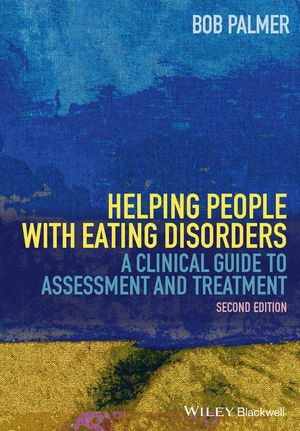
Helping People with Eating Disorders (eBook)
John Wiley & Sons (Verlag)
978-1-118-60668-1 (ISBN)
Up-to-date and accessible, the second edition of Helping People with Eating Disorders is a comprehensive guide to understanding, assessing, and treating eating disorders.
- Focuses on evidence-based practice with references to the latest research and new DSM-V classifications
- Discusses the types of eating disorders and their causes, reviews treatment methods and their outcomes, and provides guidance on dealing with challenging cases
- Illustrates concepts and methods using several case studies that run throughout the book, as well as many examples from the author’s clinical work
- Written in clear and concise language by an expert with over 40 years’ experience in the field
Bob Palmer is Honorary Professor of Psychiatry at the University of Leicester, UK, where he spent much of his career as an NHS clinician and consultant psychiatrist. Over the last 40 years, he has become a leading figure in the field of eating disorders and has been involved in innovative research, clinical practice, education and administration. He is a recipient of Lifetime Achievement Awards from the Academy for Eating Disorders and Beat, the UK eating disorders charity. He is also the author of numerous articles and the author or editor of several books.
Bob Palmer is Honorary Professor of Psychiatry at the University of Leicester, UK, where he spent much of his career as an NHS clinician and consultant psychiatrist. Over the last 40 years, he has become a leading figure in the field of eating disorders and has been involved in innovative research, clinical practice, education and administration. He is a recipient of Lifetime Achievement Awards from the Academy for Eating Disorders and Beat, the UK eating disorders charity. He is also the author of numerous articles and the author or editor of several books.
About the Author vi
Preface to the Second Edition vii
Preface to the First Edition viii
1 What are the Eating Disorders? 1
2 Who Suffers from Eating Disorders? Who Asks for Help? 25
3 What Causes Eating Disorders? 42
4 Thinking about Eating Disorders 70
5 What is Involved in Recovery from Eating Disorder? 84
6 Assessing People with Eating Disorders 93
7 What Helps People with 'Bulimic Disorders'? 123
8 What Helps People with Anorexia Nervosa? 158
9 Unusual Eating Disorders 202
10 What May Go Wrong? 215
11 The Organising Services for People with Eating Disorders 241
References 260
Index 287
PREFACE TO THE FIRST EDITION
I have written this book to provide an introduction for clinicians to the eating disorders, anorexia nervosa and bulimia nervosa – conditions that have become increasingly salient over recent years. More and more people working in various health professions have been confronted with the need to try to help sufferers to escape from what can be miserable and life-blighting disorders. Some professionals find themselves with the additional task of organising services for people with eating disorders, and in doing so, they may get caught up with the ambivalence of the general public who often seem to hold contrasting attitudes to the eating disorders, viewing them at times as the trivial fads of silly young women and at other times as mysterious and deadly diseases lurking in their midst and picking off young people at the threshold of promising lives. Those who plan and fund health care may share these extreme views – albeit less openly – but almost everywhere provision is patchy and often inadequate.
Those who would seek to do better face a variety of obstacles. Not least amongst these is the wide range of advice and opinion about the nature of these disorders. There is a lot to sift through, and at times, it seems that there is a more dirt than gold. This book is designed to do some of that sifting and sorting for the reader. I hope that it may be useful to have some help from someone who has been panning this particular stream for many years. However, I would warn you that although I have tried to give a balanced account, I can present things only as they appear to me. Even an experienced eye may miss what is important or be sometimes misled by ‘fool’s gold’. The enthusiasm that we all need in clinical practice may at times distort judgement. It is important to be confident about what we do and for that confidence to rest on as sure a foundation as possible. Where possible, I have tried to include discussion of, or reference to, the sources of the views that I put forward. However, in the end, you must judge for yourself – and for the people whom you are trying to help.
I have tried to make the book practical in orientation. It is about trying to help people with eating disorders. Whenever I was faced with a decision as to whether to include something or leave it out, I decided on the basis of clinical utility. Consequently, some topics which might have made the book more interesting may have been omitted in favour of some which are less fascinating but more useful clinically. This book does not set out to be a theoretical treatise upon the nature or wider significance of eating disorders. Such books can be of great interest and may even be important, but something different is required to support the professional confronted by a sufferer asking for help as the professional needs to be able to put the person seeking help into wider context, to assess her problems, to know what others have found useful to offer and to avoid making things worse. Most of all, the professional needs a measure of confidence. Of course, such competence and confidence cannot come just from a book, but the right kind of book could help, and I have tried to write such a book. I cannot be the judge of how useful it will be in practice. Only time, and those who read the book, will tell.
I shall, of course, be delighted if as many people as possible read – and buy – this book. These might include the student, the sufferer, perhaps the families of sufferers and even that fabled figure ‘the interested general reader’. However, it is not written with them in mind. I have written this book for people who have chosen – or find themselves chosen – to offer help to those suffering from clinical eating disorders. My guess is that they may come from a variety of the so-called ‘helping professions’, mainly but not exclusively those relating to mental health. Their background – and perhaps their professional qualification – may be in nursing, psychology, occupational therapy, social work, counselling or one of the medical specialities, especially psychiatry. Or sometimes in none of these. Nevertheless, I have assumed some basic clinical knowledge and vocabulary. I have sometimes used terms such as ‘major depression’ or ‘electrolytes’ or ‘obsessive compulsive disorder’ without definition, confident that most readers will know what I mean, or at least can easily find out. More importantly, I have assumed that most readers will have that less definable characteristic – clinical nous. They may or may not have had much experience of being with people suffering from eating disorders, but they will know what it is like to be in a professional ‘helping relationship’ with people who are ill or in distress. I hope that this description fits you or, if it does not, that you will understand for whom the book is mainly intended.
The subject of helping people with clinical eating disorders is a large one. This book is not. This means that the overview of these disorders which the book provides may be fairly comprehensive but often not detailed. Where appropriate I have added references at the end of chapters to books and journal articles that discuss the topics in greater depth. Furthermore, I am the sole author of the book although, of course, I am largely passing on what I have learnt from others. This means that it surveys the field from my viewpoint. I have alluded above to the need to be wary of the results of lacunae in my vision which may distort the picture. I guess that I am unaware of most of these; however, one issue of which I am aware is that my clinical experience is that of an adult psychiatrist. I have almost no experience of trying to help sufferers who are under the age of 16. Many issues involved in dealing with children and early teenagers are the same as those encountered with late teenagers and adults, but many are not. The younger the sufferers, the more ‘special’ are their needs although even the use of this word reveals the perspective from which I am viewing things. Any account given in this book of the particular characteristics and needs of the youngest sufferers is second hand. I have tried to discuss them somewhat but I am aware that the emphasis throughout the book is on older sufferers. The recommended further reading is especially important for this topic.
Another important limitation of this book is that it deals with obesity only as a close neighbour of the eating disorders and as an association in some cases. Again this is for practical reasons as the book needed to be fairly short. Obesity is a big topic and I am not myself greatly experienced in that field. My practice reflects the view of many, perhaps most, clinicians working with eating disorders, in that people suffering from obesity without definite eating disorder are usually considered to be outside the remit of the clinical service in which we work. That is the way things are. Whether it is the way things should be is another question. Over the last few years, there has been a welcome coming together of people with a research interest in the eating disorders and in obesity. Perhaps clinical practice will follow. This might have real advantages. (As I write this, I am pondering the question of whether or not to start an obesity clinic as part of our service.) However, for the present, I have followed what may become the old-fashioned path of focusing upon anorexia nervosa and bulimia nervosa and leaving obesity at the margin.
Throughout the main text of the book, I have chosen to use what might be called the ‘scientific passive voice’. I dithered somewhat about this but decided in the end that it was best. By contrast, I have used the device of notes at the end of the chapter whenever I wanted to add a more personal or idiosyncratic comment or indeed anything additional to the main text that seemed worth including, but not at the expense of interrupting the flow. For these notes, I have used the first person.
Another point of language concerns the potentially touchy matter of gender. Most of those suffering from eating disorders are female. Certainly this is the case for most people who seek help. I have therefore chosen in general to use the female gender – she, her and so on – when discussing sufferers rather than resorting to the clumsy ‘she or he’, the unpronounceable s/he or the complications associated with the unnecessary plural ‘they’. When talking of those who seek to help, I have tried to avoid gender words, but where this has not been easy, I have used the male ‘he’, even though in most contexts the majority of helpers are female. This is less of a distortion than making the sufferers male and tends to clarify the text. I realise that such clarification may be at the expense of aligning the gender split in the text and what may often be thought of as the overt power dynamic of the therapeutic relationship thus described with that which has been traditional in the wider society.
The book is divided into two parts. The first, from Chapter 1 to Chapter 5, describes and attempts to explain the eating disorders. This is a prelude to the rest of the book which is more directly concerned with the practical matter of trying to help people who suffer from these disorders. This second part begins by discussing assessment and the treatment of anorexia nervosa and bulimia nervosa. The next chapters discuss the management of atypical cases and of situations where things go wrong...
| Erscheint lt. Verlag | 26.6.2014 |
|---|---|
| Sprache | englisch |
| Themenwelt | Geisteswissenschaften ► Psychologie ► Biopsychologie / Neurowissenschaften |
| Medizin / Pharmazie ► Medizinische Fachgebiete ► Psychosomatik | |
| Schlagworte | anorexia nervosa, bulimia, binge eating disorder, BED, purging, anorexic, bulimic, clinical psychology, behavioral psychology, psychiatry, unusual eating disorders, Academy for Eating Disorders, psychology of food, health psychology, adolescent health • Clinical psychology • Essstörung • Essstörung • Health & Behavioral Clinical Psychology • Klinische Psychologie • Klinische Psychologie / Verhalten • Psychiatrie • Psychologie • Psychology |
| ISBN-10 | 1-118-60668-X / 111860668X |
| ISBN-13 | 978-1-118-60668-1 / 9781118606681 |
| Informationen gemäß Produktsicherheitsverordnung (GPSR) | |
| Haben Sie eine Frage zum Produkt? |
 EPUB (Adobe DRM)
Kopierschutz: Adobe-DRM
Adobe-DRM ist ein Kopierschutz, der das eBook vor Mißbrauch schützen soll. Dabei wird das eBook bereits beim Download auf Ihre persönliche Adobe-ID autorisiert. Lesen können Sie das eBook dann nur auf den Geräten, welche ebenfalls auf Ihre Adobe-ID registriert sind.
Details zum Adobe-DRM
Dateiformat: EPUB (Electronic Publication)
EPUB ist ein offener Standard für eBooks und eignet sich besonders zur Darstellung von Belletristik und Sachbüchern. Der Fließtext wird dynamisch an die Display- und Schriftgröße angepasst. Auch für mobile Lesegeräte ist EPUB daher gut geeignet.
Systemvoraussetzungen:
PC/Mac: Mit einem PC oder Mac können Sie dieses eBook lesen. Sie benötigen eine
eReader: Dieses eBook kann mit (fast) allen eBook-Readern gelesen werden. Mit dem amazon-Kindle ist es aber nicht kompatibel.
Smartphone/Tablet: Egal ob Apple oder Android, dieses eBook können Sie lesen. Sie benötigen eine
Geräteliste und zusätzliche Hinweise
Buying eBooks from abroad
For tax law reasons we can sell eBooks just within Germany and Switzerland. Regrettably we cannot fulfill eBook-orders from other countries.
aus dem Bereich