


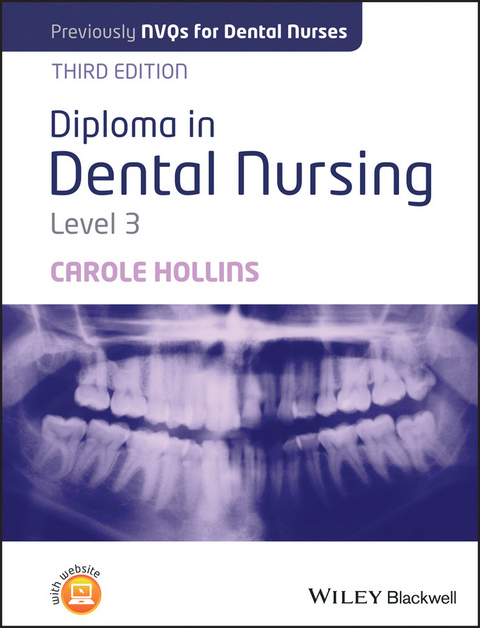
Diploma in Dental Nursing, Level 3 (eBook)
John Wiley & Sons (Verlag)
978-1-118-62947-5 (ISBN)
Diploma in Dental Nursing, Level 3 is the new edition of the must-have study companion for trainee dental nurses preparing for the City & Guilds Level 3 Diploma in Dental Nursing (formerly NVQ). The book offers comprehensive support on the units assessed by portfolio - from first aid and health and safety to specific chairside support procedures - as well as the four areas of the course tested by multiple choice questions: infection control, oral health assessment, dental radiography and oral health management.
This third edition of an established revision text has been substantially revised and restructured in line with the new qualification and reflects changes in the regulations and legislature affecting dentistry and dental workplaces, all of which have an effect on the daily role and working life of the dental nurse. It will be an invaluable guide for dental nurse trainees, qualified dental nurses and course providers.
- Expanded and revised, with extensive coverage of the fifteen Diploma units
- In full colour throughout with over 400 illustrations
- Companion website with downloadable glossary and MCQs for revision and self-assessment
Carole Hollins is a dental practitioner and member of the british Dental Association. She is a member of the Factulty of General Dental Practitioners and a former Chairman of the NEBDN. She has been involved in the training and examining of dental nurses for over twenty years, and holds relevant qualifications in both assessment and clinical teaching and learning.
Carole Hollins is a dental practitioner and member of the british Dental Association. She is a member of the Factulty of General Dental Practitioners and a former Chairman of the NEBDN. She has been involved in the training and examining of dental nurses for over twenty years, and holds relevant qualifications in both assessment and clinical teaching and learning.
1
Unit 301: Ensure Your Own Actions Reduce Risks to Health and Safety
Learning outcomes
- Be able to identify the hazards in the workplace
- Be able to act upon hazards in the workplace
- Be able to reduce the risks to health and safety in the workplace
Outcome 1 assessment criteria
The learner can:
- Identify which workplace procedures are relevant to their job
- Identify those working practices in the job that could harm them or others
- Identify those aspects of the workplace that could harm them or others
- Outline any differences between workplace legislation and supplier’s or manufacturer’s instructions
Outcome 2 assessment criteria
The learner can:
- Report hazards to the identified responsible person
- Demonstrate the ability to deal with hazards in the workplace
Outcome 3 assessment criteria
The learner can:
- Carry out their work in accordance with workplace legislation or manufacturer’s instructions
- Behave in a way that does not endanger their health and safety or that of others, or of the materials in the workplace
- Contribute to health and safety improvements within the workplace
- Follow guidelines for environmentally friendly working practices
- Ensure personal presentation protects their health and safety and that of others in line with instructions
This unit is assessed by:
- Observation in the workplace, with examples included in the learner’s portfolio
- An appropriate alternative method
Details of various elements of theory and underpinning knowledge are included in Chapter 12, and these are assessed within the written paper.
The theory and underpinning knowledge required to understand the need to act responsibly in the workplace, to understand and follow all the health and safety policies and protocols in place, and to recognise which particular workplace activities may be hazardous to the dental team are discussed in detail in Chapters 12, 14 and 15. The actions that the dental nurse will need to take in the event of a medical emergency occurring on the premises are discussed in detail in Chapter 13.
This chapter explains the dental nurses’ roles and responsibilities in relation to identifying and dealing with risks and hazards in the dental workplace. Those responsibilities are to themselves and any other person on the workplace premises. In the dental workplace, “any other person” includes patients and their guardians or escorts, visiting utility workers, such as postal workers and meter readers, and visitors such as repair and maintenance personnel.
The relevant workplace procedures that may pose a risk or hazard to the dental nurse are:
- Use of some occupational equipment and items
- Use of some hazardous occupational substances
- Moving and handling of heavy items or hazardous substances
- Disposal of hazardous substances
Overview of responsibilities
All dental workplaces, their staff and patients are covered by the provisions of the Health and Safety at Work Act (1974), as is any other workplace. In addition, other legislation is relevant to the dental workplace, due to the potentially harmful nature of the equipment and chemicals used, as well as the occupational hazards associated with delivering dental treatment or working in the dental environment.
The health and safety legislation seeks to protect staff and patients while on the premises by making staff aware of any potential hazards at work and encouraging them to find the best ways of making their particular premises safer for all concerned. In legal terms, the employer has a statutory duty to ensure that, as far as is reasonably practicable, the health, safety and welfare at work of all employees and all visitors (including patients) are protected at all times. To do this, all of the potential hazards first need to be identified, and then the likelihood of them actually causing harm to anyone must be determined. The chance that a particular workplace hazard could cause harm to someone is known as its risk, and the correct procedure to be followed by the employer (and the staff) to identify those hazards in the dental workplace that could cause harm is called a risk assessment.
Compliance with the Health and Safety at Work Act is overseen and regulated by the Health and Safety Executive (HSE). This is a government body that provides guidance to employers on the correct enforcement of the Act and investigates any serious incidents that occur in any workplace where someone suffers serious harm or is killed. Every dental workplace is required to be registered with the HSE. Compliance with the additional legislation specific to the dental workplace is also a requirement by the General Dental Council (GDC), under their Standards for the Dental Team documentation.
In the dental workplace, normal procedures that are carried out on a day-to-day basis include the assessment of a patient’s oral health, the diagnosis of oral disease, and performing the necessary dental treatment required to cure that disease. In addition, elective dental procedures are carried out to prevent or reduce the likelihood of disease developing, and an array of administrative procedures will also be necessary to support the clinical functions of the workplace.
To ensure the safety of everyone while on the premises, both the employer and employees have responsibilities to be followed.
Employers’ responsibilities
All workplaces must have a current Health and Safety Law poster on display on the premises for all staff to see (Figure 1.1). This gives the name of the employer or employing organisation and states in broad terms what employees can expect from the employer (or organisation) in relation to the safeguarding of their health and safety while on the premises, as well as what employees can do themselves. It also gives contact details for the HSE in case any problem arises with regard to the employee safety.
Figure 1.1 A health and safety poster.
To comply with the basic requirements of the Health and Safety at Work Act, every employer in the dental workplace must abide by the following requirements:
- Provide a working environment for employees that is safe, without risks to health, and adequate as regards facilities and arrangements for their welfare at work
- Maintain the place of work, including the means of access and exit, in a safe condition
- Provide and maintain safe equipment, appliances and systems of work
- Ensure all staff members are trained in the safe handling and storage of any dangerous or potentially harmful items or substances
- Provide such instruction, training and supervision as is necessary to ensure health and safety
- Review the health and safety performance of all staff annually, and be aware of and investigate any failures or concerns highlighted when they occur
- Display the official health and safety poster for all staff to refer to
To comply with these statutory obligations, dentists must keep their staff informed of all the safety measures adopted. Practices with five or more employees must produce a comprehensive health and safety policy and provide all staff with a copy. The policy will classify the practice’s health and safety procedures and name the persons responsible. It should also list the telephone numbers of all dental, administration and equipment maintenance contractors, the local HSE contact and the emergency services.
Under the Act, all employers must therefore ensure, as far as is reasonably possible, that the health and safety of all persons on the premises is protected – and this must be achieved by carrying out a risk assessment of the workplace activities that occur on the premises. This is a specific requirement under the Management of Health and Safety at Work Regulations 1999.
Risk assessment to identify the hazards
A risk assessment is merely a detailed examination of the normal day-to-day activities that occur in the workplace in an effort to identify those that have the potential to cause harm to anyone on the premises – these are called the hazards. Once the hazards have been identified, a set of precautions can be determined that will prevent or minimise the risk associated with each hazard, thereby ensuring the safety of all those on the premises.
The aim is not necessarily to eliminate every risk completely – this is probably impossible in most workplaces, including dental surgeries – but instead to minimise those risks identified as far as possible, so that there is little chance of them causing harm to anyone.
For example, various chemicals are used in the dental workplace to carry out dental treatment successfully, including decontamination solutions, X-ray processing solutions, and mercury in amalgam fillings – all are potentially harmful, but only if they are mishandled. Knowledge of their correct storage and usage by staff, and protection from misuse by all others are key factors in avoiding a hazardous event from occurring.
The procedure for carrying out a risk assessment on a hazard, whatever its nature, should always follow the same...
| Erscheint lt. Verlag | 18.6.2014 |
|---|---|
| Sprache | englisch |
| Themenwelt | Medizin / Pharmazie ► Allgemeines / Lexika |
| Medizin / Pharmazie ► Gesundheitsfachberufe | |
| Medizin / Pharmazie ► Pflege ► Fachpflege | |
| Medizin / Pharmazie ► Zahnmedizin | |
| Schlagworte | City • Companion • daily • Dental • Dental Nursing • dentistry • diploma • Edition • effect • established • First • Guide • Level • Life • line • musthave • New • Nurse • nurses • Praxis der Zahnarzthelferin • Preparing • Qualification • restructured • Revision • Study • Third • Trainee • Zahnmedizin |
| ISBN-10 | 1-118-62947-7 / 1118629477 |
| ISBN-13 | 978-1-118-62947-5 / 9781118629475 |
| Informationen gemäß Produktsicherheitsverordnung (GPSR) | |
| Haben Sie eine Frage zum Produkt? |
 EPUB (Adobe DRM)
Kopierschutz: Adobe-DRM
Adobe-DRM ist ein Kopierschutz, der das eBook vor Mißbrauch schützen soll. Dabei wird das eBook bereits beim Download auf Ihre persönliche Adobe-ID autorisiert. Lesen können Sie das eBook dann nur auf den Geräten, welche ebenfalls auf Ihre Adobe-ID registriert sind.
Details zum Adobe-DRM
Dateiformat: EPUB (Electronic Publication)
EPUB ist ein offener Standard für eBooks und eignet sich besonders zur Darstellung von Belletristik und Sachbüchern. Der Fließtext wird dynamisch an die Display- und Schriftgröße angepasst. Auch für mobile Lesegeräte ist EPUB daher gut geeignet.
Systemvoraussetzungen:
PC/Mac: Mit einem PC oder Mac können Sie dieses eBook lesen. Sie benötigen eine
eReader: Dieses eBook kann mit (fast) allen eBook-Readern gelesen werden. Mit dem amazon-Kindle ist es aber nicht kompatibel.
Smartphone/Tablet: Egal ob Apple oder Android, dieses eBook können Sie lesen. Sie benötigen eine
Geräteliste und zusätzliche Hinweise
Buying eBooks from abroad
For tax law reasons we can sell eBooks just within Germany and Switzerland. Regrettably we cannot fulfill eBook-orders from other countries.


