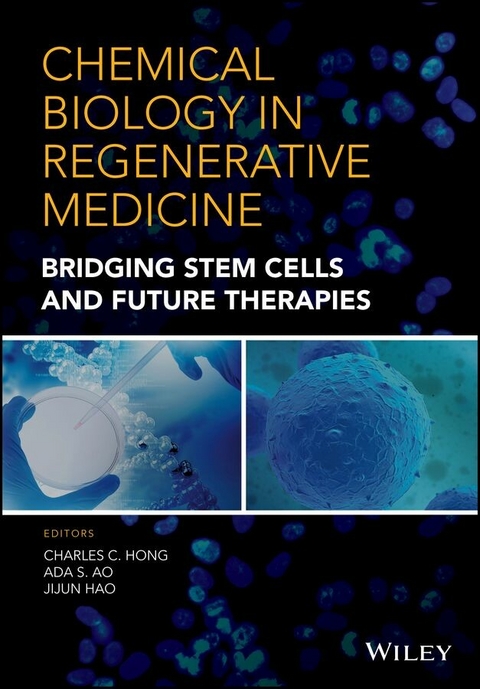
Chemical Biology in Regenerative Medicine (eBook)
240 Seiten
Wiley (Verlag)
978-1-118-69575-3 (ISBN)
Chemical Biology in Regenerative Medicine: Bridging Stem Cells and Future Therapies
The field of regenerative medicine has advanced at a rapid pace and this comprehensive summary of new developments is a timely contribution to the field as clinical trials have begun to assess the safety and efficacy of cell-based therapies.
In Chemical Biology in Regenerative Medicine, an international team of experts provides an overview of progress towards clinical application in the areas of transplantation (allogenic and autologous), manipulation of niche environment and homing, and cell reprogramming (trans-differentiation and de-differentiation). The book highlights the interdisciplinary approaches undertaken to resolve current technical problems in regenerative medicine, with special attention paid to small molecules and biomaterials engineering.
This volume provides an essential overview of this emerging technology for researchers in academic, industrial and clinical environments working in regenerative medicine, chemical biology, biochemistry, cell biology, biomaterials and bioengineering. It is appropriate for training students and newcomers to the field, benefitting readers in broadening their knowledge and giving them insights to regenerative chemical biology, as well as encouraging readers to implement the key points in their own fields of study to develop new technologies.
Dr Charles C. Hong is a physician-scientist with background in molecular biology, developmental biology, chemical biology, and cardiovascular genetics. He is an Associate Professor of Cardiovascular Medicine, Pharmacology, and Cell and Developmental Biology, and a member of the Veterans Affairs Tennessee Valley Healthcare System.? He is also a member of the Vanderbilt Institute of Chemical Biology and the Vanderbilt Center for Stem Cell Biology.?Dr. Hong received his MD-PhD with Honors from Yale, then completed cardiology fellowship at Massachusetts General Hospital, where he was a Schreyer Fellow, and postdoctoral fellowship at Harvard Medical School, where he was a Sarnoff Scholar. After a brief stint on the Harvard Medical School faculty, Dr. Hong came to Vanderbilt in 2006.?The Hong laboratory is focused on Chemical Biology of vertebrate development and stem cell differentiation, specifically Chemical Genetics of Embryonic Development; Regenerative Chemical Biology & Drug Discovery/ Experimental Therapeutics. Dr Ada S. Ao, Postdoctoral Research Fellow, Department of Medicine, Division of Cardiovascular Medicine, Vanderbilt University, USA. Prof Jijun Hao, Research Assistant Professor, Western University of Health Sciences, USA.
1
Wnt Signaling in Regulation of Stem Cells
David T. Paik and Antonis K. Hatzopoulos
Department of Medicine, Vanderbilt University, USA
1.1 Overview of Wnt Signaling
The Wnt signaling pathway is classically divided into so-called canonical and noncanonical branches based on the activation of specific intracellular components. Canonical Wnt signaling is activated when Wnt ligands bind to the Frizzled (Fzd) family of 7-transmembrane domain receptors and co-receptors, such as low-density lipoprotein receptor-related protein (LRP) 5/6, Ryk, and Ror2 [1–4]. This disrupts the formation of the β-catenin destruction complex, which consists of the scaffolding protein Axin, the Adenomatous polyposis coli (APC) protein, Dishevelled (Dsh), casein kinase Iα (CK-Iα), and glycogen synthase kinase-3Inase (CK). The dissociation of the destruction complex leads to stabilization of cytoplasmic iationein, which translocates to the nucleus to interact with TCF/LEF transcription factors and initiate transcription of canonical Wnt signaling target genes, such as c-Myc, Axin2, and Snail [5–7]. When canonical Wnt signaling is turned off, the destruction complex phosphorylates β-catenin for ubiquitin-mediated proteosomal degradation [8].
Noncanonical Wnt signaling pathways are β-catenin-independent and are mediated through other intracellular proteins [1–4, 9,10]. In the Wnt/JNK pathway, binding of Wnt to Fzd receptors activates small-GTPases, RhoA, and Rac through recruitment of Dsh, which thereby activate Rho kinase and c-Jun N-terminal kinases (JNK). In the Wnt/Ca+2 pathway, binding of Wnt to Fzd receptors increases intracellular Ca2+ levels, activating calcium/calmodulin-dependent kinase (CaMK) II, protein kinase C (PKC), and the protein phosphatase calcineurin (CaCN) to trigger dephosphorylation of NF-AT transcription factors. Thus activated NF-AT transcription factors translocate to the nucleus to stimulate transcription of their target genes [11]. Intriguingly, noncanonical Wnt signaling has been shown to inhibit canonical Wnt signaling in various mechanisms [10, 12, 13].
To date, 19 Wnt ligands and 10 Fzd receptors have been identified. The 19 Wnt genes fall into 12 conserved Wnt subfamilies, which exist in most mammalian genomes, including the human genome [14]. Different combinations of individual Wnt ligands, receptors, and co-receptors allow differential activation of β-catenin-dependent/canonical Wnt signaling, βWnt signaling, ligands, receptors, and/or Wnt signaling in a cellular context-dependent manner.
In the past 2 decades, the connection between Wnt signaling and human disease has been well established. Numerous components of the pathway have been implicated in cancer, obesity, osteoporosis, diabetes, and cardiovascular diseases [15]. Interestingly, Wnt signaling components are also critical regulators of stem and progenitor cells in various organs and tissues. A thorough understanding of the Wnt signaling pathway in the regulation of stem cells will be instrumental in translating the potential of stem cells to effective therapeutic solutions for human degenerative diseases or to the restoration of organ function after injury.
1.2 Wnt Signaling in Embryonic Stem Cells
Wnt signaling has been implicated in the maintenance of the pluripotency and differentiation potential of embryonic stem cells (ESCs). A number of studies have demonstrated that individual Wnt ligands can stimulate self-renewal of ESCs [16–18]. Activation of the canonical Wnt pathway complements the LIF/JAK-STAT pathway via upregulation of the Stat3 gene to inhibit ESC differentiation [16]. Paracrine and autocrine Wnt signaling is essential not only for self-renewal of mESCs but also to inhibit differentiation into epiblast stem cells (epiSCs) [7]. Accordingly, mutations in the βn of the io destruction complex APC protein increase β-catenin levels, diminishing the differentiation capacity of mouse ESCs (mESCs) into the three germ layers [19].
In contrast, whether Wnt signaling promotes self-renewal or differentiation of human ESCs (hESCs) has been rather controversial. In the presence of supportive feeder cells or a conditioned medium (CM) rich in factors preventing differentiation, Wnt3a enhanced self-renewing proliferation of undifferentiated hESC H1 cells. In the absence of CM, however, activation of Wnt signaling accelerated both proliferation and differentiation of hESCs [20]. The canonical Wnt ligand Wnt1 displayed the same effects on hESCs as Wnt3a, while the noncanonical Wnt ligand Wnt5a did not affect the proliferation of hESCs, indicating that β-catenin-dependent canonical Wnt activation is responsible for enhanced hESC proliferation [21,22]. Activation of the canonical Wnt pathway by 6-bromoindirubin-3′-oxime (BIO), a specific inhibitor of glycogen synthase kinase 3 (GSK3), produced comparable results in maintaining the undifferentiated phenotype of hESCs marked by sustained expression of the pluripotent transcription factors OCT3/4 (POU5F1), REX1, and NANOG and by prevention of the epithelial–mesenchymal transition (EMT) of hESCs [23,24]. In complementary fashion, addition of the Wnt inhibitors Sfrp-1, Sfrp-2, and Sfrp-4, singly or in combination, promoted differentiation of hESCs [22].
However, other studies have reported that canonical Wnt activation disrupted hESC self-renewal and promoted differentiation. Specifically, conditional activation of stabilized β-catenin in KhES-1 and KhES-3 lines resulted in downregulation of the pluripotent markers NANOG, SOX2, and POU5F1 and upregulation of the mesodermal marker T Brachyury, followed by induction of the ventral mesodermal and endothelial marker KDR (VEGFR2) and the early cardiac marker NKX2.5 [25].
Experimental evidence also suggests that canonical Wnt signaling interacts with Activin/Nodal and bone morphogenetic protein (BMP) signaling pathways to specify differentiation lineages in hESCs. Canonical Wnt activation induced Activin/Nodal and BMP signaling to promote posterior Primitive Streak (PS) and mesoderm differentiation of hESCs. Synergistic interaction between Wnt and Activin/Nodal pathways was shown to be required for anterior PS and endoderm specification, while BMP and MAPK signaling antagonized it [25]. Recent studies have also shown that hESCs treated with the Wnt inhibitor IWP are maintained as pluripotent, with the ability to differentiate into neural cells [26]. Furthermore, Wnt3a-treated hESCs acquired PS-like characteristics and differentiated into mesodermal and endodermal cells [26].
It is noteworthy that the effects of Wnt3a on hESCs and mESCs differ significantly. In mESCs, Wnt3a prevented progression of mESCs to EpiSCs, while in hESCs Wnt3a facilitated their differentiation into mesodermal and endodermal lineages [7, 26]. In another study, the pluripotent marker OCT4 in hESCs was shown to repress β-catenin during self-renewal, whereas knockdown of OCT4 activated canonical Wnt signaling [27]. In support of these studies, Wnt1-treated hESCs displayed induced differentiation to hemogenic endothelial cells, while treatment with the Wnt inhibitor Dkk1 reduced this differentiation potential [28].
The apparently contradictory reports of Wnt signaling in hESC self-renewal and differentiation may be due to the epiblast origin of the various hESC lines tested [25]. It has also been proposed that the effects of Wnt signaling on hESCs are highly sensitive to the level of Wnt activation [26,27]. Therefore, it is likely that apparently contradictory results regarding the role of Wnt signaling in human ESC pluripotency, proliferation, and differentiation reflect the heterogeneity of the corresponding lines and their sensitivity to canonical Wnt signaling levels.
1.3 Wnt Signaling in Cardiovascular Progenitor Cells and Cardiomyocyte Differentiation
Wnt signaling also plays important roles in the maintenance and expansion of cardiovascular progenitor cells and in their differentiation into endothelial and cardiomyocyte lineages [2, 10, 11]. The mammalian heart is one of the first organs to form during embryogenesis and Wnt signaling has been implicated in all phases of cardiogenesis. Initially, canonical Wnt signaling is necessary for the formation of mesodermal progenitor cells, but it must then be suppressed in order for mesoderm progenitors to yield cardiac progenitor cells (CPCs) [11]. Subsequently, noncanonical Wnt signaling is necessary for the specification of CPCs. Wnt5a, a noncanonical Wnt activator, is upregulated by the mesoderm-specific transcription factor Mesp-1 to promote formation of CPCs [29]. Other studies have shown that intrinsic Wnt2 expression in mouse ES cells is essential for efficient cardiomyocyte differentiation and that exogenous Wnt2 promotes cardiomyocyte differentiation. Interestingly, Wnt2 induced cardiogenesis through activation of the noncanonical JNK/AP-1 pathway [30]. After CPC specification, canonical Wnt signaling activation stimulates proliferation of Isl1+ CPCs, whereas subsequent Dkk1 inhibition of canonical Wnt signaling and noncanonical Wnt activation by Wnt11 are required for cardiomyocyte differentiation [31,32].
The role of Wnt signaling and the effects of Wnt signaling manipulation during heart development have been well documented in various animal models. In mouse embryos, deletion of β-catenin in the definitive endoderm led to formation of multiple hearts along the anterior–posterior (A/P) axis, as one of the earliest pieces of evidence to implicate Wnt signaling in the endoderm in the...
| Erscheint lt. Verlag | 18.6.2014 |
|---|---|
| Sprache | englisch |
| Themenwelt | Medizin / Pharmazie |
| Naturwissenschaften ► Biologie ► Biochemie | |
| Naturwissenschaften ► Biologie ► Zellbiologie | |
| Naturwissenschaften ► Chemie ► Organische Chemie | |
| Technik ► Medizintechnik | |
| Schlagworte | allogenic • application • Areas • Biochemie u. Chemische Biologie • Biochemistry (Chemical Biology) • Biowissenschaften • Bridging • Cell & Molecular Biology • Cell Therapies & Tissue Engineering • Chemical • Chemical biology • Chemie • Chemische Biologie • Chemistry • Clinical • Environment • Experts • Field • international • Life Sciences • Manipulation • Medical Science • Medizin • niche • Overview • Progress • regenerative • Regenerative medicine • Regenerative Medizin • Stammzelle • stem • Team • towards • Transplantation • Zelltherapien u. Tissue Engineering • Zell- u. Molekularbiologie |
| ISBN-10 | 1-118-69575-5 / 1118695755 |
| ISBN-13 | 978-1-118-69575-3 / 9781118695753 |
| Informationen gemäß Produktsicherheitsverordnung (GPSR) | |
| Haben Sie eine Frage zum Produkt? |
 EPUB (Adobe DRM)
Kopierschutz: Adobe-DRM
Adobe-DRM ist ein Kopierschutz, der das eBook vor Mißbrauch schützen soll. Dabei wird das eBook bereits beim Download auf Ihre persönliche Adobe-ID autorisiert. Lesen können Sie das eBook dann nur auf den Geräten, welche ebenfalls auf Ihre Adobe-ID registriert sind.
Details zum Adobe-DRM
Dateiformat: EPUB (Electronic Publication)
EPUB ist ein offener Standard für eBooks und eignet sich besonders zur Darstellung von Belletristik und Sachbüchern. Der Fließtext wird dynamisch an die Display- und Schriftgröße angepasst. Auch für mobile Lesegeräte ist EPUB daher gut geeignet.
Systemvoraussetzungen:
PC/Mac: Mit einem PC oder Mac können Sie dieses eBook lesen. Sie benötigen eine
eReader: Dieses eBook kann mit (fast) allen eBook-Readern gelesen werden. Mit dem amazon-Kindle ist es aber nicht kompatibel.
Smartphone/Tablet: Egal ob Apple oder Android, dieses eBook können Sie lesen. Sie benötigen eine
Geräteliste und zusätzliche Hinweise
Buying eBooks from abroad
For tax law reasons we can sell eBooks just within Germany and Switzerland. Regrettably we cannot fulfill eBook-orders from other countries.
aus dem Bereich