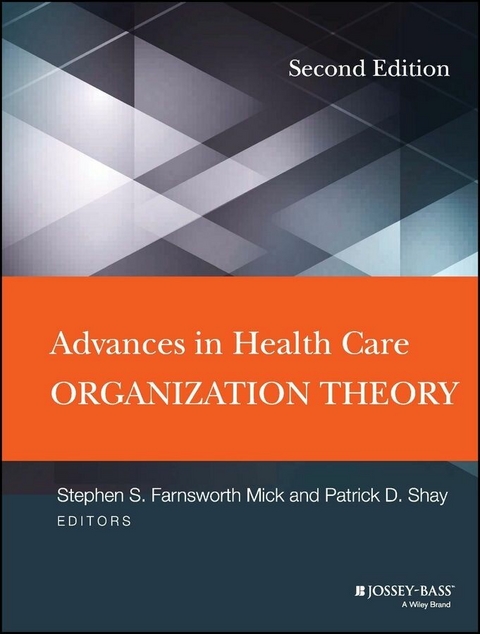
Advances in Health Care Organization Theory (eBook)
John Wiley & Sons (Verlag)
978-1-118-86277-3 (ISBN)
Advances in Health Care Organization Theory, 2nd Edition, introduces students in health administration to the fields of organization theory and organizational behavior and their application to the management of health care organizations. The book explores the major health care developments over the past decade and demonstrates the contribution of organization theory to a deeper understanding of the changes in the delivery system, including the historic passage of the Patient Protection and Affordable Care Act of 2010. Taking both a micro and macro view, editors Stephen S. Mick and Patrick D. Shay, collaborate with a roster of contributing experts to compile a comprehensive volume that covers the latest in organization theory. Topics include:
- Institutional and neo-institutional theory
- Patient-centered practices and organizational culture change
- Design and implementation of patient-centered care management teams
- Hospital-based clusters as new organizational structures
- Application of social network theory to health care
STEPHEN S. FARNSWORTH MICK, PHD, is professor in the Department of Health Administration at Virginia Commonwealth University and affiliate professor at the Jean Moulin University Lyon 3, in Lyon, France.
PATRICK D. SHAY, PHD, is assistant professor in the Department of Health Care Administration at Trinity University in San Antonio, Texas.
Explore the evolution of organization theory in the health care sector Advances in Health Care Organization Theory, 2nd Edition, introduces students in health administration to the fields of organization theory and organizational behavior and their application to the management of health care organizations. The book explores the major health care developments over the past decade and demonstrates the contribution of organization theory to a deeper understanding of the changes in the delivery system, including the historic passage of the Patient Protection and Affordable Care Act of 2010. Taking both a micro and macro view, editors Stephen S. Mick and Patrick D. Shay, collaborate with a roster of contributing experts to compile a comprehensive volume that covers the latest in organization theory. Topics include: Institutional and neo-institutional theory Patient-centered practices and organizational culture change Design and implementation of patient-centered care management teams Hospital-based clusters as new organizational structures Application of social network theory to health care
STEPHEN S. FARNSWORTH MICK, PHD, is professor in the Department of Health Administration at Virginia Commonwealth University and affiliate professor at the Jean Moulin University Lyon 3, in Lyon, France. PATRICK D. SHAY, PHD, is assistant professor in the Department of Health Care Administration at Trinity University in San Antonio, Texas.
Figures and Tables vii
Acknowledgments ix
The Editors xi
The Contributors xiii
1 Introduction: Events, Themes, and Progress 1
Stephen S. Farnsworth Mick and Patrick D. Shay
2 A Primer of Organization Theories in Health Care 25
Stephen S. Farnsworth Mick and Patrick D. Shay
3 Finding Strength in Numbers: Bringing Theoretical Pluralism into the Analysis of Health Care Organizations 53
Jacqueline S. Zinn and S. Diane Brannon
4 Explaining Change in Institutionalized Practices: A Review and Road Map for Research 79
Thomas D'Aunno
5 Mechanisms for Culture Change in US Health Institutions and the Example of the Nursing Home Industry 99
Jane Banaszak-Holl and Rosalind E. Keith
6 Managing to Care: Design and Implementation of Patient- Centered Care Management Teams 125
Douglas R. Wholey, Xi Zhu, David Knoke, Pri Shah, and Katie M. White
7 Remember It Is a Workplace: Health Care Organizations as Sociological Artifacts 153
Timothy Hoff
8 Differentiated, Integrated, and Overlooked: Hospital-Based Clusters 179
Patrick D. Shay, Roice D. Luke, and Stephen S. Farnsworth Mick
9 Profound Change in Medical Technologies: Time to Reexamine the Technology-Structure Nexus in Health Care? 205
Mary L. Fennell, Steven B. Clauser, and Miriam Plavin-Masterman
10 Social Network Analysis and the Integration of Care: Theory and Method 229
Timothy R. Huerta and Roberto Dandi
11 Complexity and Health Care: Tools for Engagement 259
James W. Begun and Marcus Thygeson
12 Synthesis and Convergence: The Maturation of Organization Theory 283
Stephen S. Farnsworth Mick and Patrick D. Shay
References 297
Name Index 355
Subject Index 369
Chapter 1
Introduction: Events, Themes, and Progress
Stephen S. Farnsworth Mick and Patrick D. Shay
Learning Objectives
- Understand why advances in theoretically based organizational analysis in health care have lagged behind the general field.
- Identify the environmental and market forces transforming health care in the United States during the early 2000s.
- Understand the utility of organization theory to explain how changes and pressures in health care influence notions of how organizations and their environments are interrelated.
The chapters in this second edition of Advances in Health Care Organization Theory are original essays in the broad realm of organization theory applied to health care organizations. In the first edition of this book, the authors explored what could be gleaned from the 1990s to inform and update organization theory in health care. The same pattern and goal applied to the Innovations in Health Care Organizations (Mick and Associates, 1990): chapter authors probed the events of the 1980s to determine what new might be written about organization theory as it was informed by the events of that time.
organization theory
An abstract systematic explanation of the causes and consequences of different organizational forms and designs.
health care organizations
An organization, usually licensed by state or federal government, that delivers health care, primary, emergency, acute, or long term in nature.
We feel the need for a third in a series of books exploring the evolution of organization theory in the health care sector because organization theory in health care remains a work in progress. Although the field is highly developed outside health care and is routinely applied in business and commercial organizations, advances in organizational analysis in health care have lagged behind the general field. This situation exists for a complicated set of reasons.
First, and perhaps most important, studying the health care sector is not a discipline-based activity. The field draws from an eclectic group of disciplines: economics, sociology, organization theory, political science, social psychology, law, engineering, and public health, not to mention all the clinical areas. In short, there has never been, and there is not likely to be, a single discipline that can claim to represent a full understanding of what goes on in health care. The organization of health care services is an applied area that invites multiple perspectives.
Second, the study of organizations, including health care organizations, has historically been concentrated in sociology departments and, to a lesser extent, business school management departments. It has taken a long time for this focus to find its place in what might be a more natural home of departments of health administration or departments with similar titles. This has had the effect of retarding the progress that might have been made in this field.
Third, and a corollary to the preceding point, within sociology departments, there has often been a disjunction between “medical” sociology and the study of organizations. In the past, medical sociology concentrated more on sociological factors behind need and use of services, correlates of disease and illness, the professions in health care, and the like. The study of organizations was generally set apart from the medical context. So even in the context of sociology departments, there was not much of an integration of medical sociology and health care organizations, with some notable exceptions (e.g., W. Richard Scott at Stanford University and A. B. Hollingshead at Yale University). Taken together, the field developed in a somewhat haphazard way.
Fourth, departments in which health management has been and is taught are relatively new on the academic scene. Most developed only after World War II, and of those, the majority were not established until after the 1970s and 1980s. In short, there have not been many academic homes for prolonged and deep study of health care organizations.
Fifth, active or retired administrative practitioners in the field dominated the initial faculties of health administration departments. Very few academics were involved in the original units, and because of that, the field was imprinted by the practitioners' perspectives emphasizing management practice, case analyses, and an operational focus. With some exceptions, the empirical and theoretical foundations of health care organizational analysis were largely absent when the field was begun.
Sixth, given the relatively recent emergence of academic homes in which health care organizations received specific study and given the dominance of practitioner-oriented faculties, there were few doctoral programs that trained future academics in the subject matter. Most faculty came, and often still do come, from sociology departments and business schools. Many of the first generation of academics interested in health care had no formal training in health care management or even broader health policy. It has taken time for a cadre of people trained in health care management to be educated in the field. Even today, there are few doctoral-level programs in health care or health services research that even offer training in organization theory and analysis.
Seventh, the dominance of health economics as the central health policy discipline in health care has had the effect of pushing organizational analysis to the sidelines. This is in part because the organization sui generis is regarded as a black box, which is of less interest than the market forces affecting it. Today this circumstance is changing due to rising interest in what goes on inside that black box spurred by the patient safety and quality movement that began in earnest with the Institute of Medicine's publication of To Err Is Human (1999). Nevertheless, the sometimes profoundly different view of organizations that economics and organization theorists hold, combined with the dominance of the former over the latter in the policy realm, has had a chilling effect.
market forces
The interplay of supply and demand on price and quantity of products and services.
These various and interrelated forces have combined to stunt the growth of theoretically based organizational analysis in health care. This history is a powerful one, and the forces that have existed are difficult to overcome. That is why we continue to offer a book like this, the third in a sequence of volumes that review various areas where organization theory has made interesting and pertinent advances in understanding health care. Despite the slowness of the health care arena in appreciating the strength and insight that organization theory can bring to it, some of the most pressing issues in health care—patient safety, quality, access, and efficiency, among others—are at least in part organizational issues. And, organizational analysis should be able to contribute to their clarification and possible improvement.
So our work continues with this collection of essays in which we explore the first decade of the 2000s to see what new developments and thoughts can be gleaned from changes and events beginning roughly around 2000 through 2012, including the historic passage of the Patient Protection and Affordable Care Act of 2010. Although the span of a decade is a totally arbitrary chopping up of time's arrow, it does provide discrete boundaries for consideration of new twists and turns, some striking, some not, in the health care system that allow holding constant enough of the health care background so that new or renewed perspectives on its organizations can be described and studied.
As readers will discover in chapter after chapter, the first decade of this new century was packed with changes and challenges that we believe have profoundly altered the landscape of organization theory and organizational analysis in health care. Each chapter is testimony to this claim, and readers are invited to see for themselves if they agree. We also note that this book focuses almost exclusively on the United States. This choice is deliberate. The American experience is complicated enough in itself to warrant such close attention, and many of its institutions are peculiar enough that we felt that this limit was justified. However, we also believe that, with imagination, readers might see cross-national similarities and applications not explicitly developed here. We are aware that by limiting the national context of the chapters in this book, we may also be limiting the generality of what we have written. That said, we continue to hope that we do add to our cumulative knowledge of health care organizations.
Environmental and Market Changes in Health Care in the 2000s
Characteristics of the health care environment of the early 2000s caused many of us to revamp our notions of how organizations and their environments interrelated. These characteristics include continued consolidation of freestanding hospitals into local, regional, and national systems; the proffering of new forms of office-based medical practice such as the patient-centered medical home and accountable care organizations; continued advances in information technology; the establishment of widely available data online on hospital, nursing home, and home health care performance; medical advances in genomics allowing for individualized care; major legislative efforts to increase access to prescription drugs (the Medicare Modernization Act of 2003) and...
| Erscheint lt. Verlag | 23.6.2014 |
|---|---|
| Sprache | englisch |
| Themenwelt | Medizin / Pharmazie ► Allgemeines / Lexika |
| Medizin / Pharmazie ► Gesundheitswesen | |
| Schlagworte | Advances in Health Care Organization Theory, 2nd Edition • Ãffentlicher Gesundheitsdienst u. Gesundheitspolitik • Gesundheits- u. Sozialwesen • Health & Social Care • Health Care • Health Care Administration • health care delivery • Health care governance • health care management • health care market • health care organization development • health organization behavior • health services management • health services policy • hospital administration • Öffentlicher Gesundheitsdienst u. Gesundheitspolitik • organization behavior • Organization Theory • Patient Relations • Patrick D. Shay • Public Health Services & Policy • Stephen S. Mick |
| ISBN-10 | 1-118-86277-5 / 1118862775 |
| ISBN-13 | 978-1-118-86277-3 / 9781118862773 |
| Informationen gemäß Produktsicherheitsverordnung (GPSR) | |
| Haben Sie eine Frage zum Produkt? |
 EPUB (Adobe DRM)
Kopierschutz: Adobe-DRM
Adobe-DRM ist ein Kopierschutz, der das eBook vor Mißbrauch schützen soll. Dabei wird das eBook bereits beim Download auf Ihre persönliche Adobe-ID autorisiert. Lesen können Sie das eBook dann nur auf den Geräten, welche ebenfalls auf Ihre Adobe-ID registriert sind.
Details zum Adobe-DRM
Dateiformat: EPUB (Electronic Publication)
EPUB ist ein offener Standard für eBooks und eignet sich besonders zur Darstellung von Belletristik und Sachbüchern. Der Fließtext wird dynamisch an die Display- und Schriftgröße angepasst. Auch für mobile Lesegeräte ist EPUB daher gut geeignet.
Systemvoraussetzungen:
PC/Mac: Mit einem PC oder Mac können Sie dieses eBook lesen. Sie benötigen eine
eReader: Dieses eBook kann mit (fast) allen eBook-Readern gelesen werden. Mit dem amazon-Kindle ist es aber nicht kompatibel.
Smartphone/Tablet: Egal ob Apple oder Android, dieses eBook können Sie lesen. Sie benötigen eine
Geräteliste und zusätzliche Hinweise
Buying eBooks from abroad
For tax law reasons we can sell eBooks just within Germany and Switzerland. Regrettably we cannot fulfill eBook-orders from other countries.
aus dem Bereich