


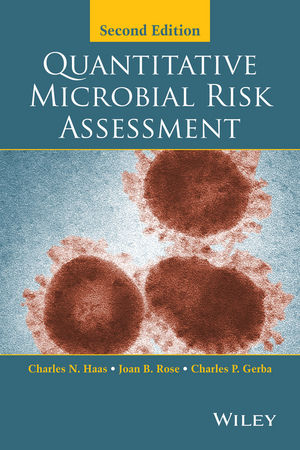
Quantitative Microbial Risk Assessment (eBook)
John Wiley & Sons (Verlag)
978-1-118-91002-3 (ISBN)
• Reviews the latest methodologies to quantify at every step of the microbial exposure pathways, from the first release of a pathogen to the actual human infection
• Provides techniques on how to gather information, on how each microorganism moves through the environment, how to determine their survival rates on various media, and how people are exposed to the microorganism
• Explains how QMRA can be used as a tool to measure the impact of interventions and identify the best policies and practices to protect public health and safety
• Includes new information on genetic methods
• Techniques use to develop risk models for drinking water, groundwater, recreational water, food and pathogens in the indoor environment
Charles N. Haas is the head of the department of Civil, Architectural and Environmental Engineering at Drexel University and the Betz Chair Professor of Environmental Engineering. He has served on numerous advisory committees of the US EPA and the National Research Council
Joan Rose serves as the Homer Nowlin Chair in Water Research at Michigan State University, the Co-Director of the Center for Advancing Microbial Risk Assessment (CAMRA) and the Director of the Center for Water Sciences (CWS). She is a member of the National Academy of Engineering.
Charles P. Gerba is a Professor in the department of Soil, Water and Environmental Science at the University of Arizona. He is the author of 11 books and over 400 journal papers. Dr. Gerba is a member of the U.S. Environmental Protection Agency's Science Advisory Board Committees on Drinking Water and Research Strategies.
Provides the latest QMRA methodologies to determine infection risk cause by either accidental microbial infections or deliberate infections caused by terrorism Reviews the latest methodologies to quantify at every step of the microbial exposure pathways, from the first release of a pathogen to the actual human infection Provides techniques on how to gather information, on how each microorganism moves through the environment, how to determine their survival rates on various media, and how people are exposed to the microorganism Explains how QMRA can be used as a tool to measure the impact of interventions and identify the best policies and practices to protect public health and safety Includes new information on genetic methods Techniques use to develop risk models for drinking water, groundwater, recreational water, food and pathogens in the indoor environment
Charles N. Haas is the head of the department of Civil, Architectural and Environmental Engineering at Drexel University and the Betz Chair Professor of Environmental Engineering. He has served on numerous advisory committees of the US EPA and the National Research Council Joan Rose serves as the Homer Nowlin Chair in Water Research at Michigan State University, the Co-Director of the Center for Advancing Microbial Risk Assessment (CAMRA) and the Director of the Center for Water Sciences (CWS). She is a member of the National Academy of Engineering. Charles P. Gerba is a Professor in the department of Soil, Water and Environmental Science at the University of Arizona. He is the author of 11 books and over 400 journal papers. Dr. Gerba is a member of the U.S. Environmental Protection Agency's Science Advisory Board Committees on Drinking Water and Research Strategies.
Preface
1. Motivation
2. Microbial Agents and Transmission
3. Risk Assessment Paradigms
4. Conducting the Hazard Identification (HAZ ID)
5. Analytical Methods and the QMRA Framework: Developing Occurrence and Exposure Databases
6. Exposure Assessment
7. Predictive Microbiology
8. Conducting the Dose Response Assessment
9. Uncertainty
10. Population Disease Transmission
11. Risk Characterization and Decision Making
Chapter 1
Motivation
The prevention of infectious disease transmission from human exposure to contaminated food, water, soil, and air remains a major task of environmental and public health professionals. There are numerous microbial hazards, including exposure via food, water, air, and malicious release of pathogens that may arise. Indeed, some have argued that the property of virulence of human pathogens is one which is favored by evolutionary interactions between pathogens and host populations and therefore will always be of important concern [1]. To make rational decisions in preparing, responding, and recovering from exposures to such hazards, a quantitative framework is of high benefit.
The objective of this book is to comprehensively set forth the methods for assessment of risk from infectious agents transmitted via these routes in a framework that is compatible with the framework for other risk assessments (e.g., for chemical agents) as set forth in standard protocols [2, 3].
In this chapter, information on the occurrence of infectious disease in broad categories will be presented, along with a historical background on prior methods for assessment of microbial safety of food, water, and air. This will be followed by an overview of key issues covered in this book.
Prevalence of Infectious Disease
Outbreaks of infectious waterborne illness continue to occur, although it remains impossible to identify the infectious agent in all cases. For example, in 1991, a waterborne outbreak in Ireland resulting from sewage contamination of water supplies infected about 5000 persons. However, the infectious agent responsible for this outbreak could not be determined [4]. In the United States, it has been estimated that 38 million cases of foodborne infectious disease occur annually with unidentified agents [5].
In the United States, there have typically been three to five reported outbreaks per year in community drinking water systems involving infectious microorganisms, with perhaps up to 10,000 annual cases [6]. The 1994 Milwaukee Cryptosporidium outbreak with over 400,000 cases [7, 8] was a highly unusual event among these statistics. As shown in Figure 1.1, there has been an increasing ability to identify microorganisms responsible for waterborne diseases, and it is expected that with advances in molecular biology, this will increase.
Figure 1.1 Percentages of outbreaks associated with public water systems (n = 680) by time period 1971–2006 that had unknown etiologies based on data from Ref. [6].
There are substantially more outbreaks and cases of foodborne infectious diseases than are reported. Table 1.1 summarizes reports of U.S. cases of principal microbial infectious foodborne illnesses for two 5-year periods (1988–1992 and 2002–2006). There is a mix of causal agents, including bacteria, virus, and protozoa. It is noteworthy that (as in the case of waterborne outbreaks) the frequency of outbreaks of unknown etiology has dramatically decreased but the frequency of outbreaks associated with norovirus has dramatically increased. These changes are due in part to the ability to better identify causal agents (e.g., via molecular methods).
Table 1.1 Comparison of Five-Year Averages for Common Foodborne Reported Outbreaks
Source: From Refs. [9, 10].
| Agent | Annual Average 1988–1992 | Annual Average 2002–2006 |
| Cases | Outbreaks | Cases | Outbreaks |
| Campylobacter | 99.6 | 4.4 | 624 | 22 |
| Escherichia coli | 48.8 | 2.2 | 481a | 30a |
| Salmonella | 4,235.4 | 109.8 | 3,475 | 144 |
| Shigella | 957.6 | 5 | 495 | 12 |
| Staphylococcus aureus | 335.6 | 9.4 | 554 | 25 |
| Hepatitis | 421.8 | 8.6 | 238 | 1 |
| Listeria monocytogenes | 0.4 | 0.2 | 22 | 2 |
| Giardia | 36.8 | 1.4 | 2 | 1 |
| Norovirus | 58.4 | 0.4 | 10,854 | 338 |
| Vibrio (all) | 11.4 | 1.8 | 114 | 5 |
| Unknown etiologies | 40,483 | 1,422 | 4,052 | 30 |
a Include both Shiga toxigenic and enterotoxigenic.
It is generally recognized that reported outbreaks, either of water- or foodborne infectious disease, represent only a small fraction of the total population disease burden. However, particularly in the United States, voluntary reporting systems and the occurrence of mild cases (for which no medical attention is sought but nevertheless are frank cases of disease) have made it difficult to estimate the total caseload.
In the United Kingdom, comparisons between the number of confirmed cases in infectious disease outbreaks and total confirmed laboratory illnesses (occurring in England and Wales) have been made (Table 1.2). This suggests that the ratio of reported outbreak cases to total cases that may seek medical attention may be from 10 to 500:1, with some dependency on the particular agent.
Table 1.2 Comparison of Laboratory Isolations and Outbreak Cases in England and Wales, 1992–1994
Source: Modified from Ref. [11].
| Agent | Cases: 1992–1994 | Ratio |
| All Laboratory Reports | Confirmed Outbreak Cases |
| Campylobacter | 122,250 | 240 | 509.4 |
| Rotavirus | 47,463 | 127 | 373.7 |
| S. sonnei | 29,080 | 847 | 34.3 |
| Salmonella | 92,416 | 5,960 | 15.5 |
| Cryptosporidium | 14,454 | 1,066 | 13.6 |
| E. coli O157 | 1,266 | 128 | 9.9 |
Colford et al. [12] developed estimates for the total disease burden associated with acute gastroenteritis from drinking water. This relies on combining the reported outbreak data with interventional epidemiologic studies. Based on their analysis, the total U.S. disease burden is estimated to be 4.26–11.69 million cases per year in the United States, which is substantially in excess of the reported outbreaks. In the case of foodborne illness, there are an estimated 14 million cases per year [13].
Drinking water and food are by no means the only potential routes of exposure to infectious agents in the environment. Recreation in water (either natural or artificial pools) containing pathogens can produce illness [14].
Indoor air transmission can be a vehicle of infection. Legionella transmitted through indoor environments has been a concern since the 1970s [15]. The multinational epidemic of severe acute respiratory syndrome (SARS), caused by a coronavirus, was abetted at least in one location in Hong Kong by indoor aerosol transmission between apartments of infected individuals and susceptible individuals [16]. A broad spectrum of other respiratory pathogens including influenza, rhinoviruses, and mycobacteria can be transmitted by this route [17].
The deliberate release of Bacillus anthracis spores in 2001 (the “Amerithrax” incidents) brought widespread awareness to the potential for indoor releases (as well as releases in other venues) of bioterrorist agents to cause risk [18]. Therefore, of necessity, microbial risk assessors may need to consider the impact of malicious activity in certain applications.
Prior Approaches
Concerns for microbial quality of food, water, and other environmental media have long existed. In the early twentieth century, the use of indicator microorganisms was developed for the control and assessment of the hygienic quality of such media and the adequacy of disinfection and sterilization processes. The coliform group of organisms was perhaps first employed for this purpose [19–21]. Indicator techniques have also found utility in the food industry, such as the total count for milk and other more recent proposals [22]. Other indicator groups for food, water, or environmental media have been examined, such as enterococci [23–25], acid-fast bacteria [26], bacteriophage [27–29], and Clostridia spores [29–31].
The use of indicator organisms was historically justified in because of difficulty in enumerating pathogens. However, with the increasing availability of modern microbial methods, for example, PCR, immunoassay, etc., for direct pathogen assessment, this justification has become less persuasive. In addition, in order to develop health-based standards from indicators, extensive epidemiologic surveillance is often necessary. The use of epidemiology has limitations with respect to detection limits (for an adverse effect) and is also quite expensive to conduct. Indicator...
| Erscheint lt. Verlag | 9.6.2014 |
|---|---|
| Sprache | englisch |
| Themenwelt | Medizin / Pharmazie ► Medizinische Fachgebiete ► Arbeits- / Sozial- / Umweltmedizin |
| Medizin / Pharmazie ► Medizinische Fachgebiete ► Mikrobiologie / Infektologie / Reisemedizin | |
| Naturwissenschaften ► Biologie ► Mikrobiologie / Immunologie | |
| Naturwissenschaften ► Chemie | |
| Technik ► Umwelttechnik / Biotechnologie | |
| Schlagworte | Arbeitssicherheit u. Umweltschutz i. d. Chemie • Assessment • Biowissenschaften • Book • Center • Chemical and Environmental Health and Safety • Chemie • Chemistry • Department • Edition • Environmental Chemistry • every • exposure • IMPROVE • Independent • Laboratory • Latest • Life Sciences • Methodologies • microbial • Microbiology & Virology • Mikrobiologie u. Virologie • New • outgrowth • Pathways • QMRA • quantify • quantitative microbial risk • Research • States • STEP • techniques • Umweltchemie • United |
| ISBN-10 | 1-118-91002-8 / 1118910028 |
| ISBN-13 | 978-1-118-91002-3 / 9781118910023 |
| Informationen gemäß Produktsicherheitsverordnung (GPSR) | |
| Haben Sie eine Frage zum Produkt? |
 EPUB (Adobe DRM)
Kopierschutz: Adobe-DRM
Adobe-DRM ist ein Kopierschutz, der das eBook vor Mißbrauch schützen soll. Dabei wird das eBook bereits beim Download auf Ihre persönliche Adobe-ID autorisiert. Lesen können Sie das eBook dann nur auf den Geräten, welche ebenfalls auf Ihre Adobe-ID registriert sind.
Details zum Adobe-DRM
Dateiformat: EPUB (Electronic Publication)
EPUB ist ein offener Standard für eBooks und eignet sich besonders zur Darstellung von Belletristik und Sachbüchern. Der Fließtext wird dynamisch an die Display- und Schriftgröße angepasst. Auch für mobile Lesegeräte ist EPUB daher gut geeignet.
Systemvoraussetzungen:
PC/Mac: Mit einem PC oder Mac können Sie dieses eBook lesen. Sie benötigen eine
eReader: Dieses eBook kann mit (fast) allen eBook-Readern gelesen werden. Mit dem amazon-Kindle ist es aber nicht kompatibel.
Smartphone/Tablet: Egal ob Apple oder Android, dieses eBook können Sie lesen. Sie benötigen eine
Geräteliste und zusätzliche Hinweise
Buying eBooks from abroad
For tax law reasons we can sell eBooks just within Germany and Switzerland. Regrettably we cannot fulfill eBook-orders from other countries.


