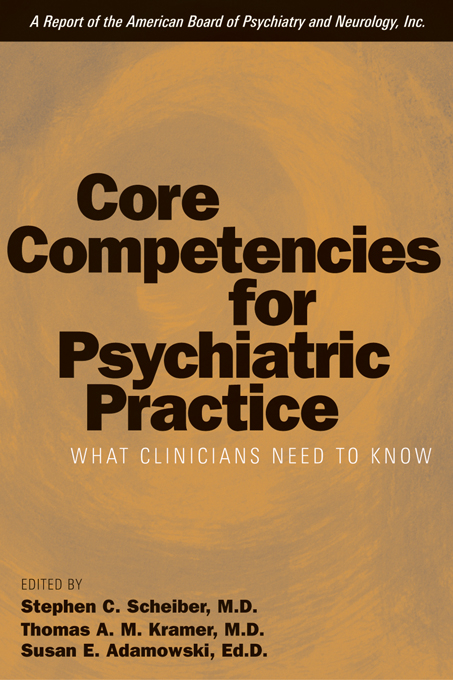
Core Competencies for Psychiatric Practice (eBook)
194 Seiten
American Psychiatric Publishing (Verlag)
978-1-58562-751-6 (ISBN)
Written with a view to educating and certifying the next generations of psychiatrists, this groundbreaking compendium by distinguished contributors offers a concise look at the final product of the June 2001 Invitational Core Competencies Conference sponsored by the American Board of Psychiatry and Neurology (ABPN) as regards psychiatry.
The practice of medicine has changed radically during the past few decades. Patients -- better informed than ever -- now demand more of their physicians, viewing them as partners rather than revering them as sole decision-makers.In this environment, nonnegotiable core competencies -- ever-evolving and measured by certification, recertification, and, more recently, maintenance of certification -- are more important than ever.Written from the perspective of those responsible for educating and certifying the next generations of psychiatrists, this groundbreaking compendium by distinguished contributors offers -- for the first time -- a concise look at the final product of the June 2001 Invitational Core Competencies Conference sponsored by the American Board of Psychiatry and Neurology (ABPN) as regards psychiatry (with a future comparable publication focusing on neurology). Divided into four parts, ? Part I sets the stage for the current concept of physician "e;competence"e; by presenting a brief history of medical competence, explaining the logic behind the development of the current competence outline.? Part II provides two different views of how to look at core competencies: how competence is defined by the Royal College of Physicians and Surgeons of Canada and, based on some of their work, what is currently being done in the United States.? Part III discusses the organizing principles -- identified in 1999 by the Accreditation Council for Graduate Medical Education (ACGME) and the American Board of Medical Specialties (ABMS) -- that frame all of our conversations about competence, as currently delineated for psychiatrists across the six core competency categories: Patient Care, Medical Knowledge, Interpersonal and Communications Skills, Practice-Based Learning and Improvement, Professionalism, and Systems-Based Practice. Also presented are discussions of when in a physician's career these competencies should be assessed and what methodologies would be appropriate for that assessment.? Part IV discusses how the psychiatry core competencies are changing board certification and recertification. Also presented are informed predictions about the changes that medical school faculty and residency training directors will have to make and how practitioners will have to change behaviors to maintain their board certification. Concluding with an appendix outlining the six core competencies for psychiatry, this invaluable resource will both help psychiatric residents and their faculty and training directors understand the core competencies important to the ABPN and provide practitioners with a view of what will be contained in their upcoming maintenance of certification programs now being designed.
lt;P>Stephen C. Scheiber, M.D., is Clinical Professor of Psychiatry at Northwestern University Medical School in Evanston, Illinois; Clinical Professor of Psychiatry at the Medical College of Wisconsin in Milwaukee; and Executive Vice President of the American Board of Psychiatry and Neurology, Inc. in Deerfield, Illinois.
Thomas A. M. Kramer, M.D., is Director of Student Counseling and Resource Service at The University of Chicago in Chicago, Illinois.
Susan E. Adamowski, Ed.D., is Director of New Assessment Initiatives at the American Board of Psychiatry and Neurology, Inc. in Deerfield, Illinois.
ContributorsForewordPrefaceAbbreviationsPart I: An Introduction to Core CompetenciesChapter 1. What Core Competencies Mean to Psychiatrists and TraineesChapter 2. The Evolving Concept of Clinical Competence in Psychiatric PracticePart II: Origins of Core Competencies: Canadian Groundbreaking and American DevelopmentChapter 3. Advance Standards: The Canadian Concept of Specialty Competencies as Delineated by Physician RolesChapter 4. The ACGME and ABMS Initiatives: Toward the Development of Core CompetenciesPart III: Core Competencies and the Practice of Psychiatry Today: The ABPN InitiativeChapter 5. General and Psychiatry-Specific Patient Care Core CompetenciesChapter 6. General and Psychiatry-Specific Medical Knowledge Core CompetenciesChapter 7. Interpersonal and Communications Skills Core CompetenciesChapter 8. Practice-Based Learning and Improvement Core CompetenciesChapter 9. Professionalism Core CompetenciesChapter 10. Systems-Based Practice Core CompetenciesChapter 11. Cross Competencies: What Psychiatrists Should Know About NeurologyPart IV: The Impact of Core CompetenciesChapter 12. Implications of the Core Competencies on ABPN Certification and Maintenance of Certification for Psychiatric PractitionersChapter 13. Implications of the Core Competencies on the Full Spectrum of Psychiatric Medical Education for Clinical Psychiatric Practice: From Medical School Through Continuing Medical EducationChapter 14. A Forward View: Core Competencies in Future Psychiatric PracticeAppendix A: Psychiatry Quadrad Core Competencies OutlineIndex
| Erscheint lt. Verlag | 13.8.2008 |
|---|---|
| Zusatzinfo | 8 tables |
| Verlagsort | Washington |
| Sprache | englisch |
| Maße | 150 x 150 mm |
| Gewicht | 308 g |
| Themenwelt | Medizin / Pharmazie ► Gesundheitsfachberufe |
| Medizin / Pharmazie ► Medizinische Fachgebiete ► Psychiatrie / Psychotherapie | |
| ISBN-10 | 1-58562-751-8 / 1585627518 |
| ISBN-13 | 978-1-58562-751-6 / 9781585627516 |
| Informationen gemäß Produktsicherheitsverordnung (GPSR) | |
| Haben Sie eine Frage zum Produkt? |
 PDF (Adobe DRM)
Kopierschutz: Adobe-DRM
Adobe-DRM ist ein Kopierschutz, der das eBook vor Mißbrauch schützen soll. Dabei wird das eBook bereits beim Download auf Ihre persönliche Adobe-ID autorisiert. Lesen können Sie das eBook dann nur auf den Geräten, welche ebenfalls auf Ihre Adobe-ID registriert sind.
Details zum Adobe-DRM
Dateiformat: PDF (Portable Document Format)
Mit einem festen Seitenlayout eignet sich die PDF besonders für Fachbücher mit Spalten, Tabellen und Abbildungen. Eine PDF kann auf fast allen Geräten angezeigt werden, ist aber für kleine Displays (Smartphone, eReader) nur eingeschränkt geeignet.
Systemvoraussetzungen:
PC/Mac: Mit einem PC oder Mac können Sie dieses eBook lesen. Sie benötigen eine
eReader: Dieses eBook kann mit (fast) allen eBook-Readern gelesen werden. Mit dem amazon-Kindle ist es aber nicht kompatibel.
Smartphone/Tablet: Egal ob Apple oder Android, dieses eBook können Sie lesen. Sie benötigen eine
Geräteliste und zusätzliche Hinweise
Buying eBooks from abroad
For tax law reasons we can sell eBooks just within Germany and Switzerland. Regrettably we cannot fulfill eBook-orders from other countries.
aus dem Bereich