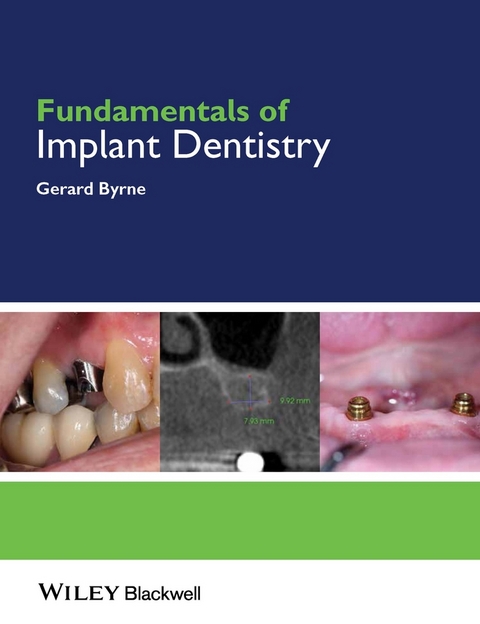
Fundamentals of Implant Dentistry (eBook)
John Wiley & Sons (Verlag)
978-1-118-27498-9 (ISBN)
Fundamentals of Implant Dentistry provides a concise yet comprehensive look at the basic background and science of implantology and includes practical, evidence-based instruction on common procedures such as single implant crowns, bridges and overdentures. Well-illustrated with clear line drawings and clinical photos, the book serves as the perfect introduction to this exciting area of dentistry.
Gerard Byrne is Associate Professor of Restorative Dentistry at the University of Nebraska Medical Center, College of Dentistry, Lincoln, Nebraska, where he teaches foundational courses in implant dentistry, restorative dentistry, and prosthodontics.
Fundamentals of Implant Dentistry is a basic guide to foundational knowledge and skills and their application in clinical practice. More comprehensive than a procedural atlas and more accessible than a specialist reference, this text is an indispensable tool for dental students and clinicians beginning work with dental implants.Fundamentals of Implant Dentistry provides a concise yet comprehensive look at the basic background and science of implantology and includes practical, evidence based instruction on common procedures such as single implant crowns, bridges and overdentures. Well illustrated with clear line drawings and clinical photos, the book serves as the perfect introduction to this exciting area of dentistry.
Gerard Byrne is Associate Professor of Restorative Dentistry at the University of Nebraska Medical Center, College of Dentistry, Lincoln, Nebraska, where he teaches foundational courses in implant dentistry, restorative dentistry, and prosthodontics.
Acknowledgments vii
About the Companion Website viii
1 Introduction to Dental Implants 1
2 Implant-Tissue Interface Biology 23
3 Implant Biomechanics 43
4 Implant Systems 63
5 Assessment, Diagnosis, and Treatment Planning 81
6 Essentials for Implant Treatment 103
7 Surgical Planning and Procedures 119
8 Single-Implant Crowns 145
9 Multi-Unit Implant Fixed Prostheses 159
10 Mandibular Implant Overdentures 173
11 Advanced Topics: Surgery 193
12 Advanced Topics: Prosthetics 211
13 Complications 225
Appendix A 243
Appendix B 247
Index 249
1
Introduction to Dental Implants
- 1.1 Introduction
- 1.2 Tooth loss
- 1.3 Early dental implants
- 1.4 Pioneering implant research
- 1.5 Commercial implant history
- 1.6 Notable implant “milestones”
- 1.7 Criteria for implant success
- 1.8 Clinical studies, implant validation
- 1.9 Implant regulation
- 1.10 Research and development
- 1.11 Summary
1.1 Introduction
Implantation involves the embedding of a native or foreign tissue or substance within body tissues. The end point of dental implantation is recovered dental function and aesthetics.
It has long been a common refrain in dental practice for patients to express the desire for a “screw-in” tooth replacement. The dream of predictable stable implant prostheses and the current concept of implant “osseointegration” became a reality through the pioneering research of Brånemark and coworkers in Sweden from the mid-1960s, and Schroeder and coworkers in Switzerland from the mid-1970s. (Brånemark et al. 1969, 1977, 1985; Albrektsson et al. 1981; Schroeder et al. 1991, 1996). From a clinical standpoint, research has shown that modern titanium (Ti) endosseous implants have an overall survival rate of 90–95%.
Beginning in 1952 Brånemark discovered, in the course of vital microscopic studies of blood rheology and bone healing, that titanium (Ti) optical chambers inserted in rabbit bone became firmly attached to the bone and were difficult to remove for reuse; the living bone had “bonded” to the Ti. Later in the 1960s, Brånemark further studied this phenomenon in dogs and, from his perspective as an orthopedic surgeon, contemplated the idea of using Ti implants for artificial joints, bone repair, and edentulism. Brånemark resolved to work primarily on the rehabilitation of edentulism. He coined the term “osseointegration” to describe the stable functional bond between the metal Ti screws and living bone. Brånemark and his team, with meticulous attention to detail, adherence to sound biological principles, and long-term continuous study, proceeded to develop a standard set of protocols for implant rehabilitation of edentulism. Brånemark et al. (1985) postulated a two-stage surgical approach allowing the submerged implant to heal or integrate for 3–6 months before exposure to the oral environment (Fig. 1.1a,b). Schroeder et al. (1996) in later independent studies postulated a one-stage surgery, a nonsubmerged technique, with transmucosal healing and a shorter healing period of 3–4 months. Otherwise, the techniques were similar in that both used Ti, careful atraumatic site preparation, and prolonged healing.
1.1. (a) Brånemark Mark III self-threading machined implant screw with Ti-Unite® surface and smooth collar (courtesy of Nobel Biocare). (b) Modern implant crown diagram comprising an implant and screw-retained combination abutment-crown (courtesy of Nobel Biocare). (c) Left central incisor implant with metal-ceramic crown.While Brånemark's vision is now accepted and lauded, it is interesting to note that there was significant controversy and skepticism at the time in his native Sweden regarding this new implant method (Albrektsson and Sennerby 2005). In a 2005 commentary, Brånemark suggested that we need to continue to focus on the “decisive effect of functional load on the healing process and remodeling of bone and marrow” rather than focus on the “hardware.” He further commented that: “the mouth is a much more important part of the human body than medicine and controlling agencies recognize.”
1.2 Tooth Loss
Consequences of Tooth Loss on Alveolar Bone
Bone needs functional stimulation to maintain its form and density. The alveolar bone grows with the developing and erupting teeth. Wolff's Law states that bone remodels (changes its internal and external architecture) in relation to the forces applied. The loss of a tooth and thence loss of functional bone stimulation, leads to bone atrophy and a reduction in alveolar ridge width and height (Tallgren et al. 1980). A removable prosthesis does not stimulate and maintain bone but serves to exacerbate ridge resorption. Ridge resorption of up to 22% vertically and 63% horizontally occurs within 6 months after tooth extraction in otherwise dentate patients (Tan et al. 2012). During the first year following tooth extraction, there is an average ridge width decrease of 25%, and an average 4.0 mm height reduction. Implants retain alveolar bone height, but do not completely prevent some alveolar resorption when placed immediately into tooth extraction sites.
Demographics of Tooth Loss
Age is related directly to every indicator of tooth loss: caries, periodontal disease, endodontic problems, and fracture (Meskin et al. 1988; Misch 2007; Jokstad 2009). The average number of lost teeth increases with age (Müller et al. 2007; Zitzmann et al. 2007). There has been a steady increase in the global population that is over 65 years of age. Worldwide, there is a projected increase of over 65 year olds from 550 million in 2000 to 973 million in 2030. Life expectancy is increasing in economically developed countries, and was 85 years in 2001 for the United States (Kinsella 2005). Although the incidence of complete edentulism is on the decline in Europe, the United States, and other economically developed countries, as life expectancy continues to increase, and with continued immigration, the number of people requiring full dentures in the next 3–5 decades will continue to increase. The total edentulism rate in the U.S. adult population is 10.5% or approximately 18 million people. The reported rate of one and two arch edentulism is 17% or 30 million people, in the United States (Marcus et al. 1996). Global demand for complete denture prostheses is likely to continue increasing (Felton 2009) (Fig. 1.2a,b).
1.2. (a) Brånemark implants with attached transmucosal abutments (courtesy of Dr. E. Kim). (b) Brånemark-style reconstruction: mandibular fixed “hybrid” prosthesis supported by five implants (courtesy of Dr. E. Kim).Partial edentulism is even more prevalent in the United States. In 45- to 54-year-old patients, 31.3% have mandibular free-end edentulism, while 13.6% have free-end maxillary edentulism. This partial edentulism rate increases to 35% (mandibular) and 18% (maxillary) in the 55- to 64-year-old age group. The number of U.S. patients with at least one quadrant of posterior teeth missing is more than 44 million (Misch 2007). Up to 70% of the adult U.S. population may be missing at least one tooth. Up until 1995, it is estimated that 1% of patients with an implant indication for tooth loss had been treated with implants. Misch (2007) estimated that a total of 74 million adults in the United States are potential candidates for dental implants. The “baby-boomer” (post-Second World War babies) population in developed countries offers significant growth potential for implant treatment due to high disposable income and longer life expectancy.
Current market research shows that the global dental implant market is expected to grow from $3.2 billion in 2010 to $4.2 billion in 2015. Europe is currently the world's largest market with a 42% market share, and a growth rate of 7%pa, followed by the United States and Japan (Market Reports 2010).
Reasons Why Implant Treatment Is Increasing
- Implant success has been validated over prolonged periods.
- The population is aging; tooth loss increases with age.
- Traditional restorative dentistry procedures have a limited life span.
- Dentures deliver relatively poor function.
- Tooth loss and removable prostheses generate negative psychology for a patient.
- Dental implant treatment is viewed positively by the public.
1.3 Early Dental Implants
Historically, numerous attempts have been made to replace lost teeth with artificial substitutes, but with limited success (Ring 1995a, 1995b; Sullivan 2001). Dental implant therapy was initially aimed at the fully edentulous patient or dental invalid who was unable to cope with conventional dentures.
Implant Classification
See NIH (1978) and Schroeder et al. (1996).
- Subperiosteal: A CoCr casting custom made for an edentulous bony ridge and placed subperiosteally with integral transmucosal posts for denture retention.
- Endosseous—blade (plate), ramus frame, trans-osteal or staple, root form, or cylindrical: These implants are anchored in bone and penetrate the oral mucosa to provide prosthetic anchorage. Linkow (1968) introduced the Ti blade implant. The ramus frame has a tripod of blade-like bone anchorages. Root form designs were introduced in the 1980s by Brånemark et al. (1969), Kirsch and Ackermann (1989) (“intramobil zylinder,” IMZ®), Schulte (1992)...
| Erscheint lt. Verlag | 21.3.2014 |
|---|---|
| Reihe/Serie | Fundamentals (Dentistry) |
| Fundamentals (Dentistry) | Fundamentals (Dentistry) |
| Sprache | englisch |
| Themenwelt | Medizin / Pharmazie ► Gesundheitsfachberufe |
| Medizin / Pharmazie ► Medizinische Fachgebiete | |
| Medizin / Pharmazie ► Zahnmedizin | |
| Schlagworte | accessible • application • BASIC • Clinical • Comprehensive • concise • Dental • dentistry • foundational • fundamentals • Guide • Implant • Implantat • Implant Dentistry • Implantologie • Implantologie i. d. Zahnheilkunde • Implantology • implants • indispensable • Practice • procedural • Reference • Specialist • students • Tool • Work • Zahnmedizin |
| ISBN-10 | 1-118-27498-9 / 1118274989 |
| ISBN-13 | 978-1-118-27498-9 / 9781118274989 |
| Informationen gemäß Produktsicherheitsverordnung (GPSR) | |
| Haben Sie eine Frage zum Produkt? |
 EPUB (Adobe DRM)
Kopierschutz: Adobe-DRM
Adobe-DRM ist ein Kopierschutz, der das eBook vor Mißbrauch schützen soll. Dabei wird das eBook bereits beim Download auf Ihre persönliche Adobe-ID autorisiert. Lesen können Sie das eBook dann nur auf den Geräten, welche ebenfalls auf Ihre Adobe-ID registriert sind.
Details zum Adobe-DRM
Dateiformat: EPUB (Electronic Publication)
EPUB ist ein offener Standard für eBooks und eignet sich besonders zur Darstellung von Belletristik und Sachbüchern. Der Fließtext wird dynamisch an die Display- und Schriftgröße angepasst. Auch für mobile Lesegeräte ist EPUB daher gut geeignet.
Systemvoraussetzungen:
PC/Mac: Mit einem PC oder Mac können Sie dieses eBook lesen. Sie benötigen eine
eReader: Dieses eBook kann mit (fast) allen eBook-Readern gelesen werden. Mit dem amazon-Kindle ist es aber nicht kompatibel.
Smartphone/Tablet: Egal ob Apple oder Android, dieses eBook können Sie lesen. Sie benötigen eine
Geräteliste und zusätzliche Hinweise
Buying eBooks from abroad
For tax law reasons we can sell eBooks just within Germany and Switzerland. Regrettably we cannot fulfill eBook-orders from other countries.
aus dem Bereich