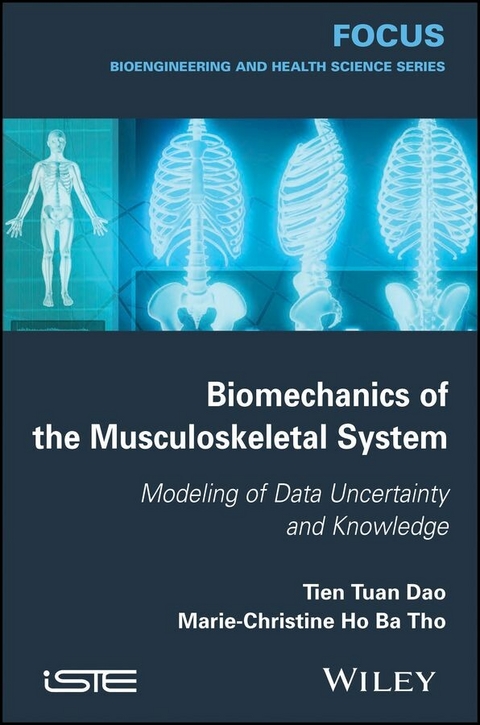
Biomechanics of the Musculoskeletal System (eBook)
167 Seiten
Wiley-Iste (Verlag)
978-1-118-93101-1 (ISBN)
The topic of this book is the modeling of data uncertainty and knowledge for a health engineering problem such as the biomechanics of the musculoskeletal system. This is the first book on this subject. It begins with the state of the art in related topics such as data uncertainty, knowledge modeling, and the biomechanics of the musculoskeletal system, followed by fundamental and theoretical aspects of this field. Clinically relevant applications of musculoskeletal system modeling are then introduced. The book finishes with a chapter on practical software and tools for knowledge modeling and reasoning purposes.
Dr. Tien Tuan DAO received the Engineer Diploma and the Master degree in Computer Science in 2005 at the University of Cantho in Vietnam and in 2006 at the University of Technology of Compiègne (UTC) in France respectively. After receiving the PhD degree in Biomechanics and Bioengineering in 2009 at UTC, he pursued his research activities as a postdoctoral fellow at the same university until 2011. From 2012, he is holding a CNRS research engineer position at the UMR CNRS 7338 Biomechanics and Bioengineering Laboratory at the UTC. His research interest relates to the modeling of human osteo-articular and musculoskeletal systems using biomechanics and knowledge-based engineering approaches. Marie Christine HO BA THO is Professor in Mechanics since 1998 at UTC (Université de Technologie de Compiègne) and currently Head of Biomechanics and Bioengineering Laboratory associated with CNRS (Centre National de Rercherches Scientifiques).
Preface ix
Chapter 1 Biomechanics of the Musculoskeletal System
1
1.1 Biomechanics and its applications 1
1.2 Biomechanics of the musculoskeletal system: current
knowledge 5
1.3 Challenges and perspectives of rigid multi-body
musculoskeletal models 26
1.4 Summary 26
1.5 Bibliography 30
Chapter 2 Modeling of Biomechanical Data Uncertainty
37
2.1 Introduction of biomechanical data and their uncertainties
37
2.2 Biomechanical data uncertainty modeling 49
2.3 Biomechanical data uncertainty propagation 62
2.4 Conclusions and perspectives 69
2.5 Summary 70
2.6 Bibliography 71
Chapter 3 Knowledge Modeling in Biomechanics of the
Musculoskeletal System 75
3.1 Knowledge modeling in Biomechanics 75
3.2 Knowledge representation 77
3.3 Knowledge reasoning 79
3.4 Conventional and advanced knowledge discovery methods 80
3.5 CDS system 91
3.6 Conclusions 97
3.7 Summary 98
3.8 Bibliography 98
Chapter 4 Clinical Applications of Biomechanical and
Knowledge-Based Models 103
4.1 Patient-specific musculoskeletal model: effect of the
orthosis 103
4.2 Computational musculoskeletal ontological model 117
4.3 Predictive models of the pathologies of the lower limbs
130
4.4 Conclusions 136
4.5 Summary 137
4.6 Bibliography 137
Chapter 5 Software and Tools for Knowledge Modeling and
Reasoning/Inference 143
5.1 Open source and Commercial knowledge modeling software and
tools 143
5.2 Protégé: ontology editor and knowledge-based
framework 145
5.3 JESS: reasoning and inference library 148
5.4 Conclusion 150
5.5 Summary 150
5.6 Bibliography 151
Index 153
1
Biomechanics of the Musculoskeletal System
The musculoskeletal system plays an essential role in the equilibrium and motion of the human body. Biomechanics of the musculoskeletal system uses physical laws and engineering methods to describe the mechanical behavior of the musculoskeletal system during motion. In this chapter, first, the introduction of biomechanics and related applications is presented. Second, the state of the art of knowledge in biomechanics of the musculoskeletal system, in particular the development of in silico rigid multi-body musculoskeletal models and their perspectives, is addressed.
1.1. Biomechanics and its applications
1.1.1. Introduction
Biomechanics is a research field which aims to solve biomedical or biological problems by using mechanical engineering methods, techniques and theories [HAT 74, WIN 11]. Living systems such as human musculoskeletal system or cardiovascular system are the main objects of biomechanics research study. Engineering methods range from experimental to numerical approaches. Experimental studies [KEY 65, SHA 01] aim to observe qualitatively and quantitatively the changes of biological tissues (e.g. bone, muscle, cartilage and ligament) or structures (e.g. knee) under normal and abnormal conditions. Experimental studies could be performed in vivo and ex vivo or in vitro conditions. In vivo experimentation relates to the study of whole living subject in natural environment. Ex vivo or in vitro experimentations deal with the testing of tissues isolated outside its biological surroundings of the living organism. Such experimentations are commonly performed in a culture environment. It is important to note that the characteristics and behaviors of a biological tissue/structure in vivo condition are completely different from those of the same tissue/structure in vitro or ex vivo conditions. Moreover, in silico numerical studies [REI 02, KIT 02, VEN 06] aim to model and simulate living systems to provide unobservable information of the tissue or structure under investigation such as bone stress under body loading or muscle force during motion. Moreover, numerical studies could be used to test the impact of a clinical treatment procedure (e.g. surgery or functional rehabilitation) or the impact of an implanted device (e.g. prosthesis or orthotic) on the living tissues or structures.
A biomechanics study is commonly performed in response to a basic research question or to depict its potential application for a specific case (e.g. clinical case and industrial case) as illustrated in Figure 1.1. An example of a basic research question could be how to determine the pathophysiological processes of musculoskeletal disorders. Such a basic research question allows us to better understand the functional behavior of tissues and structure. An example of an applied research study could be the application of the finite element method to predict the femoral bone stress when a femoral prosthesis is implanted to optimize the design and fabrication of the investigated prosthesis. In fact, such basic or applied research problems could be solved by using mechanical engineering methods, techniques and theories. Moreover, a biomechanics study relates to single-scale object of study (i.e. cell and molecule, tissue and organ, system, or individual or population) or multi-scale object of study.
Figure 1.1. Overview of biomechanics field of study
1.1.2. Applications in biomechanics
Biomechanics studies could lead to clinical, sportive and industrial applications. A non-exhaustive list of potential applications is provided below:
1.2. Biomechanics of the musculoskeletal system: current knowledge
1.2.1. Introduction
Biomechanics of the musculoskeletal system is a specific branch of biomechanics, which focuses on the studies of the behavior of isolated tissues and structures (e.g. bones and segments, muscles and tendons, ligaments, cartilage, nerves and joints) as well as on the interaction between these tissues to create stability and motion functions. The objective of such a study is to provide substantial insights into the physiological and pathophysiological processes of the musculoskeletal system in the normal and pathological cases, respectively.
This section aims to describe the current knowledge extracted from basic or applied research studies on the interaction of tissues using mechanical engineering methods, techniques and theories.
Musculoskeletal models are commonly used to study the interaction of tissues. From a mechanical engineering point of view, there are two approaches for developing a musculoskeletal model as illustrated in Figure 1.2. The first approach relates to the rigid multi-body dynamics using tissue properties and Newton’s laws of motion to describe the kinematic and dynamic behavior of the musculoskeletal system. The second approach deals with deformable modeling using tissue properties and finite element methods to study the structure interaction with and without fluid consideration under normal and abnormal loading conditions. In this chapter, we focus only on the rigid multi-body modeling. Current knowledge of this modeling approach is addressed in the following section.
Figure 1.2. Overview of musculoskeletal models and their interaction
1.2.2. Rigid multi-body musculoskeletal modeling
In the framework of rigid multi-body dynamics, a 3D musculoskeletal model could be a generic parameterized model or a patient-specific model. The generic parameterized model uses an available model provided by musculoskeletal modeling software to scale and calibrate all properties for a specific subject. This approach reduces significantly the development time and effort. The patient-specific model uses common medical images to create individualized geometries and properties of the subject/patient under investigation, leading to more accurate simulation results. In fact, the development of a 3D musculoskeletal model requires advanced modeling knowledge and skills. Moreover, this development process is very time-consuming. For these reasons, the use of musculoskeletal modeling software is an efficient solution, especially in the case of clinical application where the decision-making needs to be performed quickly and with minimum effort. The next section addresses commonly used rigid multi-body musculoskeletal modeling software in the scientific community.
1.2.2.1. Modeling software
There are many pieces of modeling pieces of software, which could be used to develop generic parameterized or patient-specific musculoskeletal models. The main characteristics...
| Erscheint lt. Verlag | 9.5.2014 |
|---|---|
| Sprache | englisch |
| Themenwelt | Medizin / Pharmazie ► Medizinische Fachgebiete |
| Medizin / Pharmazie ► Physiotherapie / Ergotherapie ► Orthopädie | |
| Studium ► 1. Studienabschnitt (Vorklinik) ► Physiologie | |
| Technik ► Umwelttechnik / Biotechnologie | |
| Schlagworte | Biomechanics • Biomechanik • biomedical engineering • Biomedizintechnik |
| ISBN-10 | 1-118-93101-7 / 1118931017 |
| ISBN-13 | 978-1-118-93101-1 / 9781118931011 |
| Informationen gemäß Produktsicherheitsverordnung (GPSR) | |
| Haben Sie eine Frage zum Produkt? |
 PDF (Adobe DRM)
Größe: 4,7 MB
Kopierschutz: Adobe-DRM
Adobe-DRM ist ein Kopierschutz, der das eBook vor Mißbrauch schützen soll. Dabei wird das eBook bereits beim Download auf Ihre persönliche Adobe-ID autorisiert. Lesen können Sie das eBook dann nur auf den Geräten, welche ebenfalls auf Ihre Adobe-ID registriert sind.
Details zum Adobe-DRM
Dateiformat: PDF (Portable Document Format)
Mit einem festen Seitenlayout eignet sich die PDF besonders für Fachbücher mit Spalten, Tabellen und Abbildungen. Eine PDF kann auf fast allen Geräten angezeigt werden, ist aber für kleine Displays (Smartphone, eReader) nur eingeschränkt geeignet.
Systemvoraussetzungen:
PC/Mac: Mit einem PC oder Mac können Sie dieses eBook lesen. Sie benötigen eine
eReader: Dieses eBook kann mit (fast) allen eBook-Readern gelesen werden. Mit dem amazon-Kindle ist es aber nicht kompatibel.
Smartphone/Tablet: Egal ob Apple oder Android, dieses eBook können Sie lesen. Sie benötigen eine
Geräteliste und zusätzliche Hinweise
Zusätzliches Feature: Online Lesen
Dieses eBook können Sie zusätzlich zum Download auch online im Webbrowser lesen.
Buying eBooks from abroad
For tax law reasons we can sell eBooks just within Germany and Switzerland. Regrettably we cannot fulfill eBook-orders from other countries.
 EPUB (Adobe DRM)
Kopierschutz: Adobe-DRM
Adobe-DRM ist ein Kopierschutz, der das eBook vor Mißbrauch schützen soll. Dabei wird das eBook bereits beim Download auf Ihre persönliche Adobe-ID autorisiert. Lesen können Sie das eBook dann nur auf den Geräten, welche ebenfalls auf Ihre Adobe-ID registriert sind.
Details zum Adobe-DRM
Dateiformat: EPUB (Electronic Publication)
EPUB ist ein offener Standard für eBooks und eignet sich besonders zur Darstellung von Belletristik und Sachbüchern. Der Fließtext wird dynamisch an die Display- und Schriftgröße angepasst. Auch für mobile Lesegeräte ist EPUB daher gut geeignet.
Systemvoraussetzungen:
PC/Mac: Mit einem PC oder Mac können Sie dieses eBook lesen. Sie benötigen eine
eReader: Dieses eBook kann mit (fast) allen eBook-Readern gelesen werden. Mit dem amazon-Kindle ist es aber nicht kompatibel.
Smartphone/Tablet: Egal ob Apple oder Android, dieses eBook können Sie lesen. Sie benötigen eine
Geräteliste und zusätzliche Hinweise
Buying eBooks from abroad
For tax law reasons we can sell eBooks just within Germany and Switzerland. Regrettably we cannot fulfill eBook-orders from other countries.
aus dem Bereich