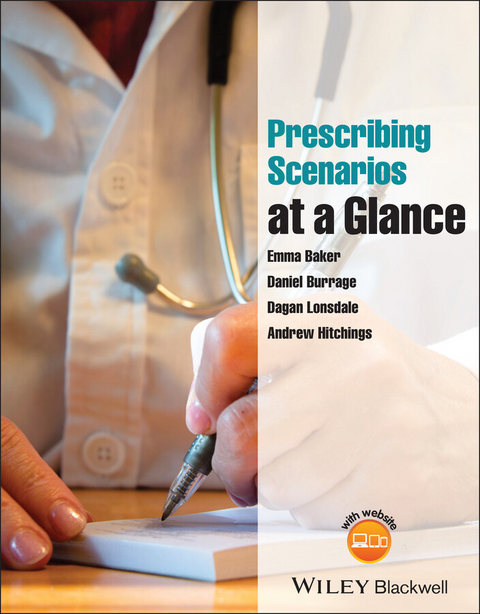
Prescribing Scenarios at a Glance (eBook)
John Wiley & Sons (Verlag)
978-1-118-57087-6 (ISBN)
Prescribing Scenarios at a Glance is an innovative resource which allows medical students and junior doctors to practise prescribing skills safely for themselves. Supporting those who wish to develop their prescribing knowledge and clinical reasoning, this book features 50 acute and on call scenarios in a hospital setting. Users will be able to practise skills such as initiating a prescription, planning management, reviewing therapy, and identifying adverse drug reactions and interactions.
Prescribing Scenarios at a Glance:
• Contains case scenarios, mock drug charts and model answers with discussion
• Features a workbook of prepared drug charts for each case that allow users to practise prescription writing
• Includes detailed explanations and answers to all case scenarios, including examples of correctly completed charts
• Includes access to refill drug charts for each scenario available on the companion website at www.ataglanceseries.com/prescribingscenarios, allowing users to rehearse each scenario as many times as they like
An ideal companion for medical students, foundation doctors and non-medical prescribers as they develop their prescribing skills, this book will help to instil confidence, reduce errors, and encourage best practice. It will also be a valuable resource for candidates preparing for prescribing exams.
This title is also available as a mobile App from MedHand Mobile Libraries. Buy it now from iTunes, Google Play or the MedHand Store.
Emma Baker is Professor of Clinical Pharmacology, St. George's, University of London, and Consultant Physician, St. George's Healthcare NHS Trust, London
Daniel Burrage is Academic Clinical Fellow, St. George's, University of London, and Specialty Registrar (ST3) in Clinical Pharmacology, General Medicine and Stroke Medicine, St. George's Healthcare NHS Trust, London
Dagan Lonsdale is Academic Clinical Fellow, St. George's, University of London, and Specialty Registrar (ST3) in Clinical Pharmacology, General Medicine and Intensive Care Medicine, St. George's Healthcare NHS Trust, London
Andrew Hitchings is Clinical Research Fellow, St. George's, University of London, and Specialty Registrar (ST7) in Clinical Pharmacology, General Medicine and Intensive Care Medicine, St. George's Healthcare NHS Trust, London
Prescribing Scenarios at a Glance is an innovative resource which allows medical students and junior doctors to practise prescribing skills safely for themselves. Supporting those who wish to develop their prescribing knowledge and clinical reasoning, this book features 50 acute and on call scenarios in a hospital setting. Users will be able to practise skills such as initiating a prescription, planning management, reviewing therapy, and identifying adverse drug reactions and interactions. Prescribing Scenarios at a Glance: Contains case scenarios, mock drug charts and model answers with discussion Features a workbook of prepared drug charts for each case that allow users to practise prescription writing Includes detailed explanations and answers to all case scenarios, including examples of correctly completed charts Includes access to refill drug charts for each scenario available on the companion website at www.ataglanceseries.com/prescribingscenarios, allowing users to rehearse each scenario as many times as they like An ideal companion for medical students, foundation doctors and non-medical prescribers as they develop their prescribing skills, this book will help to instil confidence, reduce errors, and encourage best practice. It will also be a valuable resource for candidates preparing for prescribing exams.This title is also available as a mobile App from MedHand Mobile Libraries. Buy it now from iTunes, Google Play or the MedHand Store.
Emma Baker is Professor of Clinical Pharmacology, St. George's, University of London, and Consultant Physician, St. George's Healthcare NHS Trust, London Daniel Burrage is Academic Clinical Fellow, St. George's, University of London, and Specialty Registrar (ST3) in Clinical Pharmacology, General Medicine and Stroke Medicine, St. George's Healthcare NHS Trust, London Dagan Lonsdale is Academic Clinical Fellow, St. George's, University of London, and Specialty Registrar (ST3) in Clinical Pharmacology, General Medicine and Intensive Care Medicine, St. George's Healthcare NHS Trust, London Andrew Hitchings is Clinical Research Fellow, St. George's, University of London, and Specialty Registrar (ST7) in Clinical Pharmacology, General Medicine and Intensive Care Medicine, St. George's Healthcare NHS Trust, London
Cover 1
Title page 5
Copyright page 6
Contents 7
Acknowledgements 9
Dedication 9
List of abbreviations 10
How to use your textbook 12
About the companion website 15
Introduction: Practical prescribing scenarios 16
Purpose of the book 16
How to use this book 16
Contents 16
Cases 16
Working through the cases 16
Model answers 16
Disclaimer 17
The prescribing process 17
How to decide what to prescribe 17
How to write the prescription 21
The tools 21
Writing a legal prescription 21
Components of a prescription 21
Practical considerations 22
Writing a prescription 24
Dose calculations 27
Dosing by body weight 27
Converting doses between common units 27
Converting doses between concentrations expressed as percentage and mass 27
Calculations for drug infusions 28
Minimising medication errors 29
Types of error and their prevention 29
Section 1: The acute take 31
Cases 32
1 An 82-year-old woman who requires venous thromboembolism prophylaxis 32
History 32
Examination 32
Investigations 32
Task 32
2 A 104-year-old woman with respiratory failure 32
History 32
Examination 32
Investigations 32
Task 32
3 A 64-year-old man with severe acute abdominal pain 33
History 33
Examination 33
Investigations 33
Task 33
4 A 55-year-old woman with atrial fibrillation 33
History 33
Examination 33
Investigations 33
Task 33
5 A 32-year-old man with community-acquired pneumonia 34
History 34
Examination 34
Investigations 34
Task 34
6 A 45-year-old woman with status epilepticus 34
History 34
Examination 34
Investigations 34
Task 34
7 A 27-year-old woman with suspected bacterial meningitis 35
History 35
Examination 35
Investigations 35
Task 35
8 A 31-year-old woman with paracetamol overdose 36
History 36
Examination 36
Investigations 36
Task 36
9 A 59-year-old man with acute pulmonary oedema 37
History 37
Examination 37
Investigations 37
Task 37
10 A 24-year-old woman with acute asthma 37
History 37
Examination 37
Investigations 37
Task 37
11 A 57-year-old man who has suddenly deteriorated 38
History 38
Examination 38
Investigations 38
Task 38
12 An 84-year-old man taking warfarin who has a headache 38
History 38
Examination 38
Investigations 38
Task 38
13 A 66-year-old man with acute coronary syndrome 39
History 39
Examination 39
Investigations 39
Task 39
14 A 67-year-old man with an exacerbation of COPD 39
History 39
Examination 39
Investigations 39
Task 39
Answers 40
1 An 82-year-old woman who requires venous thromboembolism prophylaxis 40
What should I consider when deciding what to prescribe? 40
How do I write the prescription? 41
Further reading 41
2 A 104-year-old woman with respiratory failure 42
What should I consider when deciding what to prescribe? 42
How do I write the prescription? 43
Further reading/useful references 43
3 A 64-year-old man with severe acute abdominal pain 43
What should I consider when deciding what to prescribe? 43
How do I write the prescription? 44
Further reading 44
4 A 55-year-old woman with atrial fibrillation 45
What should I consider when deciding what to prescribe? 45
How do I write the prescription? 46
Further reading 46
5 A 32-year-old man with community-acquired pneumonia 47
What should I consider when deciding what to prescribe? 47
How do I write the prescription? 48
Further reading 48
6 A 45-year-old woman with status epilepticus 49
What should I consider when deciding what to prescribe? 49
How do I write the prescription? 49
Further reading 50
7 A 27-year-old woman with suspected bacterial meningitis 50
What should I consider when deciding what to prescribe? 50
How do I write the prescription? 51
Further reading 52
8 A 31-year-old woman with paracetamol overdose 52
What should I consider when deciding what to prescribe? 52
How do I write the prescription? 53
Further reading 53
9 A 59-year-old man with acute pulmonary oedema 54
What should I consider when deciding what to prescribe? 54
How do I write the prescriptions? 55
Further reading 56
10 A 24-year-old woman with acute asthma 56
What should I consider when deciding what to prescribe? 56
How do I write the prescription? 57
Further reading 58
11 A 57-year-old man who has suddenly deteriorated 59
What should I consider when deciding what to prescribe? 59
How do I write the prescription? 60
Further reading 60
12 An 84-year-old man taking warfarin who has a headache 61
What should I consider when deciding what to prescribe? 61
How do I write the prescription? 62
Further reading 62
13 A 66-year-old man with acute coronary syndrome 63
What should I consider when deciding what to prescribe? 63
How do I write the prescription? 64
Further reading 65
14 A 67-year-old man with an exacerbation of COPD 66
What should I consider when deciding what to prescribe? 66
How do I write the prescription? 67
Further reading 68
Section 2: On call in the hospital 69
Cases 70
15 A 91-year-old man with hypoglycaemia 70
History 70
Examination 70
Investigations 70
Task 70
16 A 60-year-old woman requesting night sedation 70
History 70
Examination 70
Investigations 70
Task 70
17 A 62-year-old man with suspected opioid toxicity 71
History 71
Examination 71
Investigations 71
Task 71
18 A 58-year-old man who has low blood pressure 71
History 71
Examination 71
Investigations 71
Task 71
19 A 44-year-old woman who is ‘nil by mouth’ 72
History 72
Examination 72
Investigations 72
Task 72
20 A 59-year-old man with circulatory compromise 72
History 72
Examination 72
Task 72
21 A 15-month-old girl with gastroenteritis 73
History 73
Examination 73
Investigations 73
Task 73
22 A 5-year-old boy with a painful right arm 73
History 73
Examination 73
Task 73
Suggested resource 73
23 A 12-hour-old boy with signs of sepsis 74
History 74
Examination 74
Task 74
24 A 60-year-old man who has developed a hot joint 74
History 74
Examination 74
Task 74
25 A 65-year-old man with hypokalaemia 75
History 75
Examination 75
Investigations 75
Task 75
26 A 69-year-old woman being treated with gentamicin 75
History 75
Examination 75
Investigations 75
Task 75
27 A 69-year-old man anticoagulated with warfarin 76
History 76
Examination 76
Investigations 76
Task 76
28 A 28-year-old woman with nausea 76
History 76
Examination 76
From the anaesthetic chart 76
Task 76
29 A 29-year-old man who is in pain following an operation 77
History 77
Examination 77
Task 77
30 A 49-year-old man due to undergo surgery 77
History 77
Examination 77
Investigations 77
Task 77
31 A 79-year-old woman with acute kidney injury 78
History 78
Examination 78
Investigations 78
Task 78
32 An 85-year-old woman with hospital-acquired pneumonia 79
History 79
Examination 79
Investigations 79
Task 79
33 A 47-year-old man who has developed an abnormal liver profile 80
History 80
Examination 80
Investigations 80
Task 80
34 An 83-year-old man who develops diarrhoea 81
History 81
Examination 81
Investigations 81
Task 81
35 An 88-year-old man with hyperkalaemia 82
History 82
Examination 82
Investigations 82
Task 82
36 A 69-year-old woman with acute alcohol withdrawal 83
History 83
Examination 83
Investigations 83
Task 83
Answers 84
15 A 91-year-old man with hypoglycaemia 84
What should I consider when deciding what to prescribe? 84
How do I write the prescription? 85
Further reading 85
16 A 60-year-old woman requesting night sedation 85
What should I consider when deciding what to prescribe? 85
How do I write the prescription? 86
Further reading 86
17 A 62-year-old man with suspected opioid toxicity 86
What should I consider when deciding what to prescribe? 86
How do I write the prescription? 87
Further reading 87
18 A 58-year-old man who has low blood pressure 88
What should I consider when deciding what to prescribe? 88
How do I write the prescription? 89
Further reading 89
19 A 44-year-old woman who is ‘nil by mouth’ 90
What should I consider when deciding what to prescribe? 90
How do I write the prescription? 91
Further reading 91
20 A 59-year-old man with circulatory compromise 92
What should I consider when deciding what to prescribe? 92
How do I write the prescription? 93
Further reading 94
21 A 15-month-old girl with gastroenteritis 95
What should I consider when deciding what to prescribe? 95
How do I write the prescription? 96
Further reading 96
22 A 5-year-old boy with a painful right arm 96
What should I consider when deciding what to prescribe? 96
How do I write the prescription? 97
Further reading 97
23 A 12-hour-old boy with signs of sepsis 98
What should I consider when deciding what to prescribe? 98
How do I write the prescription? 98
Further reading 99
24 A 60-year-old man who has developed a hot joint 99
What should I consider when deciding what to prescribe? 99
How do I write the prescription? 100
Further reading 100
25 A 65-year-old man with hypokalaemia 101
What should I consider when deciding what to prescribe? 101
How do I write the prescription? 101
26 A 69-year-old woman being treated with gentamicin 104
What should I consider when deciding what to prescribe? 104
How do I write the prescription? 104
Further reading 104
27 A 69-year-old man anticoagulated with warfarin 106
What should I consider when deciding what to prescribe? 106
How do I write the prescription? 107
Further reading 107
28 A 28-year-old woman with nausea 107
What should I consider when deciding what to prescribe? 107
How do I write the prescription? 108
Further reading 108
29 A 29-year-old man who is in pain following an operation 109
What should I consider when deciding what to prescribe? 109
How do I write the prescription? 111
Further reading 111
30 A 49-year-old man due to undergo surgery 112
What should I consider when deciding what to prescribe? 112
How do I write the prescription? 113
Further reading 113
31 A 79-year-old woman with acute kidney injury 114
What should I consider when deciding what to prescribe? 114
How do I write the prescription? 115
Further reading 115
32 An 85-year-old woman with hospital-acquired pneumonia 116
What should I consider when deciding what to prescribe? 116
How do I write the prescription? 117
Further reading 118
33 A 47-year-old man who has developed an abnormal liver profile 118
What should I consider when reviewing the drug chart? 118
How do I write the prescription? 119
Further reading 120
34 An 83-year-old man who develops diarrhoea 120
What should I consider when reviewing Mr George’s treatment? 120
How do I write the prescription? 122
Further reading 122
35 An 88-year-old man with hyperkalaemia 123
What should I consider when deciding what to prescribe? 123
How do I write the prescription? 124
Further reading 124
36 A 69-year-old woman with acute alcohol withdrawal 125
What should I consider when deciding what to prescribe? 125
How do I write the prescription? 126
Further reading 126
Section 3: Routine inpatient review 129
Cases 130
37 A 69-year-old woman with constipation 130
History 130
Examination 130
Investigations 130
Task 130
38 A 71-year-old man who has developed a tremor 130
History 130
Examination 130
Task 130
39 An 81-year-old woman at risk of fragility fractures 131
History 131
Examination 131
Investigations 131
Task 131
40 A 23-year-old pregnant woman with pulmonary embolism 131
History 131
Examination 131
Investigations 131
Task 131
41 A 31-year-old man with increased seizure frequency 132
History 132
Examination 132
Investigations 132
Task 132
42 A 58-year-old man with diabetes mellitus treated with insulin 132
History 132
Examination 132
Investigations 132
Task 132
43 A 53-year-old man who wants to stop smoking 133
History 133
Examination 133
Task 133
44 A 90-year-old woman on numerous medications 133
History 133
Examination 133
Investigations 133
Task 133
45 A 54-year-old woman with a peptic ulcer 134
History 134
Examination 134
Investigations 134
Task 134
46 A 64-year-old woman with chronic kidney disease 134
History 134
Examination 134
Investigations 134
Task 134
47 A 66-year-old man with palpitations 135
History 135
Examination 135
Investigations 135
Task 135
48 A 70-year-old man with ST-elevation acute coronary syndrome 135
History 135
Examination 135
Investigations 135
Task 135
49 A 49-year-old woman with chronic liver disease complaining of pain 136
History 136
Examination 136
Investigations 136
Task 136
50 An 89-year-old man approaching the end of life 136
History 136
Examination 136
Investigations 136
Task 136
Answers 137
37 A 69-year-old woman with constipation 137
What should I consider when deciding what to prescribe? 137
How do I write the prescription? 138
Further reading 138
38 A 71-year-old man who has developed a tremor 138
What should I consider when deciding what to prescribe? 138
How do I write the prescription? 139
Further reading 139
39 An 81-year-old woman at risk of fragility fractures 140
What should I consider when deciding what to prescribe? 140
How do I write the prescription? 141
Further reading 141
40 A 23-year-old pregnant woman with pulmonary embolism 142
What should I consider when deciding what to prescribe? 142
How do I write the prescription? 142
Further reading 143
41 A 31-year-old man with increased seizure frequency 143
What should I consider when deciding what to prescribe? 143
How do I write the prescription? 144
Further reading 144
42 A 58-year-old man with diabetes mellitus treated with insulin 145
What should I consider when deciding what to prescribe? 145
How do I write the prescription? 147
Further reading 147
43 A 53-year-old man who wants to stop smoking 148
What should I consider when deciding what to prescribe? 148
How do I write the prescription? 149
Further reading 149
44 A 90-year-old woman on numerous medications 150
What should I consider when deciding what to prescribe? 150
How do I write the prescription? 152
Further reading 152
45 A 54-year-old woman with a peptic ulcer 152
What should I consider when deciding what to prescribe? 152
How do I write the prescription? 153
Further reading 154
46 A 64-year-old woman with chronic kidney disease 154
What should I consider when deciding what to prescribe? 154
How do I write the prescription? 156
Further reading 156
47 A 66-year-old man with palpitations 156
What should I consider when deciding what to prescribe? 156
How do I write the prescription? 157
Further reading 157
48 A 70-year-old man with ST-elevation acute coronary syndrome 158
What should I consider when deciding what to prescribe? 158
How do I write the prescription? 159
Further reading 160
49 A 49-year-old woman with chronic liver disease complaining of pain 160
What should I consider when deciding what to prescribe? 160
How do I write the prescription? 161
Further reading 162
50 An 89-year-old man approaching the end of life 162
What do I need to consider when reviewing therapy? 162
How do I write the prescription? 163
Further reading 164
Appendix 1 Antibiotic guidelines 165
Appendix 2 Case summaries 166
Index 168
Work Book 179
1 An 82-year-old woman who requires venous thromboembolism prophylaxis 184
2 A 104-year-old woman with respiratory failure 186
3 A 64-year-old man with severe acute abdominal pain 188
4 A 55-year-old woman with atrial fibrillation 190
5 A 32-year-old man with community-acquired pneumonia 192
6 A 45-year-old woman with status epilepticus 194
7 A 27-year-old woman with suspected bacterial meningitis 196
8 A 31-year-old woman with paracetamol overdose 198
9 A 59-year-old man with acute pulmonary oedema 200
10 A 24-year-old woman with acute asthma 202
11 A 57-year-old man who has suddenly deteriorated 204
12 An 84-year-old man taking warfarin who has a headache 206
13 A 66-year-old man with acute coronary syndrome 208
14 A 67-year-old man with an exacerbation of COPD 212
15 A 91-year-old man with hypoglycaemia 216
16 A 60-year-old woman requesting night sedation 218
17 A 62-year-old man with suspected opioid toxicity 220
18 A 58-year-old man who has low blood pressure 222
19 A 44-year-old woman who is ‘nil by mouth’ 224
20 A 59-year-old man with circulatory compromise 226
21 A 15-month-old girl with gastroenteritis 228
22 A 5-year-old boy with a painful right arm 230
23 A 12-hour-old boy with signs of sepsis 232
24 A 60-year-old man who has developed a hot joint 234
25 A 65-year-old man with hypokalaemia 236
26 A 69-year-old woman being treated with gentamicin 238
27 A 69-year-old man anticoagulated with warfarin 240
28 A 28-year-old woman with nausea 242
29 A 29-year-old man who is in pain following an operation 244
30 A 49-year-old man due to undergo surgery 246
31 A 79-year-old woman with acute kidney injury 248
32 An 85-year-old woman with hospital-acquired pneumonia 250
33 A 47-year-old man who has developed an abnormal liver profile 252
34 An 83-year-old man who develops diarrhoea 254
35 An 88-year-old man with hyperkalaemia 258
36 A 69-year-old woman with acute alcohol withdrawal 260
37 A 69-year-old woman with constipation 262
38 A 71-year-old man who has developed a tremor 264
39 An 81-year-old woman at risk of fragility fractures 266
40 A 23-year-old pregnant woman with pulmonary embolism 268
41 A 31-year-old man with increased seizure frequency 270
42 A 58-year-old man with diabetes mellitus treated with insulin 272
43 A 53-year-old man who wants to stop smoking 274
44 A 90-year-old woman on numerous medications 276
45 A 54-year-old woman with a peptic ulcer 280
46 A 64-year-old woman with chronic kidney disease 282
47 A 66-year-old man with palpitations 284
48 A 70-year-old man with ST-elevation acute coronary syndrome 286
49 A 49-year-old woman with chronic liver disease complaining of pain 290
50 An 89-year-old man approaching the end of life 292
EULA 294
| Erscheint lt. Verlag | 7.5.2014 |
|---|---|
| Reihe/Serie | At a Glance |
| At a Glance | At a Glance |
| Sprache | englisch |
| Themenwelt | Medizin / Pharmazie ► Gesundheitsfachberufe |
| Medizin / Pharmazie ► Medizinische Fachgebiete ► Pharmakologie / Pharmakotherapie | |
| Schlagworte | Able • allows • Book • Call • CASE • Clinical Pharmacology & Therapeutics • Contains • doctors • glance • Hospital • Innovative • Junior • Klinische Pharmakologie u. Therapie • Medical • medical education • Medical Science • Medizin • Medizinstudium • Pharmacology & Pharmaceutical Medicine • Pharmakologie • Pharmakologie u. Pharmazeutische Medizin • practise • practise skills • Prescribing • prescribing knowledge • prescription • resource • Scenarios • Skills • Users |
| ISBN-10 | 1-118-57087-1 / 1118570871 |
| ISBN-13 | 978-1-118-57087-6 / 9781118570876 |
| Informationen gemäß Produktsicherheitsverordnung (GPSR) | |
| Haben Sie eine Frage zum Produkt? |
 PDF (Adobe DRM)
Kopierschutz: Adobe-DRM
Adobe-DRM ist ein Kopierschutz, der das eBook vor Mißbrauch schützen soll. Dabei wird das eBook bereits beim Download auf Ihre persönliche Adobe-ID autorisiert. Lesen können Sie das eBook dann nur auf den Geräten, welche ebenfalls auf Ihre Adobe-ID registriert sind.
Details zum Adobe-DRM
Dateiformat: PDF (Portable Document Format)
Mit einem festen Seitenlayout eignet sich die PDF besonders für Fachbücher mit Spalten, Tabellen und Abbildungen. Eine PDF kann auf fast allen Geräten angezeigt werden, ist aber für kleine Displays (Smartphone, eReader) nur eingeschränkt geeignet.
Systemvoraussetzungen:
PC/Mac: Mit einem PC oder Mac können Sie dieses eBook lesen. Sie benötigen eine
eReader: Dieses eBook kann mit (fast) allen eBook-Readern gelesen werden. Mit dem amazon-Kindle ist es aber nicht kompatibel.
Smartphone/Tablet: Egal ob Apple oder Android, dieses eBook können Sie lesen. Sie benötigen eine
Geräteliste und zusätzliche Hinweise
Buying eBooks from abroad
For tax law reasons we can sell eBooks just within Germany and Switzerland. Regrettably we cannot fulfill eBook-orders from other countries.
aus dem Bereich