Fundamentals of Nursing Models, Theories and Practice (eBook)
John Wiley & Sons (Verlag)
978-1-118-49210-9 (ISBN)
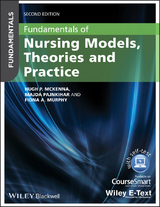
A concise, accessible introduction to the development, application and evaluation of nursing theories, this new edition of Fundamentals of Nursing Models, Theories & Practice provides a thorough overview of the body of knowledge on the topic, and a clear outline of their relevance to everyday nursing practice. Linking the development of theory to practice, this full-updated text features learning outcomes, key concept summaries and reflective exercises to aid the study of this key element of all modern nursing courses.
Special Features
- Clearly examines the relationship between nursing theory, clinical practice and nursing roles
- Accessible and user-friendly with a range of features to help study, including key concepts, learning objectives and reflective exercises
- Useful for all pre-registration nursing students, as well as newly qualified nurses
- Accompanied by an online resource centre featuring case studies, multiple choice questions, exercises and activities
A concise, accessible introduction to the development, application and evaluation of nursing theories, this new edition of Fundamentals of Nursing Models, Theories & Practice provides a thorough overview of the body of knowledge on the topic, and a clear outline of their relevance to everyday nursing practice. Linking the development of theory to practice, this full-updated text features learning outcomes, key concept summaries and reflective exercises to aid the study of this key element of all modern nursing courses. Special Features Clearly examines the relationship between nursing theory, clinical practice and nursing roles Accessible and user-friendly with a range of features to help study, including key concepts, learning objectives and reflective exercises Useful for all pre-registration nursing students, as well as newly qualified nurses Accompanied by an online resource centre featuring case studies, multiple choice questions, exercises and activities
Hugh P. McKenna CBE is Pro Vice Chancellor of Research and Innovation at University of Ulster, UK. Majda Pajnkihar is Dean, Senior Research Fellow, and Head of Institute of Nursing Care in the Faculty of Health Sciences, University of Maribor, Slovenia. Fiona Murphy is Associate Professor at the College of Human & Health Sciences, Swansea University, UK.
About the series viii
Dedication ix
Preface x
How to use your textbook xii
About the companion website xvii
Chapter 1 The case for nursing theory 1
Introduction 2
The necessity and meaning of theory 4
Theory defined 5
Construction of theory 9
Theory and science of nursing 11
Other interpretations of theory 13
Main paradigms and philosophies and their influence on the development of nursing science 14
Theory and practice of nursing 16
Do we really need theory? 18
Nursing theories today 18
Conclusion 21
Chapter 2 Knowing in nursing and nursing knowledge 23
Introduction 24
Defining knowing and knowledge 24
Philosophies of knowledge 25
How do nurses know? 35
Developing nursing knowledge 48
Conclusion 52
Chapter 3 Theory from practice and practice from theory 53
Introduction 54
First steps - reflecting on theory 54
The questions begged 55
Developing nursing theory 56
Levels of theory 58
The relationship between theory and practice 69
The questions begged - some answers 76
Conclusion 77
Chapter 4 Nursing theories and new nursing roles 79
Introduction 80
Defining role 81
Background to the development of new roles in nursing 81
Some implications of the new nursing roles 84
Using theory to understand new roles in nursing 85
Conclusion 97
Chapter 5 Nursing theories or nursing models 99
Introduction 100
Reasons for historical nursing theory evolution 100
Model 102
Theory 103
Theory or model? 104
The classification of theories 106
Current trends in nursing theories 109
The nursing metaparadigm 110
Limitations of nursing theories 114
Benefits of nursing theories 118
Conclusions 121
Chapter 6 Interpersonal relationships: the essence of nursing models and theories 123
Introduction 124
Types of interpersonal relationships 124
Interpersonal theories of nursing 127
Implications for nurse education 133
Social capital 135
Threats to the development of interpersonal relationships in nursing and the use of interpersonal theories 136
Conclusion 138
Chapter 7 How to select a suitable model or theory 140
Introduction 141
Selecting an appropriate nursing theory 142
Potential problems when selecting a nursing theory 143
Choosing a suitable nursing theory 150
Nurses' own philosophy as a basis for selecting a theory 153
A strategy for choice 154
Who should select the theory? 155
Nursing theories or theories developed by another discipline? 156
Conclusion 158
Chapter 8 Research and theory: some relationships 161
Introduction 162
Building theory through research: an inductive approach 162
Is the link between theory and research strong? 165
Research in nursing 166
Theory-generating research (TGR) 167
Theory-testing research (TTR) 171
Theory-framed research (TFR) 174
Theory-evaluating research (TER) 175
Strategies for theory development through research 180
Conclusions 184
Chapter 9 Criteria for theory description, analysis and evaluation 186
Introduction 187
The evaluator of a nursing theory 187
Significance of the theory 187
Step 1: Theory description 189
Step 2: Theory analysis 192
Step 3: Theory evaluation 201
Conclusion 206
References 208
Index 220
1
The case for nursing theory
Outline of content
This chapter covers the following: the case for theory; the argument that all intentional and rational actions, including nursing actions, by definition must have an underlying theory; an initial definition of theory; how theory and practice become integrated in nursing praxis.
Learning outcomes
At the end of this chapter you should be able to:
- Understand what nursing theory is
- Define theory
- Understand the construction/development of a theory
- Discuss the relationship between nursing theory and science
- Evaluate the relationship between nursing theory and practice
- Know the limitations of the nursing theory
- Understand the importance of nursing theory for contemporary nursing
Introduction
Before nursing students and registered nurses recognise the content and function of theory, they often ask themselves question such as the following. What are nursing theories? Why study them? What has this got to do with nursing? How can something that is divorced from action, that is by definition abstract and conjectural, be of value to something like nursing, which is one of the most practical of activities?
This book will help to answer these questions. Theories exist everywhere in society. There are numerous theories of the family, of the internal combustion engine, of how cancer cells multiply, of changes in the weather. There are even lots of theories as to who killed President John F. Kennedy or Marilyn Monroe. The world is full of theories, some tested as accurate, some untested and some speculative. It is no surprise, then, that there are theories of nursing. But what do theories do? In essence, they are simply used to describe, explain or predict phenomena (see Reflective Exercise 1.1). This will be explored in detail later.
Reflective Exercise 1.1
Theory
Write down or discuss with other people two different theories for one of the following:
- the break-up of the Beatles
- the assassination of John F. Kennedy
- global warming
- newborn babies smiling when spoken to
Consider if there is the basis of truth in any of these theories.
Now, none of the theories that you outlined for any of the topics in Reflective Exercise 1.1 may be true. In fact, they may be erroneous or downright preposterous. The point is that we all use theories to explain what goes on in our lives or in the world. But if you wanted to, you could probably test or find out whether your theories are true. Later on in this chapter we will outline what theories are made of and how they are formed.
In many ways, theories are like maps. Maps are used to give us directions or to help us find our way in a complicated landscape or terrain. Maps often make simple what is a very complex picture. At their best, nursing theories also give us directions as to how to best care for patients. But why have we got so many nursing theories (over 50 at last count)? If you take any large city, there are many maps. For instance, in London, there are street maps, underground maps, electricity supply maps, Ordinance Survey maps and so on. Consider the London Underground map or the Moscow or Paris Metro maps – they are simple and easy to follow but they do not look anything like the complex reality of the underground networks they represent. In other words, they make a complex system understandable.
Similarly, nursing is highly complex and we need different theories to help us understand what is going on. A theory that can be used in emergency care may not be much use in mental health care, and a theory that can be used to help nurses in a busy surgical ward may be of little use in community care.
Nursing theories can provide frameworks for practice and in many clinical settings they have been used in the assessment of patients’ needs. For instance, in the UK one of the most popular nursing theories was designed by three nurses who worked at Edinburgh University – Nancy Roper, Winifred Logan and Alison Tierney. They based their theory on the work of an American nurse called Virginia Henderson. Her theory outlined how nurses should be focused on encouraging patients to be independent in certain activities of daily living (ADLs) such as sleeping, eating, mobilising etc. Roper et al. took this a step further by identifying 12 ADLs. They stressed that it was the nurses’ role to prevent people having problems with these ADLs. If this could not be achieved then nurses should help the patients to be independent in the ADLs. If this was not possible then nurses should give the patient and/or the patient’s family the knowledge and skills to cope with their dependence on the ADLs. Many clinical nurses used the ADL theory to assess patients. They simply see how independent the patient is for each ADL and then focus their care on those for which the patient is dependent.
Therefore, theory can help us to carry out an individual patient’s care and can contribute to better observation and recognition of specific patient needs, be they biological, social or psychological. Nursing theories are often derived from practice. In other words, nursing theorists have constructed their theories based on what they have experienced when working with patients and their families. Understanding the basic elements of a theory and its role, as well as taking a critical view of it, can help to develop a body of knowledge that nurses need for everyday work.
In this book we want to highlight the need for and use of nursing theory and its function. We will try to convince you of the importance of nursing theories to the nursing profession, to nursing education and especially to practice. This first chapter will introduce you to new words and ideas and it will take some concentration to understand the terminology. You may decide to read it in small doses, rather than all of it in one sitting. However, once you have mastered this first chapter, the rest of the book will be relatively easy to understand and, believe it or not, enjoyable. Several aspects of nursing theory are discussed in later chapters, and when reading those, dipping back into this first chapter will be helpful. Have a look at Reflective Exercise 1.2.
Reflective Exercise 1.2
Terminology
When you get involved in a new subject, you often have to learn new words to understand the topic. If you are a nursing student, you have had to learn many new anatomical or psychological words and phrases. Also, think of all the new words you would have to learn to take on any of the following hobbies:
- photography
- astronomy
- music
- gardening
See how many more you can think of. People accept learning new terms as part of understanding something in which they have an interest. The same is true in nursing theory.
The necessity and meaning of theory
Some people argue that in the real world of practice most nurses are not concerned with theories and that they are of interest only to nursing academics. However, our position is that there is no such thing as nursing without theory, because there is no such thing as atheoretical nursing. Nursing is theory in action and every nursing act finds its basis in some theory. For instance, if a nurse is talking to a patient, she may be using communication theory. At its simplest, a communication theory would include a speaker, a listener, a message and understanding between the speaker and the listener. Similarly, if she is putting a dressing on a patient, she may be using a theory of asepsis from the field of microbiology. Nurses may not always have a named theory in mind or they may even reject the notion that they are using a theory at all. Yet nurses do what they do for a reason and where there is a reason or purpose in mind, there is, more often than not, a theory.
When providing care to a patient, we are doing something in a purposeful manner. While doing it, we are seeking to understand, to uncover meaning, to determine how we should act on the basis of our understanding. This process describes theorising or theory construction. In this sense, theory is not some rarefied academic pursuit, but something that every nurse employs many times a day.
From the moment we start to think about something intentionally, we are constructing a theory. When we speak of construction, we are referring to how something is built or how the parts are put together to form a whole structure. Frequently we are referring to a building that has been constructed, such as a house or a bridge. When we bring thoughts together to form some understanding, we are also constructing. In this instance we are producing a mental building that has about it a sense of wholeness, which can be explained and shared with others through language.
This draws attention to another significant aspect of this process: when we think, we do so in language. A set of symbols that label the mental images are constructed, made up of our thoughts and the connections we make between them. In daily life too, people use different words and symbols to express meaning. In the same way, all theorists constructing their own theory use their own language and symbols to express and describe the theory. For example, an American nurse theorist, Jean Watson (1979), developed a theory that...
| Erscheint lt. Verlag | 17.4.2014 |
|---|---|
| Reihe/Serie | Fundamentals |
| Fundamentals | Fundamentals |
| Sprache | englisch |
| Themenwelt | Medizin / Pharmazie ► Pflege |
| Schlagworte | accessible • Ausbildung u. Perspektiven i. d. Krankenpflege • Body • clear • concise • Development • Edition • Einführungen in die Krankenpflege • Einführungen in die Krankenpflege • Element • Everyday • fundamentals • Introduction • Introductions to Nursing • Knowledge • Krankenpflege • Models • New • nursing • Nursing Education & Professional Development • nursing practice • Outline • Relevance • thorough overview • topic • useful |
| ISBN-10 | 1-118-49210-2 / 1118492102 |
| ISBN-13 | 978-1-118-49210-9 / 9781118492109 |
| Informationen gemäß Produktsicherheitsverordnung (GPSR) | |
| Haben Sie eine Frage zum Produkt? |
 EPUB (Adobe DRM)
Größe: 8,3 MB
Kopierschutz: Adobe-DRM
Adobe-DRM ist ein Kopierschutz, der das eBook vor Mißbrauch schützen soll. Dabei wird das eBook bereits beim Download auf Ihre persönliche Adobe-ID autorisiert. Lesen können Sie das eBook dann nur auf den Geräten, welche ebenfalls auf Ihre Adobe-ID registriert sind.
Details zum Adobe-DRM
Dateiformat: EPUB (Electronic Publication)
EPUB ist ein offener Standard für eBooks und eignet sich besonders zur Darstellung von Belletristik und Sachbüchern. Der Fließtext wird dynamisch an die Display- und Schriftgröße angepasst. Auch für mobile Lesegeräte ist EPUB daher gut geeignet.
Systemvoraussetzungen:
PC/Mac: Mit einem PC oder Mac können Sie dieses eBook lesen. Sie benötigen eine
eReader: Dieses eBook kann mit (fast) allen eBook-Readern gelesen werden. Mit dem amazon-Kindle ist es aber nicht kompatibel.
Smartphone/Tablet: Egal ob Apple oder Android, dieses eBook können Sie lesen. Sie benötigen eine
Geräteliste und zusätzliche Hinweise
Zusätzliches Feature: Online Lesen
Dieses eBook können Sie zusätzlich zum Download auch online im Webbrowser lesen.
Buying eBooks from abroad
For tax law reasons we can sell eBooks just within Germany and Switzerland. Regrettably we cannot fulfill eBook-orders from other countries.
 PDF (Adobe DRM)
Kopierschutz: Adobe-DRM
Adobe-DRM ist ein Kopierschutz, der das eBook vor Mißbrauch schützen soll. Dabei wird das eBook bereits beim Download auf Ihre persönliche Adobe-ID autorisiert. Lesen können Sie das eBook dann nur auf den Geräten, welche ebenfalls auf Ihre Adobe-ID registriert sind.
Details zum Adobe-DRM
Dateiformat: PDF (Portable Document Format)
Mit einem festen Seitenlayout eignet sich die PDF besonders für Fachbücher mit Spalten, Tabellen und Abbildungen. Eine PDF kann auf fast allen Geräten angezeigt werden, ist aber für kleine Displays (Smartphone, eReader) nur eingeschränkt geeignet.
Systemvoraussetzungen:
PC/Mac: Mit einem PC oder Mac können Sie dieses eBook lesen. Sie benötigen eine
eReader: Dieses eBook kann mit (fast) allen eBook-Readern gelesen werden. Mit dem amazon-Kindle ist es aber nicht kompatibel.
Smartphone/Tablet: Egal ob Apple oder Android, dieses eBook können Sie lesen. Sie benötigen eine
Geräteliste und zusätzliche Hinweise
Buying eBooks from abroad
For tax law reasons we can sell eBooks just within Germany and Switzerland. Regrettably we cannot fulfill eBook-orders from other countries.
aus dem Bereich