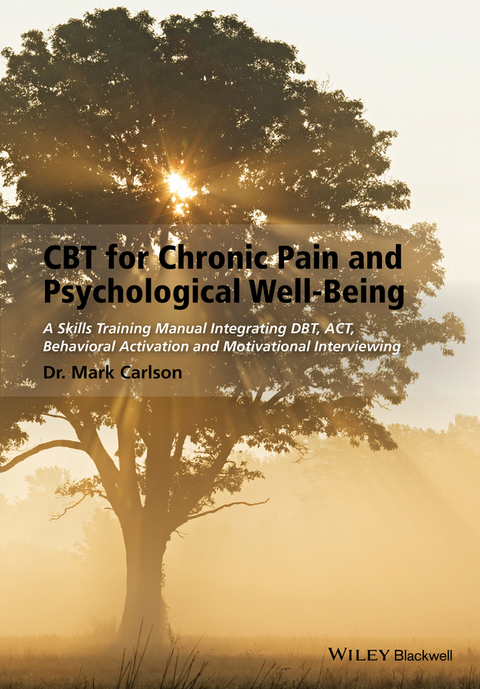
CBT for Chronic Pain and Psychological Well-Being (eBook)
John Wiley & Sons (Verlag)
978-1-118-81844-2 (ISBN)
The first clinical manual of evidence-based CBT skills for managing psychological issues associated with chronic pain, drawn from current approaches such as DBT, ACT, and motivational interviewing.
- The first skills training manual in the field of chronic pain and mental health disorders to provide an integrated session-by-session outline that is customizable for clinicians
- Adaptive and evidence-based - integrates skill sets from DBT, ACT, Behavioral Activation, and Motivational Interviewing to address the unique needs of individual chronic pain sufferers
- Clinicians can import the approach into their work, selecting the most appropriate skills and sessions, or create an entire therapeutic program with the manual as its foundation
- Includes invaluable measurement and tracking tools for clinicians required to report outcomes
Mark R. Carlson is Founder, President, CEO, and co-owner of Mental Health Systems (MHS), Minnesota. He is also Vice-President of the Dialectical Behavior Therapy National Certification and Accreditation Association (DBTNCAA) and Adjunct Professor in Psychology at Argosy University, Twin Cities. He served as the Clinical Director of multiple clinics before leaving to found MHS.
The first clinical manual of evidence-based CBT skills for managing psychological issues associated with chronic pain, drawn from current approaches such as DBT, ACT, and motivational interviewing. The first skills training manual in the field of chronic pain and mental health disorders to provide an integrated session-by-session outline that is customizable for clinicians Adaptive and evidence-based - integrates skill sets from DBT, ACT, Behavioral Activation, and Motivational Interviewing to address the unique needs of individual chronic pain sufferers Clinicians can import the approach into their work, selecting the most appropriate skills and sessions, or create an entire therapeutic program with the manual as its foundation Includes invaluable measurement and tracking tools for clinicians required to report outcomes
Mark R. Carlson is Founder, President, CEO, and co-owner of Mental Health Systems (MHS), Minnesota. He is also Vice-President of the Dialectical Behavior Therapy National Certification and Accreditation Association (DBTNCAA) and Adjunct Professor in Psychology at Argosy University, Twin Cities. He served as the Clinical Director of multiple clinics before leaving to found MHS.
Acknowledgments viii
1 Introduction to Comorbid Mental Health and Chronic Pain
1
2 Treatment Organization, Outline, and Structure of the
Program 6
3 Clinical Manual for TAG Program 15
Biological Section 15
Goal setting and motivation 15
Functioning and loss 21
Sleep 26
Emergence and patterns 29
Adherence to treatment protocols 33
Complexity 38
Working with your team 41
Psychological Section 46
Orientation to change 46
Readiness to change 50
Depression 54
Anxiety 59
First step toward change 64
Anger management 69
Attending to distress 73
Meaning and pain 79
Stress management 83
Defense mechanisms and coping styles 87
Stigma 91
Chemical abuse 96
Lifespan issues 101
Managing fl are-ups 104
Social Section 108
Managing confl ict 108
The 3 Is 112
Problem-solving 116
Nurturing support systems 120
Social roles in relationships 124
Intimacy 129
Styles of interacting 132
4 Handouts and Homework 136
Master Skills Sheet 223
Appendix - Safety Contract 230
References 231
Index 234
Chapter 2
Treatment Organization, Outline, and Structure of the Program
The TAG (Teach, Apply, and Generalize) program has its roots in the philosophy of contextualism. Leaders in the philosophy of contextualism include James, Dewey, Mead, K. Burke, and Bormann. The predominant character of behavior analysis or at least what is central and distinctive about behavior analysis, is contextualistic (Hayes 1988). The philosophy of contextualism corresponds well with Behavioral Analytic concepts of the operant, accomplishment of attainable goals, the active role of the therapist, and working with order and randomness. The TAG program incorporates these key concepts into its fundamental structure and operations. The TAG program is based on Cognitive Behavioral Therapy through practice, primary intervention strategies, and skills training. The TAG program incorporates skills and concepts from: Dialectical Behavior Therapy (DBT), Motivational Interviewing (MI), Acceptance and Commitment Therapy (ACT), and Behavioral Activation (BA). The TAG curriculum also includes grief and loss work, Existential approaches, relapse-prevention, Mindfulness, identity development, and an additional track of service for individuals with substance dependence through DBT-S (dialectical behavior therapy for substance use disorders).
There are many theories and approaches in the field of psychology. Empirically Supported Treatments (ESTs) were identified and relevant research was reviewed in order to create the TAG program. It was decided to continue the development through a contextual model that incorporates components shared by all approaches to psychotherapy, as well as six elements that are common to the rituals and procedures used by all psychotherapists (see below). As Arkowitz (1992) reports, dissatisfaction with individual theoretical approaches spawned three movements: (a) theoretical integration, (b) technical eclecticism, and (c) common factors. The contextual model is a derivative of the common factors view (Wampold 2001).
According to Wampold (2001):
A contextual model was proposed by Jerome Frank in his book, Persuasion and Healing (Frank & Frank 1991). According to Frank and Frank (1991), “the aim of psychotherapy is to help people feel and function better by encouraging appropriate modifications in their assumptive worlds, thereby transforming the meanings of experiences to more favorable ones” (p. 30). Persons who present for psychotherapy are demoralized and have a variety of problems, typically depression and anxiety. That is, people seek psychotherapy for the demoralization that results from their symptoms rather than from symptom relief. Frank has proposed that “psychotherapy achieves its effects largely and directly by treating demoralization and only indirectly treating overt symptoms of covert psychopathology”
(Parloff, 1986, p. 522)
Frank and Frank (1991) described the components shared by all approaches to psychotherapy. The first component is that psychotherapy involves an emotionally charged, confiding relationship with a helping person (i.e., the therapist). The second component is that the context of the relationship is a healing setting, in which the client presents to a professional whom the client believes can provide help and who is entrusted to work in his or her behalf. The third component is that there exists a rationale, conceptual scheme, or myth that provides a plausible explanation for the patient's symptoms and prescribes a ritual or procedure for resolving them. The final component is a ritual or procedure that requires the active participation of both client and therapist and is based on the rationale (i.e., the ritual or procedure is believed to be a viable means of helping the client).
Frank and Frank (1991) discussed six elements that are common to the rituals and procedures used by all psychotherapists. First, the therapist combats the client's sense of alienation by developing a relationship that is maintained after the client divulges feelings of demoralization. Second, the therapist maintains the patient's expectation of being helped by linking hope for improvement to the process of therapy. Third, the therapist provides new learning experiences. Fourth, the client's emotions are aroused as a result of the therapy. Fifth, the therapist enhances the client's sense of mastery or self-efficacy. Sixth, the therapist provides opportunities for practice.
Wampold (2001) furthers this concept by adding that in the contextual model, specific ingredients are necessary to construct a coherent treatment that therapists have faith in and that provides a convincing rationale to clients.
The TAG program was created for individuals experiencing issues with comorbid mental health and chronic pain. The model that was adopted as a framework of understanding and organization is the biopsychosocial model of pain pioneered by G. L. Engel (1977).
According to Lewandowski (2006):
We are beginning to live in the era of the biopsychosocial (BPS) view of pain, which takes into account the biological (physical) influences, but also looks at the psychological (emotional) influences and places them in a social (personal) context.
The Cartesian (Biological) Model of Pain
The explanation for pain that has dominated much of medical history came from the sixteenth-century Western philosopher, physiologist, and mathematician René Descartes. The Cartesian model – essentially a biological model – set forth that anything that could be doubted should be rejected. Under Cartesian thinking, the only useful factor in the pain experience was tissue injury. Tissue injury could be measured; it could be proven. The degree of pain was assumed to be determined by and directly proportional to the degree of injury. Only the physical aspects of pain mattered. Any person with a particular injury was expected to feel and respond in exactly the same way as any other person with that same injury. In the Cartesian model, tissue injury can be likened to a dial controlling volume; turn up the injury, the tissue damage, and you turn up the pain. But chronic pain has been shown to be much less mechanistic.
The Gate-Control Model of Pain
The Cartesian theory was the firmly accepted way of looking at pain until 1965, when Ronald Melzack, a Canadian psychologist, and Patrick Wall, a British physiologist, put forth the gate-control theory of pain. Melzack and Wall (1988) argued that pain signals do not travel simply from the injured tissue to the brain; rather, those signals must go through a gating mechanism in the spinal cord. When the gate is closed, pain is not registered in the brain. When the gate is opened, pain registers. And the gate can be opened or closed by more factors than the signals caused by tissue damage.
The gate-control theory goes beyond a simple focus on the body and takes into account the impact of the mind. Melzack and Wall said that the gate could be opened or closed by emotions, memories, mood, and thoughts. After the signals reach a certain threshold, the brain generates pain sensations. In fact, the brain can register pain even when there is no tissue damage whatsoever (as with phantom pain from amputated limbs). PET scans have shown that parts of the brain light up with pain even when there is no tissue damage.
Despite wide acceptance of the gate-control theory of pain, today's physicians still tend to see pain in Cartesian terms (as a physical process and a sign of tissue damage) because they are trained in Cartesian terms. They know how to look for ruptured disks, fractures, infection, and disease. But when it comes to pain, most physicians get only a few hours of training in pain management, if they get any at all.
The Biopsychosocial Model: The Future of Pain Management
While there are people who still believe that pain must not be real if a physical cause can't be found, the tide is turning. Unfortunately, some of the people questioning the reality of pain are medical professionals. But the more comprehensive and inclusive biopsychosocial model, pioneered by G. L. Engel (1977), is gaining widespread acceptance as more and more success is reported in its use.
One major drawback to the biological model was that it expected every person with the same injury to experience the same pain. There is no question that the focus of medicine on biological factors improved the quality of our lives. Take medications, for example. Antibiotics give us a powerful weapon against bacterial infections, anti-inflammatory medications reduce swelling and pain, and anti-hypertensives lower blood pressure. But the biological model did not consider external influences as relevant to disease in general and pain in particular.
Today, our understanding of pain has evolved and broadened. We are beginning to live in the era of the biopsychosocial (BPS) view of pain, which takes into account the biological (physical) influences but also looks at the psychological (emotional) influences and places them in a social (personal) context. The BPS model considers the entire person – body, mind, and environment.
The TAG Program for Chronic Pain and Psychological Well-Being – Structure, Purpose, and Rationale
The TAG program is designed to be 3–6+ months in duration and have flexibility in implementation across modalities of treatment. The concepts and skills training of the TAG program can be easily applied in individual therapy if that is the primary modality for intervention. The individual therapist will be able to...
| Erscheint lt. Verlag | 15.4.2014 |
|---|---|
| Sprache | englisch |
| Themenwelt | Geisteswissenschaften ► Psychologie |
| Medizin / Pharmazie ► Gesundheitsfachberufe | |
| Medizin / Pharmazie ► Medizinische Fachgebiete ► Psychiatrie / Psychotherapie | |
| Medizin / Pharmazie ► Medizinische Fachgebiete ► Schmerztherapie | |
| Schlagworte | CBT, DBT, Cognitive Behaviour Therapy, Dialectical Behaviour Therapy, therapy, behaviour therapy, psychotherapy, psychotherapeutic, psychology, therapeutic, psychological disorders, cognitive behaviour, ACT, mental health, dysfunction, anxiety, depression, chemical abuse, anger management, stress management • Chronischer Schmerz • Clinical psychology • Cognitive behavioral therapy (CBT) • Health & Behavioral Clinical Psychology • Klinische Psychologie • Klinische Psychologie / Verhalten • Kognitive Verhaltenstherapie • Kopfschmerz • Medical Science • Medizin • Pain (including Headache) • Psychologie • Psychology • Schmerzen, Kopfschmerzen |
| ISBN-10 | 1-118-81844-X / 111881844X |
| ISBN-13 | 978-1-118-81844-2 / 9781118818442 |
| Informationen gemäß Produktsicherheitsverordnung (GPSR) | |
| Haben Sie eine Frage zum Produkt? |
 EPUB (Adobe DRM)
Kopierschutz: Adobe-DRM
Adobe-DRM ist ein Kopierschutz, der das eBook vor Mißbrauch schützen soll. Dabei wird das eBook bereits beim Download auf Ihre persönliche Adobe-ID autorisiert. Lesen können Sie das eBook dann nur auf den Geräten, welche ebenfalls auf Ihre Adobe-ID registriert sind.
Details zum Adobe-DRM
Dateiformat: EPUB (Electronic Publication)
EPUB ist ein offener Standard für eBooks und eignet sich besonders zur Darstellung von Belletristik und Sachbüchern. Der Fließtext wird dynamisch an die Display- und Schriftgröße angepasst. Auch für mobile Lesegeräte ist EPUB daher gut geeignet.
Systemvoraussetzungen:
PC/Mac: Mit einem PC oder Mac können Sie dieses eBook lesen. Sie benötigen eine
eReader: Dieses eBook kann mit (fast) allen eBook-Readern gelesen werden. Mit dem amazon-Kindle ist es aber nicht kompatibel.
Smartphone/Tablet: Egal ob Apple oder Android, dieses eBook können Sie lesen. Sie benötigen eine
Geräteliste und zusätzliche Hinweise
Buying eBooks from abroad
For tax law reasons we can sell eBooks just within Germany and Switzerland. Regrettably we cannot fulfill eBook-orders from other countries.
aus dem Bereich