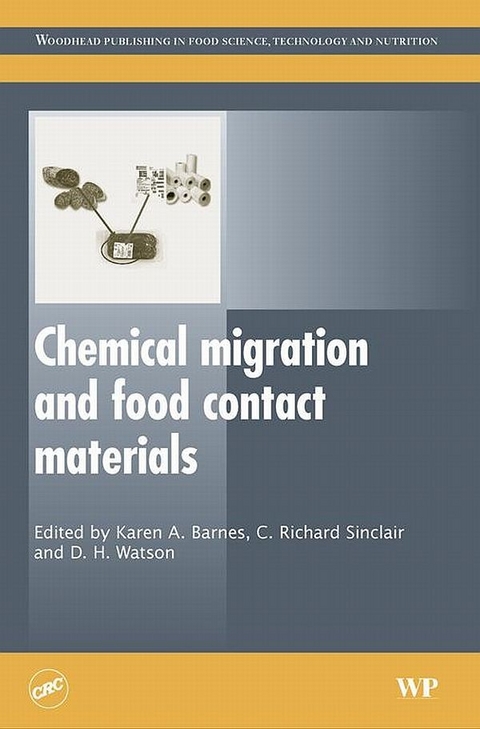
Chemical Migration and Food Contact Materials (eBook)
480 Seiten
Elsevier Science (Verlag)
978-1-84569-209-4 (ISBN)
Food and beverages can be very aggressive chemical milieu and may interact strongly with materials that they touch. Whenever food is placed in contact with another substance, there is a risk that chemicals from the contact material may migrate into the food. These chemicals may be harmful if ingested in large quantities, or impart a taint or odour to the food, negatively affecting food quality. Food packaging is the most obvious example of a food contact material. As the demand for pre-packaged foods increases, so might the potential risk to consumers from the release of chemicals into the food product. Chemical migration and food contact materials reviews the latest controls and research in this field and how they can be used to ensure that food is safe to eat.Part one discusses the regulation and quality control of chemical migration into food. Part two reviews the latest developments in areas such as exposure estimation and analysis of food contact materials. The final part contains specific chapters on major food contact materials and packaging types, such as recycled plastics, metals, paper and board, multi-layer packaging and intelligent packaging.With its distinguished editors and international team of authors, Chemical migration and food contact materials is an essential reference for scientists and professionals in food packaging manufacture and food processing, as well as all those concerned with assessing the safety of food. - Reviews worldwide regulation of food contact materials- Includes the latest developments in the analysis of food contact materials- Looks in detail at different food contact materials
Chemical migration into food: an overview
L. Castle Defra Central Science Laboratory, UK
1.1 Introduction
Packaging is beneficial. It protects the packaged foodstuff from spoilage by external agents such as pests, odours, micro-organisms, light and oxygen. However, the transfer of chemicals from packaging to food may have a negative impact on the quality and safety of food. This is why migration from packaging and other food contact materials merits study, consideration and control. Packaging is perhaps the most important, and certainly the most obvious, example of a material or article intended to come into contact with food. There are many other situations where materials are deliberately used in contact with food during its manufacture, transport, storage, preparation and consumption. These include the materials used to construct storage vessels, conveyor belts, tubing, food preparation surfaces, and cooking and eating utensils.
Food and beverages can be very aggressive products and may interact strongly with materials that they touch. Collectively, they are as good as many of the solvents used in a chemistry laboratory. For example, food acids can corrode metals, fats and oils can swell and leach plastics, and beverages can disintegrate unprotected paper and cartonboard. In fact, no food contact material is completely inert and so it is possible for their chemical constituents to ‘migrate’ into the packaged food. Metals, glass, ceramics, plastics, rubber and paper can all release minute amounts of their chemical constituents when they touch certain types of foods. This release of chemicals to the food is known technically as migration. This can be defined scientifically as ‘the mass transfer from an external source into food by sub-microscopic processes’. More colloquial terms used are ‘leaching’, ‘bleeding’ or ‘leaking’ of substances from the packaging into the food. In this chapter the term ‘food’ is used throughout to mean both food and beverages. Similarly, ‘packaging’ also denotes other food contact materials.
Any chemical migration into food is important because it can have two impacts on the food.
• Food safety – some substances used to manufacture packaging materials could be harmful if they migrated to the food and were ingested in large enough quantities.
• Food quality – migrating substances may impart taint or odour to the food and so reduce consumer appeal.
Chemical migration from packaging is not an inconsequential process. It has been estimated that the per-capita use of packaging materials for retail foodstuffs sold in the EU countries is about 1200 cm2 per person per day. This is about the size of two A4 sheets of paper and is not an inconsiderable amount. It is also about the area of film used for just two 35 gram packets of potato crisps, for example. With the increasing consumption of snack and take-away foods (Chapter 19) and moves to smaller pack sizes (with higher surface area to mass ratio) to satisfy smaller households and convenience eating, it seems inevitable that the use of packaging materials in contact with our diet will continue to increase.
For some food–package combinations the concentration of chemical migrants in the food can approach that of substances used as direct food additives, at levels of tens of parts-per-million (mg substance per kg of food, mg/kg). Therefore, all parties involved in the production, transport, selling and consumption of foods need to be aware of the potential for chemical migration and ways of minimising it. Everyone involved needs to ensure that packaging materials are correctly specified and used for the intended application so that there is no excessive chemical migration. The chain of care involves:
• primary manufacturers of raw materials, e.g., polymer and paper manufacturers
• converters who turn the raw material into packaging for food use
• vendors of the materials, e.g., retailers of articles, supply companies
• users of the material – the food packer
• food retailers
• enforcement authorities
• consumers – with respect to the proper use both of pre-packaged foods and of materials and articles used in the home.
The correct specification and use of packaging materials requires effective exchange of information up and down this chain of use. It also requires an understanding of chemical migration and the main factors that control it.
1.2 Chemical migration and the main factors that control it
1.2.1 The mechanistic basis of migration
Migration of chemical substances is a diffusion process subject to both kinetic and thermodynamic control and can be described by diffusion mathematics derived from Fick’s Law. The mathematics describe the diffusion process as a function of time, temperature, thickness of the material, amount of chemical in the material, partition coefficient and distribution coefficient. The kinetic dimension of migration dictates how fast the process of migration occurs. The thermodynamic dimension dictates how extensively the transfer of substances will be when migration is finished – when the system is at equilibrium. The kinetic and thermodynamic aspects should not be confused. For example, migration may proceed at a slow rate but, if the chemical migrant has a higher affinity for the food than for the packaging material, then given enough time (e.g. a long shelf life) it may still migrate extensively into the food. On the other hand, if a different food or beverage is packed and the chemical is only poorly soluble in that food or beverage, then migration could be low no matter how long the shelf life is.
Being a molecular diffusion process, chemical migration is subject to the normal laws of physics and chemistry. There are several determinants of chemical migration and exactly what migration occurs depends first on the identities and concentrations of the chemicals present in the packaging material. Other important parameters are the nature of the food along with the conditions of contact. Lastly, the intrinsic properties of the packaging material itself are important considerations. If a material interacts strongly with the food it could give high migration by leaching. Conversely, an inert material with low diffusivity is likely to give low migration values. It is important to understand the factors that control chemical migration because from this understanding springs the ability to prevent or limit any undesirable migration into foods.
1.2.2 Composition of the packaging material
The packaging material is the source of any chemical migration. The extent of any migration depends first on the concentration of the chemical in the packaging. If a substance is not present in a packaging material then it cannot migrate. This is self-evident but easily forgotten, and is important especially when considering models to assess consumer exposure (Chapter 6). If a substance is present in the packaging then, other things remaining equal, migration levels will be higher if the concentration in the packaging is increased and vice versa.
1.2.3 The nature and extent of contact
The nature and extent of any contact between the packaging and the food is the next important parameter to consider. This depends on the physical properties of the food (solid foods make only limited contact whereas liquids make more extensive contact) and the size and shape of the pack. Consider an individual portion pack of margarine (say, 7 g in contact with 28 cm2, or 4000 cm2/kg) compared to a catering pack of the margarine (say, 2 kg in contact with 1050 cm2 or 525 cm2/kg). If the same plastic was used to make the two pack sizes (polystyrene or polypropylene would be candidates) then the same migration on a unit area basis would give rise to an eight-fold higher exposure per portion eaten for the individual portion pack, compared with the catering pack. The most extreme examples of this mass ratio of surface area to food are to be found outside the area of general packaging materials, for example, the relatively limited contact made by small gaskets used in a large food processing plant, gloves or conveyor belts used to handle tonnes of food in a packing plant, or tubing used to pipe tens or hundreds of thousands of litres of liquid during its service life.
Another factor that determines the nature and extent of any contact with the food is the presence of a barrier layer. If the chemical that may migrate is located in one layer of the packaging material but this is separated from the food by an intervening layer, then this barrier layer – between food and chemical migrant – may retard or prevent migration from occurring. This is quite a common situation with modern multi-laminate packaging materials where inks, adhesives, or one or more of the laminate plies do not touch the food directly. The packaging industry has long exploited barrier layers to protect food products from air, light and moisture, in controlling the inner atmosphere of the pack (MAP and CAP, modified and controlled atmosphere packs), and in retaining desirable aromas whilst...
| Erscheint lt. Verlag | 22.12.2006 |
|---|---|
| Sprache | englisch |
| Themenwelt | Studium ► Querschnittsbereiche ► Prävention / Gesundheitsförderung |
| Technik ► Lebensmitteltechnologie | |
| ISBN-10 | 1-84569-209-8 / 1845692098 |
| ISBN-13 | 978-1-84569-209-4 / 9781845692094 |
| Informationen gemäß Produktsicherheitsverordnung (GPSR) | |
| Haben Sie eine Frage zum Produkt? |
 EPUB (Adobe DRM)
Kopierschutz: Adobe-DRM
Adobe-DRM ist ein Kopierschutz, der das eBook vor Mißbrauch schützen soll. Dabei wird das eBook bereits beim Download auf Ihre persönliche Adobe-ID autorisiert. Lesen können Sie das eBook dann nur auf den Geräten, welche ebenfalls auf Ihre Adobe-ID registriert sind.
Details zum Adobe-DRM
Dateiformat: EPUB (Electronic Publication)
EPUB ist ein offener Standard für eBooks und eignet sich besonders zur Darstellung von Belletristik und Sachbüchern. Der Fließtext wird dynamisch an die Display- und Schriftgröße angepasst. Auch für mobile Lesegeräte ist EPUB daher gut geeignet.
Systemvoraussetzungen:
PC/Mac: Mit einem PC oder Mac können Sie dieses eBook lesen. Sie benötigen eine
eReader: Dieses eBook kann mit (fast) allen eBook-Readern gelesen werden. Mit dem amazon-Kindle ist es aber nicht kompatibel.
Smartphone/Tablet: Egal ob Apple oder Android, dieses eBook können Sie lesen. Sie benötigen eine
Geräteliste und zusätzliche Hinweise
Buying eBooks from abroad
For tax law reasons we can sell eBooks just within Germany and Switzerland. Regrettably we cannot fulfill eBook-orders from other countries.
aus dem Bereich