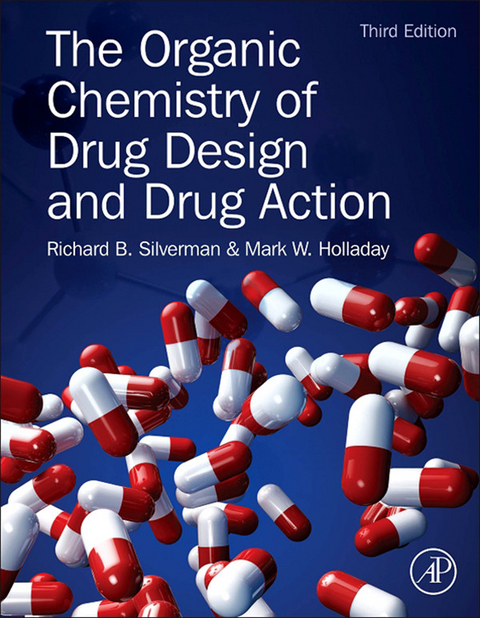
Organic Chemistry of Drug Design and Drug Action (eBook)
536 Seiten
Elsevier Science (Verlag)
978-0-12-382031-0 (ISBN)
The Organic Chemistry of Drug Design and Drug Action, Third Edition, represents a unique approach to medicinal chemistry based on physical organic chemical principles and reaction mechanisms that rationalize drug action, which allows reader to extrapolate those core principles and mechanisms to many related classes of drug molecules. This new edition includes updates to all chapters, including new examples and references. It reflects significant changes in the process of drug design over the last decade and preserves the successful approach of the previous editions while including significant changes in format and coverage. This text is designed for undergraduate and graduate students in chemistry studying medicinal chemistry or pharmaceutical chemistry; research chemists and biochemists working in pharmaceutical and biotechnology industries. - Updates to all chapters, including new examples and references- Chapter 1 (Introduction): Completely rewritten and expanded as an overview of topics discussed in detail throughout the book- Chapter 2 (Lead Discovery and Lead Modification): Sections on sources of compounds for screening including library collections, virtual screening, and computational methods, as well as hit-to-lead and scaffold hopping; expanded sections on sources of lead compounds, fragment-based lead discovery, and molecular graphics; and deemphasized solid-phase synthesis and combinatorial chemistry- Chapter 3 (Receptors): Drug-receptor interactions, cation-p and halogen bonding; atropisomers; case history of the insomnia drug suvorexant- Chapter 4 (Enzymes): Expanded sections on enzyme catalysis in drug discovery and enzyme synthesis- Chapter 5 (Enzyme Inhibition and Inactivation): New case histories:- for competitive inhibition, the epidermal growth factor receptor tyrosine kinase inhibitor, erlotinib and Abelson kinase inhibitor, imatinib- for transition state analogue inhibition, the purine nucleoside phosphorylase inhibitors, forodesine and DADMe-ImmH, as well as the mechanism of the multisubstrate analog inhibitor isoniazid- for slow, tight-binding inhibition, the dipeptidyl peptidase-4 inhibitor, saxagliptin- Chapter 7 (Drug Resistance and Drug Synergism): This new chapter includes topics taken from two chapters in the previous edition, with many new examples- Chapter 8 (Drug Metabolism): Discussions of toxicophores and reactive metabolites- Chapter 9 (Prodrugs and Drug Delivery Systems): Discussion of antibody drug conjugates
Front Cover 1
The Organic Chemistry of Drug Design and Drug Action 4
Copyright 5
Dedications 6
Contents 8
Preface to the First Edition 14
Preface to the Second Edition 16
Preface to the Third Edition 18
Chapter 1 - Introduction 20
1.1. OVERVIEW 20
1.2. DRUGS DISCOVERED WITHOUT RATIONAL DESIGN 21
1.3. OVERVIEW OF MODERN RATIONAL DRUG DESIGN 26
1.4. EPILOGUE 33
1.5. GENERAL REFERENCES 34
1.6. PROBLEMS (ANSWERS CAN BE FOUND IN THE APPENDIX AT THE END OF THE BOOK) 35
REFERENCES 35
Chapter 2 - Lead Discovery and Lead Modification 38
2.1. LEAD DISCOVERY 39
2.2. LEAD MODIFICATION 73
2.3. GENERAL REFERENCES 114
2.4. PROBLEMS (ANSWERS CAN BE FOUND IN THE APPENDIX AT THE END OF THE BOOK) 121
REFERENCES 125
Chapter 3 - Receptors 142
3.1. INTRODUCTION 142
3.2. DRUG–RECEPTOR INTERACTIONS 144
3.3. GENERAL REFERENCES 176
3.4. PROBLEMS (ANSWERS CAN BE FOUND IN THE APPENDIX AT THE END OF THE BOOK) 176
REFERENCES 178
Chapter 4 - Enzymes 184
4.1. ENZYMES AS CATALYSTS 184
4.2. MECHANISMS OF ENZYME CATALYSIS 188
4.3. COENZYME CATALYSIS 194
4.4. ENZYME CATALYSIS IN DRUG DISCOVERY 215
4.5. GENERAL REFERENCES 217
4.6. PROBLEMS (ANSWERS CAN BE FOUND IN THE APPENDIX AT THE END OF THE BOOK) 218
REFERENCES 221
Chapter 5 - Enzyme Inhibition and Inactivation 226
5.1. WHY INHIBIT AN ENZYME? 227
5.2. REVERSIBLE ENZYME INHIBITORS 229
5.3. IRREVERSIBLE ENZYME INHIBITORS 257
5.4. GENERAL REFERENCES 277
5.5. PROBLEMS (ANSWERS CAN BE FOUND IN THE APPENDIX AT THE END OF THE BOOK) 280
Chapter 6 - DNA-Interactive Agents 294
6.1. INTRODUCTION 294
6.2. DNA STRUCTURE AND PROPERTIES 296
6.3. CLASSES OF DRUGS THAT INTERACT WITH DNA 306
6.4. GENERAL REFERENCES 338
6.5. PROBLEMS (ANSWERS CAN BE FOUND IN THE APPENDIX AT THE END OF THE BOOK) 338
REFERENCES 339
Chapter 7 - Drug Resistance and Drug Synergism 352
7.1. DRUG RESISTANCE 352
7.2. DRUG SYNERGISM (DRUG COMBINATION) 365
7.3. GENERAL REFERENCES 371
7.4. PROBLEMS (ANSWERS CAN BE FOUND IN THE APPENDIX AT THE END OF THE BOOK) 371
REFERENCES 371
Chapter 8 - Drug Metabolism 376
8.1. INTRODUCTION 376
8.2. SYNTHESIS OF RADIOACTIVE COMPOUNDS 378
8.3. ANALYTICAL METHODS IN DRUG METABOLISM 380
8.4. PATHWAYS FOR DRUG DEACTIVATION AND ELIMINATION 382
8.5. GENERAL REFERENCES 426
8.6. PROBLEMS (ANSWERS CAN BE FOUND IN THE APPENDIX AT THE END OF THE BOOK) 427
Chapter 9 - Prodrugs and Drug Delivery Systems 442
9.1. ENZYME ACTIVATION OF DRUGS 442
9.2. MECHANISMS OF DRUG INACTIVATION 444
9.3. GENERAL REFERENCES 478
9.4. PROBLEMS (ANSWERS CAN BE FOUND IN THE APPENDIX AT THE END OF THE BOOK) 478
REFERENCES 480
Appendix - Answers to Chapter Problems 488
CHAPTER 1 488
CHAPTER 2 488
CHAPTER 3 495
CHAPTER 4 498
CHAPTER 5 506
CHAPTER 6 511
CHAPTER 7 514
CHAPTER 8 514
CHAPTER 9 520
Index 526
Lead Discovery and Lead Modification
Abstract
Chapter 2 focuses, in detail, on the many considerations encountered in lead discovery and lead modification stages of modern rational drug design, as typically practiced in pharmaceutical companies and many academic research laboratories. Examples emphasize how the concepts of organic chemistry are applied during the practice of these key stages of drug discovery. Major topics of discussion are the various sources for lead compounds, including virtual screening, computational methods, and fragment-based approaches, and desired properties of lead compounds. This is followed by an exploration of the objectives, considerations, and methods for subsequently optimizing lead compounds across multiple parameters such as potency, selectivity, and ADME properties. Approaches for the identification of the pharmacophore and for the determination of structure-activity relationships, including quantitative and other computational and molecular graphics-based methods, are discussed, and properties important to oral bioavailability and membrane permeability are described.
Keywords
lead identificationendogenous ligandhigh throughput screeninghigh throughput organic synthesisdrug-like propertieslead-like propertiesvirtual screeningstructure-activity relationshipsbioisostereconformational constraintslipophilicitylog Pmembrane permeabilityoral bioavailabilityblood-brain barrierADMEpharmacokinetics
Chapter Outline
2.1.1. General Considerations?20
2.1.2. Sources of Lead Compounds?20
2.1.2.1. Endogenous Ligands?20
2.1.2.2. Other Known Ligands?23
2.1.2.3. Screening of Compounds?24
2.1.2.3.1. Sources of Compounds for Screening?26
2.1.2.3.1.1. Natural Products?26
2.1.2.3.1.2 Medicinal Chemistry Collections and Other “Handcrafted” Compounds?27
2.1.2.3.1.3 High-Throughput Organic Synthesis?27
2.1.2.3.2. Drug-Like, Lead-Like, and Other Desirable Properties of Compounds for Screening?32
2.1.2.3.3. Random Screening?36
2.1.2.3.5. Hit-To-Lead Process?43
2.1.2.3.6. Fragment-based Lead Discovery?45
2.2.1. Identification of the Active Part: The Pharmacophore?55
2.2.2. Functional Group Modification?57
2.2.3. Structure–Activity Relationships?57
2.2.4. Structure Modifications to Increase Potency, Therapeutic Index, and ADME Properties?59
2.2.4.4. Conformational Constraints and Ring-Chain Transformations?66
2.2.5. Structure Modifications to Increase Oral Bioavailability and Membrane Permeability?72
2.2.5.1. Electronic Effects: The Hammett Equation?72
2.2.5.2. Lipophilicity Effects?74
2.2.5.2.1. Importance of Lipophilicity?74
2.2.5.2.2. Measurement of Lipophilicities?74
2.2.5.2.3. Computer Automation of logP Determination?78
2.2.5.2.4. Membrane Lipophilicity?79
2.2.5.3. Balancing Potency of Ionizable Compounds with Lipophilicity and Oral Bioavailability?79
2.2.5.4. Properties that Influence Ability to Cross the Blood–Brain Barrier?81
2.2.5.5. Correlation of Lipophilicity with Promiscuity and Toxicity?82
2.2.6. Computational Methods in Lead Modification?83
2.2.6.2. Quantitative Structure–Activity Relationships (QSARs)?83
2.2.6.2.1. Historical Overview. Steric Effects: The Taft Equation and Other Equations?83
2.2.6.2.2. Methods Used to Correlate Physicochemical Parameters with Biological Activity?84
2.2.6.2.2.1 Hansch Analysis: A Linear Multiple Regression Analysis?84
2.2.6.2.2.2 Manual Stepwise Methods: Topliss Operational Schemes and Others?85
2.2.6.2.2.4 Free and Wilson or de Novo Method?88
2.2.6.2.2.5 Computational Methods for ADME Descriptors?89
2.2.6.4. Molecular Graphics-Based Lead Modification?90
References?106
Lead Discovery
General Considerations
Sources of Lead Compounds
Endogenous Ligands
| Erscheint lt. Verlag | 29.3.2014 |
|---|---|
| Sprache | englisch |
| Themenwelt | Medizin / Pharmazie ► Gesundheitsfachberufe |
| Medizin / Pharmazie ► Medizinische Fachgebiete ► Pharmakologie / Pharmakotherapie | |
| Naturwissenschaften ► Chemie ► Organische Chemie | |
| Technik | |
| ISBN-10 | 0-12-382031-6 / 0123820316 |
| ISBN-13 | 978-0-12-382031-0 / 9780123820310 |
| Informationen gemäß Produktsicherheitsverordnung (GPSR) | |
| Haben Sie eine Frage zum Produkt? |
 EPUB (Adobe DRM)
Kopierschutz: Adobe-DRM
Adobe-DRM ist ein Kopierschutz, der das eBook vor Mißbrauch schützen soll. Dabei wird das eBook bereits beim Download auf Ihre persönliche Adobe-ID autorisiert. Lesen können Sie das eBook dann nur auf den Geräten, welche ebenfalls auf Ihre Adobe-ID registriert sind.
Details zum Adobe-DRM
Dateiformat: EPUB (Electronic Publication)
EPUB ist ein offener Standard für eBooks und eignet sich besonders zur Darstellung von Belletristik und Sachbüchern. Der Fließtext wird dynamisch an die Display- und Schriftgröße angepasst. Auch für mobile Lesegeräte ist EPUB daher gut geeignet.
Systemvoraussetzungen:
PC/Mac: Mit einem PC oder Mac können Sie dieses eBook lesen. Sie benötigen eine
eReader: Dieses eBook kann mit (fast) allen eBook-Readern gelesen werden. Mit dem amazon-Kindle ist es aber nicht kompatibel.
Smartphone/Tablet: Egal ob Apple oder Android, dieses eBook können Sie lesen. Sie benötigen eine
Geräteliste und zusätzliche Hinweise
Buying eBooks from abroad
For tax law reasons we can sell eBooks just within Germany and Switzerland. Regrettably we cannot fulfill eBook-orders from other countries.
aus dem Bereich