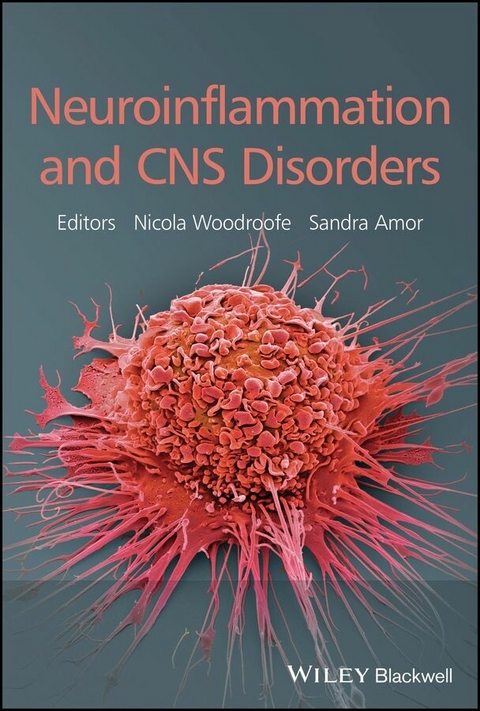
Neuroinflammation and CNS Disorders (eBook)
John Wiley & Sons (Verlag)
978-1-118-40653-3 (ISBN)
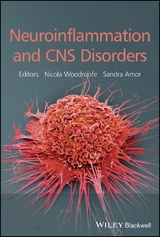
The last decade has seen an upsurge of information on the role of immune responses in neurodegenerative disorders. In many of these diseases it is still unclear whether the innate and adaptive responses are pathogenic or play a role in repair, and thus understanding their precise roles is key to controlling these diseases by designing immune-therapeutic approaches.
The connection between many neurological diseases is the realisation that the immune and nervous systems are inextricable linked, and that perturbations in this delicate balance are involved in many disorders. This has opened up new avenues for therapeutic approaches to treatment of CNS inflammatory and neurodegenerative disorders. Neuroinflammation and CNS Disorders brings together the very latest information on the interactions between the immune system and central nervous system. The first section of the book highlights the basic concepts in the field whilst the second section, the main body of the book, covers the role of the immune response in specific disorders of the central nervous system.
Neuroinflammation and CNS Disorders will provide an invaluable guide for both researchers and clinicians working in this complex and dynamic field.
Nicola Woodroofe is Professor of Neuroimmunology and Head of the Biomedical Research Centre, Sheffield Hallam University, UK.
Sandra Amor is Professor, Multiple Sclerosis Research Group, Neuropathology, VU University Medical Center Amsterdam, The Netherlands.
The last decade has seen an upsurge of information on the role of immune responses in neurodegenerative disorders. In many of these diseases it is still unclear whether the innate and adaptive responses are pathogenic or play a role in repair, and thus understanding their precise roles is key to controlling these diseases by designing immune-therapeutic approaches. The connection between many neurological diseases is the realisation that the immune and nervous systems are inextricable linked, and that perturbations in this delicate balance are involved in many disorders. This has opened up new avenues for therapeutic approaches to treatment of CNS inflammatory and neurodegenerative disorders. Neuroinflammation and CNS Disorders brings together the very latest information on the interactions between the immune system and central nervous system. The first section of the book highlights the basic concepts in the field whilst the second section, the main body of the book, covers the role of the immune response in specific disorders of the central nervous system. Neuroinflammation and CNS Disorders will provide an invaluable guide for both researchers and clinicians working in this complex and dynamic field.
Nicola Woodroofe is Professor of Neuroimmunology and Head of the Biomedical Research Centre, Sheffield Hallam University, UK. Sandra Amor is Professor, Multiple Sclerosis Research Group, Neuropathology, VU University Medical Center Amsterdam, The Netherlands.
Neuroinflammation and CNS Disorders 3
Contents 7
List of Contributors 9
Preface 15
Introduction: Interactions between the Immune and Central Nervous Systems 17
Origins 17
By invitation only 18
Cross-talk between the immune system and CNS 18
Of mice and men 21
Immune responses and neurodegenerative disorders 21
Acknowledgements 22
References 22
About the Companion Website 23
1 Immune Privilege of the Brain 25
Introduction 25
The original experiment 25
Mechanisms of the brains immune privilege 28
Concluding remarks 29
Acknowledgements 30
References 30
2 Innate Immunity in the CNS – A Focus on the Myeloid Cell 33
Introduction to concepts of innate immunity 33
Cells of the innate immune system 34
Innate immune cell receptors 36
Innate immune responses in the CNS 38
Roles of dendritic cells 38
Roles of microglia and macrophages 41
Myeloid cell polarization 44
Anti-inflammatory and trophic roles of macrophages and microglia 47
Astrocytes and their roles in innate immunity 48
Summary 50
Conflict of interests 50
References 50
3 Adaptive Immune Responses in the CNS 61
Introduction to concepts of adaptive immunity 61
Leukocyte populations in the CNS 62
T cell populations 62
T lymphocyte subsets 64
Th1, Th2 and Th17 cells 64
Cytotoxic T lymphocytes 65
Regulatory T cells (Tregs) 66
B cells 66
Mediators of the adaptive immune response 67
Control of lymphocyte migration into the CNS 67
Chemokines 68
Lymphocyte interaction with APCs 69
MHC expression on cells of the CNS 69
Studies in vitro 69
Studies in vivo 70
Costimulatory molecules on microglia 71
Astrocytes and T cell activation 71
Antigen presentation in the CNS 72
Immune recognition of CNS antigens 72
Targets of immune responses in CNS 72
Suppression of immune responses in the CNS 73
Termination of immune responses 75
Relapses and remissions in immune responses 75
Allografts and cytotoxic T cell responses 77
Limited antigen presentation 77
Resistance to cytotoxicity 77
Summary 78
References 78
4 Ageing and the Immune Response in the CNS 83
Gene expression in the ageing brain 83
Inflammation as a hallmark of the ageing brain 84
Microglia 90
Surveillance and motility 90
Microglial role in synaptic transmission 90
Microglia in the ageing brain 91
Microglia in the neurogenic niche 97
Changes in regulation of microglial activation with ageing 100
Neural contribution to age-associated brain inflammation 100
Role of astrocytes in age-associated neuroinflammation 101
Immune cells in the aged brain 102
Implications of altered neuroinflammation for the ageing brain 103
References 104
5 Brain Repair: The Role of Endogenous and Transplanted Neural Stem Cells 113
Introduction 113
The homeostatic regulatory role of endogenous NPCs 114
NPC transplantation as a therapeutic tool to promote brain repair 118
The bystander effect of transplanted NPCs 119
Immunomodulatory effects of transplanted NPCs 121
Neurotrophic effects of transplanted NPCs 122
Conclusions and perspectives 123
Acknowledgements 125
References 125
6 Neuroinflammation in Alzheimers, Parkinsons and Huntingtons Diseases 135
General introduction 135
Alzheimers disease 136
Microglia in AD 137
Astrocytes in AD 138
Molecular mediators in AD 140
Anti-inflammatory therapy in AD 144
Neuroinflammation in Parkinsons disease 146
Microglia in PD 146
Astrocytes in PD 148
Oligodendrocytes (OLs) in PD 149
Molecular mediators in microglia activation 150
Adaptive immunity in PD 151
Neuroinflammation in Huntingtons disease 155
Microglia in HD 155
Astrocytes and oligodendrocytes in HD 157
Molecular mediators 158
Complement in HD 158
Conclusions 159
References 159
7 CNS Infections 175
Introduction 175
Herpes viruses 176
Herpes simplex viruses-1 and -2 176
Varicella zoster virus 179
Cytomegalovirus 179
Epstein–Barr virus 180
Human herpes virus-6 (HHV6) 181
Mononegavirales 183
Measles virus 183
Henipaviruses 187
Lyssaviruses 187
Togaviruses and flaviviruses 189
Picornaviruses 192
Retroviruses 193
Human immunodeficiency virus 193
Human T cell lymphotrophic virus-1 (HTLV1) 194
JC polyoma virus 195
Prion diseases 195
Pathogenesis 195
Prion replication 196
Transmission from the gastrointestinal tract to the CNS 197
Immunopathology 197
Conclusions 198
References 199
8 Neuroimmunology of Amyotrophic Lateral Sclerosis 209
Overview of amyotrophic lateral sclerosis 209
Mutant superoxide dismutase animal model of ALS 215
TDP43 animal model of ALS 216
Proposed mechanisms of motoneuron injury in ALS 216
Neuroinflammation and mSOD1 mice 217
Immunologic aspects of ALS: part 1 – microglia 217
Immunologic aspects of ALS: part 2 – T cells 221
Immunologic aspects of ALS: part 3 – B cells 225
Immunologic aspects of ALS: part 4 – astrocytes 225
Immunologic aspects of ALS: part 5 – cytokines, chemokines and other markers of inflammation in ALS 227
Immunologic aspects of ALS: part 6 – dendritic cells 228
Conclusions 229
References 230
9 Demyelinating Disorders of the CNS 235
Introduction 235
Specific diseases 237
Acute disseminated encephalomyelitis and acute haemorrhagic leucoencephalopathy 237
Optic neuritis 238
Clinically isolated syndrome 238
Neuromyelitis optica 239
Multiple sclerosis 242
Animal models of inflammatory demyelinating diseases 246
Conclusion 254
Conflict of interest 255
Acknowledgements 255
References 255
10 Other Autoimmune Disorders: Systemic Lupus Erythematosus, Primary Sjögrens Syndrome, Gluten-related Neurological Dysfunction and Paraneoplastic Neurological Syndromes 259
Systemic lupus erythematosus 259
Introduction 259
Epidemiology 260
Neurological manifestations 260
Primary Sjögrens syndrome 265
Introduction 265
Epidemiology 265
Neurological manifestations 265
Pathophysiology of neurological manifestations 267
Gluten-related neurological dysfunction 268
Introduction 268
Epidemiology 268
Neurological manifestations 269
Pathophysiology of neurological manifestations 274
Paraneoplastic neurological syndromes 277
Introduction 277
Epidemiology 278
Neurological manifestations 278
Pathophysiology of PNS 280
References 281
11 Inflammation in the Pathogenesis of Depression 285
Introduction 285
A role for the immune system in depressive illness – what is the evidence? 286
Immune system activation induces changes in mood 286
Exogenous cytokine immunotherapy as a trigger for depressive illness 288
Biochemical mechanisms implicated in mediating the depressive effects of cytokines 289
Increased incidence of depression in patients with inflammatory disorders 291
Evidence for activation of the immune system in depressed patients 292
Innate immune system activation 292
Adaptive immune system activation in depressed patients 293
Evidence for inflammatory cytokine production in the CNS of depressed patients 294
Stress as a trigger for activating the immune system in depressed patients 295
Cytokine expression in the CNS – a key mediator of stress-induced behavioural, HPA axis and neurotrophin-related changes 296
Antidepressants have anti-inflammatory actions 298
Microglia as a target for the anti-inflammatory actions of antidepressants 301
Can non-pharmacological treatments for depression impact the inflammatory response? 302
Anti-inflammatory actions may be independent of monoamine re-uptake inhibition 302
Do anti-inflammatory therapies have antidepressant potential? 303
Conclusion 304
Acknowledgements 304
References 304
12 Immune Responses in the CNS in Epilepsy 313
Introduction 313
Innate immunity in epilepsy 315
Human epilepsy 315
Experimental studies 317
Adaptive immunity in epilepsy 322
Human epilepsy 322
Experimental studies 328
Conclusions 331
References 332
13 Inflammatory Mediators and Dysfunction of the Neurovascular Unit following Ischaemia Reperfusion 341
Focal ischaemia and early mechanisms of injury 342
Calcium ion homeostasis 342
Free radical formation 344
The ischaemic inflammatory response 345
The neurovascular unit 348
Blood–brain barrier permeability 350
References 354
14 Spinal Cord Injury 363
Overview of neuroinflammation and spinal cord injury 363
Role of the innate immune response: neutrophils 365
Role of the innate immune response: astrocytes 366
Role of the innate immune response: macrophages 369
Role of the adaptive immune response: T and B cells 372
Current clinical approaches 375
Conclusion 377
References 377
15 Immune Responses to Tumours in the CNS 387
Tumours of the CNS 387
Primary tumours of the CNS 388
Secondary tumours 391
Blood–brain barrier in CNS tumours 391
The inflammatory infiltrate in CNS tumours 392
A traditional neuropathologists perspective 392
Revelations by immunochemistry 393
Biology of immune responses to CNS tumours 394
Present and potent? 394
Or rather: present but permissive? 396
Systemic aspects 399
Immunotherapy of CNS tumours 400
Different strategies 400
Conclusions 404
Acknowledgements 405
References 405
Index 409
| Erscheint lt. Verlag | 10.4.2014 |
|---|---|
| Sprache | englisch |
| Themenwelt | Medizin / Pharmazie ► Medizinische Fachgebiete ► Neurologie |
| Naturwissenschaften ► Biologie | |
| Technik | |
| Schlagworte | Adaptive • antel • bacigaluppi • Bechmann • Biowissenschaften • boddeke • brain • Clinical Immunology • cns david male • Companion • contributors • Divya • endogenous • Immune • Ingo • Introduction • Klinische Immunologie • Life Sciences • List • Marco • Medical Science • Medizin • Neural • Neurologie • Neurology • Neuroscience • Neurowissenschaften • preface • privilege • responses • stem • transplanted • VII • Website |
| ISBN-10 | 1-118-40653-2 / 1118406532 |
| ISBN-13 | 978-1-118-40653-3 / 9781118406533 |
| Informationen gemäß Produktsicherheitsverordnung (GPSR) | |
| Haben Sie eine Frage zum Produkt? |
 PDF (Adobe DRM)
Kopierschutz: Adobe-DRM
Adobe-DRM ist ein Kopierschutz, der das eBook vor Mißbrauch schützen soll. Dabei wird das eBook bereits beim Download auf Ihre persönliche Adobe-ID autorisiert. Lesen können Sie das eBook dann nur auf den Geräten, welche ebenfalls auf Ihre Adobe-ID registriert sind.
Details zum Adobe-DRM
Dateiformat: PDF (Portable Document Format)
Mit einem festen Seitenlayout eignet sich die PDF besonders für Fachbücher mit Spalten, Tabellen und Abbildungen. Eine PDF kann auf fast allen Geräten angezeigt werden, ist aber für kleine Displays (Smartphone, eReader) nur eingeschränkt geeignet.
Systemvoraussetzungen:
PC/Mac: Mit einem PC oder Mac können Sie dieses eBook lesen. Sie benötigen eine
eReader: Dieses eBook kann mit (fast) allen eBook-Readern gelesen werden. Mit dem amazon-Kindle ist es aber nicht kompatibel.
Smartphone/Tablet: Egal ob Apple oder Android, dieses eBook können Sie lesen. Sie benötigen eine
Geräteliste und zusätzliche Hinweise
Buying eBooks from abroad
For tax law reasons we can sell eBooks just within Germany and Switzerland. Regrettably we cannot fulfill eBook-orders from other countries.
aus dem Bereich