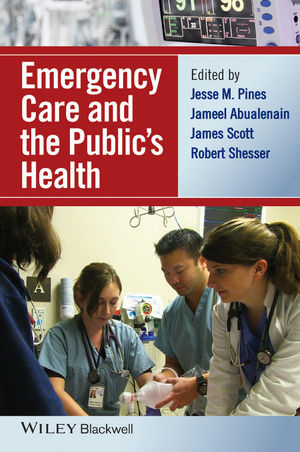
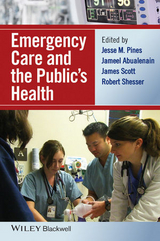
Emergency Care and the Public's Health (eBook)
John Wiley & Sons (Verlag)
978-1-118-77978-1 (ISBN)
- The development of new diagnostic, therapeutic, and information technologies
- A growing need to prepare and respond to emerging public health threats
- The expansion of the role of allied health professionals to address the workforce crisis
- Novel expectations for care coordination
- The fundamental economics of emergency care under new payment models, and
- The key relationship with American law.
Emergency Care and the Public's Health explores the complex role of emergency care in the context of these changes and as an increasingly vital component of health care systems both within and outside the US.
From an expert emergency medicine team, this new title is a reference for emergency care and critical care providers, allied health professionals and hospital administrators. It is also for relevant for public policy and healthcare policy professionals.
Jesse Pines, MD, MBA, MSCE, Director, Office for Clinical Practice Innovation, Professor of Emergency Medicine and Health Policy, The George Washington University, Washington, US
Jameel Abualenain, MD, MPH, Assistant Professor, Department of Emergency Medicine, The George Washington University, Washington, US; King Abdulaziz University, Jeddah, Saudi Arabia
James Scott, MD, Professor of Emergency Medicine and Health Policy, School of Medicine and Health Science, The George Washington University, Washington, US
Robert Shesser, MD, MPH, Professor and Chair, Department of Emergency Medicine, The George Washington University, Washington, US
As US health care systems undergo a period of transformative change, so too will emergency care, and more specifically emergency departments. This transformation will include: The development of new diagnostic, therapeutic, and information technologies A growing need to prepare and respond to emerging public health threats The expansion of the role of allied health professionals to address the workforce crisis Novel expectations for care coordination The fundamental economics of emergency care under new payment models, and The key relationship with American law. Emergency Care and the Public's Health explores the complex role of emergency care in the context of these changes and as an increasingly vital component of health care systems both within and outside the US. From an expert emergency medicine team, this new title is a reference for emergency care and critical care providers, allied health professionals and hospital administrators. It is also for relevant for public policy and healthcare policy professionals.
Jesse Pines, MD, MBA, MSCE, Director, Office for Clinical Practice Innovation, Professor of Emergency Medicine and Health Policy, The George Washington University, Washington, US Jameel Abualenain, MD, MPH, Assistant Professor, Department of Emergency Medicine, The George Washington University, Washington, US; King Abdulaziz University, Jeddah, Saudi Arabia James Scott, MD, Professor of Emergency Medicine and Health Policy, School of Medicine and Health Science, The George Washington University, Washington, US Robert Shesser, MD, MPH, Professor and Chair, Department of Emergency Medicine, The George Washington University, Washington, US
Cover 1
Title Page 5
Copyright 6
Contents 7
Editor Biographies 9
List of Contributors 13
Foreword 17
Part 1 The US emergency care system 19
Chapter 1 The emergency care system in the United States 21
Introduction 21
A journey through the myths and misconceptions of emergency care 23
A look at international emergency care 23
First generation ED electronic health records 1.0 24
The human factor in emergency care 24
Evolving technology: Telehealth and simulation 25
What the future holds for the ED workforce 25
Role of the ED in national preparedness 26
Evolving role of the ED in care coordination 26
How new payment reform policies will impact emergency care 27
Legal issues in emergency care 27
Charting a course for the future of emergency care in the United States 28
References 28
Chapter 2 Ten common misconceptions about emergency care 29
Misconception 1: EDs are crowded because large numbers of medically indigent patients use EDs for “primary care” 29
Misconception 3: EDs are inherently expensive relative to alternative outpatient settings for many visit categories 30
Misconception 4: ED frequent users just use ED for their care and have no longitudinal care relationships with other doctors 31
Misconception 5: There are generally accepted guide linesabout what constitutes “appropriate” ED use 32
Misconception 6: There are clear-cut guidelines about which ED patients should be admitted to the hospital 32
Misconception 7: Care for most conditions treated in the ED is carefully measured and reported to the public 33
Misconception 8: Emergency physicians are employed by the hospital and have a practice structure similar to other physicians at the hospital 34
Misconception 9: Most US acute care hospitals have the proper staff and equipment to care for all types of patient problems 35
Misconception 10: The ED workforce consists of physicians who failed to succeed in “private practice” 36
References 37
Chapter 3 International perspectives on emergency care 39
Introduction 40
Australia 40
Canada 42
Denmark 45
France 47
India 50
Iran 51
Japan 53
Singapore 55
United Kingdom 58
References 59
Part 2 Technology in emergency care 63
Chapter 4 Human factors in emergency care 65
Human factors engineering methods 66
Workflow 67
Overcrowding 68
Teamwork 68
Interruptions 69
Health IT 70
Clinical decision-making 71
Application to frontline health care workers 72
Conclusions 72
References 73
Chapter 5 Information technology in emergency care 77
Emergency department information system features 77
EDIS supports ED workflow 81
Value of EDIS 83
EDIS adoption 83
Barriers to EDIS adoption 83
United States HIT policy: meaningful use 85
Conclusions 90
References 90
Chapter 6 Telehealth and acute care 93
Case study: University of Mississippi Medical Center 94
ED specialty consultations 95
Extending ED provider access 97
Nurse advice lines 98
Online medical consultations 98
Patient centered triage tools 99
Remote patient monitoring and follow-up 100
mHealth 101
Medical apps 101
Integration with quality drivers 102
References 102
Chapter 7 Simulation in emergency care 105
Introduction 105
Performance gaps in emergency medicine 105
Learning concepts related to improving patient outcomes 106
Evaluation of educational efficacy in health care 107
History of medical simulation 108
Improving care through simulation 109
Procedural skills training 109
Teamwork training 110
Environmental assessment 111
Disaster preparedness 111
Conclusions 112
References 113
Part 3 Emergency care workforce 115
Chapter 8 Emergency care workforce projections 117
Rapid growth of ED utilization 117
Population growth and changing demographics 119
Effect of ACA on ED utilization 120
Current and predicted ED workforce numbers 121
Current models of emergency department staffing 122
Potential future models 124
References 125
Part 4 Emergency preparedness and response to emergencies and disasters 129
Chapter 9 US emergency and disaster response in the past, present, and future: The multi-faceted role of emergency health care 131
Past and present 132
Future 140
References 142
Chapter 10 Emergency public health 145
Introduction 145
Public health functions during response to an emergency 146
Basic functions of public health 146
Emergency functions of public health 147
Overview of existing policies 149
Challenges 150
Emergency public health as a defined discipline 153
Conclusions 155
References 155
Part 5 Emergency care payment reform and legal issues 157
Chapter 11 The role of the emergency department in care coordination 159
Introduction 159
Importance of care coordination 159
Current literature on care coordination in the ED 161
Care coordination within EDs 161
Care coordination within hospitals 162
Care coordination within communities 162
Common problems with care coordination 164
Conclusions 165
References 166
Chapter 12 Payment reform in emergency care 169
Introduction 169
Early payment reform initiatives 170
Newer payment reform models 172
Emergency medicine and payment reform 178
Challenges 179
Conclusions 181
References 182
Chapter 13 The legal framework for hospital emergency care 187
Introduction 187
First principles – no right to healthcare and no corresponding duty of care 188
Cracks in the wall 190
Emtala 194
Conclusions 204
Notes and References 205
Chapter 14 The future of emergency medicine 209
Evolution of US health systems 209
A brief history of emergency care 210
Future practice and funding of emergency medicine 211
Future of pre-hospital emergency medical service systems 216
Emergency medicine workforce development 217
Conclusions 217
References 217
Index 219
"Emergency Care and the Public's Health provides useful and practical information to enhance the understanding of the state of emergency care in the United States today. . . In my opinion, physicians in training (including EM residents), emergency care providers, allied health care professionals, current and future ED directors, administrators, and even hospital leaders (CEOs, CFOs) should be exposed to this book." (Academic Emergency Medicine, 1 February 2015)
| Erscheint lt. Verlag | 27.3.2014 |
|---|---|
| Sprache | englisch |
| Themenwelt | Medizin / Pharmazie ► Gesundheitsfachberufe |
| Medizin / Pharmazie ► Gesundheitswesen | |
| Medizin / Pharmazie ► Medizinische Fachgebiete ► Notfallmedizin | |
| Medizin / Pharmazie ► Pflege ► Fachpflege | |
| Schlagworte | Acute, Critical & Emergency Care • American • Care • Change • changes • ConText • departments • Development • Diagnostic • Expansion • growing • Health • Intensiv- u. Notfallpflege • Krankenpflege • Law • New • nursing • Period • Public • publics • Relationship • Role • specifically • threats • Transformation • Transformative • undergo • US |
| ISBN-10 | 1-118-77978-9 / 1118779789 |
| ISBN-13 | 978-1-118-77978-1 / 9781118779781 |
| Informationen gemäß Produktsicherheitsverordnung (GPSR) | |
| Haben Sie eine Frage zum Produkt? |
 PDF (Adobe DRM)
Kopierschutz: Adobe-DRM
Adobe-DRM ist ein Kopierschutz, der das eBook vor Mißbrauch schützen soll. Dabei wird das eBook bereits beim Download auf Ihre persönliche Adobe-ID autorisiert. Lesen können Sie das eBook dann nur auf den Geräten, welche ebenfalls auf Ihre Adobe-ID registriert sind.
Details zum Adobe-DRM
Dateiformat: PDF (Portable Document Format)
Mit einem festen Seitenlayout eignet sich die PDF besonders für Fachbücher mit Spalten, Tabellen und Abbildungen. Eine PDF kann auf fast allen Geräten angezeigt werden, ist aber für kleine Displays (Smartphone, eReader) nur eingeschränkt geeignet.
Systemvoraussetzungen:
PC/Mac: Mit einem PC oder Mac können Sie dieses eBook lesen. Sie benötigen eine
eReader: Dieses eBook kann mit (fast) allen eBook-Readern gelesen werden. Mit dem amazon-Kindle ist es aber nicht kompatibel.
Smartphone/Tablet: Egal ob Apple oder Android, dieses eBook können Sie lesen. Sie benötigen eine
Geräteliste und zusätzliche Hinweise
Buying eBooks from abroad
For tax law reasons we can sell eBooks just within Germany and Switzerland. Regrettably we cannot fulfill eBook-orders from other countries.
aus dem Bereich