


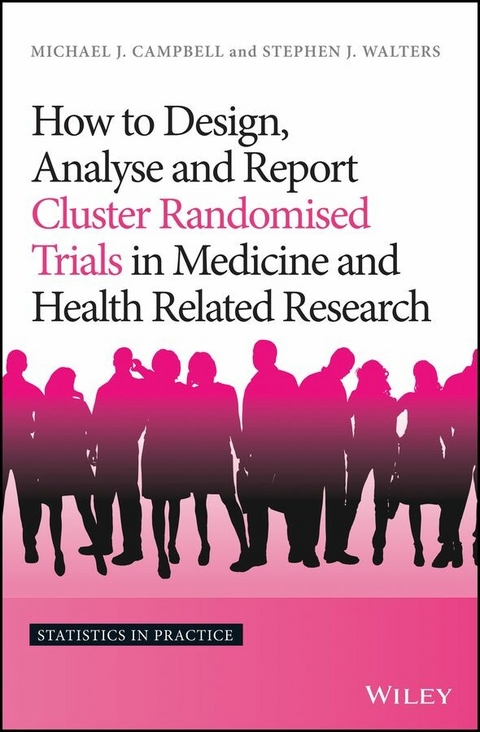
How to Design, Analyse and Report Cluster Randomised Trials in Medicine and Health Related Research (eBook)
John Wiley & Sons (Verlag)
978-1-118-76360-5 (ISBN)
Written by two researchers with extensive experience in the field, this book presents a complete guide to the design, analysis and reporting of cluster randomised trials. It spans a wide range of applications: trials in developing countries, trials in primary care, trials in the health services. A key feature is the use of R code and code from other popular packages to plan and analyse cluster trials, using data from actual trials. The book contains clear technical descriptions of the models used, and considers in detail the ethics involved in such trials and the problems in planning them. For readers and students who do not intend to run a trial but wish to be a critical reader of the literature, there are sections on the CONSORT statement, and exercises in reading published trials.
- Written in a clear, accessible style
- Features real examples taken from the authors’ extensive practitioner experience of designing and analysing clinical trials
- Demonstrates the use of R, Stata and SPSS for statistical analysis
- Includes computer code so the reader can replicate all the analyses
- Discusses neglected areas such as ethics and practical issues in running cluster randomised trials
How to Design, Analyse and Report Cluster Randomised Trials in Medicine and Health Related Research provides an excellent reference tool and can be read with profit by statisticians, health services researchers, systematic reviewers and critical readers of cluster randomised trials.
A complete guide to understanding cluster randomised trials Written by two researchers with extensive experience in the field, this book presents a complete guide to the design, analysis and reporting of cluster randomised trials. It spans a wide range of applications: trials in developing countries, trials in primary care, trials in the health services. A key feature is the use of R code and code from other popular packages to plan and analyse cluster trials, using data from actual trials. The book contains clear technical descriptions of the models used, and considers in detail the ethics involved in such trials and the problems in planning them. For readers and students who do not intend to run a trial but wish to be a critical reader of the literature, there are sections on the CONSORT statement, and exercises in reading published trials. Written in a clear, accessible style Features real examples taken from the authors extensive practitioner experience of designing and analysing clinical trials Demonstrates the use of R, Stata and SPSS for statistical analysis Includes computer code so the reader can replicate all the analyses Discusses neglected areas such as ethics and practical issues in running cluster randomised trials How to Design, Analyse and Report Cluster Randomised Trials in Medicine and Health Related Research provides an excellent reference tool and can be read with profit by statisticians, health services researchers, systematic reviewers and critical readers of cluster randomised trials.
MICHAEL J. CAMPBELL and STEPHEN J. WALTERS, Medical Statistics Group, School of Health and Related Research, University of Sheffield, UK
"Overall, the reviewers are enthusiastic about the book. The authors have covered all important areas of cRCTs, using a practical and pragmatic approach to the topic. The code is helpful for the practical implementation of the examples. The material is simple to understand, which will appeal to applied researchers, not only to biostatisticians. As such, we clearly recommend this book to all researchers interested in cRCTs. For biostatisticians involved in cRCTs and investigators of cRCTs, it is a must-have on the bookshelf." (Biometrical Journal, 1 May 2015)
Chapter 1
Introduction
In this chapter, we will discuss the rationale for randomised trials and how cluster trials differ from individually randomised trials. The development of cluster trials and how they fit into the framework of complex interventions will be outlined. We will describe a number of trials that will be discussed throughout the book. Two fundamental concepts, namely, the unit of inference and how to measure the degree of clustering will also be discussed.
1.1 Randomised controlled trials
How do we know that a treatment works? It has long been asserted that the only way of assessing whether a treatment actually works is through a randomised controlled trial (RCT). Testing Treatments, an excellent book (Evans et al., 2011, available free at www.testingtreatments.org), gives a series of examples where treatments, thought to be beneficial on the basis of observational data, have been shown, in fact, to harm patients. The modern paradigm is the example of hormone replacement therapy, which had been perceived as beneficial until the Women's Health Initiative trial (Prentice et al., 1998) and other studies showed that, far from reducing the risk of heart disease, it actually slightly increased the risk.
The main ingredients of an RCT can be labelled as ‘ABC’ (Campbell, 1999).
1.1.1 A-Allocation at random
This means that who gets the new treatment, which is to be evaluated, and who does not is determined by chance. These days this usually means allocation is determined by a computer-generated random sequence. However, in the past, this was done with shuffled envelopes and other mechanical means such as tossing a coin. The main purpose of randomisation is to ensure that, in the long run, the only consistent difference between the randomised groups is that one group got the new treatment and the other did not; all other differences have been averaged out. Factors that might influence outcome are often called prognostic factors. For example, people with more severe disease at the start of treatment may be expected to do worse than people with mild disease. The important point about randomisation is that it ensures, in the long run, that there is no preponderance of a prognostic factor in one group compared with another. A further point is that this is true for both known and unknown factors. Thus if, after a trial had been published, it became known that a certain gene had prognostic significance, even though it would be too late to measure the gene in the patients, the investigators are protected from major imbalances in the gene frequency in the treatment and control groups by randomisation. An operative phrase here is ‘in the long run’. Trials cannot be infinitely large, and so for any trial of finite size, it may be possible to find imbalances in prognostic factors, and steps may be needed to control these. As we shall see later, cluster trials are primarily judged on the number of clusters they contain and since this is often not large, imbalance is a particular problem.
Simple randomisation means that the treatment allocation is determined purely by chance. However, this might mean that the numbers in each group are unequal, which usually reduces the efficiency of the study. Thus, a development is blocked randomisation, whereby an even number of subjects are selected and randomised so that half of the subjects get one treatment and the other half the alternative treatment.
If there are known important prognostic factors in a trial, then it would be foolish to leave a balanced outcome to chance, and so stratified randomisation is carried out. Here, the subjects are divided into groups or strata depending on the prognostic factor and blocked randomisation carried out within each stratum. For example, patients might be divided into those with severe disease and those with mild disease, and then randomisation carried out separately within those two disease severity groups. This ensures that there are approximately the same number of patients in each treatment group with severe disease and the same number with mild disease.
Another important feature of randomisation is that neither the patient nor the person recruiting the patient knows in advance which treatment the patient is to receive.
1.1.2 B-Blindness
This means that the treatment is concealed to either the investigator or the patient. A double-blind trial means that neither the investigator nor the patient knows which treatment they are getting. Blindness can be important because belief can prove an important part in a patient's recovery and outcome. In some cases, such as whether to plaster a fracture or not, it may be impossible to blind the patient. However, it may still be possible to blind the person measuring the outcome of the trial.
1.1.3 C-Control
This usually refers to contemporaneous controls. This means that patients are evaluated at the same time in each group. Other factors which affect all patients, such as improved quality of care, should affect the intervention group and the control group equally. The control may comprise ‘treatment as usual’ (sometimes abbreviated to tau), which is common for non-pharmacological treatments, or a placebo for pharmacological treatments. A placebo is an inert compound that physically resembles the active drug, so that the patient is unaware whether they have taken the drug with the active compound. They are used because often the very act of giving treatments will bring about improvements, irrespective of the actual treatment. An alternative control is another active treatment. Usually it is helpful to know in advance that this active treatment is effective relative to no treatment, because an inconclusive result (i.e. no difference between the two treatments on test) would mean that we would be unable to decide if the new treatment was beneficial or not relative to no treatment.
The idea of testing treatments has been shown by many authors to have a long history. However, it was not until the 1940s that trials that used proper randomisation, contemporaneous controls and blindness were published (MRC, 1948). These initial trials were individually randomised and analysed, that is individual patients were randomised to alternative treatments and then the outcome was measured on these patients. This has formed the gold standard for assessing medical treatments ever since.
1.2 Complex interventions
However, often interventions are not single simple interventions such as drugs, but so-called complex interventions, with a variety of interacting components. The United Kingdom's Medical Research Council website has a good description of these (http://www.mrc.ac.uk/Utilities/Documentrecord/index.htm?d=MRC004871).
Examples of complex interventions might include specialist stroke units, training surgeons in a new technique and a leaflet campaign to get children to take their asthma medication. Here, a number of patients will all be treated in the same unit; for example a surgeon will operate on a number of different patients and so all these patients will benefit (or suffer!) from the same level of skill, namely that possessed by that surgeon.
Let us consider an example of an RCT to evaluate the clinical effectiveness of a new surgical technique compared to existing surgical techniques in a population of patients undergoing surgery. There are at least three possible designs for a proposed RCT to evaluate a new surgical technique:
- Design 1: All surgeons are trained in the new technique. When a patient presents for surgery to a particular surgeon, the surgeon is told, via a randomisation method, which type of surgery to use.
- Design 2: Some surgeons are already trained in the new technique and some are not (perhaps they had to volunteer for training). If a patient presents who is eligible for surgery, they are randomised to either a surgeon using the new technique or the one using the old.
- Design 3: Willing surgeons are randomised to be either trained in the new technique or not. Those trained in the new technique will then use it when appropriate. Patients arrive at surgery through the usual channels.
Each of these designs has advantages and disadvantages. In Design 1, the randomisation is conducted within a surgeon, so we can compare patients operated on by the same surgeon with the new technique against those treated with the standard method. Thus, the fact that some surgeons are better and more experienced than others will not affect the comparison. On the other hand, it may be very difficult for a surgeon who has been trained in a new technique to revert to a former mode of practice, and we do not know if the training might have improved the outcomes for the standard method as well.
In Design 2, patients treated by a good and experienced surgeon could be expected to do better than patients treated by an inexperienced (poor) surgeon, so the comparisons will depend not just on the patient but also on the surgeon. These are so-called therapist trials and are a form of cluster trial which we will discuss later. It is also possible that the better surgeons are the ones who volunteer for further training, so confounding the effects of experience and the new technique.
In Design 3, we have a truly randomised comparison. However, again each surgeon can be expected to treat a number of patients, and these patients' outcomes will be affected by the surgeons' skill, training and experience. Thus,...
| Erscheint lt. Verlag | 28.3.2014 |
|---|---|
| Reihe/Serie | Statistics in Practice |
| Statistics in Practice | Statistics in Practice |
| Sprache | englisch |
| Themenwelt | Mathematik / Informatik ► Mathematik ► Statistik |
| Mathematik / Informatik ► Mathematik ► Wahrscheinlichkeit / Kombinatorik | |
| Medizin / Pharmazie ► Medizinische Fachgebiete | |
| Studium ► Querschnittsbereiche ► Epidemiologie / Med. Biometrie | |
| Technik | |
| Schlagworte | Analyse and Report Cluster Randomised Trials in Medicine and Health Related Research • Biostatistics • Biostatistik • Clinical Trials • cRCTs • Generalized Linear Models • how to design • Klinische Studien • marginal and random effect • Medical Science • Medizin • Michael J. Campbell • Pharmacology & Pharmaceutical Medicine • Pharmakologie u. Pharmazeutische Medizin • SPSS and R for statistical analysis • Stata • Statistics • Statistik • Stephen J. Walters |
| ISBN-10 | 1-118-76360-2 / 1118763602 |
| ISBN-13 | 978-1-118-76360-5 / 9781118763605 |
| Informationen gemäß Produktsicherheitsverordnung (GPSR) | |
| Haben Sie eine Frage zum Produkt? |
 EPUB (Adobe DRM)
Kopierschutz: Adobe-DRM
Adobe-DRM ist ein Kopierschutz, der das eBook vor Mißbrauch schützen soll. Dabei wird das eBook bereits beim Download auf Ihre persönliche Adobe-ID autorisiert. Lesen können Sie das eBook dann nur auf den Geräten, welche ebenfalls auf Ihre Adobe-ID registriert sind.
Details zum Adobe-DRM
Dateiformat: EPUB (Electronic Publication)
EPUB ist ein offener Standard für eBooks und eignet sich besonders zur Darstellung von Belletristik und Sachbüchern. Der Fließtext wird dynamisch an die Display- und Schriftgröße angepasst. Auch für mobile Lesegeräte ist EPUB daher gut geeignet.
Systemvoraussetzungen:
PC/Mac: Mit einem PC oder Mac können Sie dieses eBook lesen. Sie benötigen eine
eReader: Dieses eBook kann mit (fast) allen eBook-Readern gelesen werden. Mit dem amazon-Kindle ist es aber nicht kompatibel.
Smartphone/Tablet: Egal ob Apple oder Android, dieses eBook können Sie lesen. Sie benötigen eine
Geräteliste und zusätzliche Hinweise
Buying eBooks from abroad
For tax law reasons we can sell eBooks just within Germany and Switzerland. Regrettably we cannot fulfill eBook-orders from other countries.


