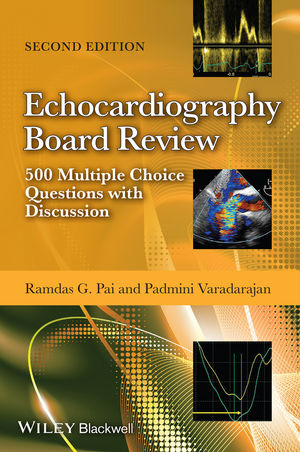
Echocardiography Board Review (eBook)
John Wiley & Sons (Verlag)
978-1-118-51559-4 (ISBN)
Echocardiography Board Review, 2nd Edition
500 Multiple Choice Questions with Discussion
Ramdas G. Pai, MD, Professor of Medicine, Loma Linda University, CA, USA
Padmini Varadarajan, MD, Associate Professor of Medicine, Loma Linda University, CA, USA
Echocardiography is an essential tool for the modern-day cardiologist and routinely used in the diagnosis, management and follow-up of patients with suspected or known heart diseases.
This best-selling book now returns in a fully revised new edition, once again providing cardiologists and cardiology/echocardiography trainees with a rapid reference, self-assessment question and answer guide to all aspects of echocardiography.
Packed with full-color images and written by experienced echocardiographers, the book covers:
- applied ultrasound physics
- practical hydrodynamics
- valvular heart disease
- myocardial diseases
- congenital heart disease
- non-invasive hemodynamics
- surgical echocardiography
Containing 500 case-based questions, including clear explanations and discussions for every question, Echocardiography Board Review, 2nd Edition, is the perfect preparation guide for all those about to take the National Board of Echocardiography's Board exam, including cardiology and echocardiography trainees and specialist physicians preparing for re-certification. Sonographers planning to take RDCS or RDMS certification examinations should find this book very helpful as well.
Of related interest
Practical Manual of Echocardiography in the Urgent Setting
Fridman, ISBN 978-0-470-65997-7
Successful Accreditation in Echocardiography: A Self-Assessment Guide
Banypersad, ISBN 978-0-470-65692-1
Website
www.wiley.com/go/cardiology
Ramdas G Pai. MD, FACC, FRCP (Edin), Professor of Medicine, Director, Cardiac Imaging Center, Loma Linda University Medical Center, CA, USA.
Padmini Varadarajan. MD, FACC, Assistant Professor of Medicine, Advanced Cardiac Imaging, University of Southern California, USA.
Echocardiography Board Review, 2nd Edition 500 Multiple Choice Questions with Discussion Ramdas G. Pai, MD, Professor of Medicine, Loma Linda University, CA, USA Padmini Varadarajan, MD, Associate Professor of Medicine, Loma Linda University, CA, USA Echocardiography is an essential tool for the modern-day cardiologist and routinely used in the diagnosis, management and follow-up of patients with suspected or known heart diseases. This best-selling book now returns in a fully revised new edition, once again providing cardiologists and cardiology/echocardiography trainees with a rapid reference, self-assessment question and answer guide to all aspects of echocardiography. Packed with full-color images and written by experienced echocardiographers, the book covers: applied ultrasound physics practical hydrodynamics valvular heart disease myocardial diseases congenital heart disease non-invasive hemodynamics surgical echocardiography Containing 500 case-based questions, including clear explanations and discussions for every question, Echocardiography Board Review, 2nd Edition, is the perfect preparation guide for all those about to take the National Board of Echocardiography s Board exam, including cardiology and echocardiography trainees and specialist physicians preparing for re-certification. Sonographers planning to take RDCS or RDMS certification examinations should find this book very helpful as well. Of related interest Practical Manual of Echocardiography in the Urgent Setting Fridman, ISBN 978-0-470-65997-7 Successful Accreditation in Echocardiography: A Self-Assessment Guide Banypersad, ISBN 978-0-470-65692-1 Website www.wiley.com/go/cardiology
Ramdas G Pai. MD, FACC, FRCP (Edin), Professor of Medicine, Director, Cardiac Imaging Center, Loma Linda University Medical Center, CA, USA. Padmini Varadarajan. MD, FACC, Assistant Professor of Medicine, Advanced Cardiac Imaging, University of Southern California, USA.
Preface ix
Chapter 1 1
Questions 1-20 1
Answers 1-20 4
Chapter 2 7
Questions 21-40 7
Answers 21-40 10
Chapter 3 13
Questions 41-60 13
Answers 41-60 16
Chapter 4 19
Questions 61-80 19
Answers 61-80 23
Chapter 5 27
Questions 81-100 27
Answers 81-100 30
Chapter 6 33
Questions 101-120 33
Answers 101-120 37
Chapter 7 41
Questions 121-140 41
Answers 121-140 44
Chapter 8 47
Questions 141-160 47
Answers 141-160 50
Chapter 9 53
Questions 161-180 53
Answers 161-180 56
Chapter 10 59
Questions 181-200 59
Answers 181-200 62
Chapter 11 65
Questions 201-220 65
Answers 201-220 69
Chapter 12 73
Questions 221-240 73
Answers 221-240 82
Chapter 13 85
Questions 241-260 85
Answers 241-260 96
Chapter 14 99
Questions 261-280 99
Answers 261-280 110
Chapter 15 113
Questions 281-300 113
Answers 281-300 124
Chapter 16 127
Questions 301-320 127
Answers 301-320 138
Chapter 17 143
Questions 321-340 143
Answers 321-340 154
Chapter 18 157
Questions 341-360 157
Answers 341-360 168
Chapter 19 173
Questions 361-380 173
Answers 361-380 185
Chapter 20 189
Questions 381-400 189
Answers 381-400 200
Chapter 21 205
Questions 401-420 205
Answers 401-420 214
Chapter 22 219
Questions 421-440 219
Answers 421-440 230
Chapter 23 233
Questions 441-460 233
Answers 441-460 243
Chapter 24 245
Questions 461-480 245
Answers 461-480 256
Chapter 25 259
Questions 481-500 259
Answers 481-500 270
Chapter 1
Questions
- 1. The speed of sound in tissues is:
- A. Roughly 1540 m/s
- B. Roughly 1540 km/s
- C. Roughly 1540 cm/s
- D. Roughly 1540 m/min
- 2. The relationship between propagation speed, frequency, and wavelength is given by the formula:
- A. Propagation speed = frequency × wavelength
- B. Propagation speed = wavelength/frequency
- C. Propagation speed = frequency/wavelength
- D. Propagation speed = wavelength × period
- 3. The frame rate increases with:
- A. Increasing the depth
- B. Reducing sector angle
- C. Increasing line density
- D. Adding color Doppler to B-mode imaging
- 4. Period is a measure of:
- A. Duration of one wavelength
- B. Duration of half a wavelength
- C. Amplitude of the wave
- 5. Determination of regurgitant orifice area by the proximal isovelocity surface area (PISA) method is based on:
- A. Law of conservation of mass
- B. Law of conservation of energy
- C. Law of conservation of momentum
- D. Jet momentum analysis
- 6. In which situation can you not use the simplified Bernoulli equation to derive the pressure gradient?
- A. Peak instantaneous gradient across a nonobstructed mitral valve
- B. Peak gradient across a severely stenotic aortic valve
- C. Mean gradient across a severely stenotic aortic valve
- D. Mean gradient across a stenotic tricuspid valve
- 7. Which of the following resolutions change with increasing field depth?
- A. Axial resolution
- B. Lateral resolution
- 8. With a fixed-focus transducer with crystal diameter 20 mm and wavelength 2.5 mm, what is the depth of the focus?
- A. 40 m
- B. 30 mm
- C. 40 mm
- D. 4 m
- 9. A sonographer adjusts the ultrasound machine to double the depth of view from 5 to 10 cm. If sector angle is reduced to keep the frame rate constant, which of the following has changed?
- A. Axial resolution
- B. Temporal resolution
- C. Lateral resolution
- D. The wavelength
- 10. Which of the following properties of a reflected wave is most important in the genesis of a two-dimensional image?
- A. Amplitude
- B. Period
- C. Pulse repetition period
- D. Pulse duration
- 11. Increasing depth will change all of the following except:
- A. Pulse duration
- B. Pulse repetition period
- C. Pulse repetition frequency
- D. Duty factor
- 12. The two-dimensional images are produced because of this phenomenon when the ultrasound reaches the tissue:
- A. Refraction
- B. Backscatter
- C. Specular reflection
- D. Transmission
- 13. Attenuation of ultrasound as it travels through tissue is higher at:
- A. Greater depth
- B. Lower transducer frequency
- C. Blood rather than soft tissue like muscle
- D. Bone more than air
- 14. The half-intensity depth is a measure of:
- A. Ultrasound attenuation in tissue
- B. Half the wall thickness in mm
- C. Coating on the surface of the transducer
- D. Half the ultrasound beam width
- 15. What is the highest pulse repetition frequency (PRF) of a 3 MHz pulsed wave transducer imaging at a depth of 7 cm?
- A. 21 000 Hz
- B. 2 333 Hz
- C. 11 000 Hz
- D. 2.1 million Hz
- 16. Examples of continuous wave imaging include:
- A. Two-dimensional image
- B. Volumetric scanner-acquired LV image
- C. Color flow imaging
- D. Nonimaging Doppler probe (Pedoff)
- 17. Which of the following manipulations will increase the frame rate?
- A. Increase depth
- B. Increase transmit frequency
- C. Decrease sector angle
- D. Increase transmit power
- 18. The lateral resolution increases with:
- A. Decreasing transducer diameter
- B. Reducing power
- C. Beam focusing
- D. Reducing transmit frequency
- 19. Axial resolution can be improved by which of the following manipulations?
- A. Reduce beam diameter
- B. Beam focusing
- C. Reduce gain
- D. Increase transmit frequency
- 20. Type of sound used in medical imaging is:
- A. Ultrasound
- B. Infrasound
- C. Audible sound
Answers for chapter 1
- 1. Answer: A.
Speed of sound in tissue is 1540 m/s. Hence, travel time to a depth of 15 cm is roughly 0.1 ms one way (1540 m/s = 154 000 cm/s or 154 cm/ms or 15 cm per 0.1 ms) or 0.2 ms for to and fro travel. This is independent of transducer frequency and depends only on the medium of transmission.
- 2. Answer: A
Wavelength depends on frequency and propagation speed. It is given by the following relationship: wavelength (mm) = propagation speed (mm/µs)/frequency (MHZ). Hence, propagation speed = frequency × wavelength.
- 3. Answer: B.
Reducing the sector angle will reduce the time required to complete a frame by reducing the number of scan lines. This increases the temporal resolution. Decreasing the depth will increase the frame rate as well by reducing the transit time for ultrasound. Adding color Doppler will reduce the frame rate as more data need to be processed.
- 4. Answer: A
Period is the time taken for one cycle or one wavelength to occur. The common unit for period is µs. Period decreases as frequency increases. The relationship is given by the equation: period = 1/frequency. For a 5-MHZ ultrasound the period is 0.2 µs (1/5 million cycles) = 0.2 µs.
- 5. Answer: A.
The law of conservation of mass is the basis of the continuity equation. As the flow rate at the PISA surface and the regurgitant orifice is the same, dividing the flow rate (cm3/s) by the velocity (cm/s) at the regurgitant orifice obtained by continuous wave Doppler gives the effective regurgitant area in cm2 (regurgitant flow rate in cm3/s divided by flow velocity in cm/s equals effective regurgitant area in cm2).
- 6. Answer: A.
In a non-obstructed mitral valve flow velocities are low. Significant energy is expended in accelerating the flow (flow acceleration). As the flow velocity is low, energy associated with convective acceleration is low. As viscous losses in this situation are minimal, the other two components (flow acceleration and convective acceleration) of the Bernoulli equation have to be taken into account. In the simplified Bernoulli equation, the flow acceleration component is ignored. Put simply, when you deal with low-velocity signals in pulsatile system, the simplified Bernoulli equation does not describe the pressure flow relationship accurately.
- 7. Answer: B.
Lateral resolution depends on beam width, which increases at increasing depths. Axial resolution depends on spatial pulse length, which is a function of transducer frequency, pulse duration, and propagation velocity in the medium.
- 8. Answer: C.
Depth of focus equals squared crystal diameter divided by wavelength multiplied by 4. In this situation, (20 mm)2/(2.5 mm × 4) = 400/10 = 40 mm.
- 9. Answer: C.
Lateral resolution diminishes at increasing depths owing to beam divergence. Frame rate determines the temporal resolution as temporal resolution is the reciprocal of frame rate. For example, frame rate of 50 fps gives a temporal resolution of 1/50 = 0.02 s or 20 m. Wavelength is a function of the transducer frequency and is independent of depth and frame rate adjustments.
- 10. Answer: A.
Amplitude or strength of the reflected beam, and its temporal registration, which determines depth registration.
- 11. Answer: A.
Pulse duration is the characteristic of the pulse and does not change with depth. Increase in depth will increase the pulse repetition period, and hence reduce frequency and the duty factor.
- 12. Answer: B.
Backscatter or diffuse reflection produces most of the clinical images. Specular reflection reaches the transducer only when the incident angle is 90° to the surface, which is not the case in most of the images produced. Refracted and transmitted ultrasounds do not come back to the transducer.
- 13. Answer: A.
Attenuation is the loss of ultrasound energy as it travels through the tissue and is caused by absorption and random scatter. It is greater with longer travel path length as it has to go through more tissue. Attenuation is greater at higher frequencies due to shorter wavelength. Attenuation is greatest for air followed by bone, soft tissue, and water or blood.
- 14. Answer: A.
It is a measure of attenuation and reflects the depth at which the ultrasound energy is reduced by half. It is given by the formula: 6 cm/frequency in MHz For example, for an ultrasound frequency of 3 MHz the half-intensity depth is 2 cm, and for 6 MHz it is 1 cm.
- 15. Answer: C.
The PRF is independent of transducer frequency and only determined by time of flight, which is the total time taken by ultrasound in the body in both directions. Ultrasound can travel 154 000 cm in a second at a travel speed of...
| Erscheint lt. Verlag | 24.2.2014 |
|---|---|
| Sprache | englisch |
| Themenwelt | Medizin / Pharmazie ► Allgemeines / Lexika |
| Medizinische Fachgebiete ► Innere Medizin ► Kardiologie / Angiologie | |
| Medizin / Pharmazie ► Studium | |
| Schlagworte | bestselling • Board • Book • Cardiovascular Disease • Choice • Diagnosis • discussion • Diseases • Echocardiography • Edition • Essential • FollowUp • Fully • heart • Kardiovaskuläre Erkrankungen • Kardiovaskuläre Erkrankungen • known • Medical Science • Medizin • modernday • Multiple • New • once • patients • Professor • questions • Ramdas • Reference • Returns • Revised • Tool • USA |
| ISBN-10 | 1-118-51559-5 / 1118515595 |
| ISBN-13 | 978-1-118-51559-4 / 9781118515594 |
| Informationen gemäß Produktsicherheitsverordnung (GPSR) | |
| Haben Sie eine Frage zum Produkt? |
 EPUB (Adobe DRM)
Kopierschutz: Adobe-DRM
Adobe-DRM ist ein Kopierschutz, der das eBook vor Mißbrauch schützen soll. Dabei wird das eBook bereits beim Download auf Ihre persönliche Adobe-ID autorisiert. Lesen können Sie das eBook dann nur auf den Geräten, welche ebenfalls auf Ihre Adobe-ID registriert sind.
Details zum Adobe-DRM
Dateiformat: EPUB (Electronic Publication)
EPUB ist ein offener Standard für eBooks und eignet sich besonders zur Darstellung von Belletristik und Sachbüchern. Der Fließtext wird dynamisch an die Display- und Schriftgröße angepasst. Auch für mobile Lesegeräte ist EPUB daher gut geeignet.
Systemvoraussetzungen:
PC/Mac: Mit einem PC oder Mac können Sie dieses eBook lesen. Sie benötigen eine
eReader: Dieses eBook kann mit (fast) allen eBook-Readern gelesen werden. Mit dem amazon-Kindle ist es aber nicht kompatibel.
Smartphone/Tablet: Egal ob Apple oder Android, dieses eBook können Sie lesen. Sie benötigen eine
Geräteliste und zusätzliche Hinweise
Buying eBooks from abroad
For tax law reasons we can sell eBooks just within Germany and Switzerland. Regrettably we cannot fulfill eBook-orders from other countries.
aus dem Bereich