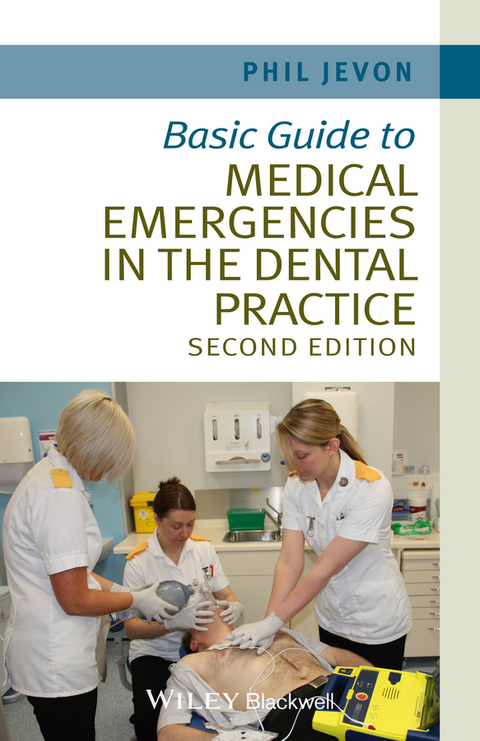
Basic Guide to Medical Emergencies in the Dental Practice (eBook)
John Wiley & Sons (Verlag)
978-1-118-68881-6 (ISBN)
The Basic Guide to Medical Emergencies in the Dental Practice is a must-have book for all dental care professionals and general dentists.
Written in a clear and accessible style, this second edition has been fully revised and updated in line with the latest guidelines. Chapters cover such key topics as the ABCDE approach to patient assessment, resuscitation equipment, respiratory and cardiac disorders, paediatric emergencies, and legal and ethical issues. Readers will also find two brand new chapters on the principles of first aid, and drugs for medical emergencies.
- Follows Resuscitation Council (UK) Guidelines
- Companion website with self-assessment exercises, serving as revision as well as non-verifiable CPD credit
- Over 50% new images
- Student friendly colourful layout with learning outcomes
Phil Jevon is Resuscitation Officer/Clinical Skills Lead at Manor Hospital, Walsall. He is a Resuscitation Council (UK) ALS, EPLS, ILS, PILS, NLS Instructor and is an Honorary Clinical Lecturer at the Birmingham School of Medicine
The Basic Guide to Medical Emergencies in the Dental Practice is a must-have book for all dental care professionals and general dentists.Written in a clear and accessible style, this second edition has been fully revised and updated in line with the latest guidelines. Chapters cover such key topics as the ABCDE approach to patient assessment, resuscitation equipment, respiratory and cardiac disorders, paediatric emergencies, and legal and ethical issues. Readers will also find two brand new chapters on the principles of first aid, and drugs for medical emergencies. Follows Resuscitation Council (UK) Guidelines Companion website with self-assessment exercises, serving as revision as well as non-verifiable CPD credit Over 50% new images Student friendly colourful layout with learning outcomes
Phil Jevon is Resuscitation Officer/Clinical Skills Lead at Manor Hospital, Walsall. He is a Resuscitation Council (UK) ALS, EPLS, ILS, PILS, NLS Instructor and is an Honorary Clinical Lecturer at the Birmingham School of Medicine
1. An overview of the management of medical emergencies and resuscitation in the dental practice
2. Resuscitation equipment in the dental practice
3. Recognition of the sick patient: the ABCDE approach
4. Respiratory disorders
5. Cardiovascular disorders
6. Endocrine disorders
7. Neurological disorders
8. Anaphylaxis
9. Cardiopulmonary resuscitation in the dental practice
10. Airway management & ventilation
11. Automated external defibrillation
12. Paediatric emergencies
13. Drugs for medical emergencies
14. Principles of first aid in the dental practice
15. Professional, ethical & legal issues
Chapter 1
An overview of the management of medical emergencies and resuscitation in the dental practice
INTRODUCTION
Every dental practice has a duty of care to ensure that an effective and safe service is provided for its patients (Jevon, 2012). The satisfactory performance in a medical emergency or in a resuscitation attempt in the dental practice has wide-ranging implications in terms of resuscitation equipment, resuscitation training, standards of care, clinical governance, risk management and clinical audit (Jevon, 2009).
The Resuscitation Council (UK) (2013) has updated its standards for clinical practice and training in resuscitation for dental practitioners and dental care professionals in general dental practice. All members of the dental team need to be aware of what their role would be in the event of a medical emergency and should be trained appropriately with regular practice sessions (Greenwood, 2009).
The aim of this chapter is to provide an overview of the management of medical emergencies and resuscitation in the dental practice.
LEARNING OUTCOMES
At the end of the chapter the reader will be able to:
- Discuss the concept of the chain of survival
- Discuss the incidence of medical emergencies in the dental practice
- Outline the General Dental Council guidelines on medical emergencies
- Summarise the Resuscitation Council (UK) standards
- Discuss the principles of safer handling during cardiopulmonary resuscitation (CPR)
- Outline the procedure for calling 999 for an ambulance
- Discuss the importance of human factors and teamwork in a medical emergency
CONCEPT OF THE CHAIN OF SURVIVAL
Survival from cardiac arrest relies on a sequence of time-sensitive interventions (Nolan et al., 2010). The concept of the original chain of survival emphasised that each time-sensitive intervention must be optimised in order to maximise the chance of survival: a chain is only as strong as its weakest link (Cummins et al., 1991).
The chain of survival (Figure 1.1) stresses the importance of recognising critical illness and/or angina and preventing cardiac arrest (both in and out of hospital) and post-resuscitation care (Nolan et al., 2006):
- Early recognition and call for help to prevent cardiac arrest: this link stresses the importance of recognising patients at risk of cardiac arrest, dialling 999 for the emergency services and providing effective treatment to hopefully prevent cardiac arrest (Nolan et al., 2010); patients sustaining an out-of-hospital cardiac arrest usually display warning symptoms for a significant duration before the event (Müller et al., 2006).
- Early CPR to buy time and early defibrillation to restart the heart: the two central links in the chain stress the importance of linking CPR and defibrillation as essential components of early resuscitation in an attempt to restore life. Early CPR can double or even triple the chances of a patient surviving an out-of-hospital ventricular fibrillation (shockable rhythm) induced cardiac arrest (Holmberg et al., 1998, 2001; Waalewijn et al., 2001).
- Post-resuscitation care to restore quality of life: the priority is to preserve cerebral and myocardial function and to restore quality of life (Nolan et al., 2010).
Figure 1.1 Chain of survival. Source: Laerdal Medical Ltd, Orpington, Kent, UK. Reproduced with permission.
INCIDENCE OF MEDICAL EMERGENCIES IN DENTAL PRACTICE
The incidence of medical emergencies in dental practice is very low. Medical emergencies occur in hospital dental practice more frequently, but in similar proportions to that found in general dental practice (Atherton et al., 2000). With the elderly population in dental practices increasing, medical emergencies in the dental practice will undoubtedly occur (Dym, 2008).
A literature search for published surveys on the incidence of medical emergencies and resuscitation in the dental practice found the following.
Survey of dental practitioners in Australia
A postal questionnaire survey of 1250 general dental practitioners undertaken in Australia (Chapman, 1997) found that:
- one in seven (14%) had had to resuscitate a patient;
- the most common medical emergencies encountered were adverse reactions to local anaesthetics, grand mal seizures, angina and hypoglycaemia.
Survey of dentists in England
A survey of dentists (Girdler and Smith, 1999) (300 responded) in England found that over a 12-month period they had encountered:
- vasovagal syncope (63%) – 596 patients affected;
- angina (12%) – 53 patients affected;
- hypoglycaemia (10%) – 54 patients affected;
- epileptic fit (10%) – 42 patients affected;
- choking (5%) – 27 patients affected;
- asthma (5%) – 20 patients affected;
- cardiac arrest (0.3%) – 1 patient affected.
Survey of dental practitioners in a UK university dental hospital
Atherton et al. (2000) assessed the frequency of medical emergencies by undertaking a survey of clinical staff (dentists, hygienists, nurses and radiographers) at a university dental hospital. The researchers found that:
- fainting was the commonest event;
- other medical emergency events were experienced with an average frequency of 1.8 events per year;
- highest frequency of emergencies were reported by staff in oral surgery.
Survey of dentists in New Zealand
A total of 199 dentists responded to a postal survey undertaken by Broadbent and Thomson (2001) in New Zealand, with the following findings:
- Medical emergencies had occurred in 129 practices (65.2%) within the previous 10 years (mean – 2.0 events per 10,000 patients treated under local analgesia, other forms of pain control or sedation);
- Vasovagal events were the most common emergencies occurring in 121 (61.1%) practices within the previous year (mean 6.9 events per 10,000 patients treated under local analgesia, other forms of pain control or sedation).
Survey of dental staff in Ohio
A survey of dental staff in Ohio (Kandray et al., 2007) found that 5% had performed CPR on a patient in their dental surgery.
Survey of dentists in Germany
A survey of 620 dentists in Germany (Müller et al., 2008) found that in a 12-month period:
- 57% had encountered up to 3 emergencies;
- 36% had encountered up to 10 emergencies;
- Vasovagal episode was the most common reported emergency – average 2 per dentist;
- 42 dentists (7%) had encountered an epileptic fit;
- 24 dentists (4%) had encountered an asthma attack;
- 5 dentists (0.8%) had encountered choking;
- 7 dentists (1.1%) had encountered anaphylaxis;
- 2 dentists (0.3%) had encountered a cardiopulmonary arrest.
GENERAL DENTAL COUNCIL GUIDELINES ON MEDICAL EMERGENCIES
Standards for the Dental team (General Dental Council, 2013) emphasises that all dental professionals are responsible for putting patients' interests first, and acting to protect them. Central to this responsibility is the need for dental professionals to ensure that they are able to deal with medical emergencies that may arise in their practice. Such emergencies are, fortunately, a rare occurrence, but it is important to recognise that a medical emergency could happen at any time and that all members of the dental team need to know their role in the event of one occurring.
The General Dental Council, in its publication Principles of Dental Team Working (General Dental Council, 2006), states that the person who employs, manages or leads a team in a dental practice should ensure that:
- There are arrangements for at least two people available to deal with medical emergencies when treatment is planned to take place;
- All members of staff, not just the registered team members, know their role if a patient collapses or there is another kind of medical emergency;
- All members of staff who might be involved in dealing with a medical emergency are trained and prepared to deal with such an emergency at any time;
- Members of the team practice together regularly in a simulated emergency so they know exactly what to do.
Maintaining the knowledge and competence to deal with medical emergencies is an important aspect of all dental professionals continuing professional development (General Dental Council, 2006). The above guidance has been endorsed by the Resuscitation Council (UK) (2013).
RESUSCITATION COUNCIL (UK) QUALITY STANDARDS
The Resuscitation Council (UK)'s Quality standards for cardiopulmonary resuscitation practice and training: primary...
| Erscheint lt. Verlag | 7.3.2014 |
|---|---|
| Reihe/Serie | Basic Guide Dentistry Series |
| Basic Guide Dentistry Series | Basic Guide Dentistry Series |
| Sprache | englisch |
| Themenwelt | Medizin / Pharmazie ► Allgemeines / Lexika |
| Medizin / Pharmazie ► Gesundheitsfachberufe | |
| Medizin / Pharmazie ► Zahnmedizin | |
| Schlagworte | abcde approach • accessible • Aid • Assessment • BASIC • Book • Brand • Care • Chapters • clear • Dental • Dental Hygiene & Therapy • Dental Nursing • dentistry • Edition • Emergencies • First • Guide • Guidelines • Key • Latest • line • Medical • musthave • New • Patient • Practice • Praxis der Zahnarzthelferin • Principles • Readers • Style • Topics • two • Zahnmedizin • Zahn- u. Mundhygiene u. Therapie |
| ISBN-10 | 1-118-68881-3 / 1118688813 |
| ISBN-13 | 978-1-118-68881-6 / 9781118688816 |
| Informationen gemäß Produktsicherheitsverordnung (GPSR) | |
| Haben Sie eine Frage zum Produkt? |
 EPUB (Adobe DRM)
Kopierschutz: Adobe-DRM
Adobe-DRM ist ein Kopierschutz, der das eBook vor Mißbrauch schützen soll. Dabei wird das eBook bereits beim Download auf Ihre persönliche Adobe-ID autorisiert. Lesen können Sie das eBook dann nur auf den Geräten, welche ebenfalls auf Ihre Adobe-ID registriert sind.
Details zum Adobe-DRM
Dateiformat: EPUB (Electronic Publication)
EPUB ist ein offener Standard für eBooks und eignet sich besonders zur Darstellung von Belletristik und Sachbüchern. Der Fließtext wird dynamisch an die Display- und Schriftgröße angepasst. Auch für mobile Lesegeräte ist EPUB daher gut geeignet.
Systemvoraussetzungen:
PC/Mac: Mit einem PC oder Mac können Sie dieses eBook lesen. Sie benötigen eine
eReader: Dieses eBook kann mit (fast) allen eBook-Readern gelesen werden. Mit dem amazon-Kindle ist es aber nicht kompatibel.
Smartphone/Tablet: Egal ob Apple oder Android, dieses eBook können Sie lesen. Sie benötigen eine
Geräteliste und zusätzliche Hinweise
Buying eBooks from abroad
For tax law reasons we can sell eBooks just within Germany and Switzerland. Regrettably we cannot fulfill eBook-orders from other countries.
aus dem Bereich