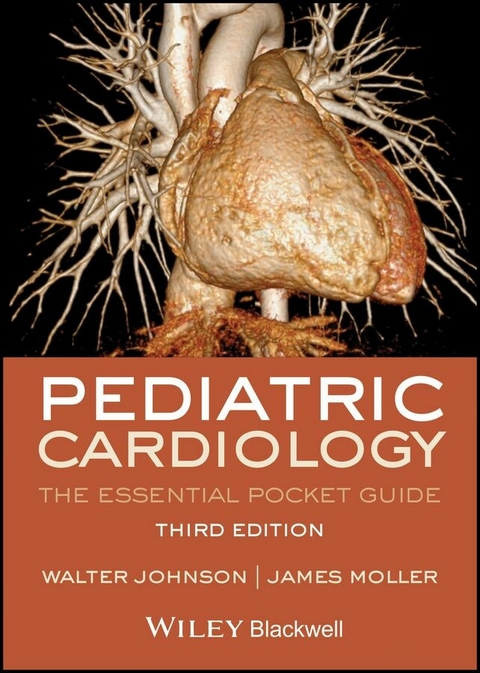
Pediatric Cardiology (eBook)
John Wiley & Sons (Verlag)
978-1-118-50338-6 (ISBN)
Caring for children with heart disease is extremely complex, requiring a different and often tailor-made approach compared with adults with similar cardiac problems.
Built on the success of previous editions and brought to you by a stellar author team, Pediatric Cardiology: The Essential Pocket Guide provides a unique, concise and extremely practical overview of heart disease in children.
From history-taking, physical examination, ECG, and chest X-ray - the basics that enable clinicians to uncover possible problems and eliminate areas of false concern - it goes on to examine the range of more complex topics in the diagnosis and treatment/management of childhood cardiovascular disease.
New to this edition you'll find:
- An enhanced section on imaging including recent advances in cardiac MRI and fetal echocardiography.
- New techniques in genetic testing for heart disease in special populations.
- Much more emphasis on the importance of echocardiography in understanding the pathophysiology of congenital cardiac malformations.
- Expanded section on cardiac conditions in the neonate, specifically on prenatal diagnosis and management, neonatal screening for congenital heart disease, and hypoplastic left heart syndrome.
- Expanded and updated congestive cardiac failure section, including the latest in genetic and metabolic causes of heart failure, and medical/surgical treatment options; discussion of bridging therapies; essentials of transplantation, including common drug treatment regimens, clinical recognition of treatment complications and rejection, outcomes, morbidity and survival.
In addition, every chapter is fully updated with the very latest clinical guidelines and management options from the AHA, ACC and ESC.
Pediatric Cardiology: The Essential Pocket Guide, 3rd edition, is quite simply a must-have guide for all members of the multidisciplinary team managing children suffering from heart disease.
Walter H. Johnson, Jr., MD, Division of Pediatric Cardiology, University of Alabama at Birmingham, Birmingham, AL, USA
James H. Moller, MD, Division of Cardiology, University of Minnesota, Minneapolis, MN, USA
Caring for children with heart disease is extremely complex, requiring a different and often tailor-made approach compared with adults with similar cardiac problems. Built on the success of previous editions and brought to you by a stellar author team, Pediatric Cardiology: The Essential Pocket Guide provides a unique, concise and extremely practical overview of heart disease in children. From history-taking, physical examination, ECG, and chest X-ray the basics that enable clinicians to uncover possible problems and eliminate areas of false concern it goes on to examine the range of more complex topics in the diagnosis and treatment/management of childhood cardiovascular disease. New to this edition you ll find: An enhanced section on imaging including recent advances in cardiac MRI and fetal echocardiography. New techniques in genetic testing for heart disease in special populations. Much more emphasis on the importance of echocardiography in understanding the pathophysiology of congenital cardiac malformations. Expanded section on cardiac conditions in the neonate, specifically on prenatal diagnosis and management, neonatal screening for congenital heart disease, and hypoplastic left heart syndrome. Expanded and updated congestive cardiac failure section, including the latest in genetic and metabolic causes of heart failure, and medical/surgical treatment options; discussion of bridging therapies; essentials of transplantation, including common drug treatment regimens, clinical recognition of treatment complications and rejection, outcomes, morbidity and survival. In addition, every chapter is fully updated with the very latest clinical guidelines and management options from the AHA, ACC and ESC. Pediatric Cardiology: The Essential Pocket Guide, 3rd edition, is quite simply a must-have guide for all members of the multidisciplinary team managing children suffering from heart disease.
Walter H. Johnson, Jr., MD, Division of Pediatric Cardiology, University of Alabama at Birmingham, Birmingham, AL, USA James H. Moller, MD, Division of Cardiology, University of Minnesota, Minneapolis, MN, USA
Preface vii
1. Tools to diagnose cardiac conditions in children 1
2. Environmental and genetic conditions associated with heart disease in children 73
3. Classification and physiology of congenital heart disease in children 86
4. Anomalies with a left-to-right shunt in children 95
5. Conditions obstructing blood flow in children 148
6. Congenital heart disease with a right-to-left shunt in children 186
7. Unusual forms of congenital heart disease in children 233
8. Unique cardiac conditions in newborn infants 245
9. The cardiac conditions acquired during childhood 259
10. Abnormalities of heart rate and conduction in children 291
11. Congestive heart failure in infants and children 315
12. A healthy lifestyle and preventing heart disease in children 329
Additional reading 373
Index 375
"This is an extremely valuable resource not only for those interested in pediatric cardiology, but also general pediatricians and adult cardiologists who manage patients with congenital heart diseases." (Doody's, 6 February 2015)
"Pediatric Cardiology: The Essential Pocket Guide, 3rd edition, is quite simply a must-have guide for all members of the multidisciplinary team managing children suffering from heart disease." (Kingbook73's Medical Ebook and Video Collection, 20 August 2014)
Chapter 2
Environmental and genetic conditions associated with heart disease in children
Syndromes associated with maternal conditions
Maternal inflammatory (collagen vascular) disease
Other drugs and environmental exposures
Syndromes with gross chromosomal abnormalities
Turner syndrome (45, X; Monosomy X)
Syndromes with chromosomal abnormalities detectable by special cytogenetic techniques
DiGeorge syndrome and velocardiofacial syndrome (22q11.2 deletion)
Williams syndrome (Williams–Beuren syndrome)
Other syndromes with familial occurrence
Noonan syndrome and related conditions
This chapter presents the commonest conditions with an association with congenital heart disease. This area is changing rapidly, particularly with the understanding of genetic mutations in conditions that have traditionally been described only clinically.
Syndromes associated with maternal conditions
Maternal diabetes mellitus
Maternal diabetes mellitus may result in macrosomic, large-for-gestational-age infants who commonly have hypoglycemia and respiratory distress. Ventricular septal defect (VSD), especially a small muscular VSD, may occur, but the classic cardiac problem of the infant of diabetic mother (IDM) is asymmetric hypertrophy of the interventricular septum. This condition can appear dramatic by echocardiography and result in left ventricular outflow obstruction. It almost always regresses completely by several weeks of age.
Fetal alcohol syndrome
Fetal alcohol syndrome may result from even a modest consumption of alcohol during early gestation. The clinical spectrum is broad; classical features include unusual triangular facies, thin upper lip, absent philtrum, and small palpebral fissures, often with microphthalmia; hypoplastic nails; and a variety of neurodevelopmental abnormalities. Cardiac anomalies, usually ASD, VSD or tetralogy of Fallot, occur in 15–40% of affected infants and children.
Maternal HIV infection
Maternal HIV infection has been associated with an increased incidence of congenital malformations, compared with non-HIV-infected mothers. This is independent of antiretroviral therapy during pregnancy. The occurrence of cardiac malformations is about 3% with the usual distribution of anomalies.
Maternal inflammatory (collagen vascular) disease
In the absence of structural cardiac deformities, congenital complete atrioventricular block (CCAVB) is often associated with maternal connective tissue disease, classically systemic lupus erythematosus (SLE). CCAVB may develop from mothers with no history of lupus or related diseases who may have autoantibodies of various types. In clinically well mothers who are antinuclear antibody (ANA) negative, the presence of a Sjogren's syndrome antibody, usually anti-Ro (anti-SS-A), may exist. In these mothers, injury to the developing conduction system and, rarely, the myocardium occurs when these maternal IgG autoantibodies cross the placenta and bind to fetal cardiac tissue. The risk of a mother with SLE giving birth to an infant with complete heart block has been estimated at 1 in 60; if maternal anti-SS-A antibodies are present, the risk is 1 in 20.
Maternal phenylketonuria
If not properly controlled by diet during gestation, maternal phenylketonuria may result in neurologic abnormality in the neonate. Cardiac malformations, usually tetralogy of Fallot, ASD or VSD, occur in 20% of these neonates.
Maternal rubella infection
In the first trimester of pregnancy, maternal rubella infection often results in a newborn of low birth weight with multiple anomalies, including microcephaly, cataracts, and deafness. Hepatosplenomegaly and petechiae may be present in infancy. Cardiac lesions are often present, with patent ductus arteriosus occurring most commonly followed by peripheral pulmonary artery stenosis, VSD, and pulmonary valve abnormalities. Maternal immunization prior to pregnancy prevents these problems.
Medications and other agents
Retinoic acid
Retinoic acid, other retinoids, and possibly very large exogenous doses of vitamin A have been associated with various fetal anomalies, including conotruncal defects and aortic arch anomalies.
Lithium
A common therapy for depression, lithium used during early gestation has been associated with Ebstein's malformation of the tricuspid valve, although recent studies show no consistent or a slight association.
Other drugs and environmental exposures
A variety of other therapeutic and nontherapeutic drugs, and also various environmental exposures, have been associated with some increased risk of cardiac malformation, but the strength and consistency of the association are often weak and the amount and quality of the available data are often limited.
In the following sections, diagnostic features of a variety of syndromes will be described briefly and will include comments on the nature of the associated cardiac anomaly.
Syndromes with gross chromosomal abnormalities
Down syndrome (Trisomy 21)
This syndrome involves complete or partial duplication of chromosome 21 in all or some (mosaic) of the body cells of the affected individual.
Features
Features include slanted eyes, thick epicanthal folds, flattened bridge of the nose, thick, protuberant tongue, and a shortened anteroposterior diameter of the head. Common signs are short, broad hands, short, inward-curved fifth fingers, and a single transverse palmar crease (simian crease), together with a generalized hypotonia, joint hyperextensibility, and small stature.
Cardiac anomalies
Anomalies are found in 40–50% of patients. Approximately, one-third are VSD, one-third are atrioventricular septal defects (usually the complete form), and the remainder consist almost exclusively of PDA, ASD, and tetralogy of Fallot. It is rare to find cardiac lesions other than these five diagnoses, especially aortic stenosis and coarctation of the aorta.
Turner syndrome (45, X; Monosomy X)
In this syndrome, a complete or partial absence of one of the X chromosomes in all or some (mosaicism) of the body cells is found.
Features
Although children have a female appearance, they also show abnormal gonadal development. Characteristically, they are short in stature (rarely over 60 inches or 152 cm), have a stocky build, webbing of the neck, a broad chest with widely spaced nipples, cubitus valgus, a low hairline, and edema of the hands and feet (a striking and diagnostic feature in neonates). Renal defects commonly occur and may be associated with hypertension. Gastrointestinal bleeding occurs rarely but can be catastrophic.
Turner syndrome occurs in 1 in 2500 female live births; it is estimated that 99% of fetuses with 45, X perish in utero.
Cardiac anomalies
Anomalies, almost exclusively obstructive left-sided cardiac lesions, occur in 35–55% of individuals. Coarctation of the aorta occurs in 20% of Turner syndrome patients and accounts for the greatest share (90%) of operations or interventions compared with other defects. Bicuspid aortic valve, with stenosis ranging from minimal to severe, occurs in up to 35% of Turner syndrome patients and may appear without coarctation. Anomalous pulmonary venous connection, hypoplastic left heart syndrome, mitral valve abnormalities, and aortic aneurysm occur less commonly.
Trisomy 18 syndrome
Features
Infants with an extra chromosome 18 have low birth weight, multiple malformations, and severe retardation. Although females live longer than males, these infants usually die within weeks or months of birth. Overlapping of the flexed middle fingers by the second and fifth digits (camptodactyly) is very characteristic of this condition. Other features include micrognathia, low-set ears, rockerbottom feet, umbilical and inguinal hernias, and...
| Erscheint lt. Verlag | 3.2.2014 |
|---|---|
| Sprache | englisch |
| Themenwelt | Medizin / Pharmazie ► Allgemeines / Lexika |
| Medizinische Fachgebiete ► Innere Medizin ► Kardiologie / Angiologie | |
| Medizin / Pharmazie ► Medizinische Fachgebiete ► Pädiatrie | |
| Schlagworte | adults • Approach • author • built • Cardiac • children • Complex • Different • Editions • essential pocket • Guide • Heart disease • History • Kardiovaskuläre Erkrankung • Kardiovaskuläre Erkrankung • Kinderheilkunde • Medical Science • Medizin • Overview • Pädiatrie • Pädiatrische Kardiologie • Pädiatrie • Pädiatrische Kardiologie • Pediatric • pediatric cardiology • Pediatrics • possible • Practical • previous • Problems • similar • Stellar • Success • Team • Unique |
| ISBN-10 | 1-118-50338-4 / 1118503384 |
| ISBN-13 | 978-1-118-50338-6 / 9781118503386 |
| Informationen gemäß Produktsicherheitsverordnung (GPSR) | |
| Haben Sie eine Frage zum Produkt? |
 EPUB (Adobe DRM)
Größe: 13,9 MB
Kopierschutz: Adobe-DRM
Adobe-DRM ist ein Kopierschutz, der das eBook vor Mißbrauch schützen soll. Dabei wird das eBook bereits beim Download auf Ihre persönliche Adobe-ID autorisiert. Lesen können Sie das eBook dann nur auf den Geräten, welche ebenfalls auf Ihre Adobe-ID registriert sind.
Details zum Adobe-DRM
Dateiformat: EPUB (Electronic Publication)
EPUB ist ein offener Standard für eBooks und eignet sich besonders zur Darstellung von Belletristik und Sachbüchern. Der Fließtext wird dynamisch an die Display- und Schriftgröße angepasst. Auch für mobile Lesegeräte ist EPUB daher gut geeignet.
Systemvoraussetzungen:
PC/Mac: Mit einem PC oder Mac können Sie dieses eBook lesen. Sie benötigen eine
eReader: Dieses eBook kann mit (fast) allen eBook-Readern gelesen werden. Mit dem amazon-Kindle ist es aber nicht kompatibel.
Smartphone/Tablet: Egal ob Apple oder Android, dieses eBook können Sie lesen. Sie benötigen eine
Geräteliste und zusätzliche Hinweise
Zusätzliches Feature: Online Lesen
Dieses eBook können Sie zusätzlich zum Download auch online im Webbrowser lesen.
Buying eBooks from abroad
For tax law reasons we can sell eBooks just within Germany and Switzerland. Regrettably we cannot fulfill eBook-orders from other countries.
 PDF (Adobe DRM)
Kopierschutz: Adobe-DRM
Adobe-DRM ist ein Kopierschutz, der das eBook vor Mißbrauch schützen soll. Dabei wird das eBook bereits beim Download auf Ihre persönliche Adobe-ID autorisiert. Lesen können Sie das eBook dann nur auf den Geräten, welche ebenfalls auf Ihre Adobe-ID registriert sind.
Details zum Adobe-DRM
Dateiformat: PDF (Portable Document Format)
Mit einem festen Seitenlayout eignet sich die PDF besonders für Fachbücher mit Spalten, Tabellen und Abbildungen. Eine PDF kann auf fast allen Geräten angezeigt werden, ist aber für kleine Displays (Smartphone, eReader) nur eingeschränkt geeignet.
Systemvoraussetzungen:
PC/Mac: Mit einem PC oder Mac können Sie dieses eBook lesen. Sie benötigen eine
eReader: Dieses eBook kann mit (fast) allen eBook-Readern gelesen werden. Mit dem amazon-Kindle ist es aber nicht kompatibel.
Smartphone/Tablet: Egal ob Apple oder Android, dieses eBook können Sie lesen. Sie benötigen eine
Geräteliste und zusätzliche Hinweise
Buying eBooks from abroad
For tax law reasons we can sell eBooks just within Germany and Switzerland. Regrettably we cannot fulfill eBook-orders from other countries.
aus dem Bereich